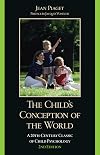
The Child's Conception of the World: A 20th-Century Classic of Child Psychology
by Jean Piaget
On This Page
Description
A milestone of child psychology, The Child's Conception of the World explores the ways in which the reasoning powers of young children differ from those of adults. What conceptions of the world does the child naturally form at the different stages of its development? To what extent does the child distinguish the external world from an internal or subjective world and what limits does he or she draw between the self and objective reality? These questions make up the first problem, the child's show more notion of reality. A second fundamental problem is the significance of explanations put forward by the child. What use does he or she make of the notions of cause and law? Is the form of explanation presented by the child a new type? These and like questions form the second problem, the child's notion of causality. Jacques Voneche, Director of the Piaget Archives in Geneva, Switzerland, provides a preface to this classic in which he reveals the provanance of The Child's Conception of the World within the context of Piaget's other work and the then-burgeoning field of developmental psychology. show lessTags
Recommendations

































Member Reviews
piaget is a boring old structuralist. what has made this book so important to me is the wealth of beautiful interviews with children answering questions like "how does the sun rise?"
Ratings
Members
- Recently Added By
Author Information

238+ Works 4,702 Members
Jean Piaget, 1896-1980 Jean Piaget, a Swiss psychologist, whose original training was in the natural sciences, spent much of his career studying the psychological development of children, largely at the Institut J.J. Rousseau at the University of Geneva, but also at home, with his own children as subjects. The impact of this research on child show more psychology has been enormous, and Piaget is the starting point for those seeking to learn how children view numbers, how they think of cause-and-effect relationships, or how they make moral judgments. Piaget found that cognitive development from infancy to adolescence invariably proceeds in four major stages from infancy to adolescence: sensory-motor, preoperational, concrete operational, and formal operational. Each of these stages is marked by the development of cognitive structures, making possible the solution of problems that were impossible earlier and laying the foundation for the cognitive advances of the next stage. He showed that rational adult thinking is the culmination of an extensive process that begins with elementary sensory experiences and unfolds gradually until the individual is capable of dealing with imagined concepts, that is, abstract thought. By learning how children comprehend the world and how their intellectual processes mature, Piaget contributed much to the theory of knowledge as an active process in which the mind transforms reality. Put simply, Piaget described children from a perspective that no one had seen before. (Bowker Author Biography) show less
Classifications
Statistics
- Members
- 245
- Popularity
- 132,986
- Reviews
- 2
- Rating
- (4.18)
- Languages
- 8 — English, French, German, Italian, Portuguese, Russian, Spanish, Turkish
- Media
- Paper, Ebook
- ISBNs
- 32
- ASINs
- 15