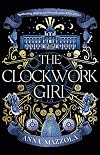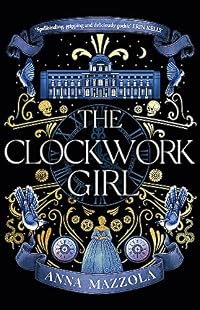
The Clockwork Girl
by Anna Mazzola
On This Page
Description
Paris, 1750. In the midst of winter, as birds fall frozen from the sky, a new maid arrives at the home of a celebrated clockmaker and his clever, unworldly daughter. But rumours are stirring that Reinharts uncanny mechanical creations - bejewelled birds, silver spiders - are more than mere automata. That they might defy the laws of nature, perhaps even at the expense of the living. But Madeleine is hiding a dark past, and a dangerous purpose - to discover the truth of the clockmakers show more experiments and record his every move, in exchange for her own chance of freedom. Meanwhile, in the streets, children are quietly disappearing - and Madeleine comes to fear that she has stumbled upon a greater conspiracy. One which might reach to the heart of Versailles. show lessTags
Recommendations


































Member Reviews
In a Nutshell: A slow-paced gothic story with a great plot and outstanding historical research. If you want a look at a darker historical version of Paris and a fictional story based on real incidents, do pick this up.
Story:
Where the book worked for me:
➤ I loved seeing a side of historical Paris that is hardly ever portrayed in contemporary fiction. It is gloomy, grimy, and corrupt. It’s a place where wealth and power rule over humanity. What an amazing depiction of the dark underbelly of the city!
➤ All the details related to automata are mind-blowing. I found it tough to fathom how the brainiacs of that era thought of these bizarre and yet astounding creations with the limited tech available.
➤ None of the characters are straightforward. It was fun unravelling the layers hidden beneath the fake facades. Grey characters always add much more fun to a book.
➤ The three ladies whose perspective we see are quite dissimilar to each other, and each represents a particular stratum of the Parisian society. This adds to the novelty of the experience.
➤ The author’s note at the end depicts how much of the book is based on facts. I had understood that the automata and some historical personae such as Louis Xv were based on actualities. But the number of real people in the story turned out to be much larger than I had guessed. Plus, I was dismayed to learn about what is called ‘The Vanishing Children of Paris’. This book mixes facts and fiction perfectly. Kudos to the author’s research.
➤ There are some feminist undertones in the story, particularly in Veronique’s arc.
➤ There are plenty of French words in the storyline, which adds a touch of authenticity to the proceedings. The meanings of these are provided in a glossary at the end of the book.
➤ I loved the denouement. It wasn’t too dragged, nor was it too abrupt. It concluded at the right juxtaposition of old endings and new beginnings.
Where the book could have worked better for me:
⚠ It was very, very dark. Some of the incidents mentioned in the book are horrifying. Can’t reveal anything because that would be tantamount to major spoilers. But if you are sensitive about triggers, especially related to children, do consider yourself warned.
⚠ The book is quite slow at the start and takes its time to build up. Of course, the end makes it all worthwhile.
All in all, I did like the book a lot. But I might have enjoyed it even more had I picked it up in a different frame of mind. I’ve been having back-to-back emotionally gut-wrenching reads, and this one didn’t help matters. At the same time, I appreciate the extensive efforts taken by the author for this story in terms of plot, characters and historical accuracy.
4.25 stars from me.
My thanks to Orion Publishing Group and NetGalley for the DRC of “The Clockwork Girl”. This review is voluntary and contains my honest opinion about the book.
***********************
Join me on the Facebook group, Readers Forever!, for more reviews, book-related discussions and fun. show less
Story:
Paris, 1750. Twenty-three year old Madeleine has just begun her new job as the lady’s maid to Veronique, the daughter of celebrated clockmaker Maximilian Reinhart. What they both don’t know is that Madeleine is a lady with a secret mission. Rumours abound of Reinhart’s strange obsession with automata, mechanical creations that he designs and creates with his own hands but that seem to defy all laws of nature. At the same time, children are also disappearing from the streets of Paris. What lies at the heart ofshow more
this conspiracy? Who is the Clockwork Girl? What is Madeleine looking for? Read and find out.
The book comes to us in a limited third person pov of Madeleine, Veronique and Jeanne, a major character you’ll meet in the course of the story.
Where the book worked for me:
➤ I loved seeing a side of historical Paris that is hardly ever portrayed in contemporary fiction. It is gloomy, grimy, and corrupt. It’s a place where wealth and power rule over humanity. What an amazing depiction of the dark underbelly of the city!
➤ All the details related to automata are mind-blowing. I found it tough to fathom how the brainiacs of that era thought of these bizarre and yet astounding creations with the limited tech available.
➤ None of the characters are straightforward. It was fun unravelling the layers hidden beneath the fake facades. Grey characters always add much more fun to a book.
➤ The three ladies whose perspective we see are quite dissimilar to each other, and each represents a particular stratum of the Parisian society. This adds to the novelty of the experience.
➤ The author’s note at the end depicts how much of the book is based on facts. I had understood that the automata and some historical personae such as Louis Xv were based on actualities. But the number of real people in the story turned out to be much larger than I had guessed. Plus, I was dismayed to learn about what is called ‘The Vanishing Children of Paris’. This book mixes facts and fiction perfectly. Kudos to the author’s research.
➤ There are some feminist undertones in the story, particularly in Veronique’s arc.
➤ There are plenty of French words in the storyline, which adds a touch of authenticity to the proceedings. The meanings of these are provided in a glossary at the end of the book.
➤ I loved the denouement. It wasn’t too dragged, nor was it too abrupt. It concluded at the right juxtaposition of old endings and new beginnings.
Where the book could have worked better for me:
⚠ It was very, very dark. Some of the incidents mentioned in the book are horrifying. Can’t reveal anything because that would be tantamount to major spoilers. But if you are sensitive about triggers, especially related to children, do consider yourself warned.
⚠ The book is quite slow at the start and takes its time to build up. Of course, the end makes it all worthwhile.
All in all, I did like the book a lot. But I might have enjoyed it even more had I picked it up in a different frame of mind. I’ve been having back-to-back emotionally gut-wrenching reads, and this one didn’t help matters. At the same time, I appreciate the extensive efforts taken by the author for this story in terms of plot, characters and historical accuracy.
4.25 stars from me.
My thanks to Orion Publishing Group and NetGalley for the DRC of “The Clockwork Girl”. This review is voluntary and contains my honest opinion about the book.
***********************
Join me on the Facebook group, Readers Forever!, for more reviews, book-related discussions and fun. show less
Overall, this was a fascinating read - 18th century Paris historical fiction that doesn't shy away from the cruel realities of the time: the squalor and the destitution, even the creepy secrets and fecal smells behind the palaces and the nobles. Even though I'm French, I learnt a few facts from this book, like an old-fashioned word in French and that there used to be something called the Samaritaine before La Samaritaine shop was created!
Let's talk about the three points of view - Madeleine, the astute prostitute / maid / spy, Véronique, the ingenious bourgeois teenager, Jeanne, Madame de Pompadour aka Louis XV's mistress. Although I wasn't fully convinced at the very beginning, I was soon won over by the different voices as they show more represented 3 parallel viewpoints from different perspectives on society, and in general I like the variety of characters. The common theme of women, poor people and non-white characters being trapped in the web of unfair people in an unfair world was well-crafted.
In this world, beauty seems a mask, a glamour, the machines created by Reinhart and his daughter a fascinating example of the liminality between the beautiful and the ugly, but also the living and the dead, another main theme. As someone who used to work in robotics, I liked to read about the machines as well as the characters discussing ethical points and science.
(Also, reading about clockwork machines and Madame de Pompadour woke up my Whovian radar, The Girl in the Fireplace, anyone?)
What I liked less: I wanted to feel more connection with the characters, I felt that all of them could have been explored more, especially Joseph. I felt that Madeleine was incredibly brave, yet the scenes where she tries to spy and then report back were unsatisfying as they felt underwhelming and repetitive, for the first half of the book or so. Yet, the author portrayed Madeleine's shift from powerlessness to being an agent of her own life quite well, I just wished it would have been done earlier in the book.
I was sad that it seemed OK that so many animals were being killed for the sake of the anatomical or automation experiments, I know this was the status quo then, and still now, and seemed historically accurate, but I wish this has been explored more ethically, even though there were moments when Madeleine and Joseph were also uncomfortable with this.
I guessed a few plot twists but it didn't prevent me from appreciating the story and the atmosphere.
I really like this book, I'd rate it between 3.5 and 4 but it's closer to 4 :)
I want to thank Anna Mazzola and Orion publishing group for giving me an ARC version of the book in exchange for an honest review through NetGalley :) show less
Let's talk about the three points of view - Madeleine, the astute prostitute / maid / spy, Véronique, the ingenious bourgeois teenager, Jeanne, Madame de Pompadour aka Louis XV's mistress. Although I wasn't fully convinced at the very beginning, I was soon won over by the different voices as they show more represented 3 parallel viewpoints from different perspectives on society, and in general I like the variety of characters. The common theme of women, poor people and non-white characters being trapped in the web of unfair people in an unfair world was well-crafted.
In this world, beauty seems a mask, a glamour, the machines created by Reinhart and his daughter a fascinating example of the liminality between the beautiful and the ugly, but also the living and the dead, another main theme. As someone who used to work in robotics, I liked to read about the machines as well as the characters discussing ethical points and science.
(Also, reading about clockwork machines and Madame de Pompadour woke up my Whovian radar, The Girl in the Fireplace, anyone?)
What I liked less: I wanted to feel more connection with the characters, I felt that all of them could have been explored more, especially Joseph. I felt that Madeleine was incredibly brave, yet the scenes where she tries to spy and then report back were unsatisfying as they felt underwhelming and repetitive, for the first half of the book or so. Yet, the author portrayed Madeleine's shift from powerlessness to being an agent of her own life quite well, I just wished it would have been done earlier in the book.
I was sad that it seemed OK that so many animals were being killed for the sake of the anatomical or automation experiments, I know this was the status quo then, and still now, and seemed historically accurate, but I wish this has been explored more ethically, even though there were moments when Madeleine and Joseph were also uncomfortable with this.
I guessed a few plot twists but it didn't prevent me from appreciating the story and the atmosphere.
I really like this book, I'd rate it between 3.5 and 4 but it's closer to 4 :)
I want to thank Anna Mazzola and Orion publishing group for giving me an ARC version of the book in exchange for an honest review through NetGalley :) show less
After the death of their father, Madeleine and her two sisters are forced to work in the brothel run by her mother. The youngest daughter dies in childbirth and Madeleine is scarred by a client, fearful of being cast out Madeleine is forced to become a mouche, a police spy. Sent to work in the household of Doctor Reinhart, an anatomist and clockmaker, Madeleine becomes friendly with his daughter. However as children are going missing in Paris, the Doctor's clockwork models become more and more lifelike - is there a link?
Mazzola is developing into a really compelling writer of historical fiction. The three books have all had very different settings but are linked by a supernatural underpinning. Here the setting is 18th Century Paris show more where a weak Louis XV is obsessed with science and is ruled by his advisors. The sense of time and place is really strong and the story is not really one about the supernatural but more akin to the ideas of Mary Shelley. show less
Mazzola is developing into a really compelling writer of historical fiction. The three books have all had very different settings but are linked by a supernatural underpinning. Here the setting is 18th Century Paris show more where a weak Louis XV is obsessed with science and is ruled by his advisors. The sense of time and place is really strong and the story is not really one about the supernatural but more akin to the ideas of Mary Shelley. show less
A bit slow, & a bit predictable, BUT Mazzola does wonders capturing the sights & smells of 18th century Paris.
Gothic executed to perfection!
Madeleine infiltrates the clockmaker’s household as a maid to inform the police of the strange happenings taking place there.
The clockmaker builds the strangest and eerily accurate machines, and with young children disappearing in the streets of Paris, the authorities fear it must be him doing experiments to build his machines to perfection.
With the conspiracy reaching all the way to Versailles and the King himself, the ending has a twist you will not see coming.
Quite enjoyed it.
Madeleine infiltrates the clockmaker’s household as a maid to inform the police of the strange happenings taking place there.
The clockmaker builds the strangest and eerily accurate machines, and with young children disappearing in the streets of Paris, the authorities fear it must be him doing experiments to build his machines to perfection.
With the conspiracy reaching all the way to Versailles and the King himself, the ending has a twist you will not see coming.
Quite enjoyed it.
A grim historical mystery about automatons, murder and anatomy.
A bit slow sometimes, but I did not want to stop reading
A bit slow sometimes, but I did not want to stop reading
Ratings
Members
- Recently Added By
Lists

Maybe This Year? Books to Look Forward To
409 works; 9 members

Netgalley Reads
456 works; 3 members

Books Read in 2022
5,164 works; 113 members

Dublin Literary Award 2023 Longlist
67 works; 5 members
Author Information

7+ Works 462 Members
Awards and Honors
Common Knowledge
- Canonical title
- The Clockwork Girl
Classifications
Statistics
- Members
- 139
- Popularity
- 234,305
- Reviews
- 6
- Rating
- (4.06)
- Languages
- English
- Media
- Paper, Audiobook, Ebook
- ISBNs
- 8
- ASINs
- 3