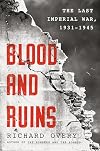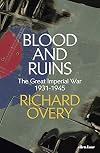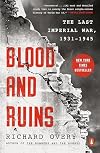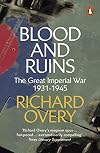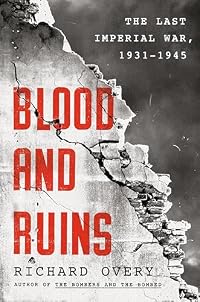
Blood and Ruins: The Last Imperial War, 1931-1945
by Richard Overy
On This Page
Description
"A thought-provoking and original reassessment of World War II, from Britain's leading military historian Richard Overy sets out in Blood and Ruins to recast the way in which we view the Second World War and its origins and aftermath. As one of Britain's most decorated and respected World War II historians, he argues that this was the "last imperial war," with almost a century-long lead-up of global imperial expansion, which reached its peak in the territorial ambitions of Italy, Germany and show more Japan in the 1930s and early 1940s, before descending into the largest and costliest war in human history and the end, after 1945, of all territorial empires. Overy also argues for a more global perspective on the war, one that looks broader than the typical focus on military conflict between the Allied and Axis states. Above all, Overy explains the bitter cost for those involved in fighting, and the exceptional level of crime and atrocity that marked the war and its protracted aftermath-which extended far beyond 1945. Blood and Ruins is a masterpiece, a new and definitive look at the ultimate struggle over the future of the global order, which will compel us to view the war in novel and unfamiliar ways. Thought-provoking, original and challenging, Blood and Ruins sets out to understand the war anew"-- show lessTags
Recommendations




Member Reviews
I cannot praise this book enough. Eighty years since the battles of Guadalcanal, El Alamein and Stalingrad, Overy's 878-page masterpiece manages to cover much more than the canonical Second World War in one perfectly arranged volume. It is the new starting point for its study.
Overy solves the problem of the competition between narrative and thematic history by doing both in an orderly way. Four chapters take the story from 1931 to 1945, seven chapters look at the great themes of the conflict and a final chapter looks at the legacy of the war in decolonisation.
He takes one broad interpretative position (that the conflict must be seen as an essentially imperial struggle between older and aspirant empires finally decided by new ideological show more structures that were against empire) and asks one question that he never actually answers perhaps because he cannot.
That most interesting question is why vast populations within the contesting powers suddenly switched into behaviours that involved the acceptance of conscripted enslavement and complicity in mass murder under the command of relatively small elites with the levers on power.
It is a question of fundamental importance to our objective assessment of the capability and worth of our own species and is probably beyond the ability of any working historian to answer without moving into speculative territory that would work against his or her credibility.
What Overy does, though, is provide the facts as efficiently and as completely as may be possible in a single volume so that we can make our own anthropological and perhaps moral judgements of what happened not only in the fourteen years of imperial war but afterwards.
I might criticise him a little for one lapse in one section in failing to question the standard moral narrative provided to us in the West by our victorious history but I think not lapsing would have taken him into such dangerous territory that his book would have been devalued immediately.
I cannot blame him for not answering the question he poses because the answer may be very frightening to all of us, to our own self-image of being individuals and not a herd, of being good rather than evil, of being superior to animals rather than fundamentally animal ourselves.
The precise mechanisms of power are not merely institutional, they are fundamentally psychological and anthropological. They lie in issues as basic as the pecking order that you find in nature and the way co-operative behaviours create dependency on others.
The consequential horrors of nation-empires at war are provided as facts on the ground and not as evidence in some moralistic polemic. One picture he has of what would be primary school children being guided by trusted authority into gas vans is the tip of a terrifying abyss of murder.
The Holocaust is the known worst or is it? Do we sometimes conveniently present the Holocaust as a 'unique' horror so that we can load all the evil onto one apparently unnatural event run by demons from hell in order not to face the sheer breadth and depth of violence in war?
This is the problem. The Holocaust was actually a natural event, the latest in a long line of genocides in history and prehistory but one merely with access to inventive technologies. The perpetrators were not demons but humans such as you might see walking down your street.
Let us step back to the primary focus of the book. Three aggressive 'hungry' powers challenge two fat self-satisfied empires in an expectation of empire as their right. But why do they consider it their right? Because they think themselves 'civilised' and civilisation means empire.
What does empire mean? It means the control of vast areas of the world as natural territory where 'lesser' human beings exist to serve the civilised and where any brutality is acceptable to control those peoples and clear space for the civilised and their needs.
Does that sound familiar? It should. Because the Axis imperial mission is precisely what the British, French and the Dutch, Spanish, Portuguese and Belgians had done in the not-so-recent past and what American Manifest Destiny did to indigenous peoples in their turn.
In other words the mentality behind brutality was created and shaped by what we think as the 'good guys' in the Second World War who could moderate their position only because their command and control (and brutality) had worked - it had created a resource base.
The Japanese looked at China and thought that it was their right to own it before the Westerners could seize it. The Germans looked East, seeing Slavs as if they were African natives with the problem of the Jews a gross racial inconvenience. Italy wanted a slice of an Africa already carved up.
It is undoubtedly true that Axis racism and brutality was of another order to that of the older empires (or at least the Axis brought their brutality closer to home and 'civilisation') but the mental map and attitudes would not be alien to British officials in India or French in Indo-China.
The other victors too were lesser demons rather than angels. The hypocrisy of a deeply racist US in trumpeting the rights of man is well known as is that of the Soviet Union with its Gulag and its strategy of slaughtering national elites as it did in Katyn Wood.
Of course, when war broke out, we see the conduct of Japanese troops (the rape of Nanking and the slaughter in Manila), of German troops (with the Wehrmacht willing war criminals ready to slaughter families) and of Italian troops murderous in their inept and blundering way.
But, before too long, Churchill was complicit in the deliberate terror bombing tactics of Harris over Germany and Roosevelt in the equally vicious and deliberately terror-directed fire-bombing of Tokyo while Soviet troops raped their way across Prussia with complete tolerance back in Moscow.
One officer who protested rape ended up in the Gulag for 'bourgeois humanism'. American intelligence officers had a tough time trying to get front line troops in the Pacific to take prisoners for questioning.
This gets us back to the problem of our species. This is that we are not truly free individuals (or rather only some of us are). However, we are not a potential hive either as might be suggested in the nightmare post war fashionable liberal critiques of totalitarianism.
What we are is something closer to a complex herd species, perhaps with a lemming quality. At a certain point, we all willingly coalesce into a social narrative not of our making and quite possibly personally harmful to us and our families and have done so certainly since the Greek city-state.
As the international socialists crumbled within days of imperial-national war being declared in 1914 so did the churches in 1939 and 1941, despite all the cant of believing in the gospel of peace of Jesus Christ. Only the Jehovah's Witnesses showed courage and many died for that reason.
Pacifists too represented very considerable movements of people in the 'free world' in the late 1930s but they too crumbled under social pressure quickly. Here we get to the heart of the matter - reality is socially constructed and war allows elites to construct that reality.
The mechanism by which our herd species, allowed freedom in peace in the West at least, enslaves itself to imperial elites is what is not and cannot be covered in this book but the book is absolutely invaluable to the person who wants to start that process of understanding.
It is an understanding that is vital because you can see the same mechanisms re-emerging even as I write this in the struggle for mastery between the latest iteration of imperial conflict, a process that goes back at least to the facing off of the Egyptians and Hittites at Megiddo (Armageddon).
This time the now-cyclical nonsense is between the 'West' (actually the political class of the Western alliance) and the 'SCO' (the political elites in Moscow and Beijing). Once again, reality is being falsely constructed by both sides to get their herds moving in the right direction.
For this reason, Overy's book is not just a history book, it is a book that gives us the raw data in a new form, without bias or loss of moral compass, that we need to understand our own situation - impotent as individuals before the mass and the State as manipulator of the mass.
The social construction of reality under the command of elites is not a false reality or 'fake news', it is reality and that reality can quickly get out of control and unleash animal forces that are quite capable of mass rape, the murder of ordinary people and widespread destruction.
And if you do not believe me - take a look at the atrocities on all sides in the current Tigrayan War in Ethiopia or the deaths, barely reported in the mainstream media, that took place in the Congolese Wars or the evidence of our own and French behaviour during decolonisation.
The final chapter of Overy's book is the most cursory but in some ways the most revealing because it shows how the savagery of 1931 to 1945 did not end there but continued out of sight of the 'civilised', perpetrated by precisely those victors who had claimed the moral high ground.
Nuremburg refused to deal with mass terror bombing or US unrestricted submarine warfare in the Pacific. Germany was never obliged to deal with the murderers of women and children in the East. Soviet crimes are self-evident. Dutch behaviour in Indonesia was unconscionable. The list goes on.
Although the story of the Second World War is one we all think we know and there is much that is familiar, there is also much here that will be new to most of us and possibly awkward, supported by references that indicate a man who is in total command of his sources.
Churchill may be regarded as a great war leader from the point of view of the homelander but he was a ruthless imperialist too. Stalin was a brutal leader but his troops were exhausted when they reached the Vistula and it would have been unreasonable to test them further to relieve Warsaw.
The German military was highly effective in its early expansion but lost its edge not simply because of greater material resources on the opposing side but because the Allies learned by doing in the face of challenge in both theatres.
This brings out another, perhaps more positive side of the socially constructed herd, its adaptability under pressure, its ability to learn rapidly and exploit its advantages and an understanding of the behaviours of the other side.
No one has a workable system to win in the casino in the long run and no power can beat the house in the struggle between empires. The house is a matter of resources and control over populations, economics and that ability to construct narratives that enable power to be exercised.
The Axis powers were doomed from the point that the United States decided to fight back and hard and the Nazis failed to push Stalin out of the industrial zones to the East and create the conditions for regime change amongst a discontented population. It was only a matter of time.
But it was also only a matter of time before the triumph of the two new ideological powers unravelled the older empires as well and came into direct conflict. The blindness to this aspect of strategy is perhaps what is most unnerving about Axis and old imperial decision-making.
Perhaps, despite the racism in the East (which had some reasonable origin in foul Japanese behaviour), the terror bombing of Japan and the hypocrisies, the nation that comes out of this best is the US which, for all its flaws, showed an anti-imperialist commitment to be commended.
It can also be honestly said that it was least inclined to oppress its own people to undertake war and least inclined to atrocity. Its later history may have tainted its status as moral arbiter (as did the cowardice of elites towards popular racism) but it was easily the best of a bad bunch.
Given just how evil war is, the act of perpetrating war for whatever reason should be a mark against a nation. Both the US (attacked at Pearl Harbour and with war on it declared by Germany) and the Soviet Union (attacked by Germany, noting its earlier occupations of others) come out best here.
If the Axis empires are the prime aggressors, it has to be said that the British and French Empires escalated things by initiating declarations of war against Germany in 1939. We should fear today that alliances designed for defence may end up with our being dragged into things we may regret.
Complex alliances to maintain the balance of power, neglect of homeland defence and failure to distinguish between wrongful imperial acquisition and legitimate unification of peoples are permitted because elites know that, ultimately, they can guide the herd.
Our entire international system is based on some fundamental conceptual flaws - above all, that borders must be fixed eternally and externally rather than through democratic non-violent self-determination - and those flaws are going to see many small wars and some big ones to come.
And the herd will follow as it always has done and always will, elites will countenance horrible crimes claiming existential necessity and ordinary people will once again become thieves, rapists and killers when they are unleashed on the world. And so it goes ... show less
Overy solves the problem of the competition between narrative and thematic history by doing both in an orderly way. Four chapters take the story from 1931 to 1945, seven chapters look at the great themes of the conflict and a final chapter looks at the legacy of the war in decolonisation.
He takes one broad interpretative position (that the conflict must be seen as an essentially imperial struggle between older and aspirant empires finally decided by new ideological show more structures that were against empire) and asks one question that he never actually answers perhaps because he cannot.
That most interesting question is why vast populations within the contesting powers suddenly switched into behaviours that involved the acceptance of conscripted enslavement and complicity in mass murder under the command of relatively small elites with the levers on power.
It is a question of fundamental importance to our objective assessment of the capability and worth of our own species and is probably beyond the ability of any working historian to answer without moving into speculative territory that would work against his or her credibility.
What Overy does, though, is provide the facts as efficiently and as completely as may be possible in a single volume so that we can make our own anthropological and perhaps moral judgements of what happened not only in the fourteen years of imperial war but afterwards.
I might criticise him a little for one lapse in one section in failing to question the standard moral narrative provided to us in the West by our victorious history but I think not lapsing would have taken him into such dangerous territory that his book would have been devalued immediately.
I cannot blame him for not answering the question he poses because the answer may be very frightening to all of us, to our own self-image of being individuals and not a herd, of being good rather than evil, of being superior to animals rather than fundamentally animal ourselves.
The precise mechanisms of power are not merely institutional, they are fundamentally psychological and anthropological. They lie in issues as basic as the pecking order that you find in nature and the way co-operative behaviours create dependency on others.
The consequential horrors of nation-empires at war are provided as facts on the ground and not as evidence in some moralistic polemic. One picture he has of what would be primary school children being guided by trusted authority into gas vans is the tip of a terrifying abyss of murder.
The Holocaust is the known worst or is it? Do we sometimes conveniently present the Holocaust as a 'unique' horror so that we can load all the evil onto one apparently unnatural event run by demons from hell in order not to face the sheer breadth and depth of violence in war?
This is the problem. The Holocaust was actually a natural event, the latest in a long line of genocides in history and prehistory but one merely with access to inventive technologies. The perpetrators were not demons but humans such as you might see walking down your street.
Let us step back to the primary focus of the book. Three aggressive 'hungry' powers challenge two fat self-satisfied empires in an expectation of empire as their right. But why do they consider it their right? Because they think themselves 'civilised' and civilisation means empire.
What does empire mean? It means the control of vast areas of the world as natural territory where 'lesser' human beings exist to serve the civilised and where any brutality is acceptable to control those peoples and clear space for the civilised and their needs.
Does that sound familiar? It should. Because the Axis imperial mission is precisely what the British, French and the Dutch, Spanish, Portuguese and Belgians had done in the not-so-recent past and what American Manifest Destiny did to indigenous peoples in their turn.
In other words the mentality behind brutality was created and shaped by what we think as the 'good guys' in the Second World War who could moderate their position only because their command and control (and brutality) had worked - it had created a resource base.
The Japanese looked at China and thought that it was their right to own it before the Westerners could seize it. The Germans looked East, seeing Slavs as if they were African natives with the problem of the Jews a gross racial inconvenience. Italy wanted a slice of an Africa already carved up.
It is undoubtedly true that Axis racism and brutality was of another order to that of the older empires (or at least the Axis brought their brutality closer to home and 'civilisation') but the mental map and attitudes would not be alien to British officials in India or French in Indo-China.
The other victors too were lesser demons rather than angels. The hypocrisy of a deeply racist US in trumpeting the rights of man is well known as is that of the Soviet Union with its Gulag and its strategy of slaughtering national elites as it did in Katyn Wood.
Of course, when war broke out, we see the conduct of Japanese troops (the rape of Nanking and the slaughter in Manila), of German troops (with the Wehrmacht willing war criminals ready to slaughter families) and of Italian troops murderous in their inept and blundering way.
But, before too long, Churchill was complicit in the deliberate terror bombing tactics of Harris over Germany and Roosevelt in the equally vicious and deliberately terror-directed fire-bombing of Tokyo while Soviet troops raped their way across Prussia with complete tolerance back in Moscow.
One officer who protested rape ended up in the Gulag for 'bourgeois humanism'. American intelligence officers had a tough time trying to get front line troops in the Pacific to take prisoners for questioning.
This gets us back to the problem of our species. This is that we are not truly free individuals (or rather only some of us are). However, we are not a potential hive either as might be suggested in the nightmare post war fashionable liberal critiques of totalitarianism.
What we are is something closer to a complex herd species, perhaps with a lemming quality. At a certain point, we all willingly coalesce into a social narrative not of our making and quite possibly personally harmful to us and our families and have done so certainly since the Greek city-state.
As the international socialists crumbled within days of imperial-national war being declared in 1914 so did the churches in 1939 and 1941, despite all the cant of believing in the gospel of peace of Jesus Christ. Only the Jehovah's Witnesses showed courage and many died for that reason.
Pacifists too represented very considerable movements of people in the 'free world' in the late 1930s but they too crumbled under social pressure quickly. Here we get to the heart of the matter - reality is socially constructed and war allows elites to construct that reality.
The mechanism by which our herd species, allowed freedom in peace in the West at least, enslaves itself to imperial elites is what is not and cannot be covered in this book but the book is absolutely invaluable to the person who wants to start that process of understanding.
It is an understanding that is vital because you can see the same mechanisms re-emerging even as I write this in the struggle for mastery between the latest iteration of imperial conflict, a process that goes back at least to the facing off of the Egyptians and Hittites at Megiddo (Armageddon).
This time the now-cyclical nonsense is between the 'West' (actually the political class of the Western alliance) and the 'SCO' (the political elites in Moscow and Beijing). Once again, reality is being falsely constructed by both sides to get their herds moving in the right direction.
For this reason, Overy's book is not just a history book, it is a book that gives us the raw data in a new form, without bias or loss of moral compass, that we need to understand our own situation - impotent as individuals before the mass and the State as manipulator of the mass.
The social construction of reality under the command of elites is not a false reality or 'fake news', it is reality and that reality can quickly get out of control and unleash animal forces that are quite capable of mass rape, the murder of ordinary people and widespread destruction.
And if you do not believe me - take a look at the atrocities on all sides in the current Tigrayan War in Ethiopia or the deaths, barely reported in the mainstream media, that took place in the Congolese Wars or the evidence of our own and French behaviour during decolonisation.
The final chapter of Overy's book is the most cursory but in some ways the most revealing because it shows how the savagery of 1931 to 1945 did not end there but continued out of sight of the 'civilised', perpetrated by precisely those victors who had claimed the moral high ground.
Nuremburg refused to deal with mass terror bombing or US unrestricted submarine warfare in the Pacific. Germany was never obliged to deal with the murderers of women and children in the East. Soviet crimes are self-evident. Dutch behaviour in Indonesia was unconscionable. The list goes on.
Although the story of the Second World War is one we all think we know and there is much that is familiar, there is also much here that will be new to most of us and possibly awkward, supported by references that indicate a man who is in total command of his sources.
Churchill may be regarded as a great war leader from the point of view of the homelander but he was a ruthless imperialist too. Stalin was a brutal leader but his troops were exhausted when they reached the Vistula and it would have been unreasonable to test them further to relieve Warsaw.
The German military was highly effective in its early expansion but lost its edge not simply because of greater material resources on the opposing side but because the Allies learned by doing in the face of challenge in both theatres.
This brings out another, perhaps more positive side of the socially constructed herd, its adaptability under pressure, its ability to learn rapidly and exploit its advantages and an understanding of the behaviours of the other side.
No one has a workable system to win in the casino in the long run and no power can beat the house in the struggle between empires. The house is a matter of resources and control over populations, economics and that ability to construct narratives that enable power to be exercised.
The Axis powers were doomed from the point that the United States decided to fight back and hard and the Nazis failed to push Stalin out of the industrial zones to the East and create the conditions for regime change amongst a discontented population. It was only a matter of time.
But it was also only a matter of time before the triumph of the two new ideological powers unravelled the older empires as well and came into direct conflict. The blindness to this aspect of strategy is perhaps what is most unnerving about Axis and old imperial decision-making.
Perhaps, despite the racism in the East (which had some reasonable origin in foul Japanese behaviour), the terror bombing of Japan and the hypocrisies, the nation that comes out of this best is the US which, for all its flaws, showed an anti-imperialist commitment to be commended.
It can also be honestly said that it was least inclined to oppress its own people to undertake war and least inclined to atrocity. Its later history may have tainted its status as moral arbiter (as did the cowardice of elites towards popular racism) but it was easily the best of a bad bunch.
Given just how evil war is, the act of perpetrating war for whatever reason should be a mark against a nation. Both the US (attacked at Pearl Harbour and with war on it declared by Germany) and the Soviet Union (attacked by Germany, noting its earlier occupations of others) come out best here.
If the Axis empires are the prime aggressors, it has to be said that the British and French Empires escalated things by initiating declarations of war against Germany in 1939. We should fear today that alliances designed for defence may end up with our being dragged into things we may regret.
Complex alliances to maintain the balance of power, neglect of homeland defence and failure to distinguish between wrongful imperial acquisition and legitimate unification of peoples are permitted because elites know that, ultimately, they can guide the herd.
Our entire international system is based on some fundamental conceptual flaws - above all, that borders must be fixed eternally and externally rather than through democratic non-violent self-determination - and those flaws are going to see many small wars and some big ones to come.
And the herd will follow as it always has done and always will, elites will countenance horrible crimes claiming existential necessity and ordinary people will once again become thieves, rapists and killers when they are unleashed on the world. And so it goes ... show less
British historian Richard Overy begins by noting that World War II was “a war so widespread and cruel [it] challenges the historian in many ways.” He writes that it is difficult to remember now, or even imagine, a war fought so widely, with so many participants, and with weapons of such horrific destructive capability. He notes the massive scale of deprivation, dispossession, and loss suffered. But hardest of all to grasp now, he avers, is “how widespread acts of atrocity, terrorism and crime could be committed by hundreds of thousands of people who were in most cases what the historian Christopher Browning has memorably described as ‘ordinary men’, neither sadists nor psychopaths.” The era of WWII “witnessed a tidal wave show more of violent coercion, imprisonment, torture, deportation and mass, genocidal killing, carried out by uniformed servicemen, or security and police forces, or partisans and civilian irregulars, both men and women.”
How to account for this? Most histories focus on military aspects of the war, which, although important, do not address the underlying political, economic, social, and cultural conditions that facilitated such cruelty and violence - so important in light of the continuing international instability that still characterizes the world.
Overy presents this new analysis based on four underlying assumptions. First, he contends conventional chronologies of the war are no longer useful. There is little to be gained by separating the two giant world wars of the 20th Century. Second, the usual focus on the European Axis with occasional deference to action in Asia and the Pacific limits our understanding of the international currents at work and their interactions with the West. Third, the conflicts should be understood as the aggregate of a number of different smaller struggles that were waged simultaneously, including civil wars, partisan wars, and wars of liberation. And fourth, Overy argues, WWII was the last imperial war. Most general histories gloss over the significance of territorial empire in defining the period from 1931 to the aftermath of 1945. Traditional colonial rule collapsed after 1945, ending with a surfeit of “blood and ruins” and metamorphosing into the domination of a few superpowers in a new global order.
To advance these arguments, Overy proceeds in several parts. He explores the long-term factors that shaped the crisis of the 1930s. He describes WWII less from a military lens than from a social and economic perspective. He discusses the new world of nation-states that arose from the old divisions of empire. Finally, he explores the excessive violence and criminality provoked by the war.
Evaluation: I found this history extremely thought-provoking and stimulating in ways quite different from analyses of strategies and tactics. I also found myself agreeing with Overy that the social and cultural aspects of the two world wars are in the end much more critical to understanding our past and present world than the detailed analysis of individual battles or personal characteristics of different generals.
With the passing of time, and the resurgence of a growing appeal of strong men, totalitarian rule, and brutal social repression, it is more important than ever to understand what happened in our parents’ generation, and what it means for the future.
(JAB) show less
How to account for this? Most histories focus on military aspects of the war, which, although important, do not address the underlying political, economic, social, and cultural conditions that facilitated such cruelty and violence - so important in light of the continuing international instability that still characterizes the world.
Overy presents this new analysis based on four underlying assumptions. First, he contends conventional chronologies of the war are no longer useful. There is little to be gained by separating the two giant world wars of the 20th Century. Second, the usual focus on the European Axis with occasional deference to action in Asia and the Pacific limits our understanding of the international currents at work and their interactions with the West. Third, the conflicts should be understood as the aggregate of a number of different smaller struggles that were waged simultaneously, including civil wars, partisan wars, and wars of liberation. And fourth, Overy argues, WWII was the last imperial war. Most general histories gloss over the significance of territorial empire in defining the period from 1931 to the aftermath of 1945. Traditional colonial rule collapsed after 1945, ending with a surfeit of “blood and ruins” and metamorphosing into the domination of a few superpowers in a new global order.
To advance these arguments, Overy proceeds in several parts. He explores the long-term factors that shaped the crisis of the 1930s. He describes WWII less from a military lens than from a social and economic perspective. He discusses the new world of nation-states that arose from the old divisions of empire. Finally, he explores the excessive violence and criminality provoked by the war.
Evaluation: I found this history extremely thought-provoking and stimulating in ways quite different from analyses of strategies and tactics. I also found myself agreeing with Overy that the social and cultural aspects of the two world wars are in the end much more critical to understanding our past and present world than the detailed analysis of individual battles or personal characteristics of different generals.
With the passing of time, and the resurgence of a growing appeal of strong men, totalitarian rule, and brutal social repression, it is more important than ever to understand what happened in our parents’ generation, and what it means for the future.
(JAB) show less
This is an excellent, but somewhat oddly structured book. The subtitle highlights the author’s opinion that WW2 was, or at least started as, a war about empire, that pitted the old existing European empires (Britain, France, Russia and the Netherlands) against nations that wanted to build or expand their empires (Germany, Italy, and Japan). The idea is not entirely original, rooted as it is in the rhetorical discourse of the 1930s and 1940s, but it is an important perspective.
Overy pursues the idea in the first three chapters. This is an approximately 200 pages long, condensed history of the war as seen from this "imperial" perspective. Regrettably, as a brief history of the war, this is useful but not very good. Frankly, by page 373 show more you may feel a bit disappointed.
Fortunately this is followed by seven chapters that are longish stand-alone essays, which highlight various aspects of WW2 that have not been much written about previously. These essays are very good. Several of them make for uncomfortable reading, as Overy explores in detail subjects such as the war crimes committed by soldiers, partisans and resistance fighters; the mental health of soldiers; or sexual violence. Stories that later generations often chose to cover with selective forgetfulness, grim stories that do not inspire much confidence in humanity. But they sadly remain entirely relevant to this day, and these are well written accusations.
There is an alternative edition with a different cover, on which the subtitle states that 1931-1945 was the last imperial war. This seems closer to Overy's thesis. His conclusion argues that the end of the war brought about the end of empire, as the hegemonies that the USA and USSR established during the Cold War were something different, and both assisted in the dismantling of the old colonial empires. This may do a disservice to the people living in these colonies, who were working towards independence well before the war. Their agency in this must be respected, even if the war accelerated the process.
"Blood and Ruins" is not a complete history of the conflict from 1931 to 1945, and I think it doesn't strive to be. It is a book that tries to fill the gaps in our collective memory, and in that it succeeds. It reads like a collection of essays squeezed into single hefty volume, but at least that makes it easier to digest. show less
Overy pursues the idea in the first three chapters. This is an approximately 200 pages long, condensed history of the war as seen from this "imperial" perspective. Regrettably, as a brief history of the war, this is useful but not very good. Frankly, by page 373 show more you may feel a bit disappointed.
Fortunately this is followed by seven chapters that are longish stand-alone essays, which highlight various aspects of WW2 that have not been much written about previously. These essays are very good. Several of them make for uncomfortable reading, as Overy explores in detail subjects such as the war crimes committed by soldiers, partisans and resistance fighters; the mental health of soldiers; or sexual violence. Stories that later generations often chose to cover with selective forgetfulness, grim stories that do not inspire much confidence in humanity. But they sadly remain entirely relevant to this day, and these are well written accusations.
There is an alternative edition with a different cover, on which the subtitle states that 1931-1945 was the last imperial war. This seems closer to Overy's thesis. His conclusion argues that the end of the war brought about the end of empire, as the hegemonies that the USA and USSR established during the Cold War were something different, and both assisted in the dismantling of the old colonial empires. This may do a disservice to the people living in these colonies, who were working towards independence well before the war. Their agency in this must be respected, even if the war accelerated the process.
"Blood and Ruins" is not a complete history of the conflict from 1931 to 1945, and I think it doesn't strive to be. It is a book that tries to fill the gaps in our collective memory, and in that it succeeds. It reads like a collection of essays squeezed into single hefty volume, but at least that makes it easier to digest. show less
A bloodbath in which many atrocities were committed, the best known being the Holocaust, the bombing of Dresden, and the bombings of Hiroshima and Nagasaki. 100 million men fought "using weapons whose destructive capability had been honed in the First World War and developed dramatically in the years that followed it."
Richard Overy's argument in his new book on World War Two is that the war was part of an longer struggle, between the Allied nations trying to maintain a grip on their Empires, and the Axis powers trying to grab Empire for themselves,. The instances of the latter being the 1931 Japanese occupation of Manchuria in China.,the Italian dictator Mussolini's invasion of Ethiopia on 3 October 1935, and then Hitler's desire for show more "lebensraum" (living space) for the German people in the East pushing him to annex parts of Czechoslovakia on 15 March 1939.(Even though lack of land wasn't really the problem. The problem was it was owed by the junker class https://www.minds.com/newsfeed/1330125520611840010?referrer=georgestokoe. Hitler obviously couldn't expropriate the land from this class as they were some of the supporters of the Nazi party in the first place.) However, at the time, different reasons than straight up imperial conquest were given for these military actions:
"One of the reasons for caution was the much higher visibility of imperial conflicts by the 1930s, including those in the established empires. This was thanks principally to the development of modern media - worldwide newspaper reporting, popular newsreels and radio- but also the work of the League of Nations, which, for all it's alleged timidity, gave a public platform to debate violations of national sovereignty, including very public discussion of Japan's illegitimate seizure of Manchuria and Mussolini's attack on Ethiopia. International debate forced the aggressors to justify their actions on all three cases by claiming speciously that invasion was carried out to protect their interests against failed states. ") p. 39)
One of the things the book suggests is that there was a mystical aspect to imperialism,:" These were powerful fantasies about the settlement of wild frontiers, or the prospect of an Eldorado of riches, or an exalted 'civilising mission', or the fulfillment of a manifest destiny that would reinvigorate the nation." (p. 4)
This had a racialist component. Racialism wasn't confined to Nazi Germany, or fascist Italy:
" The British statistician Karl Pearson, in a lecture in 1900 on 'National Life from the Standpoint of Science' told his audience that the nation had to be kept up to a high standard of efficiency 'chiefly by war with inferior races, and with equal races by the struggle for trade routes and for the sources of raw materials and of food supply. This is the natural history view of mankind.'.. .
In 1900,Lord Curzon, the British viceroy of India, could argue that' all the million I have to manage are less than schoolchildren '. "(p. 5)
WWII itself was seen by the warring powers as a case of do-or die, on a worldwide scale. Professor Overy quotes Dennis Wheatley, the best-selling British occult horror novelist, who was recruited in 1940 by the British military Joint Planning Staff to draft papers on the nature of a new type of twentieth - century warfare, "Total War" :
'Moral and ethical questions have no validity in Total War except in as far as their maintenance or destruction contributes towards ultimate Victory. Expediency, not morality, is the sole criterion of human conduct in Total War.'
- Dennis Wheatley, Total War, 1941
Wheatley thought that" Nations-at - War "had only two options,"Total Victory", or "Total Annihilation", and that therefore any actions that would shorten the war and bring about victory would be morally justified 'irrespective of its "legal" or "illegal" implications.') p. 597
Obviously, Wheatley wasn't the only one who thought this. The term 'total war' had actually been coined by one of the German WWI military leaders, General Erich Ludendorff, in his post-war memoirs. Ludendorff viewed modern industrialised warfare as dependent on mobilising the whole population, rather than just the current armed forces. This would have been the British view, as well. .
As Prof. Overy writes,
"Mass mobilisation was an expression of modernity...Industrialised warfare depended on a cluster of modern wespons that were easily reproducible and relatively cheap so that it was possible to sustain large forces in the field and to resupply them over years of warfare -... These elements of modernity explain why mobilisation was possible, but not why it happened. The willingness of governments to embrace almost unlimited mobilisation, and of people's to submit to it, was shaped by the emergence of modern nationalism and changing perceptions of citizenship...The Darwinian paradigm of the struggle for survival in nature was widely understood to apply with equal force to the contest between peoples, empires and nations. During both world wars, one of the driving forces in sustaining the conflict, irrational though it might now appear, was fear of national extinction and the collapse of empire. "(p. 377 - 378.)
Ludendorff had an anti-Semitic take on total war, though, in that he attributed German WWI defeat, in 1918, to Jewish agitators and defeatists on the home front undermining mobilisation.
This "stab-in-the-back" conspiracy theory was one of the things that went on to fuel Nazi Ideology .: For Hitler,, the war and the racial struggle against Jews were one and the same thing, as heard in this speech to the Reichstag on 30 January 1939 in which he said if the Jews succeeded in plunging Europe into war, as they were alleged to have done in 1914, the consequence would be the annihilation of the Jewish race in Europe.
Also fuelling Nazi Ideology were "the Protocols of the Learned Elders of Zion." This fabricated document was cited as an example of Jewish perfidy. For example, when in a radio speech to the German people on 4 September 1939 Hitler blamed the British and French declaration of war on a 'Jewish-democratic international enemy', the anti-Semitic Weltdienst journal cited the Seventh 'Protocol' on universal war, and asked, "Could the war plans of Jewry be more clearly expressed?" (p. 600)
The history of the war suggests that the British establishment were not, however, having it's strings pulled by "world Jewry." Emigration to Britain by German Jews was heavily restricted by Britain just after the anti-Semitic Kristallnacht pogrom had happened , in November 1938.
From September 1939, Jewish emigration to Britain from Germany or German-occupied Europe was stopped completely. As one Foreign Office official put it, "So far as we and France are concerned the position of the Jews in Germany is now of no practical importance." (p. 624-5)
In one case where three overladen ships from Romania arrived off the coast of Palestine with Jewish refugees from Central Europe, the British colonial authorities at first refused permission to disembark. Then they interned the refugees in camps. And then they deported them to Mauritius, where they were held behind barbed wire with armed guards, many dying of typhoid or debilitation on route, and after being beaten with sticks by colonial police after protesting at being deported. "Sir John Shuckburgh, deputy under-secretary at the Colonial Office, thought that the protests showed that 'The Jews have no sense of humour and no sense of proportion'." (p. 625) Obviously, it wouldn't have been bad as getting gassed or worked to death in the Nazi concentration camps, but still bad.
This is a great book. It's very rich in analysis of World War Two. My only complaint is the narrative chapters were so fact filled that they were a bit hard to follow. Obviously, it's all valuable stuff. But a timeline before the main text, maybe followed with some pictures of wartime newspapers, headlining the main events of the war, might have been handy. You would have been able to refer back to it as you're reading the chapters. show less
Richard Overy's argument in his new book on World War Two is that the war was part of an longer struggle, between the Allied nations trying to maintain a grip on their Empires, and the Axis powers trying to grab Empire for themselves,. The instances of the latter being the 1931 Japanese occupation of Manchuria in China.,the Italian dictator Mussolini's invasion of Ethiopia on 3 October 1935, and then Hitler's desire for show more "lebensraum" (living space) for the German people in the East pushing him to annex parts of Czechoslovakia on 15 March 1939.(Even though lack of land wasn't really the problem. The problem was it was owed by the junker class https://www.minds.com/newsfeed/1330125520611840010?referrer=georgestokoe. Hitler obviously couldn't expropriate the land from this class as they were some of the supporters of the Nazi party in the first place.) However, at the time, different reasons than straight up imperial conquest were given for these military actions:
"One of the reasons for caution was the much higher visibility of imperial conflicts by the 1930s, including those in the established empires. This was thanks principally to the development of modern media - worldwide newspaper reporting, popular newsreels and radio- but also the work of the League of Nations, which, for all it's alleged timidity, gave a public platform to debate violations of national sovereignty, including very public discussion of Japan's illegitimate seizure of Manchuria and Mussolini's attack on Ethiopia. International debate forced the aggressors to justify their actions on all three cases by claiming speciously that invasion was carried out to protect their interests against failed states. ") p. 39)
One of the things the book suggests is that there was a mystical aspect to imperialism,:" These were powerful fantasies about the settlement of wild frontiers, or the prospect of an Eldorado of riches, or an exalted 'civilising mission', or the fulfillment of a manifest destiny that would reinvigorate the nation." (p. 4)
This had a racialist component. Racialism wasn't confined to Nazi Germany, or fascist Italy:
" The British statistician Karl Pearson, in a lecture in 1900 on 'National Life from the Standpoint of Science' told his audience that the nation had to be kept up to a high standard of efficiency 'chiefly by war with inferior races, and with equal races by the struggle for trade routes and for the sources of raw materials and of food supply. This is the natural history view of mankind.'.. .
In 1900,Lord Curzon, the British viceroy of India, could argue that' all the million I have to manage are less than schoolchildren '. "(p. 5)
WWII itself was seen by the warring powers as a case of do-or die, on a worldwide scale. Professor Overy quotes Dennis Wheatley, the best-selling British occult horror novelist, who was recruited in 1940 by the British military Joint Planning Staff to draft papers on the nature of a new type of twentieth - century warfare, "Total War" :
'Moral and ethical questions have no validity in Total War except in as far as their maintenance or destruction contributes towards ultimate Victory. Expediency, not morality, is the sole criterion of human conduct in Total War.'
- Dennis Wheatley, Total War, 1941
Wheatley thought that" Nations-at - War "had only two options,"Total Victory", or "Total Annihilation", and that therefore any actions that would shorten the war and bring about victory would be morally justified 'irrespective of its "legal" or "illegal" implications.') p. 597
Obviously, Wheatley wasn't the only one who thought this. The term 'total war' had actually been coined by one of the German WWI military leaders, General Erich Ludendorff, in his post-war memoirs. Ludendorff viewed modern industrialised warfare as dependent on mobilising the whole population, rather than just the current armed forces. This would have been the British view, as well. .
As Prof. Overy writes,
"Mass mobilisation was an expression of modernity...Industrialised warfare depended on a cluster of modern wespons that were easily reproducible and relatively cheap so that it was possible to sustain large forces in the field and to resupply them over years of warfare -... These elements of modernity explain why mobilisation was possible, but not why it happened. The willingness of governments to embrace almost unlimited mobilisation, and of people's to submit to it, was shaped by the emergence of modern nationalism and changing perceptions of citizenship...The Darwinian paradigm of the struggle for survival in nature was widely understood to apply with equal force to the contest between peoples, empires and nations. During both world wars, one of the driving forces in sustaining the conflict, irrational though it might now appear, was fear of national extinction and the collapse of empire. "(p. 377 - 378.)
Ludendorff had an anti-Semitic take on total war, though, in that he attributed German WWI defeat, in 1918, to Jewish agitators and defeatists on the home front undermining mobilisation.
This "stab-in-the-back" conspiracy theory was one of the things that went on to fuel Nazi Ideology .: For Hitler,, the war and the racial struggle against Jews were one and the same thing, as heard in this speech to the Reichstag on 30 January 1939 in which he said if the Jews succeeded in plunging Europe into war, as they were alleged to have done in 1914, the consequence would be the annihilation of the Jewish race in Europe.
Also fuelling Nazi Ideology were "the Protocols of the Learned Elders of Zion." This fabricated document was cited as an example of Jewish perfidy. For example, when in a radio speech to the German people on 4 September 1939 Hitler blamed the British and French declaration of war on a 'Jewish-democratic international enemy', the anti-Semitic Weltdienst journal cited the Seventh 'Protocol' on universal war, and asked, "Could the war plans of Jewry be more clearly expressed?" (p. 600)
The history of the war suggests that the British establishment were not, however, having it's strings pulled by "world Jewry." Emigration to Britain by German Jews was heavily restricted by Britain just after the anti-Semitic Kristallnacht pogrom had happened , in November 1938.
From September 1939, Jewish emigration to Britain from Germany or German-occupied Europe was stopped completely. As one Foreign Office official put it, "So far as we and France are concerned the position of the Jews in Germany is now of no practical importance." (p. 624-5)
In one case where three overladen ships from Romania arrived off the coast of Palestine with Jewish refugees from Central Europe, the British colonial authorities at first refused permission to disembark. Then they interned the refugees in camps. And then they deported them to Mauritius, where they were held behind barbed wire with armed guards, many dying of typhoid or debilitation on route, and after being beaten with sticks by colonial police after protesting at being deported. "Sir John Shuckburgh, deputy under-secretary at the Colonial Office, thought that the protests showed that 'The Jews have no sense of humour and no sense of proportion'." (p. 625) Obviously, it wouldn't have been bad as getting gassed or worked to death in the Nazi concentration camps, but still bad.
This is a great book. It's very rich in analysis of World War Two. My only complaint is the narrative chapters were so fact filled that they were a bit hard to follow. Obviously, it's all valuable stuff. But a timeline before the main text, maybe followed with some pictures of wartime newspapers, headlining the main events of the war, might have been handy. You would have been able to refer back to it as you're reading the chapters. show less
Il capolavoro di uno dei piú rinomati storici della Seconda guerra mondiale, che ci costringe a considerare quei tragici eventi sotto una luce inedita. «Uno studio vasto e dettagliato, sicuramente la miglior storia della Seconda guerra mondiale in un unico volume. Un potente monito sull'orrore della guerra e sulla minaccia rappresentata dai dittatori nutriti di sogni imperiali» («The Wall Street Journal»). Richard Overy si propone di riformulare il modo in cui guardiamo alla Seconda guerra mondiale, alle sue origini e alle sue conseguenze. Secondo il grande storico inglese si trattò di una «Grande guerra imperiale», la conclusione terribile di quasi un secolo di espansione imperiale globale, che raggiunse il suo apice nelle show more ambizioni di Italia, Germania e Giappone negli anni Trenta e all'inizio degli anni Quaranta, prima di sprofondare nella piú estesa e costosa guerra della storia dell'umanità che, dopo il 1945, sancí la fine di tutti gli imperi territoriali. Al centro del volume, le modalità secondo le quali questa guerra su vasta scala venne combattuta, alimentata, subita, sostenuta dalla mobilitazione di massa e moralmente giustificata. Overy sottolinea l'immane prezzo pagato da chi si trovò coinvolto nei combattimenti e l'eccezionale livello di criminalità e atrocità di ognuno di questi progetti imperiali. Una guerra mortale per militari e civili, una guerra all'ultimo sangue la cui posta in gioco era il futuro dell'ordine globale. (fonte: retro di copertina) show less
Dec 25, 2022Italian
En este libro no tendrás como tema principal las operaciones bélicas, leerás entre otros temas como los beligerantes justificaban conceptos como "guerra justa", las guerras civiles que se vieron durante la guerra, como se organizó en los distintos bandos la sociedad civil, los crímenes que se cometieron por todas las partes con la vulneración de las convenciones existentes sobre la guerra y por último como finalizaron los imperios una vez finalizada la guerra. Muy interesante este último apartado para entender como es el mundo hoy.
Sep 30, 2025Spanish
Ratings
Members
- Recently Added By
Author Information

74+ Works 6,890 Members
Richard Overy is Professor of History at the University of Exeter, UK. He has published more than 25 books on the history of air power, the Second World War and the European dictatorship. He was the winner of the Wolfon Prize for history in 2004 and in 2014 he won a Cundill Award for his book The Bombing War: European 1939-1945. He is a Fellow of show more the British Academy, and a Member of the European Academy for Science and Arts. show less
Awards and Honors
Common Knowledge
- Canonical title
- Blood and Ruins: The Last Imperial War, 1931-1945
- Original title
- Blood and Ruins: The Last Imperial War, 1931-1945
- Original publication date
- 2021
Classifications
Statistics
- Members
- 395
- Popularity
- 78,595
- Reviews
- 6
- Rating
- (4.60)
- Languages
- 5 — Chinese, traditional, English, German, Italian, Spanish
- Media
- Paper, Ebook
- ISBNs
- 10
- ASINs
- 4