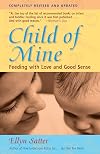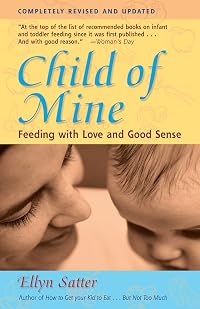
Child of Mine: Feeding with Love and Good Sense
by Ellyn Satter
On This Page
Description
Widely considered the leading book involving nutrition and feeding infants and children, this revised edition offers practical advice that takes into account the most recent research into such topics as: emotional, cultural, and genetic aspects of eating; proper diet during pregnancy; breast-feeding versus; bottle-feeding; introducing solid food to an infant's diet; feeding the preschooler; and avoiding mealtime battles. An appendix looks at a wide range of disorders including allergies, show more asthma, and hyperactivity, and how to teach a child who is reluctant to eat. The author also discusses the show lessTags
Recommendations



Member Reviews
Child of Mine presents a wonderful philosophy for feeding children. My wife and I really bought into it and it guided the way we have fed our children. The author is critical of almost all efforts to try to make kids eat more or to eat less, as she finds them terribly counterproductive, even the cause of life-long feeding problems. She argues that children, especially babies and toddlers, naturally figure out the right amounts of food to eat. Sometimes they eat too much at a meal and sometimes they don't eat at all. But over several days it averages out and they get exactly as much as they need. Allowing babies and children make the decisions on how much to eat can remove a great deal of stress from parenting. Parents aren't let off the show more hook with food, though. To sum up, Parents provide structure by choosing what children eat and when they eat. Parents also eat together with their children, and everyone has the same meal. But the children decide if and how much they eat.
Pardon me while I get all preachy: Not all parenting books actually provide truly useful help. This happened to be the first book that we found information we really could use. Satter has a philosophy that can be applied and it did work for both my children. It's been a blessing. Feeding is just such a huge and stressful thing with babies and toddlers. I've watched my children skip meals, over-stuff themselves, pick at their food and various other things that would drive me crazy. But, we let it slide, and did not put pressure on them. It was nice to be able to relax about this, and we actually got what the author promised - happy mostly-healthy eaters. Common sense I think now, but I didn't think so then.
I usually don't review books I haven't read all the way through, but this is a superb book that I won't finish for awhile. My oldest is four, I'm not ready to read about teenagers eating habits. If you do read it, note that the writing style can get repetitive, and you may want to skim and skip over sections that aren't of interest. show less
Pardon me while I get all preachy: Not all parenting books actually provide truly useful help. This happened to be the first book that we found information we really could use. Satter has a philosophy that can be applied and it did work for both my children. It's been a blessing. Feeding is just such a huge and stressful thing with babies and toddlers. I've watched my children skip meals, over-stuff themselves, pick at their food and various other things that would drive me crazy. But, we let it slide, and did not put pressure on them. It was nice to be able to relax about this, and we actually got what the author promised - happy mostly-healthy eaters. Common sense I think now, but I didn't think so then.
I usually don't review books I haven't read all the way through, but this is a superb book that I won't finish for awhile. My oldest is four, I'm not ready to read about teenagers eating habits. If you do read it, note that the writing style can get repetitive, and you may want to skim and skip over sections that aren't of interest. show less
A classic on feeding from infancy through preschool. As a book from 2000, it felt dated in quite a few spots, but I found it to be a mostly-positive and pretty self-aware resource with a lot of useful ways to frame feeding, and very easy to skim.
Her thesis is that stress in the parent and bad eating skills/habits in the child come from the parent putting more work into feeding than the child puts into eating. She suggests the way to success is to divide the task ownership unflinchingly: the parent determines the what and when of feeding, and the child determines whether and how much to eat. Crossing those lines leads to dragons. Key to the success of this strategy from both perspectives is regular snacktimes.
Her thesis is that stress in the parent and bad eating skills/habits in the child come from the parent putting more work into feeding than the child puts into eating. She suggests the way to success is to divide the task ownership unflinchingly: the parent determines the what and when of feeding, and the child determines whether and how much to eat. Crossing those lines leads to dragons. Key to the success of this strategy from both perspectives is regular snacktimes.
A very reasonable look at how to feed my child without being an overbearing freak.
The best thing I took from it is: the parent is responsible for the where, when and what of eating and the child is responsible for the whether and how much of eating.
Also, this author says not do do the "you must try a bite of everything" rule that I grew up with.
The best thing I took from it is: the parent is responsible for the where, when and what of eating and the child is responsible for the whether and how much of eating.
Also, this author says not do do the "you must try a bite of everything" rule that I grew up with.
One of the many worries a parent of a young girl can have is showing her how to establish a positive relationship with food. Did you know body image ideas can be formed as early as three years? And a relationship with food is formed before birth? Satter gives us an informative guide to feeding infants and toddlers with, well, good sense. She espouses a philosophy of moderation and accepting a child's input into the quantity of food they eat. She says, "You can't control or dictate the quantity of food your child eats, and you shouldn't try. You also can't control or dictate the kind of body your child develops, and you shouldn't try. What you can do, and it is a great deal, is set things up for your child so she, herself, can regulate show more her food intake as well as possible, and so she can develop a healthy body that is constitutionally right for her." A nutritionist, Satter provides essential charts, diagrams, and nutritional information, as well as straight-forward answers that are invaluable to parents of babies and toddlers. show less
Totally revolutionized how I feed my children. I truly think this should be required reading, especially for new moms who are stressing about what, how and how much food their kids are eating (or not eating).
a really good book about feeding babies. why did it take me so long to discover this one??
Ratings
Members
- Recently Added By
Author Information
8 Works 418 Members
Common Knowledge
- Original publication date
- 1983; 1986 (2nd Edition, Expanded) (2nd Edition, Expanded); 2000 (3rd Edition, Completely Revised and Updated) (3rd Edition, Completely Revised and Updated)
Classifications
Statistics
- Members
- 200
- Popularity
- 163,563
- Reviews
- 6
- Rating
- (3.95)
- Languages
- English, French
- Media
- Paper, Ebook
- ISBNs
- 11
- ASINs
- 2