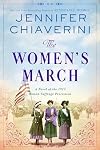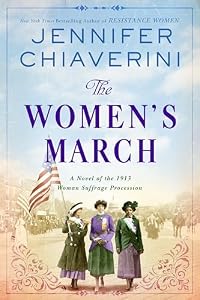
The Women's March: A Novel of the 1913 Woman Suffrage Procession
by Jennifer Chiaverini
On This Page
Description
New York Times bestselling author Jennifer Chiaverini returns with The Women's March, an enthralling historical novel of the woman's suffrage movement inspired by three courageous women who bravely risked their lives and liberty in the fight to win the vote.Twenty-five-year-old Alice Paul returns to her native New Jersey after several years on the front lines of the suffrage movement in Great Britain. Weakened from imprisonment and hunger strikes, she is nevertheless determined to show more invigorate the stagnant suffrage movement in her homeland. Nine states have already granted women voting rights, but only a constitutional amendment will secure the vote for all.
To inspire support for the campaign, Alice organizes a magnificent procession down Pennsylvania Avenue in Washington, DC, the day before the inauguration of President-elect Woodrow Wilson, a firm antisuffragist.
Joining the march is thirty-nine-year-old New Yorker Maud Malone, librarian and advocate for women's and workers' rights. The daughter of Irish immigrants, Maud has acquired a reputation—and a criminal record—for interrupting politicians' speeches with pointed questions they'd rather ignore.
Civil rights activist and journalist Ida B. Wells-Barnett resolves that women of color must also be included in the march—and the proposed amendment. Born into slavery in Mississippi, Ida worries that white suffragists may exclude Black women if it serves their own interests.
On March 3, 1913, the glorious march commences, but negligent police allow vast crowds of belligerent men to block the parade route—jeering, shouting threats, assaulting the marchers—endangering not only the success of the demonstration but the women's very lives.
Inspired by actual events, The Women's March offers a fascinating account of a crucial but little-remembered moment in American history, a turning point in the struggle for women's rights.
. show less
Tags
Recommendations













Member Reviews
She was absolutely resolved to continue putting her questions to all the men who wanted to govern her without her consent. Until she had a voice in this democracy, she would persist…
After I finished this novel, I took a break before trying to write anything for a review. Rather than ending up with a sense of inspiration fueled by triumph, I actually finished the read with a sense of inspiration mixed with anger.
Not a new anger, mind you. Sexism and racism and such aren't anything new to me. But sometimes it all just hits me harder—the reality that certain human beings too often have to fight so hard and so long for equality, justice, and fairness. Even in the land of the free.
On a related note, while I've read other novels that show more involve the theme of woman suffrage, I specifically chose to read this book when I saw Ida B. Wells-Barnett depicted as one of the three lead characters.
Ida knew what far too many white suffragists did not: that women of color had been involved in the suffrage movement from its inception, and that their participation had been omitted from the historical narrative told about the struggle.
Now, I skimmed through some critical reviews of this book before starting it. So, I came in prepared for the likelihood that much of it would read more like a narrative biography than a novel. My set expectation of reading in "biography" mode helped, as did the fact that I read the 1931 biographical book Women Builders by Sadie Iola Daniel only a little while before this.
Hence, I was just in that kind of "zone."
With that said, given the importance of the history and my high interest in the events, the deeper I got into this book, I was no longer thinking about which parts felt like a biography or which parts felt like a novel. I found the overall story too engrossing for that to matter.
This book serves as quite a reminder that not all of American history is pretty, and people's opposition to civil rights can be dehumanizing and appalling—but persisting to fight for civil rights is worthy.
And worth it.
Note:
• accounts and scenes of political and racial violence
• no profanity
• no explicit sexual content show less
After I finished this novel, I took a break before trying to write anything for a review. Rather than ending up with a sense of inspiration fueled by triumph, I actually finished the read with a sense of inspiration mixed with anger.
Not a new anger, mind you. Sexism and racism and such aren't anything new to me. But sometimes it all just hits me harder—the reality that certain human beings too often have to fight so hard and so long for equality, justice, and fairness. Even in the land of the free.
On a related note, while I've read other novels that show more involve the theme of woman suffrage, I specifically chose to read this book when I saw Ida B. Wells-Barnett depicted as one of the three lead characters.
Ida knew what far too many white suffragists did not: that women of color had been involved in the suffrage movement from its inception, and that their participation had been omitted from the historical narrative told about the struggle.
Now, I skimmed through some critical reviews of this book before starting it. So, I came in prepared for the likelihood that much of it would read more like a narrative biography than a novel. My set expectation of reading in "biography" mode helped, as did the fact that I read the 1931 biographical book Women Builders by Sadie Iola Daniel only a little while before this.
Hence, I was just in that kind of "zone."
With that said, given the importance of the history and my high interest in the events, the deeper I got into this book, I was no longer thinking about which parts felt like a biography or which parts felt like a novel. I found the overall story too engrossing for that to matter.
This book serves as quite a reminder that not all of American history is pretty, and people's opposition to civil rights can be dehumanizing and appalling—but persisting to fight for civil rights is worthy.
And worth it.
Note:
• accounts and scenes of political and racial violence
• no profanity
• no explicit sexual content show less
Jennifer Chiaverini’s The Women’s March is a fact-based novel centering around the drive to plan and complete a massive march in support of women’s suffrage on the day before Woodrow Wilson’s 1913 presidential inauguration.
It suffers from being simultaneously too broad and too narrow in viewpoint. The drive for women’s suffrage in the U.S. extended from the Seneca Falls Convention in 1848 to the adoption of the 19th Amendment in 1920 (and in some senses it continues today as the struggle for a definitive Equal Rights Amendment continues to wax and wane). A single work could hardly be expected to hit even the high points of such a long and complex issue, so Chiaverini has concentrated on the period surrounding the 1912 show more presidential campaign and the early days of the Wilson presidency. In order for the story to make sense, however, she has had to backfill 64 years of the struggle, and to provide an overview of the movement as it existed during the period on which she is concentrating. This introduces a huge and complex cast of characters, organizations, and social issues.
Meantime, she is also narrowing in on three major historical characters – suffrage amendment supporter Dr. Alice Paul, of New Jersey, workers’ rights advocate Maud Malone of New York, and pioneering Black journalist and community organizer Ida B. Wells-Barnett of Chicago. Of these three women, Wells-Barnett is easily the most compelling, yet her story is more parallel to that of the other two characters in its narrow focus on the women’s march of 1913.
There’s a lot of Sturm und Drang here regarding internecine strife among the various factions of the suffrage movement, and entirely too much ink devoted to who wore what at which event. More serious, more compelling, and ultimately much more disturbing, is the bone-deep racism and classism of much of the movement, reaching all the way back to the Seneca Falls meeting and its refusal to invite Sojourner Truth even as it courted and featured Frederick Douglass. Most of us would like our heroes to be … well, heroic … and it’s beyond disturbing to see the leaders of the various factions squabbling over who got to be center stage while at the same time continuing to deny full participation by women of color in order to appease racist elements from the Jim Crow south. Their excuse – ranging all the way back to Susan B. Anthony – was that it would be inappropriate to endanger political and social acceptance of votes for women if the issue were – you should excuse the expression – muddied by an insistence on including women of color within that group. This is largely what makes Wells-Barnett’s part of the story so compelling. One could wish that the focus had been on this stubborn, brilliant, heroic woman.
Chiaverini, however, has chosen a wider canvas, and her title – The Women’s March – works on several layers, as it describes the whole of the movement, the pre-inaugural parade, and a lesser-known but equally ambitious 250-mile foot march from New York to Washington D.C. undertaken as a half-publicity stunt, half-public declaration of intent by a group of women known as “The Army of the Hudson”. Together, the New Yorkers and the women from across the nation who determined to force Wilson into a public declaration of his stance on the issue, formed what Chiaverini calls “the greatest peacetime demonstration ever witnessed in the United States”. Press reports from the event estimate that 5,000 marchers participated in the procession up Pennsylvania Avenue, drawing crowds of up to 250,000. Along the way, they battled inadequate crowd control, physical assault from anti-suffrage supporters, and a determined silence from Wilson, whose racist and sexist attitudes would ultimately permeate his administration. Over a hundred of the marchers were hospitalized with injuries, many of them sustained while members of the D.C. police force stood by and refused to intervene. And in an unintended but eerie mirroring of events that would occur 109 years later within a stone’s throw of the marchers’ route, some of the most violent attackers “wrote to brag that they had joined in the mayhem and had no regrets”.
The more things change, the more it seems they stay the same.
Overall, The Women’s March is a valiant attempt, but it remains a heavy lift for any reader. Only those who are intensely interested in this microcosm of the long struggle for equal voting rights will get much more out of it than some inspiration for further reading. show less
It suffers from being simultaneously too broad and too narrow in viewpoint. The drive for women’s suffrage in the U.S. extended from the Seneca Falls Convention in 1848 to the adoption of the 19th Amendment in 1920 (and in some senses it continues today as the struggle for a definitive Equal Rights Amendment continues to wax and wane). A single work could hardly be expected to hit even the high points of such a long and complex issue, so Chiaverini has concentrated on the period surrounding the 1912 show more presidential campaign and the early days of the Wilson presidency. In order for the story to make sense, however, she has had to backfill 64 years of the struggle, and to provide an overview of the movement as it existed during the period on which she is concentrating. This introduces a huge and complex cast of characters, organizations, and social issues.
Meantime, she is also narrowing in on three major historical characters – suffrage amendment supporter Dr. Alice Paul, of New Jersey, workers’ rights advocate Maud Malone of New York, and pioneering Black journalist and community organizer Ida B. Wells-Barnett of Chicago. Of these three women, Wells-Barnett is easily the most compelling, yet her story is more parallel to that of the other two characters in its narrow focus on the women’s march of 1913.
There’s a lot of Sturm und Drang here regarding internecine strife among the various factions of the suffrage movement, and entirely too much ink devoted to who wore what at which event. More serious, more compelling, and ultimately much more disturbing, is the bone-deep racism and classism of much of the movement, reaching all the way back to the Seneca Falls meeting and its refusal to invite Sojourner Truth even as it courted and featured Frederick Douglass. Most of us would like our heroes to be … well, heroic … and it’s beyond disturbing to see the leaders of the various factions squabbling over who got to be center stage while at the same time continuing to deny full participation by women of color in order to appease racist elements from the Jim Crow south. Their excuse – ranging all the way back to Susan B. Anthony – was that it would be inappropriate to endanger political and social acceptance of votes for women if the issue were – you should excuse the expression – muddied by an insistence on including women of color within that group. This is largely what makes Wells-Barnett’s part of the story so compelling. One could wish that the focus had been on this stubborn, brilliant, heroic woman.
Chiaverini, however, has chosen a wider canvas, and her title – The Women’s March – works on several layers, as it describes the whole of the movement, the pre-inaugural parade, and a lesser-known but equally ambitious 250-mile foot march from New York to Washington D.C. undertaken as a half-publicity stunt, half-public declaration of intent by a group of women known as “The Army of the Hudson”. Together, the New Yorkers and the women from across the nation who determined to force Wilson into a public declaration of his stance on the issue, formed what Chiaverini calls “the greatest peacetime demonstration ever witnessed in the United States”. Press reports from the event estimate that 5,000 marchers participated in the procession up Pennsylvania Avenue, drawing crowds of up to 250,000. Along the way, they battled inadequate crowd control, physical assault from anti-suffrage supporters, and a determined silence from Wilson, whose racist and sexist attitudes would ultimately permeate his administration. Over a hundred of the marchers were hospitalized with injuries, many of them sustained while members of the D.C. police force stood by and refused to intervene. And in an unintended but eerie mirroring of events that would occur 109 years later within a stone’s throw of the marchers’ route, some of the most violent attackers “wrote to brag that they had joined in the mayhem and had no regrets”.
The more things change, the more it seems they stay the same.
Overall, The Women’s March is a valiant attempt, but it remains a heavy lift for any reader. Only those who are intensely interested in this microcosm of the long struggle for equal voting rights will get much more out of it than some inspiration for further reading. show less
Audiobook narrated by Saskia Maarleveld
Subtitle: A Novel of the 1913 Woman Suffrage Procession
As the subtitle suggest, this novel focuses on the women who risked their liberty, and their lives, to win the vote for women, including women of color. Chiaverini focuses on three of the most important suffragists of the day: Alice Paul, Maud Malone, and Ida B Wells-Barnett, to tell the story of how the idea for the march was conceived and the struggles they faced in planning for the event.
In order for women to be allowed to vote, the men who held the power, had to be the ones to grant that power, and let’s be clear, it was white men who held the power. And they were not willing to do so. The women who demonstrated were frequently taunted show more and assaulted by onlookers. No matter how peacefully they tried to ask a political candidate, “Do you support women’s suffrage?” they were taunted and jeered at by the men in the crowd, bodily ejected by a group of policemen, and like as not, arrested.
But the women, themselves, were hardly united. The National American Woman Suffrage Association – known simply as “the National” – was focused on gaining suffrage rights for women on a state-by-state basis. Alice Paul, who had been offered a position organizing their open-air meetings, felt strongly that the way to go was to push for a constitutional amendment, and one that would include ALL women, including blacks, a stance that alienated the women suffrage organizations in the South.
Chiaverini brings these historical figures to life. The chapters alternate between these three central figures, showing how each approached the issue and the unique challenges each faced. The scenes of the march itself, and the near disaster it became due to the failure of the Police Superintendent to provide adequate security, are harrowing. And I felt as disheartened as the women themselves must have felt when they finally had a meeting with President Wilson and he dismissed them stating, “I have no opinion on woman suffrage. I’ve never given the subject any thought.”
That first national march was a triumph of organization and courage, but it would be another seven years, until August 1920, before the Eighteenth Amendment was finally ratified.
While the novel itself is interesting and engaging, I really enjoyed the author’s notes at the end, where Chiaverini gives more details on what happened after the march. I had not realized before that Alice Paul drafted the first Equal Rights Amendment in 1922. I recall the attention the ERA received in the 1970s. It has yet to be ratified.
Saskia Maarleveld does a fine job of narrating the audiobook. She sets a good pace and Chiaverini’s writing helped to keep all these various female characters clearly defined. show less
Subtitle: A Novel of the 1913 Woman Suffrage Procession
As the subtitle suggest, this novel focuses on the women who risked their liberty, and their lives, to win the vote for women, including women of color. Chiaverini focuses on three of the most important suffragists of the day: Alice Paul, Maud Malone, and Ida B Wells-Barnett, to tell the story of how the idea for the march was conceived and the struggles they faced in planning for the event.
In order for women to be allowed to vote, the men who held the power, had to be the ones to grant that power, and let’s be clear, it was white men who held the power. And they were not willing to do so. The women who demonstrated were frequently taunted show more and assaulted by onlookers. No matter how peacefully they tried to ask a political candidate, “Do you support women’s suffrage?” they were taunted and jeered at by the men in the crowd, bodily ejected by a group of policemen, and like as not, arrested.
But the women, themselves, were hardly united. The National American Woman Suffrage Association – known simply as “the National” – was focused on gaining suffrage rights for women on a state-by-state basis. Alice Paul, who had been offered a position organizing their open-air meetings, felt strongly that the way to go was to push for a constitutional amendment, and one that would include ALL women, including blacks, a stance that alienated the women suffrage organizations in the South.
Chiaverini brings these historical figures to life. The chapters alternate between these three central figures, showing how each approached the issue and the unique challenges each faced. The scenes of the march itself, and the near disaster it became due to the failure of the Police Superintendent to provide adequate security, are harrowing. And I felt as disheartened as the women themselves must have felt when they finally had a meeting with President Wilson and he dismissed them stating, “I have no opinion on woman suffrage. I’ve never given the subject any thought.”
That first national march was a triumph of organization and courage, but it would be another seven years, until August 1920, before the Eighteenth Amendment was finally ratified.
While the novel itself is interesting and engaging, I really enjoyed the author’s notes at the end, where Chiaverini gives more details on what happened after the march. I had not realized before that Alice Paul drafted the first Equal Rights Amendment in 1922. I recall the attention the ERA received in the 1970s. It has yet to be ratified.
Saskia Maarleveld does a fine job of narrating the audiobook. She sets a good pace and Chiaverini’s writing helped to keep all these various female characters clearly defined. show less
I read this for a book club this month. The Women's March describes the build up to the 1913 Women's March in Washington DC through several viewpoints. This is heavy duty historical fiction, a deep read, one that obviously involved incredible research. It is still approachable, however, and also highly educational. I knew a little bit about the march, but nothing about the key players or the racial controversies involved. This will make for a great book club discussion.
This book traces the story of an event I was unfamiliar with--the Women's Procession of March 1913, held in Washington DC the day before President Woodrow Wilson's inauguration. The Women's March was to promote the women's suffrage and to force the new president to ask Congress to amend the Constitution to give all women the right to vote. Except--what about black women and other women of color? Why not have state's take care of this right, as a few already had? What this book does is present this issue with all the complexities that confronted the suffragists of that time. Race was a huge issue, but so was class and misogyny.
This book follows the lives of three women as they fight for women's suffrage in the US. Alice Paul spent years working in the suffrage movement in the UK. Upon returning to the US, she is determined to spark new interest in the movement. Maud Malone, known as a heckler, is known for interrupting politicians speeches, asking how they feel about women's votes. Ida B. Wells-Barnett, an African American woman, is interested in votes for all women, not just the white women who have to-date been the focus on the movement. Alice, determined to fight for a constitutional amendment, organizes a march scheduled the day before the inauguration of Woodrow Wilson.
This was a fairly quick and engaging read. The characters were interesting and show more dynamic. I know relatively little about the topic and found myself googling everyone after reading the book. Overall, highly recommended. show less
This was a fairly quick and engaging read. The characters were interesting and show more dynamic. I know relatively little about the topic and found myself googling everyone after reading the book. Overall, highly recommended. show less
While this was an excellent account of three members of the Woman’s Suffrage Movement, it didn’t have the punch that Resistance Women had. It read more like non-fiction than it did historical fiction. I learned a lot about three of the leaders of the Vote for Women movement in the early 20th century. Alice Paul, Ida Be Wells and Maud Malone were daringly brave women and I recommend it to anyone concerned with the early leaders of the Woman’s Movement.
Members
- Recently Added By
Lists

Feminism
167 works; 4 members
Author Information

67+ Works 19,292 Members
Jennifer Chiaverini is a graduate of the University of Notre Dame and the University of Chicago. She used to be a writing instructor at Penn State University and Edgewood College. She is the author of the Elm Creek Quilts series and four volumes of quilt patterns inspired by her novels. She is also the designer of the Elm Creek Quilts fabric lines show more from Red Rooster Fabrics. Among her most recent works, is the New York Times bestselling novel, Mrs. Lincoln's Dressmaker. (Publisher Provided) Jennifer Chiaverini is a graduate of the University of Notre Dame and the University of Chicago. She is an American quilter and author. Her books include the Elm Creek Quilts series as well as five collections of quilt patterns inspired by her novels. She designs the Elm Creek Quilts fabric lines from Red Rooster Fabrics. She was also a writing instructor at Penn State and Edgewood College. Jennifer is also the author of bestselling novels Mrs. Lincoln's Dressmaker, The Spymistress and Mrs. Lincoln's Rival. (Bowker Author Biography) show less
Common Knowledge
- Important events
- Women's Suffrage (1913, US)
Classifications
Statistics
- Members
- 230
- Popularity
- 140,921
- Reviews
- 11
- Rating
- (3.82)
- Languages
- English
- Media
- Paper, Audiobook, Ebook
- ISBNs
- 10
- ASINs
- 2