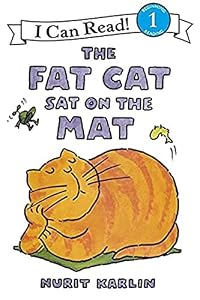
The Fat Cat Sat on the Mat
by Nurit Karlin
On This Page
Description
Rat tries to get the fat cat off the mat and back to his usual resting place in the vat.Tags
Recommendations




Member Reviews
A surrealist manifesto, a deconstructionist’s nursery rhyme—A Fat Cat Sat on a Mat is a genius work of satire, a prayer to chaos, a delight in the pointless eddies of confrontation. Best book I’ve read this year.
When the witch is away, the cat and rat will play! So it proves in this amusing beginning reader from author/illustrator Nurit Karlin, as Witch Wilma heads out one night, leaving her fat orange cat and pet rat to argue over who gets to sit on the mat...
Rhyming text and colorful cartoon-like illustrations are paired in The Fat Cat Sat on the Mat, a Level 1 reader published as part of HarperCollins' celebrated I Can Read! collection in 1996. As it happens, this is the second witchy title I have read from Karlin, following upon her 1985 picture book, The Tooth Witch. Here the text is much simpler of course, full of repetition and plenty of rhyme. The humor of the story will appeal to beginning readers, I think, and the rhyming text and show more amusing illustrations will add to the entertainment. show less
Rhyming text and colorful cartoon-like illustrations are paired in The Fat Cat Sat on the Mat, a Level 1 reader published as part of HarperCollins' celebrated I Can Read! collection in 1996. As it happens, this is the second witchy title I have read from Karlin, following upon her 1985 picture book, The Tooth Witch. Here the text is much simpler of course, full of repetition and plenty of rhyme. The humor of the story will appeal to beginning readers, I think, and the rhyming text and show more amusing illustrations will add to the entertainment. show less
In my opinion this is an adorable book! It follows Wilma the witch and her animals, the fat cat and pet rat. The story is engaging and uses onomatopoeia phrases such as "pit-a-pat" and "rat-a tat" to help readers follow the story. The illustrations are wonderful and add context to the story. An example of this being the fat cat saying "No , I won't" and then the cat looking defiant in the illustration. You can tell that the cat is serious by the pictures. The big idea of this book is that the answer to your problems are often simple. After the rat got upset at the cat for sitting of his mat, the witch shared that the mat was never the rat's to begin with, solving their argument.
In my opinion, this book is average, but the ending was a surprise. The text serves a purpose for younger readers and activities involving rhyming, and I like the use of rhyming language in the book. For example, this text uses rhyming to provide endearing humor throughout the story: “Wilma loves her pet rat. She calls the rat ‘my little brat.’” The characters in this book (the witch and her pet cat, bat, rat and hat), are wild and likable, each with their own individual, humorous personality. I also enjoyed the personification of the hat. The illustrations in this book are not outstanding, but I do enjoy the softness of the colors and the watercolor style because I think that it relates well to the story. The ending, in my show more opinion, was unexpected. For example, I expected the cat to be taught a lesson about being greedy. However, in the end I discovered a surprising big idea: it is not wise to waste your time trying to control the actions of others. show less
The Fat Cat Sat on the Mat is all about thinking through a problem and finding a solution to the problem that works out for many. I enjoyed this book for a few reasons but its also a book that was close to be as a child, but also the characters thought process and actions. I really enjoyed the art style used in this book, the characters look and feel more like people then animals at times, especially Rat and Bat. The book also makes facial expressions very helpful to understand the characters, from the anger of Rat to the nonchalant look of Cat. Another aspect of the book that I like was the language used, the rhyming and also the simplicity is good for patterns and early readers. The main characters themselves all rhyme with each show more other, Cat, Rat, Bat, Hat, Mat. This aids in the child ability to predict the next word when first starting to read and aid in their growth as a reader. show less
I had mixed feelings about this book as I was reading it. I liked it for the fact that it contained a lot of rhyming words in it which are crucial for younger children to know and learn. Words like cat, hat, mat, rat, pat and bat are good words to get children to learn how to read and sound out words. However, I feel as if those words were just thrown together to create a story that didn't quite necessarily make sense to me. There was really no plot to it except that the fat cat stole the mat from the rat. The author portrayed the animals and the hat as if they were humans which is good for kids to be creative and have a sense of imagination. But in the end, there was no moral or lesson to teach younger kids. It didn't show that it show more would have been nice for the cat to share the mat. The cat was also portrayed in a negative matter and at the end he still got what he wanted which was to sit on the mat, until he thought it was time to move, and he got to eat the fish. I feel as though the story should have taught more of a lesson to the readers. show less
This is a silly story about a cat that sits on his mat as the title leads you to conclude. It is beneficial to students whom are graphophonetically fixated, which seems to be a prevalent problem. There are a lot of rhymes, which makes it an easy and smooth read. I would recommend looking into the stories use of order, and look at reading books like "The Old Lady Who Swallowed the Fly", which also have this cause and effect type ordeal going on throughout the story.
Members
- Recently Added By
Author Information

11+ Works 2,923 Members
Nurit Karlin was born in Jerusalem on December 26, 1938. She graduated from the Bezalel Academy of Arts and Design in Jerusalem and studied animation at the School of Visual Arts in New York. Before becoming the only woman cartoonist for The New Yorker magazine in 1974, she sold drawings to The New York Times. A collection of her work, No Comment, show more was published in 1978. She stopped contributing to The New Yorker in 1988. She became a children's book author and illustrator. Her books included The Tooth Witch, The Dream Factory, and I See, You Saw. She retired about 13 years ago and moved back to Israel. She died on April 30, 2019 at the age of 80. (Bowker Author Biography) show less
Series
Belongs to Publisher Series
I Can Read! (Level 1)
Common Knowledge
- Canonical title
- The Fat Cat Sat on the Mat
Classifications
Statistics
- Members
- 2,352
- Popularity
- 8,300
- Reviews
- 32
- Rating
- (3.98)
- Languages
- English
- Media
- Paper, Audiobook, Ebook
- ISBNs
- 19
- ASINs
- 9