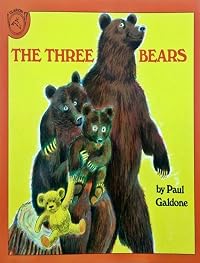
The Three Bears
by Paul Galdone
On This Page
Description
Three bears return from a walk and find a little girl asleep in baby bear's bed.Tags
Recommendations






Member Reviews
This book is painfully politically correct. No Daddy and Mommy, just Big and Medium sized bear. While I get (and support) what they're going for, it feels very heavy-handed. It also adds bulk to the story. I got it for my two and a half year old, and there were just too many WORDS on each page -- she lost the story in all the description.
Also, Goldy is seriously creepy-looking.
Also, Goldy is seriously creepy-looking.
Goldilocks stumbles upon an empty house in the woods where she discovers three different sizes of porridge, chairs, and beds. She tries each size of the porridge, chairs and beds, she falls asleep in bed the a family of bears comes home to find her in their bed, she wakes up afraid and runs away. I like this book because it was one that I heard often when I was young, also the plot builds suspense while she tries each different thing and while you wonder if she will get caught. I think one extension you could do with book would be to act it out after you read it, that way the students can really get into it.
Paul Galdone’s The Three Bears is an amusing retelling of the Goldilocks story from the perspective of the eponymous three bears. In Galdone’s version of the story, the bears are kind, good-natured creatures; Goldilocks, on the other hand, is a self-absorbed, trespassing brat who has no respect for anyone else’s property, human or otherwise. A clever device that Galdone uses in the text is the creative use of font size: the Little Wee Bear’s descriptions are matched with a little font, the Middle-Sized Bear with a middle-sized font, and the Great Big Bear with a large font. Apart from the shift in perspective, Galdone stays fairly faithful to the original source material; clearly, this book is intended as a supplemental story show more for children to read after they’ve already become familiar with the traditional Goldilocks tale.
Citation:
Galdone, Paul. The Three Bears. New York: Clarion, 1972. Print. show less
Citation:
Galdone, Paul. The Three Bears. New York: Clarion, 1972. Print. show less
I liked this book for a few reasons. First the writing in the book was engaging because each of the bears had a different sizes of the writing throughout the book. As each individual bear was being described in the story the size of the text in the book would change depending on which bear it was. Another thing is that the illustrations fit the mood of the story because the bears are portrayed as a family and Goldilocks is drawn a mischievous child for her character. The book was made for children to read classic literature and start to learn to read with similar lines throughout the book.
This would be a great book to have in a kindergarten or first grade class. The pictures are lively, and the text is simple so a young reader would feel confident selecting this book. This book does not have "mama, papa, or baby bear" which is actually a really good thing. The book names the bears "Big, middle, and small". This is a really good thing because children come from diverse families and this book does not put emphasis on the stereotypical idea of what a family is. This would be a good book to have for young students to read during independent reading time, because it has farely easy text and the pictures match the text extremely well.
Galdone switches the story to be from the bears' perspective. Their porridge is too hot, so they leave the house to give it time to cool. Bratty little Goldilocks shows up, and eats their porridge, breaks their chair, and so on. The bears come home, sort through all the new mysteries in their house, leading them to Goldilocks, who runs off, never to be seen again. The three different size bears even get three different size fonts-- fun for voicing the characters. This book would be great to use with other versions to talk about what authors can do to make a story their own.
The Three Bears by Paul Galdone is the classic tale refreshed with the illustrations of Galdone. The text generally keeps to the classic version with the main change being the the bears are differentiated by size and are not referred to as a family. Text size is varied according to which bear is speaking.
The illustrations are simple and effective. There are fun touches such as the little bear always having his teddy bear nearby. Humor is added by showing the Great Big Bear reading a small sized book with glasses on and the middle sized bear covering its ears as the Great Big Bear snores in bed. Goldilocks is portrayed as curious with big eyes and missing a tooth. Galdone has fun showing the size of the spoons and the chairs, as show more Goldilocks has to clinb into the largest chair.
This version is appropriate for storytime with pictures large enough for a group to see. The theme of leaving others possessions alone is well portrayed. The story could be expanded by comparing other versions. Recommended for school and public library collections.
For ages 3 to 6, read-aloud, folktales, respect themes, and for fans of Paul Galdone. show less
The illustrations are simple and effective. There are fun touches such as the little bear always having his teddy bear nearby. Humor is added by showing the Great Big Bear reading a small sized book with glasses on and the middle sized bear covering its ears as the Great Big Bear snores in bed. Goldilocks is portrayed as curious with big eyes and missing a tooth. Galdone has fun showing the size of the spoons and the chairs, as show more Goldilocks has to clinb into the largest chair.
This version is appropriate for storytime with pictures large enough for a group to see. The theme of leaving others possessions alone is well portrayed. The story could be expanded by comparing other versions. Recommended for school and public library collections.
For ages 3 to 6, read-aloud, folktales, respect themes, and for fans of Paul Galdone. show less
Members
- Recently Added By
Lists

Early Picture Books
467 works; 9 members

Read Aloud Revival
108 works; 4 members
Author Information

88+ Works 20,134 Members
Paul Galdone was born in Budapest, Hungary in 1907 and immigrated to the United States in 1928. Though he was also a painter and sculptor, he is best known as a writer and illustrator of children's books. During his early career Galdone worked in the art department at Doubleday where he designed a successful book jacket. The experience led him to show more believe that he could make a living as a freelance illustrator. He left behind the working world of New York City when he and his wife moved to rural Rockland County, New York. Many of Galdone's works are adaptations of fairy tales and folktales. Some of these are The House that Jack Built (1961), Cinderella (1978), and Three Aesop Fox Fables (1971). He illustrated the well-known Miss Pickerell Goes to Mars and sequels written by Ellen MacGregor. He has illustrated works by John Greenleaf Whittier, Oliver Wendell Holmes, Edward Lear, and Nathaniel Hawthorne. During his career he illustrated over 100 books and wrote and illustrated several dozen others. Galdone was twice runner up for the Caldecott Medal, in 1957 and 1958. Paul Galdone died in 1986. (Bowker Author Biography) show less
Common Knowledge
- Canonical title
- The Three Bears
- Original title
- The Three Bears
- Original publication date
- 1972
- People/Characters
- Goldilocks; The Little Wee Bear; The Middle-Sized Bear; The Great Big Bear
- Disambiguation notice
- 059011820X is also the ISBN for the book Dem Bones (1996).
Classifications
Statistics
- Members
- 2,077
- Popularity
- 9,917
- Reviews
- 27
- Rating
- (4.03)
- Languages
- English, French, Spanish
- Media
- Paper, Ebook
- ISBNs
- 31
- UPCs
- 3
- ASINs
- 15