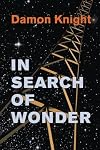
In Search of Wonder: Essays on Modern Science Fiction
by Damon Knight
On This Page
Description
A classic must-have for all readers and writers of science fiction!Damon Knight effectively invented science fiction criticism. His reviews were not mere statements of his personal preferences-his skillful essays analyzed the books and told why they were good or bad, to the edification of readers, the delight of good writers, and the embarrassment of bad ones.In this unique critical study of science fiction, Mr. Knight works on the principle that science fiction is a form of literature which show more needs no apologies and no special dispensations: it can and should be judged by the same high standards that apply to all literature. His incisive and knowing criticism covers the field brilliantly, from "Classics" to "Chuckleheads."Readers will delight in his laser-sharp thoughts on favorite books, and writers will find his criqitues of the classics invaluable in improving their own craft.This expanded Third Edition is 150,000 words, up from 120,000 in the 1967 Second Edition, and double the length of the 1956 First Edition.This new edition adds a chapter of autobiography, articles on writing and teaching science fiction, and other fascinating essays. Even if you already have the first or second editions, you should consider getting this edition simply for the new material, which includes: Chapter 1: Myself When Young [autobiographical]; Chap. 13: The Excluded Data [about Charles Fort]; Chap. 29: Milford and Clarion; Chap. 30: Science and the World; Chap. 31: What Is Science Fiction, Anyway?; Chap. 32: Writing Science Fiction; a major expansion of Chapter 5, discussing John W. Campbell, Jr.; and other additions and emendations.Table of Contents Introduction by Anthony Boucher Author's Notes Myself When Young Critics The Classics Chuckleheads Campbell and His Decade Cosmic Jerrybuilder: A. E. van Vogt Half-Bad Writers One Sane Man: Robert A. Heinlein Asimov and Empire More Chuckleheads When I Was in Kneepants: Ray Bradbury The Vorpal Pen: Theodore Sturgeon The Excluded Data: Charles Fort Microcosmic Moskowitz Anthologies Half Loaves Genius to Order: Kuttner and Moore Kornbluth and the Silver Lexicon The Jagged Blade: James Blish Overalls on Parnassus: Fletcher Pratt Amphibians New Stars Curiosa br-r-r! Decadents Britons Pitfalls and Dead Ends Symbolism Milford and Clarion Science and the World What Is Science Fiction, Anyway? Writing Science Fiction What next Bibliography Index Knight has long been a pithy and insightful commentator on science fiction, and the new material-written mostly a decade or more ago--alters that description in neither jot nor tittle ... his book is the perfect companion to your collection of favorites.-Analog show lessTags
Recommendations



















Member Reviews
Damon Knight is the most vivid contemporary critic of Golden Age science fiction. He was a pal who crashed on the couches of some of the writers that an organization he founded would later celebrate as Grandmasters. He knew precisely the nature of their talent, but from his1945 devastating takedown of A.E. van Vogt to his qualified appreciations of Asimov, Heinlein, Bradbury, and Clarke, he was quite willing to tell his friends when they tripped over their shoelaces.
Here are some highlights.
As a young man in 1945, he was undaunted by the reputation of A. E. van Vogt. He finds egregious errors in his science. He finds the plot of The World of Null-A full of “contradictions, misleading clues and irrelevant action.” Its characters do show more not act consistently with the qualities they are supposed to have. Knight says van Vogt’s sentence and diction are “fumbling and insensitive.” Nor can he build a scene or create a believable character.
He notes that a year after becoming a best seller, L. Ron Hubbard vanished “trailing a cloud of lawsuits.” His scamming and role-playing led him to waste his talent.
At times, Knight slips in the knife with faint praise: Richard Matheson’s I Am Legend “is full of good ideas, every other one of which is immediately dropped and kicked out of sight.” In Double Star, Knight says Heinlein “demonstrates again that the boobs cannot put so many greasy fingerprints on an idea that a good writer cannot lift it out shining and new.”
Asimov said his Galactic empire was “simply the Roman … Empire written large.” Knight calls that phrase “an absolutely devastating criticism of any science fiction story.”
Knight agrees with those purists who say that Bradbury does not write science fiction and that his technology is a joke. He writes, Knight says, about a remembered Midwestern childhood “seen through the wrong end of a rose-colored glass.”
Finally, Knight would not be the last to note that Arthur C. Clarke writes fiction in which gadgets are more important than people.
He makes a good case for two writers, Theodore Sturgeon and Jack Williamson, whose reputations have unjustly slipped. But he certainly overpraises Curme Gray, the author of only one novel of any note.
Most of these essays were originally published in small circulation pulps, and we are lucky to have them rescued from oblivion in this book. show less
Here are some highlights.
As a young man in 1945, he was undaunted by the reputation of A. E. van Vogt. He finds egregious errors in his science. He finds the plot of The World of Null-A full of “contradictions, misleading clues and irrelevant action.” Its characters do show more not act consistently with the qualities they are supposed to have. Knight says van Vogt’s sentence and diction are “fumbling and insensitive.” Nor can he build a scene or create a believable character.
He notes that a year after becoming a best seller, L. Ron Hubbard vanished “trailing a cloud of lawsuits.” His scamming and role-playing led him to waste his talent.
At times, Knight slips in the knife with faint praise: Richard Matheson’s I Am Legend “is full of good ideas, every other one of which is immediately dropped and kicked out of sight.” In Double Star, Knight says Heinlein “demonstrates again that the boobs cannot put so many greasy fingerprints on an idea that a good writer cannot lift it out shining and new.”
Asimov said his Galactic empire was “simply the Roman … Empire written large.” Knight calls that phrase “an absolutely devastating criticism of any science fiction story.”
Knight agrees with those purists who say that Bradbury does not write science fiction and that his technology is a joke. He writes, Knight says, about a remembered Midwestern childhood “seen through the wrong end of a rose-colored glass.”
Finally, Knight would not be the last to note that Arthur C. Clarke writes fiction in which gadgets are more important than people.
He makes a good case for two writers, Theodore Sturgeon and Jack Williamson, whose reputations have unjustly slipped. But he certainly overpraises Curme Gray, the author of only one novel of any note.
Most of these essays were originally published in small circulation pulps, and we are lucky to have them rescued from oblivion in this book. show less
Ratings
Members
- Recently Added By
Author Information

254+ Works 8,424 Members
Work Relationships
Has as a commentary on the text
Common Knowledge
- Canonical title
- In Search of Wonder: Essays on Modern Science Fiction
Classifications
Statistics
- Members
- 131
- Popularity
- 246,727
- Reviews
- 1
- Rating
- (3.86)
- Languages
- English
- Media
- Paper, Ebook
- ISBNs
- 5
- ASINs
- 6