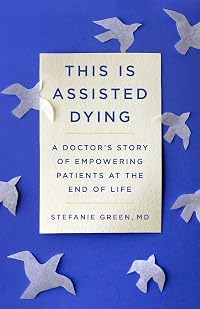
This Is Assisted Dying: A Doctor's Story of Empowering Patients at the End of Life
by Stefanie Green
On This Page
Description
"Dr. Stefanie Green has been forging new paths in the field of medical assistance in dying since 2016. In her landmark memoir, Dr. Green reveals the reasons a patient might seek an assisted death, how the process works, what the event itself can look like, the reactions of those involved, and what it feels like to oversee proceedings and administer medications that hasten death. She describes the extraordinary people she meets and the unusual circumstances she encounters as she navigates the show more intricacy, intensity, and utter humanity of these powerful interactions. Deeply authentic and powerfully emotional, This Is Assisted Dying contextualizes the myriad personal, professional, and practical issues surrounding assisted dying by bringing readers into the room with Dr. Green, sharing the voices of her patients, her colleagues, and her own narrative. As our population confronts issues of wellness, integrity, agency and community, and how to live a connected, meaningful life, this progressive and compassionate book by a physician at the forefront of medically assisted dying offers comfort and potential relief. This Is Assisted Dying will change the way people think about their choices at the end of life, and show that assisted dying is less about death than about how we wish to live."--Publisher's website. show lessTags
Recommendations












Member Reviews
These days, I wish I lived in Canada for a number of reasons. Stefanie Green is one of them. I'd want her in my Contacts list when my days are numbered in double digits. She is a physician who has encompassed the full cycle of life, from maternity/obstetric care, through family practice, to devoting her practice exclusively to care of the dying, and in fact helping deliver them from a life that is unbearable, with grace and kindness. Canada's Medical Aid in Dying laws permit physicians to administer drugs to painlessly end the lives of those who choose to exit in this way. This book explains it, describes the criteria for eligibility, how the process works, what it's like, and what the patients and their families experience. She also show more tells us how she came to commit herself to this work, and what her own feelings and experiences have been. She says that the majority of people who choose her services do not do so because of intractable pain, but rather because their lives are no longer acceptable to them, their unremitting losses of function and abilities are so great that they are unable to spend an hour doing what they love most, and they simply seek the eternal peace and rest of slipping away, surrounded by their loved ones. The case studies are deeply moving; the decisionmaking careful and thorough, with safeguards against misuse. This is a book to read in conjunction with Sunita Puri's That Good Night: Life and Medicine in the Eleventh Hour, an exploration of palliative care in terminally ill patients. Green's book shows us what the final phase can be when the considered and complete administration of comfort or curative care is no longer effective. We can do this for our cats and dogs; it can also serve humanity. show less
This is a useful and accessible book for Canadians interested in learning about the issues, procedures, and early days of “MAiD” (Medical Assistance in Dying), which came into effect in 2016. An “accessible” book, however, is not equivalent to an easily read one. There are innumerable descriptions of human suffering and the doctor-author’s experiences providing MAiD. I could handle the book only in small doses.
Green is a former family physician who for many years worked long hospital shifts as a focused-practice maternity-and-neonatal-care clinician in Victoria, British Columbia. Gradually worn down by the hours and missing time with her family, she decided to transition—you guessed it—to a focused practice in euthanasia. show more No one actually wants to call the human version of this medical procedure “euthanasia” because of its association with eugenics, but euthanasia is precisely what it is. Green is one of the earliest providers of MAiD in Canada. Along with a small group of colleagues, most of them family medicine physicians, she was instrumental in developing protocols and procedures. Green talks about a somewhat surprising overlap between maternity care and medically assisted death—saying both provide the intensity and drama that she is drawn to—but I admit to finding her selection of a practice exclusively dedicated to helping people die questionable. I am doubtful about anyone’s ability to remain mentally well balanced long-term while performing only this work. I base this observation on a lot of personal experience being present for veterinary euthanasia, which is performed routinely. Few domesticated animals die a natural death. I’ve observed the toll euthanasia takes on veterinarians. It hardens many of them, sometimes alarmingly so.
As well as providing case studies and an exploration of ethical, psychosocial, and legal issues around MaiD, Green tells stories about her own upbringing and family, so this is a combo memoir/expository piece. I can hardly say I enjoyed the book. Indeed, I suspect anyone who has been involved in the care of a terminally ill friend or family member (even a nonhuman one) will find this book bordering on (if not fully) harrowing at times. It is valuable, certainly, but any recommendation should be accompanied by the caveat that it is intense.
Rating: 3.5 rounded down show less
Green is a former family physician who for many years worked long hospital shifts as a focused-practice maternity-and-neonatal-care clinician in Victoria, British Columbia. Gradually worn down by the hours and missing time with her family, she decided to transition—you guessed it—to a focused practice in euthanasia. show more No one actually wants to call the human version of this medical procedure “euthanasia” because of its association with eugenics, but euthanasia is precisely what it is. Green is one of the earliest providers of MAiD in Canada. Along with a small group of colleagues, most of them family medicine physicians, she was instrumental in developing protocols and procedures. Green talks about a somewhat surprising overlap between maternity care and medically assisted death—saying both provide the intensity and drama that she is drawn to—but I admit to finding her selection of a practice exclusively dedicated to helping people die questionable. I am doubtful about anyone’s ability to remain mentally well balanced long-term while performing only this work. I base this observation on a lot of personal experience being present for veterinary euthanasia, which is performed routinely. Few domesticated animals die a natural death. I’ve observed the toll euthanasia takes on veterinarians. It hardens many of them, sometimes alarmingly so.
As well as providing case studies and an exploration of ethical, psychosocial, and legal issues around MaiD, Green tells stories about her own upbringing and family, so this is a combo memoir/expository piece. I can hardly say I enjoyed the book. Indeed, I suspect anyone who has been involved in the care of a terminally ill friend or family member (even a nonhuman one) will find this book bordering on (if not fully) harrowing at times. It is valuable, certainly, but any recommendation should be accompanied by the caveat that it is intense.
Rating: 3.5 rounded down show less
As the author describes it, the Canadian model of assisted death, which requires active medical guidance and intervention, seems far more compassionate than the U.S. version of assisted suicide, which allows physicians to avoid malpractice by forcing an ill patient to do all the work themselves. This book could have been improved by more discussion of ethical issues, such as the pressure that some disabled people feel that they "should" end their lives, against their will, simply because society chooses not to support them, and the work of death doulas. The best parts of the book are the patients' views on death:
"If I cannot give consent to my own death, whose body is this? Who owns my life?"
"We're befriending death. We're holding it, show more we're witnessing it, we're taking it back into our own hands."
Recommended for all libraries. show less
"If I cannot give consent to my own death, whose body is this? Who owns my life?"
"We're befriending death. We're holding it, show more we're witnessing it, we're taking it back into our own hands."
Recommended for all libraries. show less
Very good!
Ratings
Members
- Recently Added By
Lists

Globe and Mail | Canadian Non-Fiction: April 16, 2022
10 works; 1 member
Globe and Mail | Canadian Non-Fiction: April 9, 2022
10 works; 1 member

Globe and Mail | Canadian Non-Fiction: April 23, 2022
10 works; 1 member

Globe and Mail | Canadian Non-Fiction: May 7, 2022
10 works; 1 member
Globe and Mail | Canadian Non-Fiction: April 30, 2022
10 works; 1 member
Globe and Mail | Canadian Non-Fiction: May 28, 2022
10 works; 1 member
Globe and Mail | Canadian Non-Fiction: May 14, 2022
10 works; 1 member

Evergreen Award™ Winners and Nominees 2005–2024
200 works; 3 members
Author Information
2 Works 65 Members
Awards and Honors
Awards
Common Knowledge
- Canonical LCC
- WB65 G795 2022
Classifications
Statistics
- Members
- 64
- Popularity
- 485,909
- Reviews
- 4
- Rating
- (4.20)
- Languages
- English
- Media
- Paper, Audiobook, Ebook
- ISBNs
- 7
- ASINs
- 1