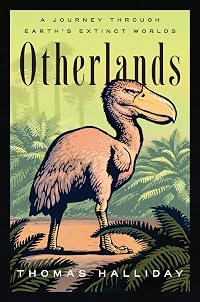
Otherlands: A World in the Making
by Thomas Halliday
On This Page
Description
Mining the most recent paleontological advances, a paleobiologist recreates sixteen extinct worlds, rendered with a novelist's eye for detail and drama, showing up close the intricate relationships of these ancient worlds.Tags
Recommendations








Member Reviews
I rarely read popular books on science. Most of them are informative but very repetitive, a lot of them are just badly written (i.e. Sapiens), and some of them are simply wrong from the perspective of the science they aim to describe.
This book does not suffer from any of these typical drawbacks. It is probably the most interesting text on paleontology you will ever encounter, not just from the perspective of some amazing facts about history of life on our planet but also because of an enjoyable writing style and an incredible plot. I will not mention the structure of the book and why it is akin to a good plot with a great flow and sudden twists and a surprise ending. I will let you discover it yourself!
This book does not suffer from any of these typical drawbacks. It is probably the most interesting text on paleontology you will ever encounter, not just from the perspective of some amazing facts about history of life on our planet but also because of an enjoyable writing style and an incredible plot. I will not mention the structure of the book and why it is akin to a good plot with a great flow and sudden twists and a surprise ending. I will let you discover it yourself!
It could be argued that I really don't need to read another book on paleozoology, the history of deep time, or extinction studies, but Halliday has a lot to offer.
First off, the way he organizes his material is quite clever, in how he works backwards from those times that might most spark the shock of recognition in the reader, to increasingly alien environments.
Next, each of these vignettes are organized as a snapshot in time, wherein Halliday tries to weave together the prevalent life forms, climate, and geology into a coherent whole.
Third, Halliday is a graceful and clear writer, who is able to make his interpretive and ethical points without seeming overly judgemental about it.
As for myself, I was particularly intrigued by two show more portions. One, some 20,000 years ago, Halliday talks about the frigid and arid region, in what is now Alaska, where creatures like horses and mammoths eked out an existence before the arrival of humanity, and how increasing warmth and water was already putting great pressure on their survival. Two, Halliday deals with the scene a little over five million years ago when the Mediterranean Basin was a glorified salt flat, before tectonic forces broke the barrier holding back the Atlantic, and the water poured in. However, all of Halliday's tableaux are well done. show less
First off, the way he organizes his material is quite clever, in how he works backwards from those times that might most spark the shock of recognition in the reader, to increasingly alien environments.
Next, each of these vignettes are organized as a snapshot in time, wherein Halliday tries to weave together the prevalent life forms, climate, and geology into a coherent whole.
Third, Halliday is a graceful and clear writer, who is able to make his interpretive and ethical points without seeming overly judgemental about it.
As for myself, I was particularly intrigued by two show more portions. One, some 20,000 years ago, Halliday talks about the frigid and arid region, in what is now Alaska, where creatures like horses and mammoths eked out an existence before the arrival of humanity, and how increasing warmth and water was already putting great pressure on their survival. Two, Halliday deals with the scene a little over five million years ago when the Mediterranean Basin was a glorified salt flat, before tectonic forces broke the barrier holding back the Atlantic, and the water poured in. However, all of Halliday's tableaux are well done. show less
Every once in a long while, I come across a book that takes my breath away and makes me glad I learned to read. This one tells the history of our planet through sixteen instances of extinction, as awe-inspiring and dramatic a story as there is, narrated with sheer brilliance.
Halliday, a paleobiologist who has re-created these sixteen snapshots in time based on fossil records, leaps around the globe to illustrate how climate, geography, topography, and geology have changed, supported, and often annihilated life over the past several billion years.
Let’s unpack that summary. Paleobiology combines the study of living organisms with the evidence of dead ones; until now, I didn’t even know that discipline existed. When I say leaps around show more the globe, for each chapter, the author has to reset where the continents have wandered, because they’re never in the same place as before, and almost never where they are now. Things change over 600 million years.
Rather than by chronology, Halliday narrates by ecological theme, as with the development of insect and bird calls, the collaboration between different species, or the advent of seasons, so each chapter presents a mind-boggling panorama. To call these snapshots does them little justice, because they appeal to several senses, not just the visual, and they’re anything but static.
Halliday writes science from the soul of a poet, only fitting, because of his universal themes. You can’t read Otherlands without realizing how nature is even more infinitely varied and variable than you probably thought, and just how ridiculously late we humans arrived to the party. So much happened before we got here, in such complexity, that I can’t read these stories of empires rising and falling without feeling humbled.
One of my favorite chapters recounts the era when the Mediterranean was a hard-rock basin whose surface was hotter than Death Valley. Tectonic plates closed the Straits of Gibraltar, and mountain ranges blocked off several rivers from emptying into the basin; nothing lived on the baked rock save a hardy form of microbe. The Mediterranean, which later washed the shores of the great “ancient” Western civilizations, held no water—and it gives me pause to read that this arid condition occurred on two separate occasions during our planet’s past.
If there’s a drawback to Otherlands, it’s that there’s so much in it. Even if you read only one chapter at a time, as I did, you can’t retain a fraction of what Halliday says, and often I had to pause to think. Sometimes it’s his use of metaphor that’s arresting, as when he compares a present-day freshwater crocodile to Gothic architecture. Other times, he tosses out an astonishing fact, such as why deer suffer a much lower rate of cancer than other mammals, or why we’re related to dinosaurs (it has to do with laying eggs).
Sometimes, I wanted to know more, but I got why he didn’t linger—he’s got worlds to create and destroy, and that takes pages and pages. Often, I shook my head in wonder, as with his explanation for why the colors yellow and black mark certain insects, or the ingenious adaptations of the simplest creatures that had no brains. If you’re like me, you can’t just run your eyes over that and move on; you have to think. I paused for a while over his single paragraph theorizing about the origin of life, in which he rejects the once-popular idea of lightning striking the so-called primordial soup and embraces the current reigning hypothesis, a hydrothermal vent in the ocean deep.
You can’t read about sixteen extinctions without wondering what that means regarding global warming, an issue that Halliday leaves for an epilogue. Refusing to play doomsayer or argue that we must stop exploiting the planet’s resources, he nevertheless presents a concise, authoritative description of where that exploitation has led us. Further, he stresses how people who have profited the least from that exploitation stand to lose the most from our increasingly destructive climate.
He doesn’t assume that science or engineering will solve our problem, though he does marvel at the two microscopic organisms, a fungus and a bacterium, that can break down plastic. Rather, he holds out cautious hope for international cooperation. His plea, like the rest of Otherlands, deserves a hearing. show less
Halliday, a paleobiologist who has re-created these sixteen snapshots in time based on fossil records, leaps around the globe to illustrate how climate, geography, topography, and geology have changed, supported, and often annihilated life over the past several billion years.
Let’s unpack that summary. Paleobiology combines the study of living organisms with the evidence of dead ones; until now, I didn’t even know that discipline existed. When I say leaps around show more the globe, for each chapter, the author has to reset where the continents have wandered, because they’re never in the same place as before, and almost never where they are now. Things change over 600 million years.
Rather than by chronology, Halliday narrates by ecological theme, as with the development of insect and bird calls, the collaboration between different species, or the advent of seasons, so each chapter presents a mind-boggling panorama. To call these snapshots does them little justice, because they appeal to several senses, not just the visual, and they’re anything but static.
Halliday writes science from the soul of a poet, only fitting, because of his universal themes. You can’t read Otherlands without realizing how nature is even more infinitely varied and variable than you probably thought, and just how ridiculously late we humans arrived to the party. So much happened before we got here, in such complexity, that I can’t read these stories of empires rising and falling without feeling humbled.
One of my favorite chapters recounts the era when the Mediterranean was a hard-rock basin whose surface was hotter than Death Valley. Tectonic plates closed the Straits of Gibraltar, and mountain ranges blocked off several rivers from emptying into the basin; nothing lived on the baked rock save a hardy form of microbe. The Mediterranean, which later washed the shores of the great “ancient” Western civilizations, held no water—and it gives me pause to read that this arid condition occurred on two separate occasions during our planet’s past.
If there’s a drawback to Otherlands, it’s that there’s so much in it. Even if you read only one chapter at a time, as I did, you can’t retain a fraction of what Halliday says, and often I had to pause to think. Sometimes it’s his use of metaphor that’s arresting, as when he compares a present-day freshwater crocodile to Gothic architecture. Other times, he tosses out an astonishing fact, such as why deer suffer a much lower rate of cancer than other mammals, or why we’re related to dinosaurs (it has to do with laying eggs).
Sometimes, I wanted to know more, but I got why he didn’t linger—he’s got worlds to create and destroy, and that takes pages and pages. Often, I shook my head in wonder, as with his explanation for why the colors yellow and black mark certain insects, or the ingenious adaptations of the simplest creatures that had no brains. If you’re like me, you can’t just run your eyes over that and move on; you have to think. I paused for a while over his single paragraph theorizing about the origin of life, in which he rejects the once-popular idea of lightning striking the so-called primordial soup and embraces the current reigning hypothesis, a hydrothermal vent in the ocean deep.
You can’t read about sixteen extinctions without wondering what that means regarding global warming, an issue that Halliday leaves for an epilogue. Refusing to play doomsayer or argue that we must stop exploiting the planet’s resources, he nevertheless presents a concise, authoritative description of where that exploitation has led us. Further, he stresses how people who have profited the least from that exploitation stand to lose the most from our increasingly destructive climate.
He doesn’t assume that science or engineering will solve our problem, though he does marvel at the two microscopic organisms, a fungus and a bacterium, that can break down plastic. Rather, he holds out cautious hope for international cooperation. His plea, like the rest of Otherlands, deserves a hearing. show less
Who would have imagined that a book about paleobiology could be both so engaging and so informative. Thomas Halliday provides a history of life on Earth that is understandable for non-specialists and reads like you are watching a nature documentary on TV.
The book is remarkably well written but it's success comes from how Halliday chose to structure the book. He has selected geological sites which are especially rich in the fossils that help us understand a specific geological era. He then sets the scene for each chapter by describing the world as it would be experienced by one set of animals or plants at that site and at that geological time. He not only describes what would be seen but what would have been heard and even what would show more have been smelled. Then, after setting the scene, he provides more information about why life is the way it is at that time.
The other reason that the book succeeds is that it tells the story backwards, starting from the ice age and working it's way backwards through time. The last chapter leaps back to our current time and talks about what our understanding of the past can tell us about the environmental challenges of the near future.
The book is strongly recommended for anyone interested in geology, biology or nature in general. It does not require any specialized knowledge before reading it but this reader found it useful to look up locations and some expressions while reading. show less
The book is remarkably well written but it's success comes from how Halliday chose to structure the book. He has selected geological sites which are especially rich in the fossils that help us understand a specific geological era. He then sets the scene for each chapter by describing the world as it would be experienced by one set of animals or plants at that site and at that geological time. He not only describes what would be seen but what would have been heard and even what would show more have been smelled. Then, after setting the scene, he provides more information about why life is the way it is at that time.
The other reason that the book succeeds is that it tells the story backwards, starting from the ice age and working it's way backwards through time. The last chapter leaps back to our current time and talks about what our understanding of the past can tell us about the environmental challenges of the near future.
The book is strongly recommended for anyone interested in geology, biology or nature in general. It does not require any specialized knowledge before reading it but this reader found it useful to look up locations and some expressions while reading. show less
Ever wondered what it would be like to experience the world of the past, such as an afternoon on the mammoth steppe, a field trip among Triassic pterosaurs, or a dive among the many and bizarre creatures living in Cambrian seas? Paleontologist Thomas Halliday is here for you. Each chapter moves the reader a bit further back in time and paints a brief but vivid picture of what one's surroundings would have felt, looked and sounded like if one were suddenly thrust into the world of yesteryear.
It wouldn't hurt to have some familiarity with general chronology and taxonomy of prehistoric life and what was happening on Earth during the relevant time periods, but it is by no means required to enjoy this wild adventure. You will definitely want show more to seek out renderings of all the species as each is mentioned in the text — many of them I hadn't heard of before and they are all positively delightful. The featured creatures in each chapter are not necessarily the flashiest or most well-known superstars from the time period, which was refreshing. In fact, many are surprisingly unassuming. The chapter that mentions muscles (dark meat vs. white) was particularly enlightening. I had never given much thought to the colors of muscles/meat before, much less considered that the differences could be due to function, though it makes perfect sense now. My only complaint: More illustrations, please! show less
It wouldn't hurt to have some familiarity with general chronology and taxonomy of prehistoric life and what was happening on Earth during the relevant time periods, but it is by no means required to enjoy this wild adventure. You will definitely want show more to seek out renderings of all the species as each is mentioned in the text — many of them I hadn't heard of before and they are all positively delightful. The featured creatures in each chapter are not necessarily the flashiest or most well-known superstars from the time period, which was refreshing. In fact, many are surprisingly unassuming. The chapter that mentions muscles (dark meat vs. white) was particularly enlightening. I had never given much thought to the colors of muscles/meat before, much less considered that the differences could be due to function, though it makes perfect sense now. My only complaint: More illustrations, please! show less
I have mixed feelings about this - there's so much to this that's fascinating but it runs up against my own personal limits of visualisation. It's a *very* visual book, each chapter focused on a single scene, describing the geography and geology of an area and the appearance and behaviour of a set of species. For me I just found it incredibly hard to picture much of what's being described. When mentioning an animal, I pretty much always instantly searched for a reconstruction - and almost always what I'd pictured from his description was significantly different. Especially the further back you go, things are so different! With the geography I was completely lost at sea and had to settle for accepting I was only getting broad show more impressions, even though often the descriptions were quite beautiful. It feels like a book written to be lavishly illustrated, full of diagrams. I finished it desperately wanting that book!
If you can accept that you're not going to get a perfect handle of the specifics and you'll be regularly looking up cool sounding animals and plants, there is a lot to fascinate you here. He really does show the past eras as alien worlds, more impressive than anything out of sci fi, yet still evoking a feeling of connectedness. Even in the pre cambrian, reading about weird primitive circles vaguely drifting through the microbial mat of the ocean floor, there's still a part of me that felt tender towards them, across 600 million years. The variety of animal life and the way it's distinctively connected to climate conditions is well illustrated. There's tons of fascinating details - one that struck me was logs being able to be floating ecosystems for decades in the Jurassic because there were no wood boring sea predators like shipworm to destroy them prematurely. The glass sponge reefs which covered 7000km of sea were incredible to me too - "at three times the length of the Great Barrier Reef, these silicon constructions are the largest biological structures ever to have existed" As with many books about the natural world, there's too much amazing stuff to keep in my head and due to my first point it was often a bit of a slog getting through it, but it definitely opened my eyes again to the sheer wonder of natural history and all the unbelievable, incredible things life has done.
It ends with an epilogue about climate change with a mild degree of hope but mostly urgency, obviously. It fits in given how much the book has talked about climate and geological changes (and occasionally the negative results of life finding a new resource) with their impacts on what life can actually exist - particularly notable of course things like the Permian extinction event. Near the end he quotes Ozymandias by Horace Smith:
"We wonder — and some Hunter may express
Wonder like ours, when thro' the wilderness
Where London stood, holding the Wolf in chace,
He meets some fragment huge, and stops to guess
What powerful but unrecorded race
Once dwelt in that annihilated place." show less
If you can accept that you're not going to get a perfect handle of the specifics and you'll be regularly looking up cool sounding animals and plants, there is a lot to fascinate you here. He really does show the past eras as alien worlds, more impressive than anything out of sci fi, yet still evoking a feeling of connectedness. Even in the pre cambrian, reading about weird primitive circles vaguely drifting through the microbial mat of the ocean floor, there's still a part of me that felt tender towards them, across 600 million years. The variety of animal life and the way it's distinctively connected to climate conditions is well illustrated. There's tons of fascinating details - one that struck me was logs being able to be floating ecosystems for decades in the Jurassic because there were no wood boring sea predators like shipworm to destroy them prematurely. The glass sponge reefs which covered 7000km of sea were incredible to me too - "at three times the length of the Great Barrier Reef, these silicon constructions are the largest biological structures ever to have existed" As with many books about the natural world, there's too much amazing stuff to keep in my head and due to my first point it was often a bit of a slog getting through it, but it definitely opened my eyes again to the sheer wonder of natural history and all the unbelievable, incredible things life has done.
It ends with an epilogue about climate change with a mild degree of hope but mostly urgency, obviously. It fits in given how much the book has talked about climate and geological changes (and occasionally the negative results of life finding a new resource) with their impacts on what life can actually exist - particularly notable of course things like the Permian extinction event. Near the end he quotes Ozymandias by Horace Smith:
"We wonder — and some Hunter may express
Wonder like ours, when thro' the wilderness
Where London stood, holding the Wolf in chace,
He meets some fragment huge, and stops to guess
What powerful but unrecorded race
Once dwelt in that annihilated place." show less
Full of fascinating and revelatory stories for this reader, such as:
By the Miocene, the epoch from 23 to 5 million years before the present, sloths will reach their zenith, with some ground sloths even slowly adapting to a marine lifestyle off the coast of Peru, using high nostrils, dense bones and a beaver-like tail to live somewhat like hippopotamuses, walking along the sea floor to find seaweed.
It’s just so weirdly wonderful and the book is full of these snippets, skilfully woven into the grander narrative taking us back through time in giant temporal leaps.
I read criticism for the lack of illustrations, one per chapter (each geological epoch or period), with the other named extinct animals and plants usually only described and show more perhaps compared to a similar modern species, but illustrations can only be an educated artistic interpretation, so this leaves visualisation to the author’s description and our imagination, which I found sufficient. For example, from the chapter about South America 32 million years ago, during the Oligocene:
A few Santiagorothia are among the mixed herd, too; they are lithe, hare-like creatures, with long bodies and limbs. They eat the low vegetation cautiously and with eyes alert, constantly on the lookout for borhyaenids: pouched predators and relatives of marsupials with hyena-like crushing jaws and grooved, ever-growing canines.
There is also one global map per chapter, and again I found this sufficient.
But the further back in time the narrative travels, the less understandable the environment becomes, despite Halliday’s brilliant descriptions of a few animals, plants and environments that can be increasingly tentatively described from the surviving fossil record. I therefore found the later chapters more difficult to grasp, as everything becomes more uncertain and more difficult to imagine.
If this subject intrigues you, I highly recommend this book. show less
By the Miocene, the epoch from 23 to 5 million years before the present, sloths will reach their zenith, with some ground sloths even slowly adapting to a marine lifestyle off the coast of Peru, using high nostrils, dense bones and a beaver-like tail to live somewhat like hippopotamuses, walking along the sea floor to find seaweed.
It’s just so weirdly wonderful and the book is full of these snippets, skilfully woven into the grander narrative taking us back through time in giant temporal leaps.
I read criticism for the lack of illustrations, one per chapter (each geological epoch or period), with the other named extinct animals and plants usually only described and show more perhaps compared to a similar modern species, but illustrations can only be an educated artistic interpretation, so this leaves visualisation to the author’s description and our imagination, which I found sufficient. For example, from the chapter about South America 32 million years ago, during the Oligocene:
A few Santiagorothia are among the mixed herd, too; they are lithe, hare-like creatures, with long bodies and limbs. They eat the low vegetation cautiously and with eyes alert, constantly on the lookout for borhyaenids: pouched predators and relatives of marsupials with hyena-like crushing jaws and grooved, ever-growing canines.
There is also one global map per chapter, and again I found this sufficient.
But the further back in time the narrative travels, the less understandable the environment becomes, despite Halliday’s brilliant descriptions of a few animals, plants and environments that can be increasingly tentatively described from the surviving fossil record. I therefore found the later chapters more difficult to grasp, as everything becomes more uncertain and more difficult to imagine.
If this subject intrigues you, I highly recommend this book. show less
Members
- Recently Added By
Lists

Books Read in 2022
5,226 works; 112 members

Books Read in 2023
5,638 works; 147 members

Books Read in 2024
4,727 works; 128 members

In Our Time books
4,934 works; 2 members
Author Information

1 Work 813 Members
Some Editions
Awards and Honors
Awards
Common Knowledge
- Canonical title
- Otherlands: A World in the Making
- Original title
- Otherlands: A World in the Making
- Alternate titles
- Otherlands: Journeys in Earth's Extinct Ecosystems
- Original publication date
- 2022-02-01
- First words
- I am looking out of the window, across farmland, houses, and parks, towards a place that for hundreds of years has been known as World's End. (introduction)
- Quotations
- The notion of a single individual is a very animal concept, utterly ignored by other kingdoms of life.
- Last words
- (Click to show. Warning: May contain spoilers.)Then, we too will live in hope.
- Publisher's editor
- Stickney, Laura; Cope, Rowan; Redmon, Hilary; Garrison, Nick
- Blurbers
- Kolbert, Elizabeth; Wulf, Andrea; McKibben, Bill; Dartnell, Lewis; Tree, Isabella
- Original language
- English
Classifications
Statistics
- Members
- 848
- Popularity
- 32,427
- Reviews
- 27
- Rating
- (4.02)
- Languages
- 7 — Dutch, English, French, German, Italian, Spanish, Swedish
- Media
- Paper, Audiobook, Ebook
- ISBNs
- 27
- ASINs
- 9