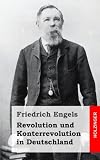
The German revolutions: The Peasant War in Germany, and Germany: revolution and counter-revolution
by Friedrich Engels
On This Page
Description
Friedrich Engels: Revolution und Konterrevolution in Deutschland Edition Holzinger. Taschenbuch Berliner Ausgabe, 2013 Vollst#65533;ndiger, durchgesehener Neusatz mit einer Biographie des Autors bearbeitet und eingerichtet von Michael Holzinger Entstanden August 1851 bis September 1852. Erstdruck unter dem Namen von Karl Marx in: New-York Daily Tribune, Oktober 1851-Oktober 1852. Erste deutsche Ausgabe: Karl Marx: Revolution und Kontre-Revolution in Deutschland. Ins Deutsche #65533;bertragen show more von Karl Kautsky, Stuttgart (Dietz) 1896. Die Autorschaft von Friedrich Engels stellte sich erst 1913 bei den Editionsarbeiten am Briefwechsel zwischen Marx und Engels heraus. - Der Text folgt dem Erstdruck. (Aus dem Englischen.) Textgrundlage ist die Ausgabe: Karl Marx, Friedrich Engels: Werke. Herausgegeben vom Institut f#65533;r Marxismus-Leninismus beim ZK der SED, 43 B#65533;nde, Band 8, Berlin: Dietz-Verlag, 1960. Herausgeber der Reihe: Michael Holzinger Reihengestaltung: Viktor Harvion Umschlaggestaltung unter Verwendung des Bildes: Friedrich Engels, Fotographie von 1888 von William Elliott Debenham (1839-1924) Gesetzt aus Minion Pro, 10 pt. show lessTags
Recommendations














Member Reviews
This is another remarkable book by a remarkable man; fascinating reading for history fans and especially interesting for a deeper understanding of the 1848 revolution in Germany.
Ratings
Members
- Recently Added By
Lists

All Things Germany
321 works; 4 members
Author Information

Friedrich Engels is perhaps best remembered as the confidant, colleague, and benefactor of Karl Marx. Engels was born into a Calvinist family on November 28, 1820. The family owned fabric mills in the Rhineland and had business interests in Manchester, England, Engels joined the family business at age 16; he never had a formal university show more education. Despite his family's industrial background, Engels was sympathetic to the poverty of the working masses. At age 18 he published an attack on industrial poverty, and later joined the Hegelian movement that so influenced Marx and bothered conservative Prussian authorities. Engels first met Marx in 1842, while Marx was editor of a radical newspaper in Cologne. However, they did not establish their lifelong friendship until they met again in Paris two years later. Engels published several works related to economics, the first of which, Outlines of a Critique of Political Economy (1844), attempted to reconcile Hegelian philosophy with the principles of political economy. His second book, The Condition of the Working Class in England (1845), was a damning description and condemnation of the poverty generated by the Industrial Revolution. Engels also co-authored three major works with Marx, the most important being the Communist Manifesto (1948). Engels also wrote several historical works, which are more important to historians than to economists. These include The Peasant War in Germany (1850), Germany: Revolution and Counter-Revolution (1851), and The Origin of the Family, Private Property and the State (1884). In general, these works are more descriptive than theoretical, and they closely parallel Marx's views on industrialization and class struggle. In addition to being a friend of Marx, Engels was his prime benefactor for a number of years. During their early years in London, beginning in 1849, the Marx family was nearly destitute, and it was only through the generosity of Engels that they prevailed. Engels was also responsible for the publication of Marx's Das Kapital. Before his death, Marx was only able to complete the first volume of this work, and so Engels edited and arranged for the publication of the last two volumes after Marx's death. Engels was an engaging and thoughtful writer. It was perhaps his great fortune and misfortune that he was connected so closely to Marx. On the one hand, he was responsible for bringing much of Marx's work to fruition in his role as benefactor and editor. On the other hand, the shadow of Marx eclipsed some of the exposure that Engels's own ideas and contributions might have had. Engels died of throat cancer in London, 1895. Following cremation at Woking Crematorium, his ashes were scattered off Beachy Head, near Eastbourne as he had requested. (Bowker Author Biography) Friedrich Engels, German political economist, was born in what is now known as Wuppertal, in 1820. From 1842 to 1844 Engels worked in a textile mill in Manchester, England. During this time Engels theorized that all of the social unrest and worker discontent he encountered were the direct result of private ownership of property. He concluded that social ills could be eliminated only through a class struggle culminating in the end of private ownership and the establishment of a communistic form of government. The publication of his Condition of the Working Class (1844) reiterated his philosophy and his conclusions about an inevitable class struggle. Friedrich Engels first met Karl Marx in 1842. When they met again in Paris in 1844, the two men discovered they had a great similarity of views and decided to work together. They delineated the principles of communism, later known as Marxism, and their work resulted in the founding of an international communistic movement. The Communist Manifesto, penned by Marx, was based in part on a draft Engels prepared. It became renowned as the classic exposition of modern communism, and it had a profound influence upon all subsequent literature dealing with communism. Marx and Engels' partnership lasted until Marx's death in 1883. Engels carried on his work by editing the second and third volumes of Marx's Das Kapital. Friedrich Engels died in 1895. (Bowker Author Biography) show less
Some Editions
Work Relationships
Common Knowledge
- Original publication date
- 1967
Classifications
- Genres
- Nonfiction, History, General Nonfiction, Politics and Government, Religion & Spirituality
- DDC/MDS
- 943.008 — History & geography History of Europe Central Europe: Germany, Austria, Switzerland, Czech, Poland, Hungary Historical periods of Germany Standard subdivisions of Germany
- LCC
- DD182 .E52 — History of Europe, Asia, Africa and Oceania Germany History of Germany History By period Modern, 1519- 1519-1648. Reformation and Counter-reformation Peasants' War, 1524-1525
- BISAC
Statistics
- Members
- 82
- Popularity
- 388,937
- Reviews
- 1
- Rating
- (3.67)
- Languages
- English, German, Italian
- Media
- Paper
- ISBNs
- 10
- ASINs
- 8