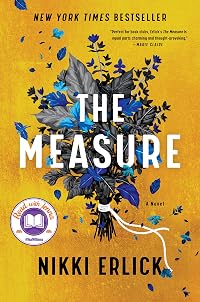
The Measure
by Nikki Erlick
On This Page
Description
It seems like any other day: You wake up, pour a cup of coffee, and head out. But today when you open your front door, waiting for you is a small wooden box. This box holds your fate inside: the answer to the exact number of years you will live. From suburban doorsteps to desert tents, every person on every continent receives the same box. In an instant, the world is thrust into a collective frenzy. Where did these boxes come from? What do they mean? Is there truth to what they promise? As show more society comes together and pulls apart, everyone faces the same shocking choice: Do they wish to know how long they'll live? And, if so, what will they do with that knowledge? The Measure charts the dawn of this new world through an unforgettable cast of characters whose decisions and fates interweave with one another: best friends whose dreams are forever entwined; pen pals finding refuge in the unknown; a couple who thought they didn't have to rush; a doctor who cannot save himself; and a politician whose box becomes the powder keg that ultimately changes everything. show lessTags
Recommendations



Member Reviews
What saves The Measure by Nikki Erlick from being a pleasant, but ho-hum read, are the insights the author places at strategic moments in the novel that allow the reader to embrace the thoughtful connections some characters have made about their circumstances.
The crux of those circumstances centers on every twenty-two year old around the globe receiving a box containing a measure of string. The string length tells them how long their lives are going to be. A short string, a short life. A long string, a long life.
Buried among all the personal angst, anger, and desperation, as well as a "whatever will be, will be,' attitude of some, are nuggets suggesting a larger awareness. For example, how history seems to so easily repeat itself as show more long-stringers, whipped into a fearful frenzy by politicians, turn on short-stringers just as immigrants have been turned on before. Or, as those, who have always been cast as The Other (people of color, non-binary folks, women), attempt to deal with just one more limitation should their box contain a dreaded short string.
These little pearls of wisdom elevate The Measure from literary obscurity to a debut novel worth the reader's attention. show less
The crux of those circumstances centers on every twenty-two year old around the globe receiving a box containing a measure of string. The string length tells them how long their lives are going to be. A short string, a short life. A long string, a long life.
Buried among all the personal angst, anger, and desperation, as well as a "whatever will be, will be,' attitude of some, are nuggets suggesting a larger awareness. For example, how history seems to so easily repeat itself as show more long-stringers, whipped into a fearful frenzy by politicians, turn on short-stringers just as immigrants have been turned on before. Or, as those, who have always been cast as The Other (people of color, non-binary folks, women), attempt to deal with just one more limitation should their box contain a dreaded short string.
These little pearls of wisdom elevate The Measure from literary obscurity to a debut novel worth the reader's attention. show less
I found the premise of this book so intriguing: a box arrives, containing the date of your death. Would you open it? It lead to a fascinating discussion at my book club. All in all, the premise carried this book for me and I enjoyed reading it a great deal.
However, there were some things that I didn't like. There are eight main characters, and that may have been too many as there was not as much character development as I like. We only ever saw the characters in terms of dealing with the length of their own or a loved one's short string. And no "long-stringers" are developed, making it seem as if they are not affected by knowing when they will die.
I was surprised at the almost total lack of religion in the story. The strings accurately show more predict life span; nothing can be done to change it. That deterministic message would surely be seized upon by religious leaders as proof of God's existence, or as the work of the devil. And there is no discussion of where the strings came from. I can't believe humans would not question who sent the strings, why, and how they know everyone's life spans. Why wasn't surveillance set up when they knew people were about to receive boxes?
What I liked was the way younger generations seemed to normalize the strings, often ignoring them, like people have normalized so many technologies that once seemed life altering and scary. I liked the way the author described a new form of discrimination against short-stringers: a new distinction to drive a wedge between people, with the usual consequences.
As I was reading, the questions that immediately came to mind were would I open my box? If I did, would I tell people? Reading this book was like a thought experiment. But the more important question raised, on reflection, is an examination of what it means to have a good life. show less
However, there were some things that I didn't like. There are eight main characters, and that may have been too many as there was not as much character development as I like. We only ever saw the characters in terms of dealing with the length of their own or a loved one's short string. And no "long-stringers" are developed, making it seem as if they are not affected by knowing when they will die.
I was surprised at the almost total lack of religion in the story. The strings accurately show more predict life span; nothing can be done to change it. That deterministic message would surely be seized upon by religious leaders as proof of God's existence, or as the work of the devil. And there is no discussion of where the strings came from. I can't believe humans would not question who sent the strings, why, and how they know everyone's life spans. Why wasn't surveillance set up when they knew people were about to receive boxes?
What I liked was the way younger generations seemed to normalize the strings, often ignoring them, like people have normalized so many technologies that once seemed life altering and scary. I liked the way the author described a new form of discrimination against short-stringers: a new distinction to drive a wedge between people, with the usual consequences.
As I was reading, the questions that immediately came to mind were would I open my box? If I did, would I tell people? Reading this book was like a thought experiment. But the more important question raised, on reflection, is an examination of what it means to have a good life. show less
The premise is irresistible, boxes with a string inside appear for every person on earth. The length of the string shows how long you have left to live. This was fascinating, beautiful, and heartbreaking. It delved into politics, moral dilemmas, and the age old question: is it better to have loved and lost or never to have loved at all. I savored it, thinking about each new quandary the characters faced. Would you open your box? Would you hire a “short stringer”? Would you date one? Should legislation be in place to regulate how they are treated? The parallels for other kinds of social persecution are obvious. There is so much to discuss!
“Did a patient receive less care because her string was short, or was a patient’s string show more short, because she received less care?”
“It was boisterous and raucous and joyful. A celebration of life. An hour of untouched unity.”
“Whenever the team discussed a shooting or a natural disaster, she was struck by how lightly their words were tossed about. In her three decades as a journalist, as the headlines seem to grow ever more grim, Deborah had seen the words shed their weight a little more with each occurrence, until they barely resembled the dense nouns and heavy adjectives that once pressed upon entire rooms.” show less
“Did a patient receive less care because her string was short, or was a patient’s string show more short, because she received less care?”
“It was boisterous and raucous and joyful. A celebration of life. An hour of untouched unity.”
“Whenever the team discussed a shooting or a natural disaster, she was struck by how lightly their words were tossed about. In her three decades as a journalist, as the headlines seem to grow ever more grim, Deborah had seen the words shed their weight a little more with each occurrence, until they barely resembled the dense nouns and heavy adjectives that once pressed upon entire rooms.” show less
🎧The Measure by Nikki Erlick —⭐️⭐️⭐️⭐️⭐️
"the measure of your life lies within”
What would you do if you knew exactly how long you had left to live? And if given the choice, would you want to know?
I usually stick to thrillers, but a new friend from Instagram convinced me to read this together. At first, I wasn't sure about it, but I ended up completely hooked. The story’s unusual and unsettling idea pulled me in right away, and listening to the audiobook made it even better. Almost all of the characters felt real and relatable, which doesn’t happen often in the books I read.
One morning, people across the world wake to find identical boxes on their doorstep. Inside each is a single string. Its length reveals show more how long they have left to live. After the initial delivery, every person receives their box on their twenty‑second birthday. It’s a haunting idea, and certainly not the kind of “gift” I would want.
What follows is a layered exploration of how individuals, couples, families, and entire communities respond to this knowledge. The divide between ‘short stringers' and 'long stringers' becomes a social fault line. Relationships strain under the weight of unequal futures. Some people cling tighter to the time they have; others unravel. A few characters receive long strings they don't deserve, while others face heartbreakingly short ones that alter every aspect of their lives. And then some refuse to open their boxes at all, an act of defiance, fear, or hope. I’d like to believe I’d be one of them, but I know curiosity would win.
The audiobook is fantastic. Julia Whelan adds a gentle emotional depth that makes the story’s tension and tenderness stand out. Since the book is so thoughtful and complex, listening to it feels like the perfect way to experience it.
This isn’t a typical thriller, but it has its own kind of suspense—emotional, ethical, and very human. It’s tense, unsettling, and makes you think long after you finish. It made me think about the choices we make, the time we waste, and the things we don’t appreciate until life makes us face them.
“The Measure” is a strong and imaginative debut, and I definitely recommend it. show less
"the measure of your life lies within”
What would you do if you knew exactly how long you had left to live? And if given the choice, would you want to know?
I usually stick to thrillers, but a new friend from Instagram convinced me to read this together. At first, I wasn't sure about it, but I ended up completely hooked. The story’s unusual and unsettling idea pulled me in right away, and listening to the audiobook made it even better. Almost all of the characters felt real and relatable, which doesn’t happen often in the books I read.
One morning, people across the world wake to find identical boxes on their doorstep. Inside each is a single string. Its length reveals show more how long they have left to live. After the initial delivery, every person receives their box on their twenty‑second birthday. It’s a haunting idea, and certainly not the kind of “gift” I would want.
What follows is a layered exploration of how individuals, couples, families, and entire communities respond to this knowledge. The divide between ‘short stringers' and 'long stringers' becomes a social fault line. Relationships strain under the weight of unequal futures. Some people cling tighter to the time they have; others unravel. A few characters receive long strings they don't deserve, while others face heartbreakingly short ones that alter every aspect of their lives. And then some refuse to open their boxes at all, an act of defiance, fear, or hope. I’d like to believe I’d be one of them, but I know curiosity would win.
The audiobook is fantastic. Julia Whelan adds a gentle emotional depth that makes the story’s tension and tenderness stand out. Since the book is so thoughtful and complex, listening to it feels like the perfect way to experience it.
This isn’t a typical thriller, but it has its own kind of suspense—emotional, ethical, and very human. It’s tense, unsettling, and makes you think long after you finish. It made me think about the choices we make, the time we waste, and the things we don’t appreciate until life makes us face them.
“The Measure” is a strong and imaginative debut, and I definitely recommend it. show less
All over the world, small wooden boxes are showing on doorsteps. Inside each box is a string, a string which tells you how long you will live. Some people open their boxes, others do not. Some government make you open, others tell you not to. But many people do open them, and then the problems begin. The long-stringers are relieved, but the short-stringers are dismayed. Soon support groups sprout up to help the short-stringers cope with their fate. And then, a short-stringer loses control and starts shooting people, which leads to a new set of problems. Short-stringers are under so much stress, they are not to be trusted, or employed, or elected to positions in government. Why bother with them when they won’t be around for much show more longer? This well-written book raises some interesting questions as a new form of age discrimination grips the world. The story follows eight people as they try to live normal lives in a world that has no normal any more. The tension gradually builds as the story progresses. Is it better to know the length of your days, or should you just live each day to the fullest, enjoying the moment and being with those you love? Should long-stringers only marry other long-stringers? Should they even be friends with a short-stringer? These are just a few of the questions that haunt the people in this new world. As for me, I’d keep that box shut, though even if I knew my world would end tomorrow, I’d plant an apple tree today. show less
Book on CD performed by Julia Whelan.
It begins with a surprise delivery. All over the world, adults receive a box. A seemingly plain wooden box with an inscription: The measure of your life lies within. Inside is a bit of delicate white fabric, under which is a string. The string is a measurement of the recipient’s life. Some people get noticeably longer strings; others receive noticeably short strings. And therein lies the difference.
This is a remarkable debut work of literary fiction. I don’t remember the last time a work of literature made me think so long and hard about my life, my goals, my experiences, my dreams.
Erlick chooses eight recipients who are of different ages and backgrounds. Some open the box immediately; others show more wait for a while; others never open their box. Some share their news with family or friends. Others keep the knowledge to themselves.
Will knowing your relative fate help you live your best life? Will it hinder you? If you are a “short-stringer” will you be angry enough to take drastic action? If you are a “long-stringer” will you take riskier options given you guaranteed longevity? Can those with short strings find contentment and success? Can those with long strings find compassion for those less fortunate?
Erlick takes the reader on an emotional roller coaster. At the end I’m left wrung out, and ready to go again. I can hardly wait for my F2F book club discussion!
Julia Whelan does a superb job of narrating the audiobook, though I admit to reading at least half of this in text format because I just couldn't stop "reading" and I could hardly spend 24 hours a day riding around in my car to listen. She has a significant number of different characters to interpret and several times there are conversations between two people of the same gender and relative age. Still I was never confused about who was speaking. show less
It begins with a surprise delivery. All over the world, adults receive a box. A seemingly plain wooden box with an inscription: The measure of your life lies within. Inside is a bit of delicate white fabric, under which is a string. The string is a measurement of the recipient’s life. Some people get noticeably longer strings; others receive noticeably short strings. And therein lies the difference.
This is a remarkable debut work of literary fiction. I don’t remember the last time a work of literature made me think so long and hard about my life, my goals, my experiences, my dreams.
Erlick chooses eight recipients who are of different ages and backgrounds. Some open the box immediately; others show more wait for a while; others never open their box. Some share their news with family or friends. Others keep the knowledge to themselves.
Will knowing your relative fate help you live your best life? Will it hinder you? If you are a “short-stringer” will you be angry enough to take drastic action? If you are a “long-stringer” will you take riskier options given you guaranteed longevity? Can those with short strings find contentment and success? Can those with long strings find compassion for those less fortunate?
Erlick takes the reader on an emotional roller coaster. At the end I’m left wrung out, and ready to go again. I can hardly wait for my F2F book club discussion!
Julia Whelan does a superb job of narrating the audiobook, though I admit to reading at least half of this in text format because I just couldn't stop "reading" and I could hardly spend 24 hours a day riding around in my car to listen. She has a significant number of different characters to interpret and several times there are conversations between two people of the same gender and relative age. Still I was never confused about who was speaking. show less
The author uses a heavy-handed metaphor to hammer home the unoriginal message that we shouldn't let our differences define us. Also, we should all live fully in the moment. Here's the allegedly thought-provoking premise: one day in early March, every adult in the entire world receives a small, wooden box, containing a piece of string. How this happened, or who is responsible, is never explained or explored. Pretty quickly, scientists determine that the length of each person's string is a measure of how long they will live.
Before you can say "blue eyes/brown eyes classroom experiment," a dichotomy develops between those individuals with strings denoting a normal lifespan and those predicting an early demise. These "short stringers" are show more barred from certain professions, dropped by health insurance plans, and labeled as potentially violent criminals. The novel primarily focuses on several members of a support group for short stringers, and their friends/lovers. There's also a moustache-twirling evil politician who stirs up more short-string paranoia, campaigning for president as the only long-string candidate who will keep the country safe from the dangerous others. The parallels to DT45 are not subtle.
The only characters with any depth are two military academy roommates who make an unprecedented choice with their string that has far-reaching repercussions. By the end of the book, thanks to the monolithically progressive Young People of the world, everyone realizes that #AllStringsMatter, and that the length of your life isn't as important as what you do with it (there is literally a "Live Like Your String is Short" t-shirt).
If you believe that racism and other -isms can be solved if we all recognize our similarities instead of our differences, this is the book for you. But if you realize there are no easy answers to the racist, homophobic mess we're in, you will likely find it as patronizing and ingenuous as I did. show less
Before you can say "blue eyes/brown eyes classroom experiment," a dichotomy develops between those individuals with strings denoting a normal lifespan and those predicting an early demise. These "short stringers" are show more barred from certain professions, dropped by health insurance plans, and labeled as potentially violent criminals. The novel primarily focuses on several members of a support group for short stringers, and their friends/lovers. There's also a moustache-twirling evil politician who stirs up more short-string paranoia, campaigning for president as the only long-string candidate who will keep the country safe from the dangerous others. The parallels to DT45 are not subtle.
The only characters with any depth are two military academy roommates who make an unprecedented choice with their string that has far-reaching repercussions. By the end of the book, thanks to the monolithically progressive Young People of the world, everyone realizes that #AllStringsMatter, and that the length of your life isn't as important as what you do with it (there is literally a "Live Like Your String is Short" t-shirt).
If you believe that racism and other -isms can be solved if we all recognize our similarities instead of our differences, this is the book for you. But if you realize there are no easy answers to the racist, homophobic mess we're in, you will likely find it as patronizing and ingenuous as I did. show less
Members
- Recently Added By
Lists

Books Read in 2023
5,547 works; 145 members

Books That Made Us Cry
278 works; 145 members

Top Five Books of 2024
795 works; 264 members

Read with Jenna
91 works; 2 members
Author Information

2 Works 2,954 Members
Some Editions
Awards and Honors
Common Knowledge
- Canonical title
- The Measure
- Original publication date
- 2022-09
- People/Characters
- Nina Wilson; Ben; Amie Wilson; Maura Hill; Hank; Anthony Rollins (show all 8); Jack Hunter; Javier García
- Epigraph
- Tell me, what is it you plan to do with your one wild and precious life?
—Mary Oliver, "The Summer Day" - Dedication
- For my grandparents,
with love and gratitude - First words
- It was difficult to imagine a time before them, a world in which they hadn't come.
- Quotations
- Deborah had once confided in Nina, after her third drink at the holiday party, that whenever the team discussed a shooting or a natural disaster, she was struck by how lightly their words were tossed about. In her three decad... (show all)es as a journalist, as the headlines seemed to grow ever more grim, Deborah had seen the words shed their weight a little more with each occurrence, until they barely resembled the dense nouns and heavy adjectives that once pressed upon entire rooms. But that was the only way to continue working, Nina thought, to shield your soul from breaking.
Did a patient receive less care because her string was short, or was a patient's string short because she received less care?
It felt like the world's most fucked-up version of the chicken-or-the-egg conundrum.
"You can always count on the artists to step up," she said, "especially during a crisis."
"Well, some days can get pretty dark," Hank said, "but other days, I just try to remember that I've lived a good life. I did my best to help people. I fell in love a few times. I tried to be a good son." Hank leaned back slow... (show all)ly in his chair. "You know, I watched a lot of people come to the end, and everyone around them kept begging them to fight. It takes real strength to keep on fighting, and yes, usually that's the right answer. Keep fighting, keep holding on, no matter what. But sometimes I think we forget that it also takes strength to be able to let go."
Jack thought that he knew what loneliness felt like, a perpetual outsider among his kin, a mistake. But that was always the absence of love. Here, with Javi, it was the loss.
And losing something felt so much... (show all) harder, so much lonelier, than simply going without.
So Ben sat there, on top of a storage trunk, in the arms of his mother, under the hand of his father, and everything that needed to be said was said in the silence, in their touch.
I'm sorry, Amie. I'm sorry for the shock that this letter will bring, and I'm sorry because you once asked me to write about little things, and this is perhaps the biggest thing of all. But you also said that we could each... (show all) find our own measure of happiness.
A stranger recently told me that she didn't want to waste any time feeling sad. She just wanted to live as much as possible. And I think that's as good a measure as any.
"I challenge everyone to do the same, to stand up against the people in your life who are acting unjustly. Help them see that we are all the same, all connected. We are all strung together."
Maura thought that maybe it would be nice to be married, to have something that felt solid and lasting in her otherwise upended life. Maybe, despite everything her string had stolen, this was one thing she could still have. - Last words
- (Click to show. Warning: May contain spoilers.)But the melody played as clearly as ever, and all the people walking around him, busy and distracted as always, paused for a second and turned their heads, trying to see where the music was coming from.
- Original language*
- Englisch
*Some information comes from Common Knowledge in other languages. Click "Edit" for more information.
Classifications
Statistics
- Members
- 2,575
- Popularity
- 7,382
- Reviews
- 87
- Rating
- (3.76)
- Languages
- 8 — Chinese, English, German, Hungarian, Italian, Croatian, Spanish, Swedish
- Media
- Paper, Audiobook, Ebook
- ISBNs
- 27
- ASINs
- 10