On This Page
Description
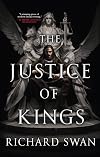
"The Empire of the Wolf simmers with unrest. Rebels, heretics, and powerful patricians all challenge the power of the Imperial throne. Only the Order of Justices stands in the way of chaos. Sir Konrad Vonvalt is the most feared Justice of all, upholding the law by way of his sharp mind, arcane powers, and skill as a swordsman. At his side stands Helena Sedanka, his talented protégé, orphaned by the wars that forged the Empire. When the pair investigates the murder of a provincial show more aristocrat, they unearth a conspiracy that stretches to the very top of Imperial society. As the stakes rise and become ever more personal, Vonvalt and Helena must make a choice: Will they abandon the laws they've sworn to uphold in order to protect the Empire?"--Dust jacket flap. show lessTags
Recommendations




















Member Reviews
The Justice of Kings by Richard Swan is going to go down as the best fantasy debut of 2022. The Empire of the Wolf has conquered a large portion of the continent and instituted a system of common law which applies to nobles and commoners alike. Administering the law are a group of Justices, who travel the land and act as detective, judge, and executioner. Sir Konrad Vonvalt is one of the most feared and respected justices of all. He is filled with conviction in the strength of the empire, the rightness of the law, and his own abilities, both as a swordsman and the magical Emperor’s Voice, with which he can compel people to speak the truth. Traveling with Sir Konrad are his assistants, Dubine Bressinger and Helena Sedanka. There is show more still unrest in the empire and rebels, heretics, and ambitious clergy all pose trouble.
When a Lord’s wife in a small city is murdered, Sir Konrad must investigate. What he hopes will be a quick investigation turns far more complicated and unearths a far-reaching conspiracy that will challenge all of Sir Konrads not inconsiderable abilities and beliefs. With constantly increasing stakes, can they protect the empire and still uphold the law? Or must they abandon their principles?
Wow does Richard Swan make some amazing choices with this story! It’s almost a nested narrative as he tells the story of Sir Konrad, but tells it through the eyes of his clerk and talented young protege, Helena. The story is being told from a future point in time so benefits from interpreting the events with the advantage of wisdom and perspective. Swan begins the story by showing Konrad going about his job, traveling a circuit around the empire, resolving disputes, and rendering judgment. You absorb the history of the Empire and how it deals with the challenges of consolidating its gains in the background of the present actions. He demonstrates the importance of the common law and Sir Konrad’s admirable adherence to fairness while also demonstrating compassion and understanding for the cultures of those absorbed into the Empire.
Helena is brilliant in her own right, but young and inexperienced, Her relationship with sir Konrad, her mentor and the one who rescued her from a meager existence is well-handled. She is torn by her loyalty and respect for Konrad but has doubts about whether his life is what she wants for herself. Other characters are not only well-drawn but grow and develop over the course of the novel, especially the town sheriff, Sir Radomir. The mystery is engrossing, the stakes ever-increasing, and the action is superb. Great world-building and fascinating characters make this one of the best books in recent memory and a fantastic start to a new series. I can’t wait for the next book!
I was provided a copy of this book by the publisher. show less
When a Lord’s wife in a small city is murdered, Sir Konrad must investigate. What he hopes will be a quick investigation turns far more complicated and unearths a far-reaching conspiracy that will challenge all of Sir Konrads not inconsiderable abilities and beliefs. With constantly increasing stakes, can they protect the empire and still uphold the law? Or must they abandon their principles?
Wow does Richard Swan make some amazing choices with this story! It’s almost a nested narrative as he tells the story of Sir Konrad, but tells it through the eyes of his clerk and talented young protege, Helena. The story is being told from a future point in time so benefits from interpreting the events with the advantage of wisdom and perspective. Swan begins the story by showing Konrad going about his job, traveling a circuit around the empire, resolving disputes, and rendering judgment. You absorb the history of the Empire and how it deals with the challenges of consolidating its gains in the background of the present actions. He demonstrates the importance of the common law and Sir Konrad’s admirable adherence to fairness while also demonstrating compassion and understanding for the cultures of those absorbed into the Empire.
Helena is brilliant in her own right, but young and inexperienced, Her relationship with sir Konrad, her mentor and the one who rescued her from a meager existence is well-handled. She is torn by her loyalty and respect for Konrad but has doubts about whether his life is what she wants for herself. Other characters are not only well-drawn but grow and develop over the course of the novel, especially the town sheriff, Sir Radomir. The mystery is engrossing, the stakes ever-increasing, and the action is superb. Great world-building and fascinating characters make this one of the best books in recent memory and a fantastic start to a new series. I can’t wait for the next book!
I was provided a copy of this book by the publisher. show less
4.25⭐
The story is that of Sir Konrad Vonvalt, an Emperor's Justice, as told by his protégé Helena Sedanka. Justices have been functioning as investigators, judges, and executioners in one person, wielding magic that helps them in such a task. However, as civilization progresses and new institutions are established, their power is starting to be called into question. After Vonvalt and Helena come back from traveling the edges of the civilization, they soon discover that something is disturbing the fragile foundations of the newly expanded empire, and their new case might be directly tied to it.
The main focus of the first book is an investigation of a crime and the mystery surrounding it. It helps showcase the powers and methods of show more Justices as well as their standing in society. The whole story is definitely a big setup for the rest of the series yet, we already get some payoffs and twists in this first book.
I really enjoyed the dark setting which is especially compounded by the magic. All justices are able to use Emperor’s Voice to compel the suspect to speak the truth, albeit with certain limitations that force them to still employ the usual investigative methods. Each Justice then has another power or powers in their repertoire and in Vonvalt's case it's necromancy. I really liked the way this power was presented and how it tied up into the overarching story.
As for the characters, the story is told by Helena Sedanka, Vonvalt's apprentice. She is 19 years old in the story but the narration is done by her aged and wiser self, which I think worked brilliantly. The young Helena is a very believable character with a young age's naivety, rashness, and rebelliousness. She can definitely come off as irritating sometimes but having the old Helena's voice acknowledge her behaviour made quite a difference. It's like we can feel more for the character because we get to know her both as young and as old. This narration also drops occasional foreshadowing but it's rare and well-timed so that it doesn't break the suspense but rather enriches it. While for the most part, the focus of the story is on Vonvalt I really enjoyed the moments she had a chance to shine and make her contributions, big or small. She grows a lot as a character through the story, yet there is still space left for her to grow in the sequels.
Vonvalt is someone we only see through Helena's and others' eyes so his real character is something left uncertain. He is presented as the epitome of Justice, always following the law perfectly and expecting everyone to uphold it in the same way. Yet, already from the beginning, there are few instances where he operates within the law but allows for different interpretations when it's for the sake of being reasonable and helping people out.
There are also very well-developed side characters with their own stories and moralities as well as the villains. The main villain might be a bit of a cliché type but it remains to be seen how he is handled.
Lastly, despite the very dark tones of the book, there was a surprising amount of humor too.
I really enjoyed this book and I have high hopes for the rest of the series. show less
The story is that of Sir Konrad Vonvalt, an Emperor's Justice, as told by his protégé Helena Sedanka. Justices have been functioning as investigators, judges, and executioners in one person, wielding magic that helps them in such a task. However, as civilization progresses and new institutions are established, their power is starting to be called into question. After Vonvalt and Helena come back from traveling the edges of the civilization, they soon discover that something is disturbing the fragile foundations of the newly expanded empire, and their new case might be directly tied to it.
The main focus of the first book is an investigation of a crime and the mystery surrounding it. It helps showcase the powers and methods of show more Justices as well as their standing in society. The whole story is definitely a big setup for the rest of the series yet, we already get some payoffs and twists in this first book.
I really enjoyed the dark setting which is especially compounded by the magic. All justices are able to use Emperor’s Voice to compel the suspect to speak the truth, albeit with certain limitations that force them to still employ the usual investigative methods. Each Justice then has another power or powers in their repertoire and in Vonvalt's case it's necromancy. I really liked the way this power was presented and how it tied up into the overarching story.
As for the characters, the story is told by Helena Sedanka, Vonvalt's apprentice. She is 19 years old in the story but the narration is done by her aged and wiser self, which I think worked brilliantly. The young Helena is a very believable character with a young age's naivety, rashness, and rebelliousness. She can definitely come off as irritating sometimes but having the old Helena's voice acknowledge her behaviour made quite a difference. It's like we can feel more for the character because we get to know her both as young and as old. This narration also drops occasional foreshadowing but it's rare and well-timed so that it doesn't break the suspense but rather enriches it. While for the most part, the focus of the story is on Vonvalt I really enjoyed the moments she had a chance to shine and make her contributions, big or small. She grows a lot as a character through the story, yet there is still space left for her to grow in the sequels.
Vonvalt is someone we only see through Helena's and others' eyes so his real character is something left uncertain. He is presented as the epitome of Justice, always following the law perfectly and expecting everyone to uphold it in the same way. Yet, already from the beginning, there are few instances where he operates within the law but allows for different interpretations when it's for the sake of being reasonable and helping people out.
There are also very well-developed side characters with their own stories and moralities as well as the villains. The main villain might be a bit of a cliché type but it remains to be seen how he is handled.
Lastly, despite the very dark tones of the book, there was a surprising amount of humor too.
I really enjoyed this book and I have high hopes for the rest of the series. show less
Much as I was intrigued by the synopsis for this book, what I found in it went well beyond my expectations, offering a fascinatingly different point of view on a medieval-analogue background undergoing far-reaching changes. Sir Konrad Vonvalt is an Emperor’s Justice, a traveling judge performing his circuit throughout his allotted slice of the Sovan empire and acting not only as judge but also as jury and, if required, as executioner whenever crimes are committed.
Vonvalt is accompanied in such travels by his guard/factotum Bressinger and by his clerk (and potential judge in training) Helena, and the tale is indeed told through a much older Helena’s memoirs. As the story starts, Vonvalt and his small retinue are trying to shed some show more light on the murder of a noblewoman, and in the course of the investigation discover that the case is tied to a far-reaching chain of events that might lead to the unraveling of the empire’s fabric, and to the very end of the Imperial Justice system.
I appreciated the choice of having Helena as a chronicler, because the wisdom (and some disillusionment) of the older woman help put the account into perspective and turn her into a quite reliable narrator, observing the facts - and her own past self - through the lens of experience. The three main characters form an interesting team: Sir Konrad is a serious, and at times moody, individual but he also possesses an inner core of conviction and respect for the law that he tries to transmit to Helena, whom he clearly envisions as his successor; his usual sternness does not always manage to cover a fatherly attitude that at times comes through but is almost never perceived as such by the younger woman, so that the sometimes strained relationship between the two of them often reminded me of Merela and Girton in the Wounded Kingdom saga. Bressinger, on the other hand, represents a more approachable adult for Helena, and despite his gruff, world-weary approach and his shifting moods, he’s the one she feels more inclined to confide in.
Helena herself is what you might call a survivor: orphaned by one of the many wars of annexation that gave birth to the Sovan empire, she learned at a very tender age to fend for herself, and was rescued by Sir Konrad who saw the promise in the young woman and decided to give her a chance for a better future. The Helena described in the story is a mixture of innocence and strength, determination and uncertainty: it’s clear that her childhood left her somewhat emotionally stunted, and she does not know yet what she wants to do with her life - following in Sir Konrad’s footsteps would certainly give her the status and security she did not have in her early life, but Helena is not sure that this is what she truly wants, and she’s often chafing at the restraints that her present role is imposing on her.
These interesting character dynamics take place in an equally interesting background: the Sovan empire is the result of some bloody wars - Sir Konrad himself did fight in one - and the judicial system put in place by the emperor is viewed as the glue that should hold it all together, which is the reason Vonvalt is always so meticulous in weighing all the aspects of his profession and authority, careful that the meting out of justice never turns into mere vengeance or an expression of unchecked power. And that’s where the unrest running throughout the empire stands: a struggle is brewing between the religious and secular powers, hinted at for the first time through the opposing views of Sir Konrad and the priest Claver over the behavior of some villagers, which the former chooses to simply reprimand while the latter would like to kill as an example to the rest of the world. The clash between Vonvalt’s concept of justice and Claver’s excess of zeal looks like the spark that might ignite the empire - and in truth we understand this is more than a possibility thanks to the opening sentence of the novel, in which the events at the small village where the two men battle are foreshadowed as the spark for the coming upheaval.
But such a spark must find a consistent amount of kindling to start the proverbial fire, and that comes to light in the course of Sir Konrad’s investigation, which proves to be the microcosm of what is brewing in the empire: the murder mystery (which is an intriguing addition to the fantasy setting) allows the readers to get a close-up view of Sovan society in the merchant town of Galen’s Vale, with its intricate political ties and the buried secrets of a small community which - as so often happens in such investigations, no matter the time frame in which they happen - come unraveled as Sir Konrad leaves no stone unturned in his search for truth and for the murderer.
The murder inquiry also offers the chance for the introduction of the only “magical” elements present in the story: Justices like Vonvalt are empowered by special skills, like the Emperor’s Voice, which compels anyone subjected to it to speak the truth, no matter what; and then there is the much darker element of necromancy, the ability to connect to a recently dead individual to learn either the details of their deaths or the secrets they carried to the grave. This latter skill is disturbing - in one occasion Helena participates in the ritual and is grievously affected by it - and also taxing for the individual performing it, introducing a welcome limitation to what might otherwise have been a deus-ex-machina narrative device: the concept here is that such powers must be used sparingly and only in the direst of circumstances, both to prevent the tainting of one’s soul and the corruption of one’s skills in pursuing truth and justice.
In the end, The Justice of Kings proved to be a compelling story of a world in the early throes of disruption, and if sometimes the pace falters between the detail-rich murder investigation and the echoes of developing unrest, the narrative remains consistently fascinating and the characters worthy of further exploration. Given this premise, I more than look forward to the next installment in the series. show less
Vonvalt is accompanied in such travels by his guard/factotum Bressinger and by his clerk (and potential judge in training) Helena, and the tale is indeed told through a much older Helena’s memoirs. As the story starts, Vonvalt and his small retinue are trying to shed some show more light on the murder of a noblewoman, and in the course of the investigation discover that the case is tied to a far-reaching chain of events that might lead to the unraveling of the empire’s fabric, and to the very end of the Imperial Justice system.
I appreciated the choice of having Helena as a chronicler, because the wisdom (and some disillusionment) of the older woman help put the account into perspective and turn her into a quite reliable narrator, observing the facts - and her own past self - through the lens of experience. The three main characters form an interesting team: Sir Konrad is a serious, and at times moody, individual but he also possesses an inner core of conviction and respect for the law that he tries to transmit to Helena, whom he clearly envisions as his successor; his usual sternness does not always manage to cover a fatherly attitude that at times comes through but is almost never perceived as such by the younger woman, so that the sometimes strained relationship between the two of them often reminded me of Merela and Girton in the Wounded Kingdom saga. Bressinger, on the other hand, represents a more approachable adult for Helena, and despite his gruff, world-weary approach and his shifting moods, he’s the one she feels more inclined to confide in.
Helena herself is what you might call a survivor: orphaned by one of the many wars of annexation that gave birth to the Sovan empire, she learned at a very tender age to fend for herself, and was rescued by Sir Konrad who saw the promise in the young woman and decided to give her a chance for a better future. The Helena described in the story is a mixture of innocence and strength, determination and uncertainty: it’s clear that her childhood left her somewhat emotionally stunted, and she does not know yet what she wants to do with her life - following in Sir Konrad’s footsteps would certainly give her the status and security she did not have in her early life, but Helena is not sure that this is what she truly wants, and she’s often chafing at the restraints that her present role is imposing on her.
These interesting character dynamics take place in an equally interesting background: the Sovan empire is the result of some bloody wars - Sir Konrad himself did fight in one - and the judicial system put in place by the emperor is viewed as the glue that should hold it all together, which is the reason Vonvalt is always so meticulous in weighing all the aspects of his profession and authority, careful that the meting out of justice never turns into mere vengeance or an expression of unchecked power. And that’s where the unrest running throughout the empire stands: a struggle is brewing between the religious and secular powers, hinted at for the first time through the opposing views of Sir Konrad and the priest Claver over the behavior of some villagers, which the former chooses to simply reprimand while the latter would like to kill as an example to the rest of the world. The clash between Vonvalt’s concept of justice and Claver’s excess of zeal looks like the spark that might ignite the empire - and in truth we understand this is more than a possibility thanks to the opening sentence of the novel, in which the events at the small village where the two men battle are foreshadowed as the spark for the coming upheaval.
But such a spark must find a consistent amount of kindling to start the proverbial fire, and that comes to light in the course of Sir Konrad’s investigation, which proves to be the microcosm of what is brewing in the empire: the murder mystery (which is an intriguing addition to the fantasy setting) allows the readers to get a close-up view of Sovan society in the merchant town of Galen’s Vale, with its intricate political ties and the buried secrets of a small community which - as so often happens in such investigations, no matter the time frame in which they happen - come unraveled as Sir Konrad leaves no stone unturned in his search for truth and for the murderer.
The murder inquiry also offers the chance for the introduction of the only “magical” elements present in the story: Justices like Vonvalt are empowered by special skills, like the Emperor’s Voice, which compels anyone subjected to it to speak the truth, no matter what; and then there is the much darker element of necromancy, the ability to connect to a recently dead individual to learn either the details of their deaths or the secrets they carried to the grave. This latter skill is disturbing - in one occasion Helena participates in the ritual and is grievously affected by it - and also taxing for the individual performing it, introducing a welcome limitation to what might otherwise have been a deus-ex-machina narrative device: the concept here is that such powers must be used sparingly and only in the direst of circumstances, both to prevent the tainting of one’s soul and the corruption of one’s skills in pursuing truth and justice.
In the end, The Justice of Kings proved to be a compelling story of a world in the early throes of disruption, and if sometimes the pace falters between the detail-rich murder investigation and the echoes of developing unrest, the narrative remains consistently fascinating and the characters worthy of further exploration. Given this premise, I more than look forward to the next installment in the series. show less
That was a very pleasant surprise. I only picked it up because I liked the hardcover and got it cheap second-hand. It is well-told, enough action, enough gore, enough humor somewhere inbetween, not the straightforward kind but it's not grim or unfunny.
I will continue this series...
I will continue this series...
This was a surprising favorite of mine for 2023. I had heard mixed reviews on this, but was looking for something new to read and saw that the kindle version happened to be on sale and I had some credits...so I thought I'd give it a try. Boy was I pleasantly pleased. This was a easy, quick read with just enough fantasy for the fantasy lovers, a nice mystery for the mystery fans and some thrilling action scenes that kept the pace moving. I really can't say enough about this and can't wait to get into the 2nd book.
“’[…]you did not fancy just smashing him with the Voice?’”
‘Vonvalt shook his head. ‘No,’ he said, with a hint of reproach. ‘Not yet, at any rate. You are more well versed than most in its limitations.’”
In “The Justice of Kings” by Richard Swan
Right! There are always limitations for the use of Magick! Lo and behold, nothing comes without a price tag! Wouldn't reality/life be very, very boring without books like these?
Most peoples' lives are:
Wake up;
Shit,Shower,Shave (!);
Dress;
Commute to work (if you’re not in WFH mode), whilst imaging not commuting to work to a job your hate;
Work in a job you hate, while being under-recognised and under paid;
Commute home, while thinking about what to have for dinner/tea;
Cook show more /eat tea;
wash pots;
watch mindless, slightly-less-boring-than-your-own-life-TV;
Go-to-bed;
dream of winning lottery;
wake up…;
Rinse and repeat 5xdays a week;
Punctuated by 2 days a week to do housework DIY etc., etc.;
Punctuated by the odd escape from reality on holiday / weekends away / sex / sport / pub / restaurant.
Shouldn’t Fantasy like this do not have to rely on unreserved suspension of disbelief? How can the fact that Vonvalt when dealing with a murder of a woman uses the voice and a few chapters previously, as he was dealing with with a minor misdemeanor, he didn’t? The justification is the uusal one,i.e., the cost of using it restricts its use, so Vonvalt cannot just go around making everyone tell the truth, yada, yada. Ring a bell? Plot contrivance galore! That’s Fantasy for you! Maybe that’s what one needs to compensate for one’s dreary lives… show less
‘Vonvalt shook his head. ‘No,’ he said, with a hint of reproach. ‘Not yet, at any rate. You are more well versed than most in its limitations.’”
In “The Justice of Kings” by Richard Swan
Right! There are always limitations for the use of Magick! Lo and behold, nothing comes without a price tag! Wouldn't reality/life be very, very boring without books like these?
Most peoples' lives are:
Wake up;
Shit,Shower,Shave (!);
Dress;
Commute to work (if you’re not in WFH mode), whilst imaging not commuting to work to a job your hate;
Work in a job you hate, while being under-recognised and under paid;
Commute home, while thinking about what to have for dinner/tea;
Cook show more /eat tea;
wash pots;
watch mindless, slightly-less-boring-than-your-own-life-TV;
Go-to-bed;
dream of winning lottery;
wake up…;
Rinse and repeat 5xdays a week;
Punctuated by 2 days a week to do housework DIY etc., etc.;
Punctuated by the odd escape from reality on holiday / weekends away / sex / sport / pub / restaurant.
Shouldn’t Fantasy like this do not have to rely on unreserved suspension of disbelief? How can the fact that Vonvalt when dealing with a murder of a woman uses the voice and a few chapters previously, as he was dealing with with a minor misdemeanor, he didn’t? The justification is the uusal one,i.e., the cost of using it restricts its use, so Vonvalt cannot just go around making everyone tell the truth, yada, yada. Ring a bell? Plot contrivance galore! That’s Fantasy for you! Maybe that’s what one needs to compensate for one’s dreary lives… show less
Vonvalt and his crew needs therapy after all this tbh....
This book was really weird in an enjoyable way and the action scenes were well written, and the final battle floored me tho because there was so much going on.
I need to read the next book immediately.....
This book was really weird in an enjoyable way and the action scenes were well written, and the final battle floored me tho because there was so much going on.
I need to read the next book immediately.....
Members
- Recently Added By
Lists

2023 Hugo Awards -- Eligible Works -- Novels
70 works; 21 members

Recommend Fantasy Books
100 works; 1 member

infjsarah's wishlist
408 works; 2 members

Books Read in 2022
5,168 works; 114 members

READ 2025
190 works; 1 member
Author Information

16 Works 1,523 Members
Some Editions
Series

Common Knowledge
- Canonical title
- The Justice of Kings
- Original title
- The Justice of Kings
- Original publication date
- 2022-02-22
- People/Characters
- Sir Konrad Vonvalt; Patria Bartholomew Claver; Helena Sedanka; Dubine Bressinger; Tymoteusz Jansen; Lady Resi August (show all 8); Waldemar Westenholtz; Radomir Dragic
- First words
- It is a strange thing to think that the end of the Empire of the Wolf, and all the death and devastation that came with it, traced its long roots back to the tiny and insignificant village of Rill.
- Last words
- (Click to show. Warning: May contain spoilers.)But I am an old woman now, and my eyes are sore, and my hand needs a rest.
Classifications
Statistics
- Members
- 711
- Popularity
- 40,008
- Reviews
- 14
- Rating
- (3.76)
- Languages
- 5 — English, German, Italian, Polish, Spanish
- Media
- Paper, Audiobook, Ebook
- ISBNs
- 17
- ASINs
- 6