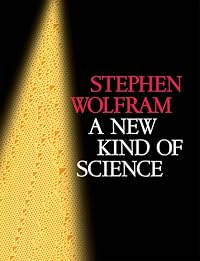
A New Kind of Science
by Stephen Wolfram
On This Page
Description
This work presents a series of dramatic discoveries never before made public. Starting from a collection of simple computer experiments---illustrated in the book by striking computer graphics---Wolfram shows how their unexpected results force a whole new way of looking at the operation of our universe. Wolfram uses his approach to tackle a remarkable array of fundamental problems in science: from the origin of the Second Law of thermodynamics, to the development of complexity in biology, the show more computational limitations of mathematics, the possibility of a truly fundamental theory of physics, and the interplay between free will and determinism. show lessTags
Recommendations












Member Reviews
Many of the reviews of this book have been quite savage, but the savageness, it seems to me, is inversely related to the fraction of the book that the reviewer had actually read. I, like many others, was aware of the marketing hype before its publication, and waited for its production with a feeling something like that of a child anticipating a Christmas, an incomprehensible number of weeks off.
I actually read a good part of this book, and found it to be something quite awesome. Moreover, I was not at all put off by its idiosyncratic style, and I much appreciated its typography, layout and the richness in its illustrations. I was awed at the scope of the work, much provoked and entertained by it. A faithful user of Mathematica (I used show more it to derive my first simulation of the trebuchet, described at www.algobeautytreb.com), I am awed by the number of programs that Wolfram lists.
Perhaps the most impressive aspect of this work is the breadth of topics that are covered. Computational hydrodynamics and thermodynamics, free will and language, cryptography and logic, quantum mechanics and Feynmen diagrams, crystallization, coarsening foams and sandpiles, evolution and embryology, traffic and financial markets. Is there any other work having a single author that encompasses such a collection?
The notes section, about 300 pages long, is wonderful to read all by itself. Each topic has its bit of history related, and there are many descriptions of things discovered and things yet to be discovered, told in a most entertaining and readable style. I could even recommend, perhaps, that some readers should read this section first.
My reaction toward the "bottom line" hypothesis, that cellular automata provide a real breakthrough in understanding the world, is a little agnostic, perhaps. Interesting in many ways, and the hydrodynamic model is clearly a fruitful one--I've seen some quite stunning movies of certain phenomena (such as two liquids of different density that are mixing). I really can't evaluate some of the claims Wolfram makes, and others seem to be a bit overblown. I guess my feeling is something like the child that woke up on Christmas morning hoping for that bicycle, but finding a chemistry set instead. While I didn't get exactly what I'd hoped for, the chemistry set is intriguing--something may come of it yet! show less
I actually read a good part of this book, and found it to be something quite awesome. Moreover, I was not at all put off by its idiosyncratic style, and I much appreciated its typography, layout and the richness in its illustrations. I was awed at the scope of the work, much provoked and entertained by it. A faithful user of Mathematica (I used show more it to derive my first simulation of the trebuchet, described at www.algobeautytreb.com), I am awed by the number of programs that Wolfram lists.
Perhaps the most impressive aspect of this work is the breadth of topics that are covered. Computational hydrodynamics and thermodynamics, free will and language, cryptography and logic, quantum mechanics and Feynmen diagrams, crystallization, coarsening foams and sandpiles, evolution and embryology, traffic and financial markets. Is there any other work having a single author that encompasses such a collection?
The notes section, about 300 pages long, is wonderful to read all by itself. Each topic has its bit of history related, and there are many descriptions of things discovered and things yet to be discovered, told in a most entertaining and readable style. I could even recommend, perhaps, that some readers should read this section first.
My reaction toward the "bottom line" hypothesis, that cellular automata provide a real breakthrough in understanding the world, is a little agnostic, perhaps. Interesting in many ways, and the hydrodynamic model is clearly a fruitful one--I've seen some quite stunning movies of certain phenomena (such as two liquids of different density that are mixing). I really can't evaluate some of the claims Wolfram makes, and others seem to be a bit overblown. I guess my feeling is something like the child that woke up on Christmas morning hoping for that bicycle, but finding a chemistry set instead. While I didn't get exactly what I'd hoped for, the chemistry set is intriguing--something may come of it yet! show less
Dear FSM, what a rambling mess of a book. This review is going to be longer than usual for me, as I have a lot of bile to get out of my system.
As I read through the first several pages, I was bemused by the author's arrogant and lofty tone. I was willing to give him a bit of credit, if he had any logical backup behind it.
Finished the introduction. The book makes clear its intentions: to analyze and reduce complex phenomenon to simple mathematical representations. Not bad, but hardly revolutionary. This had been done in various forms since Newton, perhaps even earlier, if you play fast and loose with my terms. Simple rules can produce complex results. Every CompSci student now knows this.
After this, the book rapidly goes downhill. What show more follows are several hundred slogging pages of examples, and after that, faulty hypothetical applications to such disparate fields as evolution, cognitive science, complexity theory, gravity, quantum mechanics, etc. Most of his methods are either demonstrably false, or so reduced in effectiveness as to be useless, or restatements of ideas already discovered - without giving any fair credit. The author frequently downplays the contributions of other scientists, even trying to reduce Turing, Zuse, and Goedel to mere footnotes in his book, and blandly restating simplified or distorted or useless or plagiarized versions of their discoveries.
The author's arrogant tone does nothing to help his case. This book is a damned foolish waste of time, and I expected a hell of a lot better. What a shame. The creator of Mathematica and Wolfram Alpha (both excellent tools) should stick with those. show less
As I read through the first several pages, I was bemused by the author's arrogant and lofty tone. I was willing to give him a bit of credit, if he had any logical backup behind it.
Finished the introduction. The book makes clear its intentions: to analyze and reduce complex phenomenon to simple mathematical representations. Not bad, but hardly revolutionary. This had been done in various forms since Newton, perhaps even earlier, if you play fast and loose with my terms. Simple rules can produce complex results. Every CompSci student now knows this.
After this, the book rapidly goes downhill. What show more follows are several hundred slogging pages of examples, and after that, faulty hypothetical applications to such disparate fields as evolution, cognitive science, complexity theory, gravity, quantum mechanics, etc. Most of his methods are either demonstrably false, or so reduced in effectiveness as to be useless, or restatements of ideas already discovered - without giving any fair credit. The author frequently downplays the contributions of other scientists, even trying to reduce Turing, Zuse, and Goedel to mere footnotes in his book, and blandly restating simplified or distorted or useless or plagiarized versions of their discoveries.
The author's arrogant tone does nothing to help his case. This book is a damned foolish waste of time, and I expected a hell of a lot better. What a shame. The creator of Mathematica and Wolfram Alpha (both excellent tools) should stick with those. show less
Pascal is famously quoted (paraphrased):
If Stephen Wolfram worked on this tome for about a decade, I hate to see what he cut it down from.
Even for a book written so as to be approachable by non-technical lay readers, this book is excessively repetitive, and verbose, and repetitive. 200 pages in and I've yet to read anything that I could identify as shockingly new or usefully foundational; nothing that I hadn't been exposed to by authors whose own books or articles significantly predate A New Kind of Science.
It is, so far, excellent marketing material.
----------
The chapter on fundamental physics was interesting, at least for a non-physicist. However there is little else show more in the book than does not seem obvious from reading other authors who write better and bloviate less. show less
I would have written a shorter letter, but I did not have the time.
If Stephen Wolfram worked on this tome for about a decade, I hate to see what he cut it down from.
Even for a book written so as to be approachable by non-technical lay readers, this book is excessively repetitive, and verbose, and repetitive. 200 pages in and I've yet to read anything that I could identify as shockingly new or usefully foundational; nothing that I hadn't been exposed to by authors whose own books or articles significantly predate A New Kind of Science.
It is, so far, excellent marketing material.
----------
The chapter on fundamental physics was interesting, at least for a non-physicist. However there is little else show more in the book than does not seem obvious from reading other authors who write better and bloviate less. show less
An excruciatingly long book, this one. I have immense respect for Wolfram's accomplishments, but jeez, this exploration of cellular automata and simple programs as an answer to everything knocked him down several notches. I was excited to find the book at a Half Price Books priced far less than half. That was the best part of the interaction. Five and a quarter pounds of book is tough to lug around and many hours of lost time for little gain make for an "it was okay" rating. I guess I am still impressed somewhat - anyone who can spend so much time watching patterns emerge from repetition deserves a nod for persistence.
Interesting approach, but I liked it better when it was called "The Game of Life".
(John Conway has at least a decade of priority in showing how complexity can arise from simple algorithms.)
(John Conway has at least a decade of priority in showing how complexity can arise from simple algorithms.)
Stephen Wolfram is a little bit full of himself; this book is not nearly as revolutionary or paradigm-shattering as he seems to think. Nonetheless, this is a fascinating (if very long) book containing all sorts of interesting ideas about automata, recursion, programming, and more.
I read the first 300 pages of this book and then went on to other things. It’s not that the writing was bad or uninteresting; I just got tired of the level of study that the book demanded. From the pages I did read I can say that the author is extremely thorough in his exploration, especially with respect to cellular automata where he enumerates every variety and explores every permutation in their behavior. He does an excellent job organizing and explaining the material, and the book is beautifully designed and printed. The resolution of the diagrams is the finest I've seen and it's fun just looking through them all. If you are into mathematics, computer science, or automata I would recommend getting this book. If for nothing else show more than browsing through the 350 pages of notes at the end. If you’re a general science reader you'll probably be disappointed. show less
Members
- Recently Added By
Published Reviews
ThingScore 44
"I would guess that most physicists would insist on a more traditional and rigorous treatment of the ideas in A New Kind of Science before they will take them seriously. Pictures of cellular automata are all well and good. This book has 1000 of them, and they certainly serve to illustrate that a cellular automaton can create baffling complexity starting from very little. I am not yet convinced show more that they tell us much of anything about science." show less
added by cpg
"In ANKS Wolfram says that '…the core of this book can be viewed as introducing a major generalization of mathematics' (p. 7). In this he is entirely mistaken, but there are at least two ways in which he has benefited mathematics: he has helped to popularize a relatively little-known mathematical area (CA theory), and he has unwittingly provided several highly instructive examples of the show more pitfalls of trying to dispense with mathematical rigor." show less
added by cpg
"Ultimately, I do not believe that Wolfram's book represents a new kind of science, or that future generations will believe it does. His book would be more pleasant to read if he were more modest: there's a reason why bragging is generally frowned upon (regardless of whether one's achievements are worthy of it). However, I don't want to seem too critical. Despite its flaws, I really enjoyed show more the book, and found it fascinating and thought-provoking." show less
added by cpg
Lists

Unread books
1,063 works; 82 members

Books Cited in Blueprint by Nicholas Christakis
261 works; 1 member

03
9 works; 1 member
Author Information

35+ Works 2,768 Members
Stephen Worfram is a distinguished scientist and best-selling author, and the creator of some of the world's most respected software systems, including Mathematica, Wolfram/Alpha and the Wolfram Language. For more than 30 years he has been the CEO of the global technology company Wolfram Research.
Awards and Honors
Distinctions
Common Knowledge
- Canonical title
- A New Kind of Science
- Original publication date
- 2002
Classifications
Statistics
- Members
- 1,656
- Popularity
- 13,552
- Reviews
- 19
- Rating
- (3.15)
- Languages
- English
- Media
- Paper, Ebook
- ISBNs
- 5
- UPCs
- 1
- ASINs
- 2