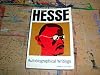
Autobiographical Writings
by Hermann Hesse
On This Page
Description
Hesse narrates his own life and describes the spiritual crises which underlie his major works.Tags
Recommendations




























Member Reviews
This is a collection of short autobiographical pieces that Hesse wrote over the course of his long life. In fact they are more like fragments, discontinuous and in some places covering the same ground, but from different angles. The introduction makes it clear that Hesse wrote his own life into all of his stories, using elaborate aliases, shifting scenes and generally mixing up the whole business of story-telling and magic making in a (very) complex whole. I was curious to get to know Hesse better, and these stories certainly achieved that. But for a while it all seemed to plod. He was fascinating, but his stories about himself seemed dull, as if the effort of constraining himself to one reality (that of recollection) hampered him. But show more when he broke out, as he did frequently the stories had that magic, and the real treasure contained in this collection is his 'A Guest at the Spa'. The only other writer to describe so perfectly the life of the Spa (a very European thing) is Simenon in one of his Maigret stories. Worth reading for this story alone, and perhaps those others relating to his early years. Recommended. show less
Ratings
Members
- Recently Added By
Author Information

Hermann Hesse (July 2, 1877 -- August 9, 1962) was a German poet, novelist, essayist and painter. His best-known works included Steppenwolf, Siddhartha, and The Glass Bead Game, each of which explores an individual's search for authenticity, self-knowledge and spirituality. In 1946, he received the Nobel Prize in Literature. Hess publicly show more announced his views on the savagery of World War I, and was considered a traitor. He moved to Switzerland where he eventually became a naturalized citizen. He warned of the advent of World War II, predicting that cultureless efficiency would destroy the modern world. His theme was usually the conflict between the elements of a person's dual nature and the problem of spiritual loneliness. His first novel, Peter Camenzind, was published in 1904. His masterpiece, Death and the Lover (1930), contrasts a scholarly abbot and his beloved pupil, who leaves the monastery for the adventurous world. Steppenwolf (1927), a European bestseller, was published when defeated Germany had begun to plan for another war. It is the story of Haller, who recognizes in himself the blend of the human and wolfish traits of the completely sterile scholarly project. During the 1960s Hesse became a favorite writer of the counter culture, especially in the United States, though his critical reputation has never equaled his popularity. Hermann Hesse died in 1962. (Bowker Author Biography) show less
Some Editions
Series
Belongs to Publisher Series
Common Knowledge
- Original publication date
- 1972 (English collection) (English collection)
- First words
- Not by parents and teachers alone was I educated, but by higher, more arcane and mysterious powers as well, among them the god Pan, who stood in my grandfather's glass cabinet in the guise of a little dancing Hindu idol.
- Last words
- (Click to show. Warning: May contain spoilers.)I will breathe this fragrance once more with gratitude. Take care and farewell!
Classifications
Statistics
- Members
- 199
- Popularity
- 163,900
- Reviews
- 1
- Rating
- (4.13)
- Languages
- English, German, Norwegian
- Media
- Paper
- ISBNs
- 8
- ASINs
- 3