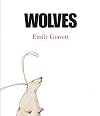
Wolves
by Emily Gravett 
On This Page
Description
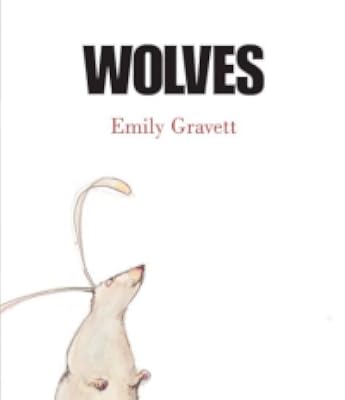
When a young rabbit checks out a library book about wolves, he learns much more about their behavior than he wanted to know.Tags
Recommendations

Member Reviews
Wolves is a very "meta" book. A rabbit checks out a book about wolves from the library, and soon we don't know what resides in that book and what resides in our book. The illustrations and use of collage/photography are the focal point of the story, and they are used in such a unique way that I had to pause and really look at each page. It is a quick read, and I imagine the intricacies of it might go over some young children's heads, but they will still enjoy it nonetheless.
Ever lost yourself in a good book? Gravett’s white rabbit has–he borrows a book about wolves from the West Bucks Public Burrowing Library and goes merrily (temporarily) along his way engrossed in its pages. Unlike Lewis Carroll’s white rabbit, Gravett’s white rabbit strolls home appearing to have all the time in the world and not a care in the world. It soon becomes apparent, though, that this carefree rabbit should have taken care to pay more attention to the words that he was reading.
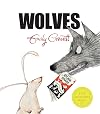
As the rabbit reads about what wolves are like (their habitat, their physical characteristics, etc.), the rabbit becomes increasingly absorbed as the wolf becomes more menacing. It is not until the rabbit gets to the part of the book that show more discusses what wolves eat (“they also enjoy smaller mammals, like beavers, voles, and … rabbits”) that the rabbit pulls its nose out of the book and takes on the startled deer-in-the-headlights expression. Behind the startled, newly cognizant rabbit, the wolf’s face covers nearly the full two-page spread.
The rabbit’s impending demise is quite evident without either of the story’s characters ever saying a word. Presumably the text that is on the pages of Wolves is lifted from the rabbit’s book that he is so engrossed in reading. The factual text combines with the fictional illustrations to create a winning whole in this cautionary “beware of the wolves” picture book.
Gravett employs plenty of whitespace against which to set her illustrations’ focus–the rabbit, the wolf, and the maroon book the rabbit is reading. Gravett’s use of white space and changing the size and arrangement of her rabbit, wolf, and book strengthens her story (Her masterful use of white space is reminiscent of Maurice Sendak’s tactics in Where the Wild Things Are in how he moves from a large amount of white space surrounding the text, to gradually enlarging to illustrations that overwhelm the entire spread as Max and the wild things have their wild rumpus, to having the white space return as Max returns to reality). The rabbit begins to fade in size and significance on the page as the wolf moves closer, gets bigger, and moves to center page. On the final two-page spread, it is the maroon book–with all its wear and tear (i.e., wolf scratches and marks)–that commands attention.
Emily Gravett won the Kate Greenaway Medal for Wolves. Wolves presents the facts in such a fascinating way that it’s difficult to be upset about the demise of the rabbit. However, for those who are upset, Gravett does offer an alternative ending so that just facts get consumed and the wolf and the rabbit share a jam sandwich.
Of course, it is true that after this reassuring page there is another page of the rabbit’s unopened mail suggesting that the rabbit has been absent for some time. Among the mail is a postcard from the library stating that the book is overdue; the library requests that rabbit return the book as soon as possible, as many other rabbits are waiting to burrow it. Still, sensitive readers will hold tight to the jam sandwich ending (or you might want to point sensitive readers to other fare altogether), and readers with a darker sense of humor will appreciate all of these extra comedic touches.
Emily Gravett (listed on the title page as Emily Grrrabbit) clearly deserves the rave reviews garnered on the back cover of the book come from The Daily Carrot (”Every burrow should own this!”), The Hareold (”A rip-roaring tail.”), and the Rabbit Review (”A wonderful introduction for young rabbits to the danger of wolves. Buy this!”). And for those concerned with meeting state and national curriculum standards, this book is a must buy since it does, after all, follow the National Carroticulum.
For another story of a completely unsuspecting prey facing an encounter with a menacing predator, pick up Pat Hutchins classic Rosie’s Walk (starring an unsuspecting hen and a fox predator). Part of the fun for kids in such stories is that they have knowledge that the protagonist does not. For more postmodern wolfish delights, pick up The True Story of the Three Little Pigs by John Scieszka, The Three Little Wolves and the Big Bad Pig by Eugene Trivizas and Helen Oxenbury, or The Wolf’s Story: What Really Happened to Little Red Riding Hood by Toby Forward. show less
As the rabbit reads about what wolves are like (their habitat, their physical characteristics, etc.), the rabbit becomes increasingly absorbed as the wolf becomes more menacing. It is not until the rabbit gets to the part of the book that show more discusses what wolves eat (“they also enjoy smaller mammals, like beavers, voles, and … rabbits”) that the rabbit pulls its nose out of the book and takes on the startled deer-in-the-headlights expression. Behind the startled, newly cognizant rabbit, the wolf’s face covers nearly the full two-page spread.
The rabbit’s impending demise is quite evident without either of the story’s characters ever saying a word. Presumably the text that is on the pages of Wolves is lifted from the rabbit’s book that he is so engrossed in reading. The factual text combines with the fictional illustrations to create a winning whole in this cautionary “beware of the wolves” picture book.
Gravett employs plenty of whitespace against which to set her illustrations’ focus–the rabbit, the wolf, and the maroon book the rabbit is reading. Gravett’s use of white space and changing the size and arrangement of her rabbit, wolf, and book strengthens her story (Her masterful use of white space is reminiscent of Maurice Sendak’s tactics in Where the Wild Things Are in how he moves from a large amount of white space surrounding the text, to gradually enlarging to illustrations that overwhelm the entire spread as Max and the wild things have their wild rumpus, to having the white space return as Max returns to reality). The rabbit begins to fade in size and significance on the page as the wolf moves closer, gets bigger, and moves to center page. On the final two-page spread, it is the maroon book–with all its wear and tear (i.e., wolf scratches and marks)–that commands attention.
Emily Gravett won the Kate Greenaway Medal for Wolves. Wolves presents the facts in such a fascinating way that it’s difficult to be upset about the demise of the rabbit. However, for those who are upset, Gravett does offer an alternative ending so that just facts get consumed and the wolf and the rabbit share a jam sandwich.
Of course, it is true that after this reassuring page there is another page of the rabbit’s unopened mail suggesting that the rabbit has been absent for some time. Among the mail is a postcard from the library stating that the book is overdue; the library requests that rabbit return the book as soon as possible, as many other rabbits are waiting to burrow it. Still, sensitive readers will hold tight to the jam sandwich ending (or you might want to point sensitive readers to other fare altogether), and readers with a darker sense of humor will appreciate all of these extra comedic touches.
Emily Gravett (listed on the title page as Emily Grrrabbit) clearly deserves the rave reviews garnered on the back cover of the book come from The Daily Carrot (”Every burrow should own this!”), The Hareold (”A rip-roaring tail.”), and the Rabbit Review (”A wonderful introduction for young rabbits to the danger of wolves. Buy this!”). And for those concerned with meeting state and national curriculum standards, this book is a must buy since it does, after all, follow the National Carroticulum.
For another story of a completely unsuspecting prey facing an encounter with a menacing predator, pick up Pat Hutchins classic Rosie’s Walk (starring an unsuspecting hen and a fox predator). Part of the fun for kids in such stories is that they have knowledge that the protagonist does not. For more postmodern wolfish delights, pick up The True Story of the Three Little Pigs by John Scieszka, The Three Little Wolves and the Big Bad Pig by Eugene Trivizas and Helen Oxenbury, or The Wolf’s Story: What Really Happened to Little Red Riding Hood by Toby Forward. show less
Tons of puns and fun as a book comes to life -- it's a bit scary, but the reader (Rabbit) regains control in the end. Photorealism vs. drawings, color vs. black and white, polished vs. rough.
Rabbit goes to the library and picks a book on wolves and begins to read it -- and his translation of the book and his imagination is graphically demonstrated. For example, when he reads that wolves inve in packs, the illustration inside the book being read shows wolves coming out of a box (a pack, get it?). And when it comes to where wolves can live, the illustrations reveal Rabbit's local landscape. When it comes to describing wolves' dense fur, Rabbit is literally walking through wolf hair, complete with fleas and ticks, like a field. Do wolves show more eat rabbits? Certainly wolves in books don't eat rabbits reading about it, so the author kindly clarifies this: "The author would like to point out that no rabbits were eaten during the making of this book. It is a work of fiction. And so, for more sensitive readers, here is an alternative ending." (The wolf turns out to be a vegetarian happy to share a jam sandwich with the rabbit reader.) Art coming to life. Fantastic. show less
Rabbit goes to the library and picks a book on wolves and begins to read it -- and his translation of the book and his imagination is graphically demonstrated. For example, when he reads that wolves inve in packs, the illustration inside the book being read shows wolves coming out of a box (a pack, get it?). And when it comes to where wolves can live, the illustrations reveal Rabbit's local landscape. When it comes to describing wolves' dense fur, Rabbit is literally walking through wolf hair, complete with fleas and ticks, like a field. Do wolves show more eat rabbits? Certainly wolves in books don't eat rabbits reading about it, so the author kindly clarifies this: "The author would like to point out that no rabbits were eaten during the making of this book. It is a work of fiction. And so, for more sensitive readers, here is an alternative ending." (The wolf turns out to be a vegetarian happy to share a jam sandwich with the rabbit reader.) Art coming to life. Fantastic. show less
This was very cute story. This is a story with in a story. The rabbit went into the library and chose a book about wolves. As the rabbit reads the book, we start to see the rabbit in the wolves fur. This creates a little suspense to what will happen next. As the story progresses, rabbit is so focused on the fun facts about wolves he doesn't realize the wolf is close by.
I really enjoyed reading this book. I like how the story creates suspense on what will happen next. It was very fun and full of facts about wolves! Too cute!
I really enjoyed reading this book. I like how the story creates suspense on what will happen next. It was very fun and full of facts about wolves! Too cute!
A rabbit checks out a book on Wolves from the library. Rabbit is the main character of this picture book and his ignorance about wolves makes the book a very entertaining read, especially as Rabbit finally realizes, to his horror, that wolves eat rabbits. The plot revolves around Rabbit reading the book Wolves, which is cleverly shown through the pictures of Rabbit reading Wolves and the open pages of the book, Wolves. The reader reads Wolves and sees Rabbit reading. The setting is vague and changes from Rabbit in the library to him walking around, on , or by the wolves. The theme of libraries and reading is shown through the sketch of the library, the label with the due dates on the inside of Wolves, and the continual picture of Rabbit show more engrossed in his book. The text is limited so that there is only a sentence or less on each spread. The illustrations greatly enhance the text and are a delight because they show Rabbit coming closer and closer to the Wolves. The moment where Rabbit realizes that Wolves eat rabbits is perfect because his eyes are shown popping out with fear and surprise and behind him is the face of the wolf which fills every inch of the background. Gravett uses elipses very well in order to increase suspense. She also provides an alternative ending for children who may be upset that Rabbit was eaten. There are fun details at the beginning and end of the book which include mail that Rabbit receives and reviews from rabbit publications, such as The Daily Carrot and The Hareold. Highly Recommended. show less
Hinting at the possiblity of a violent death in a picture book... who wouldn't enjoy that?!?! Extremely clever, tongue-in-cheek book that adults and kids should check out. Just make sure you read/look at every single page.
In this clever tome, a rabbit goes to the library and selects a book about wolves. So thoroughly engrossed in the book, the clueless rabbit loses touch with the outside world and is completely unaware that he's about to be dinner for a nearby wolf. Scratch marks on the book cover leave tell-tale signs of the rabbit's demise, BUT the author gives an alternate kid-friendly ending. Delightful.
Members
- Recently Added By
Lists

At the Library ::: Children's Picture Books about Libraries
103 works; 6 members

Baby's First Postmodernism
52 works; 8 members

Wolves -- children's/young adult fiction
53 works; 2 members

Written and Illustrated By
805 works; 1 member
Author Information

34+ Works 7,039 Members
Emily Gravett is a LibraryThing Author, an author who lists their personal library on LibraryThing.
Awards and Honors
Awards
Distinctions
Series
Belongs to Publisher Series
Common Knowledge
- Canonical title
- Wolves
- Original title
- Wolves
- Original publication date
- 2005
- People/Characters
- Rabbit; wolves
- Important places
- The Library
- Dedication
- For Oleander Grrrabbit (because I ove you) and the pottery pals (because I promised) xxx
- First words
- Shh!
Conejo fue a la biblioteca. Escogió un libro sobre ... lobos. - Last words
- (Click to show. Warning: May contain spoilers.)Remember the fine increases each day 'Wolves' is overdue.
Yours sincerely
L.Brerian.
(Head Librarian) - Original language
- English
Classifications
Statistics
- Members
- 740
- Popularity
- 38,323
- Reviews
- 133
- Rating
- (4.10)
- Languages
- 5 — Dutch, English, French, German, Spanish
- Media
- Paper, Ebook
- ISBNs
- 14
- ASINs
- 4