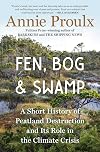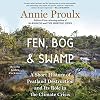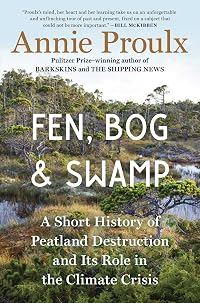
Fen, Bog and Swamp: A Short History of Peatland Destruction and Its Role in the Climate Crisis
by Annie Proulx
On This Page
Description
"A lifelong environmentalist, Annie Proulx brings her wide-ranging research and scholarship to the subject of wetlands and the vitally important yet little understood role they play in preserving the environment--by storing the carbon emissions that greatly contribute to climate change. Fens, bogs, swamps, and marine estuaries are the earth's most desirable and dependable resources, and in four stunning parts, Proulx documents the long-misunderstood role of these wetlands in saving the show more planet. Taking us on a fascinating journey through history, Proulx shows us the fens of 16th-century England to Canada's Hudson Bay lowlands, Russia's Great Vasyugan Mire, America's Okeefenokee National Wildlife Refuge, and the 19th-century explorers who began the destruction of the Amazon rainforest. Along the way, she writes of the diseases spawned in the wetlands--the Ague, malaria, Marsh Fever--and the surprisingly significant role of peat in industrialization. A sobering look at the degradation of wetlands over centuries and the serious ecological consequences, this is a stunningly important work and a rousing call to action by a writer whose passionate devotion to understanding and preserving the environment is on full and glorious display"-- show lessTags
Recommendations





Member Reviews
The Publisher Says: From Pulitzer Prize winner Annie Proulx—whose novels are infused with her knowledge and deep concern for the earth—comes a riveting, revelatory history of our wetlands, their ecological role, and what their systematic destruction means for the planet.
A lifelong environmentalist, Annie Proulx brings her wide-ranging research and scholarship to the subject of wetlands and the vitally important yet little understood role they play in preserving the environment—by storing the carbon emissions that greatly contribute to climate change. Fens, bogs, swamps, and marine estuaries are the earth’s most desirable and dependable resources, and in four stunning parts, Proulx documents the long-misunderstood role of these show more wetlands in saving the planet.
Taking us on a fascinating journey through history, Proulx shows us the fens of 16th-century England to Canada’s Hudson Bay lowlands, Russia’s Great Vasyugan Mire, America’s Okeefenokee National Wildlife Refuge, and the 19th-century explorers who began the destruction of the Amazon rainforest. Along the way, she writes of the diseases spawned in the wetlands—the Ague, malaria, Marsh Fever—and the surprisingly significant role of peat in industrialization.
A sobering look at the degradation of wetlands over centuries and the serious ecological consequences, this is a stunningly important work and a rousing call to action by a writer whose passionate devotion to understanding and preserving the environment is on full and glorious display.
I RECEIVED A DRC FROM THE PUBLISHER VIA NETGALLEY. THANK YOU.
My Review: First things first: Those title words aren't synonyms, exactly, so much as a family tree of naturally occurring wet places on Earth.
This information is important to fully understanding the scale and cost of wetland losses we've inflicted on the planet. Author Proulx (whose use of "yclept" in this book I note here with a big smile, as it's a favorite underused word of mine) is an experienced campaigner when it comes to putting English through its paces to evoke a sense of place and a perception of mood:
Nothing made by human minds is ever perfect. I'm glad the title gave Author Proulx, eighty-six at this writing, an opportunity to mourn publicly the fens of her Connecticut childhood. I was fascinated by the information about the vanished English fens. But the bogs came in for a cursory examination in comparison, seen mostly through the lens of bog bodies. I acknowledge the personal element of the fact that they're bodies probably gave more heft to the science of peat bogs that really needed to be presented. I found it a distraction, though, while others may think of it as an enhancement.
It is with the swamps and bayous of my erstwhile stomping grounds, Southern Texas and its adjacent lowlands, that the short shrift became apparent. Houston and its urban sprawl could, and should, form a book of damning indictments of greed and stupidity. New Orleans was, for reasons I simply can't understand, rescued as a human habitation after the death of the many bayous and wetlands south of it resulted in its near destruction...an expensive playground for rich people. Another book that should be written (again).
But take away from any read the best, accept that not all of it was made with your taste in mind, and Author Proulx's essential message shines a harsh lime-light onto the instrumentalist Judeo-Christian worldview that's landed us in this awful mess:
Our addiction to Being Right, to understanding the uses but not the purposes of this, our one and only planet, is killing us. And the death sentence has fallen on our generation. Lucky, lucky us we have Author Proulx to bear witness: "The waters tremble at our chutzpah and it seems we will not change." show less
A lifelong environmentalist, Annie Proulx brings her wide-ranging research and scholarship to the subject of wetlands and the vitally important yet little understood role they play in preserving the environment—by storing the carbon emissions that greatly contribute to climate change. Fens, bogs, swamps, and marine estuaries are the earth’s most desirable and dependable resources, and in four stunning parts, Proulx documents the long-misunderstood role of these show more wetlands in saving the planet.
Taking us on a fascinating journey through history, Proulx shows us the fens of 16th-century England to Canada’s Hudson Bay lowlands, Russia’s Great Vasyugan Mire, America’s Okeefenokee National Wildlife Refuge, and the 19th-century explorers who began the destruction of the Amazon rainforest. Along the way, she writes of the diseases spawned in the wetlands—the Ague, malaria, Marsh Fever—and the surprisingly significant role of peat in industrialization.
A sobering look at the degradation of wetlands over centuries and the serious ecological consequences, this is a stunningly important work and a rousing call to action by a writer whose passionate devotion to understanding and preserving the environment is on full and glorious display.
I RECEIVED A DRC FROM THE PUBLISHER VIA NETGALLEY. THANK YOU.
My Review: First things first: Those title words aren't synonyms, exactly, so much as a family tree of naturally occurring wet places on Earth.
fens, fed by rivers and streams, usually deep, peat-forming, and supporting reeds and marsh grass
bogs, shallower water fed by rainfall, peat-forming, and supporting sphagnum mosses
swamps, a peat-making, shallow wetland with trees and shrubs
This information is important to fully understanding the scale and cost of wetland losses we've inflicted on the planet. Author Proulx (whose use of "yclept" in this book I note here with a big smile, as it's a favorite underused word of mine) is an experienced campaigner when it comes to putting English through its paces to evoke a sense of place and a perception of mood:
The fen people of all periods knew the still water, infinite moods of cloud. They lived in reflections and moving reed shadows, poled through curtains of rain, gazed at the layered horizon, at curling waves that pummeled the land edge in storms.
–and–
It can take ten thousand years for a bog to convert to peat but in only a few weeks a human on a peat cutter machine can strip a large area down to the primordial gravel.
Nothing made by human minds is ever perfect. I'm glad the title gave Author Proulx, eighty-six at this writing, an opportunity to mourn publicly the fens of her Connecticut childhood. I was fascinated by the information about the vanished English fens. But the bogs came in for a cursory examination in comparison, seen mostly through the lens of bog bodies. I acknowledge the personal element of the fact that they're bodies probably gave more heft to the science of peat bogs that really needed to be presented. I found it a distraction, though, while others may think of it as an enhancement.
It is with the swamps and bayous of my erstwhile stomping grounds, Southern Texas and its adjacent lowlands, that the short shrift became apparent. Houston and its urban sprawl could, and should, form a book of damning indictments of greed and stupidity. New Orleans was, for reasons I simply can't understand, rescued as a human habitation after the death of the many bayous and wetlands south of it resulted in its near destruction...an expensive playground for rich people. Another book that should be written (again).
But take away from any read the best, accept that not all of it was made with your taste in mind, and Author Proulx's essential message shines a harsh lime-light onto the instrumentalist Judeo-Christian worldview that's landed us in this awful mess:
The attitude of looking at nature solely as something to be exploited—without cooperative thanks or appeasing sacrifices—is ingrained in western cultures.
Our addiction to Being Right, to understanding the uses but not the purposes of this, our one and only planet, is killing us. And the death sentence has fallen on our generation. Lucky, lucky us we have Author Proulx to bear witness: "The waters tremble at our chutzpah and it seems we will not change." show less
Fens, bogs, and swamps are all wetlands. The lack of oxygen under the water prevents things that fall into it (plants, animals, artifacts of human civilization) from decomposing, so it just builds up in thick layers of carbon, called peat. Peat is so dense that, if left untouched, wetlands hold more carbon than any other kind of environment. They’re also one of the most endangered environments on earth. Throughout the last several centuries they have been drained of water and pillaged for their resources, then turned into monoculture farmland.
Proulx discusses what led her to be interested in wetlands, a bit on the differences between types of wetlands. Then a chapter called “Fen” discusses the people who lived in the fens of show more prehistoric England, a chapter called “Bog” discusses human bodies found in bogs and the Battle of Teutoburg, and a chapter called “Swamp” details the draining of various North American swamps in the mid- to late-1800s.
I was very much looking forward to reading this and it was quite disappointing. Proulx is not a non-fiction writer or a science communicator. There is no real point here, no thesis statement nor call to action. There are many long tangents (it would be enough to say that the Germans lured the Romans into a swamp at the Battle of Teutoburg, I don’t need 10 pages on it!) and lots of idolizing ancient (white) people for being perfectly at-one with nature, as if they were omniscient instead of just not yet technologically capable of destroying the planet. Proulx rightly criticizes historians who allege that death-by-bog was the traditional punishment for being gay in ancient times, but alleges herself that ancient people would be upset at modern humans for draining wetlands for agriculture (I doubt it! They don’t know what climate change is but they definitely know what easy food is. And they did levee and redirect the wetlands themselves, just not to the modern extent). Most notably, while there are very brief mentions of wetlands elsewhere in the world, the book seems to be willfully only about white people. The fens of eastern England and the bogs of northern Germany together take up half the book, and discussion of swamps in the US begins and ends with white explorers, white politicians and white farmers. How can a book possibly talk about the Great Dismal Swamp and skip over the generations of escaped slaves who lived there? Let alone all of the native people who lived in wetlands across the continent for ten thousand years.
This is a white-washed nothing-burger that does not live up to its title. I want to learn more about peatlands but I’d like something both more scientific and more historical. This is just a few musings. If it was background for a novel it would be fine, but it is not a serious natural history book.
Also, I would never downgrade a book for this, but the lack of Oxford comma in the title and throughout the book drove me crazy. In my head I kept referring to it as “Fen Bognswamp”, which would be a great DnD character name. show less
Proulx discusses what led her to be interested in wetlands, a bit on the differences between types of wetlands. Then a chapter called “Fen” discusses the people who lived in the fens of show more prehistoric England, a chapter called “Bog” discusses human bodies found in bogs and the Battle of Teutoburg, and a chapter called “Swamp” details the draining of various North American swamps in the mid- to late-1800s.
I was very much looking forward to reading this and it was quite disappointing. Proulx is not a non-fiction writer or a science communicator. There is no real point here, no thesis statement nor call to action. There are many long tangents (it would be enough to say that the Germans lured the Romans into a swamp at the Battle of Teutoburg, I don’t need 10 pages on it!) and lots of idolizing ancient (white) people for being perfectly at-one with nature, as if they were omniscient instead of just not yet technologically capable of destroying the planet. Proulx rightly criticizes historians who allege that death-by-bog was the traditional punishment for being gay in ancient times, but alleges herself that ancient people would be upset at modern humans for draining wetlands for agriculture (I doubt it! They don’t know what climate change is but they definitely know what easy food is. And they did levee and redirect the wetlands themselves, just not to the modern extent). Most notably, while there are very brief mentions of wetlands elsewhere in the world, the book seems to be willfully only about white people. The fens of eastern England and the bogs of northern Germany together take up half the book, and discussion of swamps in the US begins and ends with white explorers, white politicians and white farmers. How can a book possibly talk about the Great Dismal Swamp and skip over the generations of escaped slaves who lived there? Let alone all of the native people who lived in wetlands across the continent for ten thousand years.
This is a white-washed nothing-burger that does not live up to its title. I want to learn more about peatlands but I’d like something both more scientific and more historical. This is just a few musings. If it was background for a novel it would be fine, but it is not a serious natural history book.
Also, I would never downgrade a book for this, but the lack of Oxford comma in the title and throughout the book drove me crazy. In my head I kept referring to it as “Fen Bognswamp”, which would be a great DnD character name. show less
An exquisite gem of literary perfection, this love song to the wetlands delves deeply into the science of these environments and the contributions they make to the overall ecosystem. As the author so hauntingly puts it, "The history of the wetlands is their destruction." In many ways, this book is about the painful consequences of wetland eradication as so many birds and plants become extinct almost overnight.
But the disappearance of unique and beneficial lifeforms is only the short term consequences of draining these fertile habitats. Long term, the resultant release of carbon dioxide accelerates the climate crisis. It's not all doom and gloom as the author examines certain success stories of wetland restoration.
There is so much show more fascination and bizarre science in this topic and I was riveted throughout. I didn't want it to end. show less
But the disappearance of unique and beneficial lifeforms is only the short term consequences of draining these fertile habitats. Long term, the resultant release of carbon dioxide accelerates the climate crisis. It's not all doom and gloom as the author examines certain success stories of wetland restoration.
There is so much show more fascination and bizarre science in this topic and I was riveted throughout. I didn't want it to end. show less
A love song to the wetlands, this series of essays on different land/water habitats is comprehensive and informative without being dry (pun intended).
It captures aspects of humankind's interactions with watery land from ancient peoples to modern drainage and the massive implications that has for nature and the environment.
As someone with fenland heritage, I feel inspired to make some land soggy again.
It captures aspects of humankind's interactions with watery land from ancient peoples to modern drainage and the massive implications that has for nature and the environment.
As someone with fenland heritage, I feel inspired to make some land soggy again.
This short, accessible book explains the importance of peat in our ecosystem, and how its destruction has released CO2 and contributed to climate change. Much of the earth’s wetlands have been destroyed, with large swathes of land repurposed for agricultural use. Centuries ago, the long-term effects were not understood and it seemed logical to drain a huge wet area so it could be used to grow food for an increasing population. But in modern times we can measure the environmental impact of peat destruction and yet that doesn't stop the forces of capitalism.
Annie Proulx’s description of various wetlands in Europe, South America, and North America, and the events that led to their destruction, was clear and easy to understand.In her show more acknowledgements, Proulx describes writing this book during the 2020 pandemic, which limited her sources. Unfortunately the result is a book more anecdotal than science-based, lacking a call to action for the reader. It was good, but could have been better. show less
Annie Proulx’s description of various wetlands in Europe, South America, and North America, and the events that led to their destruction, was clear and easy to understand.In her show more acknowledgements, Proulx describes writing this book during the 2020 pandemic, which limited her sources. Unfortunately the result is a book more anecdotal than science-based, lacking a call to action for the reader. It was good, but could have been better. show less
Like many authors' "pandemic" books, I'm having a hard time reviewing this one. Proulx states in the introduction that this was originally a personal essay that grew and grew into the small book that it is, as she researched and reflected, and continued writing. In it, she traces what has happened to the natural world in her 86 year lifetime through the lens of fens (mostly English), bogs (mostly North American), and swamps (mostly in the northernmost part of the South). She doesn't seem to have spent much time in Louisiana, the Houston area, southern Alabama, or Florida...which is where the book kind of breaks down: while the Fens portion is thoroughly researched (it takes 10,000 for peat to form in the UK), the section on Swamp lacks show more the same attention to detail, barring historical notes about George Washington and various instances of swampland being drained to build on.
Use of the generalized "we" always bugs me, even when I agree with the statement in which it's invoked, Another thing that annoys me is her use of a quote from Marie Araña's Conquistadores indicting a core group of conquistadors who invaded what became the Spanish and Portuguese colonies in the first half of the 16th century. She blames them for the "rape of the land" culture perpetuated by western corporations, as if the British East India Company, Hudson Bay Company, etc. didn't exist. I am the last person to exonerate the conquerors of the Americas (including the Church) for their atrocities, but it's a tall order to blame the greed of a handful of poor soldiers from western Spain for 500 years of 2 continents' history.
The strength of this volume is in its assiduous attention to detail: that the world's peatlands occupy 3% of the Earth's surface, which is more than the Amazon region. That the UK has destroyed 99% of its premodern wetlands. That the world's wetlands are a better canary in the coalmine than anything, in terms of extinction. When wetlands go, other things (like forests, fertile land, etc) fall in their wake.
Proulx goes slightly mystical, or else gives a shout-out to Ben Aaronovitch's Rivers of London series, when she invokes Alexander Pope's genius loci to describe the particular environs of fens, bog, and swampland. She grew up playing in wetlands, she shares many memories of the many species of birds, fish, amphibians, etc., that she watched as a child, and it's very clear that the destruction of wetlands feels like a harbinger of doom to her. As a child I often went camping near a protected coastal estuary and have fond memories of tromping through mudflats with herons, cranes, and flamingos. I don't know if they're still there, but I hope so.
Anyway, Proulx's takeaway is "save the planet already!" This is not super helpful in terms of specific action. I had already made a decision to stop using peat-based potting mix in my houseplants and garden, as it's nonrenewable and, uh, peat locks carbon into the ground, so mining it begins with a vast carbon footprint, and that;s before it's even been loaded into a truck to haul away. The trouble is, saving the planet's ecosystem is by and large a corporate and governmental level problem. That puts solutions in the hands of activists and activist-stockholders, who then must lobby against an opposition funded by billionaires.
Solving THAT conundrum is another book entirely, but perhaps an octogenarian's frustrated nostalgia will make a difference after all.
ARC show less
Use of the generalized "we" always bugs me, even when I agree with the statement in which it's invoked, Another thing that annoys me is her use of a quote from Marie Araña's Conquistadores indicting a core group of conquistadors who invaded what became the Spanish and Portuguese colonies in the first half of the 16th century. She blames them for the "rape of the land" culture perpetuated by western corporations, as if the British East India Company, Hudson Bay Company, etc. didn't exist. I am the last person to exonerate the conquerors of the Americas (including the Church) for their atrocities, but it's a tall order to blame the greed of a handful of poor soldiers from western Spain for 500 years of 2 continents' history.
The strength of this volume is in its assiduous attention to detail: that the world's peatlands occupy 3% of the Earth's surface, which is more than the Amazon region. That the UK has destroyed 99% of its premodern wetlands. That the world's wetlands are a better canary in the coalmine than anything, in terms of extinction. When wetlands go, other things (like forests, fertile land, etc) fall in their wake.
Proulx goes slightly mystical, or else gives a shout-out to Ben Aaronovitch's Rivers of London series, when she invokes Alexander Pope's genius loci to describe the particular environs of fens, bog, and swampland. She grew up playing in wetlands, she shares many memories of the many species of birds, fish, amphibians, etc., that she watched as a child, and it's very clear that the destruction of wetlands feels like a harbinger of doom to her. As a child I often went camping near a protected coastal estuary and have fond memories of tromping through mudflats with herons, cranes, and flamingos. I don't know if they're still there, but I hope so.
Anyway, Proulx's takeaway is "save the planet already!" This is not super helpful in terms of specific action. I had already made a decision to stop using peat-based potting mix in my houseplants and garden, as it's nonrenewable and, uh, peat locks carbon into the ground, so mining it begins with a vast carbon footprint, and that;s before it's even been loaded into a truck to haul away. The trouble is, saving the planet's ecosystem is by and large a corporate and governmental level problem. That puts solutions in the hands of activists and activist-stockholders, who then must lobby against an opposition funded by billionaires.
Solving THAT conundrum is another book entirely, but perhaps an octogenarian's frustrated nostalgia will make a difference after all.
ARC show less
My house is on swampland. Well, it isn’t swampland now, but it was in the middle of the last century. A woman a block away told me that her son caught tadpoles in the woods were my house stands.
The entire city was once swampland, as was much of Southeast Michigan. The glaciers that carved the land and melted to make the Great Lakes and the thousands of lakes in Michigan left behind waterlogged land.
The year we moved into this house a torrential rain flooded most of the city.
The Oakland County Landscape Stewardship Plan of 2017 stated:
“The development of the southeastern zone, and the conversion of historically wetland area to
residential properties, has led to a number of complications including a major loss in
stormwater storage and show more flood control capacity. These communities have struggled to adapt to
the loss of these natural stormwater retention areas as hardscape cover has expanded with
continued development. These issues were highlighted in 2012 and 2013 when rainwater from
severe storms closed highways, flooded homes, and stopped commerce and business in this
region for several days. It is important that land managers and foresters understand the
symbiosis that exists between wetlands and forests, and that they ensure the protection of these
adjacent wetland areas is worked into any forest management plan.”
I thought that I had an idea of what the area would have looked like before it was turned into a suburban neighborhood because a few blocks away is Cummingston Park, created in 1925. For as long as I have known the park it has been wet and flooded. But I learned that in the 1950s while a college student, my sixth grade teacher documented it as a wonderful wildflower haven…until the land around it became developed and the water accumulated in the park with no where to go.
Ok, then, I turned to the other local nature park, Tenhave Woods, a mile and a half away, next to my high school. It was formed in 1955. It was fenced after my high school classmate’s brother was murdered in the woods in 1967. Tenhave has a vernal pond and swampland and it is documented that it always had swamp land. It has a high fence to keep out deer and protect the wildflowers. Every spring we visit to see the trillium and other wildflowers that take over the ground. My high school biology teacher was part of the society that formed to protect both of these woods.
My husband’s family also lived on swampland. His great-grandparents and great-great-grandparents settled in Lynne Township, St. Clair County, Michigan on reclaimed swampland. In fact, the 1865 map shows A. Scoville’s land bordered the swampland. The 1897 map shows all that swampland was privately owned farms. When we visited the area we could see the drainage ditches.
How much of its wetlands has Michigan lost? I was shocked to learn that the greatest loss was around Lake Huron and Lake St Clair. Why would I be surprised? Constance Fenimore Woolston’s 1855 story St. Clair Flats tells of a man’s enchanted encounter with the St, Clair marshes only to return five years later to find them destroyed and replaced by a canal.
That’s a lot of wetlands loss.
Annie Proulx wanted to understand and organize the massive amount of information about wetlands and their loss and the impact on climate change. Her essay turned into a book. In brief, wetlands store CO2, and their destruction releases it into the atmosphere. Once lost, wetlands are not easily restores. But across the world, we are endeavoring to reclaim lost wetlands.
The book considers the various forms of wetlands:
fens, fed by rivers and streams, usually deep, peat-forming, and supporting reeds and marsh grass
bogs, shallower water fed by rainfall, peat-forming, and supporting sphagnum mosses
swamps, a peat-making, shallow wetland with trees and shrubs
I was quite charmed by the book. Proulx delves into so many aspects of wetlands. She describes humans who once lived in harmony with the land, before land was privatized and turned into ‘productive’ farmland to increase the owner’s wealth. The English fens once covered 15,500 square miles and now less than 1 percent remains. The abundant life of the fens also disappeared. My mind was set alight reading about the lost Doggerland which connected Britain and Europe, suddenly flooded by seawater from glacial melt at the end of the Ice Age. I dreamed of those people that night. “I wonder if, as the waters rose, metamorphosing proto-England from the doorstep of a vast continent to a small island, some landscape memory of hugeness underlay the country’s later drive for empire,” Proulx muses.
The sphagnum moss of the bogs “holds a third of the earth’s organic carbon,” I learned. When drained, the soil still leaks CO2 for a hundred years. “It can take ten thousand years for a bog to convert to peat but in only a few weeks a human on a peat cutter machine can strip a large area down to the primordial gravel.” In ancient times, humans made offerings to the bogs. Including humans. Bog people have been discovered across the world, preserved by the acidity and low oxygen, telling their gruesome stories of human sacrifice.
In 1849 Congress passed the first Swamp Land laws that allowed states to sell wetlands for draining. The land made first rate farm land. The Great Black Swamp, the Dismal Swamp, the Kankakee, mangrove swamps, the Limberlost–all their stories are told by Proulx.
Proulx describes the beauty of these vanished landscapes.
The fen people of all periods knew the still water, infinite moods of cloud. They lived in reflections and moving reed shadows, poled through curtains of rain, gazed at the layered horizon, at curling waves that pummeled the land edge in storms.
from Fen, Bog, & Swamp by Annie Proulx
My husband recalled when he worked as a grants officer that Duck Unlimited was a major contributor to wetlands protection as supporting duck hunting. And pages later, Proulx commented on this ironic support. Her descriptions of the multitude and number of species that flourish in wetlands is wondrous. And when we discovered them, what did we do? We brought our guns and hunted for the sake of shooting. As if our only response to being awestruck by the magnificence of the natural world is to destroy it.
And by destroying wetlands, we have increased the CO2 that drives climate change. Some wetlands are being restored as we realize their benefit.
Is it too late to stop or reverse or slow climate change? Can humans alter their concept of using the natural world to respecting it? The rights of nature is an emerging concept, and if we can alter our behavior and laws, perhaps the very worse can be avoided. Maybe.
So, I enjoy my house, inherited from my parents who bought it five years after it was built, a house which sits where once a pond existed, where even fifty years ago garter snakes and toads visited the yard. And realize that my gain and benefit had a huge cost on the local and world environment.
I received a free ARC from Simon & Schuster. My review is fair and unbiased show less
The entire city was once swampland, as was much of Southeast Michigan. The glaciers that carved the land and melted to make the Great Lakes and the thousands of lakes in Michigan left behind waterlogged land.
The year we moved into this house a torrential rain flooded most of the city.
The Oakland County Landscape Stewardship Plan of 2017 stated:
“The development of the southeastern zone, and the conversion of historically wetland area to
residential properties, has led to a number of complications including a major loss in
stormwater storage and show more flood control capacity. These communities have struggled to adapt to
the loss of these natural stormwater retention areas as hardscape cover has expanded with
continued development. These issues were highlighted in 2012 and 2013 when rainwater from
severe storms closed highways, flooded homes, and stopped commerce and business in this
region for several days. It is important that land managers and foresters understand the
symbiosis that exists between wetlands and forests, and that they ensure the protection of these
adjacent wetland areas is worked into any forest management plan.”
I thought that I had an idea of what the area would have looked like before it was turned into a suburban neighborhood because a few blocks away is Cummingston Park, created in 1925. For as long as I have known the park it has been wet and flooded. But I learned that in the 1950s while a college student, my sixth grade teacher documented it as a wonderful wildflower haven…until the land around it became developed and the water accumulated in the park with no where to go.
Ok, then, I turned to the other local nature park, Tenhave Woods, a mile and a half away, next to my high school. It was formed in 1955. It was fenced after my high school classmate’s brother was murdered in the woods in 1967. Tenhave has a vernal pond and swampland and it is documented that it always had swamp land. It has a high fence to keep out deer and protect the wildflowers. Every spring we visit to see the trillium and other wildflowers that take over the ground. My high school biology teacher was part of the society that formed to protect both of these woods.
My husband’s family also lived on swampland. His great-grandparents and great-great-grandparents settled in Lynne Township, St. Clair County, Michigan on reclaimed swampland. In fact, the 1865 map shows A. Scoville’s land bordered the swampland. The 1897 map shows all that swampland was privately owned farms. When we visited the area we could see the drainage ditches.
How much of its wetlands has Michigan lost? I was shocked to learn that the greatest loss was around Lake Huron and Lake St Clair. Why would I be surprised? Constance Fenimore Woolston’s 1855 story St. Clair Flats tells of a man’s enchanted encounter with the St, Clair marshes only to return five years later to find them destroyed and replaced by a canal.
That’s a lot of wetlands loss.
Annie Proulx wanted to understand and organize the massive amount of information about wetlands and their loss and the impact on climate change. Her essay turned into a book. In brief, wetlands store CO2, and their destruction releases it into the atmosphere. Once lost, wetlands are not easily restores. But across the world, we are endeavoring to reclaim lost wetlands.
The book considers the various forms of wetlands:
fens, fed by rivers and streams, usually deep, peat-forming, and supporting reeds and marsh grass
bogs, shallower water fed by rainfall, peat-forming, and supporting sphagnum mosses
swamps, a peat-making, shallow wetland with trees and shrubs
I was quite charmed by the book. Proulx delves into so many aspects of wetlands. She describes humans who once lived in harmony with the land, before land was privatized and turned into ‘productive’ farmland to increase the owner’s wealth. The English fens once covered 15,500 square miles and now less than 1 percent remains. The abundant life of the fens also disappeared. My mind was set alight reading about the lost Doggerland which connected Britain and Europe, suddenly flooded by seawater from glacial melt at the end of the Ice Age. I dreamed of those people that night. “I wonder if, as the waters rose, metamorphosing proto-England from the doorstep of a vast continent to a small island, some landscape memory of hugeness underlay the country’s later drive for empire,” Proulx muses.
The sphagnum moss of the bogs “holds a third of the earth’s organic carbon,” I learned. When drained, the soil still leaks CO2 for a hundred years. “It can take ten thousand years for a bog to convert to peat but in only a few weeks a human on a peat cutter machine can strip a large area down to the primordial gravel.” In ancient times, humans made offerings to the bogs. Including humans. Bog people have been discovered across the world, preserved by the acidity and low oxygen, telling their gruesome stories of human sacrifice.
In 1849 Congress passed the first Swamp Land laws that allowed states to sell wetlands for draining. The land made first rate farm land. The Great Black Swamp, the Dismal Swamp, the Kankakee, mangrove swamps, the Limberlost–all their stories are told by Proulx.
Proulx describes the beauty of these vanished landscapes.
The fen people of all periods knew the still water, infinite moods of cloud. They lived in reflections and moving reed shadows, poled through curtains of rain, gazed at the layered horizon, at curling waves that pummeled the land edge in storms.
from Fen, Bog, & Swamp by Annie Proulx
My husband recalled when he worked as a grants officer that Duck Unlimited was a major contributor to wetlands protection as supporting duck hunting. And pages later, Proulx commented on this ironic support. Her descriptions of the multitude and number of species that flourish in wetlands is wondrous. And when we discovered them, what did we do? We brought our guns and hunted for the sake of shooting. As if our only response to being awestruck by the magnificence of the natural world is to destroy it.
And by destroying wetlands, we have increased the CO2 that drives climate change. Some wetlands are being restored as we realize their benefit.
Is it too late to stop or reverse or slow climate change? Can humans alter their concept of using the natural world to respecting it? The rights of nature is an emerging concept, and if we can alter our behavior and laws, perhaps the very worse can be avoided. Maybe.
So, I enjoy my house, inherited from my parents who bought it five years after it was built, a house which sits where once a pond existed, where even fifty years ago garter snakes and toads visited the yard. And realize that my gain and benefit had a huge cost on the local and world environment.
I received a free ARC from Simon & Schuster. My review is fair and unbiased show less
Members
- Recently Added By
Lists

Books Read in 2023
5,547 works; 145 members

Books Read in 2024
4,623 works; 124 members
Author Information

43+ Works 35,205 Members
Edna Annie Proulx was born in Norwich, Connecticut on August 22, 1935. She graduated from the University of Vermont in 1969 and earned an M. A. from Sir George Williams University in Montreal in 1973. She was a journalist, wrote nonfiction articles for numerous publications, and was the author of several "how-to" books before beginning to write show more fiction in her 50s. She became the first woman to win the prestigious PEN/Faulkner Award for Fiction, for her debut novel Postcards. Her novel The Shipping News won the Pulitzer Prize for Fiction and the National Book Award in 1994. Accordion Crimes, published in 1996, won the Dos Passos Prize for literature. She also won the O. Henry prize for the year's best short story twice; in 1998 for Brokeback Mountain and in 1999 for The Mud Below. She has written more than 50 articles and stories for periodicals and edited Best American Short Stories of 1997. (Bowker Author Biography) show less
Some Editions
Awards and Honors
Awards
Distinctions
The Guardian Book of the Day (2022-09-19)
Common Knowledge
- Canonical title*
- Veen, dras, moeras
- Original title
- Fen, Bog and Swamp : A Short History of Peatland Destruction and Its Role in the Climate Crisis
- Alternate titles
- Fen, bog & swamp
- Original publication date
- 2022
- Dedication
- This little book is dedicated to the people of Ecuador who made their land the first country in the world to include legal rights for natural ecosystems in its constitution. The recent ruling against mining companies to prote... (show all)ct the Andean cloud forest Los Cedros is a significant event for the world.
- First words
- These pages started out as a personal essay to help me understand the wetlands that are so intimately tied to the climate crisis.
- Last words
- (Click to show. Warning: May contain spoilers.)In the end all humans will be "haunted by waters".
- Blurbers
- Doerr, Anthony; McKibben, Bill
- Original language
- English
*Some information comes from Common Knowledge in other languages. Click "Edit" for more information.
Classifications
- Genres
- Science & Nature, General Nonfiction, Nonfiction
- DDC/MDS
- 577.687 — Natural sciences & mathematics Biology Biomes & Ecosystems Aquatic ecology, Freshwater ecology
- LCC
- GB621 .P76 — Geography, Anthropology and Recreation Physical geography Physical geography Geomorphology. Landforms. Terrain Other natural landforms: Floodplains, caves,
- BISAC
Statistics
- Members
- 350
- Popularity
- 89,985
- Reviews
- 17
- Rating
- (3.62)
- Languages
- Dutch, English, German
- Media
- Paper, Audiobook, Ebook
- ISBNs
- 16
- ASINs
- 5