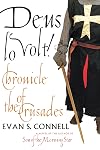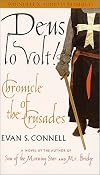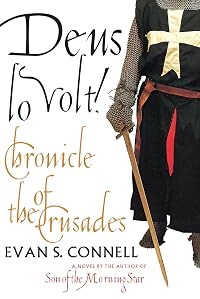
Deus lo Volt! Chronicle of the Crusades
by Evan S. Connell
On This Page
Description
God wills it! The year is 1095. Thousands of men, including many of the leaders of the Christian world, have assembled in a meadow in France near Clermont. Pope Urban appeals for the liberation of Jerusalem and the people shout, Deus lo volt! The cry is taken up, echoes forth, is carried on. The crusades have begun. Wave upon wave of Christian pilgrims assault the growing power of the Muslims in the Holy Land - and will do so for the next two hundred years. Most able men become soldiers of show more the Cross, and many of their women fight alongside them. It is a time of great adventure-of great exploration and cultural change. Uniting Christian Europe in a common cause, the crusades defined forever the spirit of the West. show lessTags
Recommendations




















Member Reviews
Excerpts from possible real chronicles of the crusades where the most famous French medieval chronicler [and here narrator], Seneschal Jean de Joinville, breaks in once in awhile. Odd book--mixture of fiction and nonfiction. Jean doesn't become part of the action until King Louis's crusade--the Seventh--near the end. He exhibits absolutely no personality; his function is to tie the excerpts together. He does attribute the various excerpts to real-life chroniclers of that period, such as Anna Comnena, writing about her father. We are carried through the sweep of the crusades from beginning to end.
The 3rd Crusade was a major part. It was interesting how Richard of England happened to be captured by Leopold of Austria and why. Background show more of 4th Crusade: why Dandolo hated Constantinople. Jean interjects at various places such-and-such relative fought at such-and-such battle, also after telling a certain anecdote he doesn't swear as to its veracity. Saladin is presented as a model of chivalry and courtesy: template for his subsequent fictional treatment for the most part.
I felt 4th Crusade--Sack of Constantinople--one of the best parts. I didn't realize some men went home rather than attack other Christians. Afterwards, there was an a"Albigensian Crusade" and an Inquisition to root heretics out. Finishing up the last crusades seemed a bit rushed. The style took awhile to get used to, but the book on the whole was enjoyable. The structure of the book was an interesting concept. show less
The 3rd Crusade was a major part. It was interesting how Richard of England happened to be captured by Leopold of Austria and why. Background show more of 4th Crusade: why Dandolo hated Constantinople. Jean interjects at various places such-and-such relative fought at such-and-such battle, also after telling a certain anecdote he doesn't swear as to its veracity. Saladin is presented as a model of chivalry and courtesy: template for his subsequent fictional treatment for the most part.
I felt 4th Crusade--Sack of Constantinople--one of the best parts. I didn't realize some men went home rather than attack other Christians. Afterwards, there was an a"Albigensian Crusade" and an Inquisition to root heretics out. Finishing up the last crusades seemed a bit rushed. The style took awhile to get used to, but the book on the whole was enjoyable. The structure of the book was an interesting concept. show less
This book is chronicle of the crusades. The author assumes the persona of a Seneschal of France, Jean de Joinville, who joins with St. Louis in a failed crusade to the Holy Land. The knight Jean, however, recounts the entire tale of the Crusades, from the initial preaching of Peter the hermit and the announcement of the first Crusade by Pope Urban in 1089, to the final fall of Acre and the routing of the knights Templar and Hospitaller from the Holy Land. The author, on the dust jacket, claims that all the conversations, the speeches, and the events are those recorded in medieval manuscripts, simply edited and put into order. The book certainly reads like an authentic medieval work, with pious asides such as "Now we see how the lord's show more work is done" with every anecdote, and wonder. The other remarkable part of the book is the constant, palpable brutality of Christians and Saracens, both of whom indulge in rape, torture, and beheadings at every chance. show less
mislukte poging om in 1 roman het verhaal te vertellen van alle kruistochten. Saai leeswerk, maar wel historisch goed onderbouwd. Moeizame stijl. Opeenstapeling van bijeen gesprokkeld feitenmateriaal in een kunstmatig kader.
May 27, 2010Dutch
Ratings
Members
- Recently Added By
Author Information

30+ Works 5,298 Members
Evan S. Connell was born August 17, 1924 in Kansas City, Missouri. He graduated from the University of Kansas in 1947. His first work, The Anatomy Lesson and Other Stories, was published in 1957. His first novel, Mrs. Bridge, was published in 1959. The sequel, Mr. Bridge, was published ten years later. In 1990, both novels were adapted into the show more film Mr. and Mrs. Bridge starring Paul Newman and Joanne Woodward. He wrote more than 15 books during his lifetime including Son of the Morning Star: Custer and the Little Bighorn, The Patriot, The Diary of a Rapist, The Connoisseur, Deus Lo Volt!, and Lost in Uttar Pradesh. He died on January 10, 2013 at the age of 88. (Bowker Author Biography) show less
Awards and Honors
Awards
Common Knowledge
- Canonical title
- Deus lo Volt! Chronicle of the Crusades
- Original title
- Deus lo Volt! Chronicle of the Crusades
- Original publication date
- 2000
- People/Characters
- Richard I, King of England; Saladin; Louis IX, King of France; Jean de Joinville
- Important places
- Constantinople; Jerusalem
- Important events
- First Crusade (1096 | 1099); Seventh Crusade
- Epigraph
- The stream of Time, inexorable, constant,
removes from our sight all things that
are born and carries into the night deeds of
little accounts, deeds worthy of notice...
-Princess Anna Comnena - Dedication
- For Naoma and Webster Schott
- First words
- In the year of our Lord 1189 my father's father, Geoffrey, died at the siege of Acre.
- Last words
- (Click to show. Warning: May contain spoilers.)The sense of it, I, Jean de Joinville, do not presume to know.
- Blurbers
- Theroux, Alexander; Steele, Max; Spinella, Michael
Classifications
Statistics
- Members
- 363
- Popularity
- 86,614
- Reviews
- 3
- Rating
- (3.47)
- Languages
- Catalan, English, Italian, Spanish
- Media
- Paper, Audiobook, Ebook
- ISBNs
- 13
- ASINs
- 5