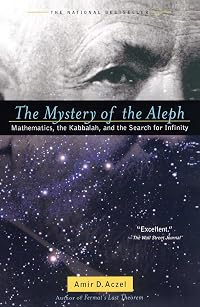
The Mystery of the Aleph: Mathematics, the Kabbalah, and the Search for Infinity
by Amir D. Aczel
On This Page
Description
"In the late 19th century, a brilliant mathematician languished in an asylum. His greatest accomplishment, the result of a series of leaps of insight, was his pioneering understanding of the nature of infinity. This is the story of Georg Cantor: how he came to his theories and the reverberations of his work, the consequences of which shape our world." "Cantor's theory of the infinite is famous for its many seeming contradictions: for example, we can prove there are as many points on a line show more one inch long as on a line one mile long; we can also prove that in all time there are as many years as there are days. According to Cantor, infinite sets are equal." "The mind-twisting, deeply philosophical work of Cantor has its roots in ancient Greek mathematics and Jewish numerology as found in the mystical work known as the Kabbalah. Cantor used the term aleph - the first letter of the Hebrew alphabet, with all its attendant divine associations - to refer to the mysterious number which is the sum of positive integers. It is not the last positive number, because ... there is no last. It is the ultimate number that is always being approached: just as, for example, there is no last fraction before the number 1"--Jacket. show lessTags
Recommendations






Member Recommendations
Member Reviews
I abandoned this book at least a decade ago, after reading only one chapter. It's a topic that I'm extremely interested in, but I just don't have a use for a book on this topic that's almost entirely without references. Flipping through the first chapter now in an attempt to remember why I found it so disappointing, this sentence stood out: "A great tribute to the Pythagoreans' intellectual achievements is the fact that they deduced the special place of the number 10 from an abstract mathematical argument rather than from counting the fingers on two hands." This seems pretty speculative; I can't help wondering whether the justification might have come *after* the idea that ten was special.
Aczel weaves together an introduction to kabbalah and transfinite numbers. Largely this is done with the biographies of Georg Cantor and Kurt Gödel. There's a Jewish connection. A God connection. Both pondered infinities into mental instability, it seems. So, this is a safer way to consider the innumerable, the uncountable, and the continuum hypothesis.
The misleading subtitle probably is largely responsible for the poor reviews, though the early chapters that jump around quite a bit do it no favors. Overall, I enjoyed it as a easy-reading history of mathematics with specific focus on infinity and set theory, and brief biographies of Georg Cantor and Kurt Godel. To fully realize the promise of the the subtitle, it would've needed far more content exploring the historical intersection of mysticism and mathematics.
Focusing on the mathematics of infinity, this popular science book and one-time national bestseller traces the development of the understanding of infinity historically, blending mathematics for the uninitiated (if not the non-mathematical) with stories of personal lives and local color. Aczel uses chronology as a natural method to structure his discussion of how ideas influenced each other and developed onward, which is actually a very useful approach. I appreciated that aspect of the book, and I appreciated the ease and clarity with which the author pulled us through some very fascinating and complex ideas, from the Greeks to modern times. I most assuredly came out better educated and intrigued.
My quibble with this book, though, is show more that its examples run the gamut on the factors of each "am I as a reader supposed to be understanding this explanation?" and "can I understand it?". When I was both intended to understand and could understand, Aczel's explanations were wonderful; I really did learn a lot. Unfortunately, he often gave an overview of a mathematical proof and then moved on after a sentence or two, neither really explaining the overview nor explaining that he never intended to explain. This, I'd like to blame on sloppy editing -- editor choosing to delete paragraphs of cogent explanation because the book gets too into the weeds, without adding in appropriate transitions -- but it happened too regularly by the end of the book to be entirely the editor's fault. A bit more smoothing would have helped the book, if not transformed it into something outstanding.
Aczel wins points for never repeating himself (nonfiction win!), for being honest about his philosophical viewpoint that mathematics has an existence outside from the minds of humans, and for writing so well as to make me very curious about what new information the next page would present. Nevertheless, though I can't express why, I still can't find myself rating this one as high as 4.0. As a result, 3.5 stars it gets. However, I'd have no qualms at all in recommending it for people interested in a basic introduction to the mathematical understanding of infinity (or in Cantor, fascinating mind that he was). show less
My quibble with this book, though, is show more that its examples run the gamut on the factors of each "am I as a reader supposed to be understanding this explanation?" and "can I understand it?". When I was both intended to understand and could understand, Aczel's explanations were wonderful; I really did learn a lot. Unfortunately, he often gave an overview of a mathematical proof and then moved on after a sentence or two, neither really explaining the overview nor explaining that he never intended to explain. This, I'd like to blame on sloppy editing -- editor choosing to delete paragraphs of cogent explanation because the book gets too into the weeds, without adding in appropriate transitions -- but it happened too regularly by the end of the book to be entirely the editor's fault. A bit more smoothing would have helped the book, if not transformed it into something outstanding.
Aczel wins points for never repeating himself (nonfiction win!), for being honest about his philosophical viewpoint that mathematics has an existence outside from the minds of humans, and for writing so well as to make me very curious about what new information the next page would present. Nevertheless, though I can't express why, I still can't find myself rating this one as high as 4.0. As a result, 3.5 stars it gets. However, I'd have no qualms at all in recommending it for people interested in a basic introduction to the mathematical understanding of infinity (or in Cantor, fascinating mind that he was). show less
I was infinitely disappointed with this book. I expected so much more. The biggest problem is that I don't believe Aczel knew what kind of book he wanted to write. The subtitle is “Mathematics, the Kabbalah, and the Search for Infinity.” What the subtitle should have been was, “Study Infinity and Lose your Mind.” Because that's really all he harped on. Cantor studied infinity, and what happened to him? He went crazy. Godel picks up the torch. Result? Crazy. I think a few more mathematicians might have gone off the deep end as well, but I don't remember. I found myself just wanting to get through it. What math there was contributed little to the narrative. The Kabbalah gets one chapter, and is barely mentioned again. But I did show more learn something about infinity. It can't be comprehended. Gee, I think I knew that before I picked up this book. Oh well, I did get one good tidbit out of it. Lord Bertrand Russell could be a real scoundrel when he wanted to. God love him. show less
This is my third book by Aczel, preceded (in reading order) by The Riddle of the Compass and Pendulum. I found this one to be the weakest of the three, which is odd since Aczel has multiple degrees in mathematics and has lectured on the subject at several top universities.
Mystery of the Aleph traces the concept of infinity from its first stirrings in Greek antiquity, through early efforts at defining it both as a mathematical concept and as a metaphor for God (the Kabbalah connection), and into the life of Georg Cantor and his successors who turned the study of infinity into a concrete mathematical exercise.
I think that perhaps Aczel, being a mathematician, was too close to the subject matter and I found many of the mathematical show more explanations a bit sparse. I also did not care for the over-emphasis on the descent into madness of both Cantor and Gödel while working on transfinite set theory. It reminded me of similar stories surrounding thermodynamics and the depression of Boltzmann and others. Repeat after me: sometimes people with bipolar disorder, schizophrenia, or other mental illnesses have jobs in math or science, but the study of hard or esoteric math problems does not cause or trigger mental illness. show less
Mystery of the Aleph traces the concept of infinity from its first stirrings in Greek antiquity, through early efforts at defining it both as a mathematical concept and as a metaphor for God (the Kabbalah connection), and into the life of Georg Cantor and his successors who turned the study of infinity into a concrete mathematical exercise.
I think that perhaps Aczel, being a mathematician, was too close to the subject matter and I found many of the mathematical show more explanations a bit sparse. I also did not care for the over-emphasis on the descent into madness of both Cantor and Gödel while working on transfinite set theory. It reminded me of similar stories surrounding thermodynamics and the depression of Boltzmann and others. Repeat after me: sometimes people with bipolar disorder, schizophrenia, or other mental illnesses have jobs in math or science, but the study of hard or esoteric math problems does not cause or trigger mental illness. show less
When I took a course on the study of the Kabbalah back in college, this book was one of the required reading materials. At the time, we only covered parts of it, but I loved the entire connection between the Kabbalah and mathematics, and hoped to read through the whole thing at some point.
Unfortunately, my perspective towards math has become much more favorable since then. I say "unfortunate" because although this book helped me become less intimidated and more interested with the field of mathematics, it didn't wow me as much as it did in the past. Moreover, the Kabbalah connection is very loosely connected -- not only is it not mentioned much more in the book after the first couple of chapters, but it's based upon a conjecture on the show more depths of Cantor's heritage. It might just be my own perception, but it doesn't seem like the theme holds together very well, and at points the timeframe of when important people are described seems to jump all over the place.
What I disliked the most, however, was Aczel's occasional insinuation that the pursuit of infinity "caused" the decline in mental health of several key figures. This bothers me because it makes it sound like there were no other root causes. While Aczel does note other things (particularly Cantor's antagonists, who made efforts to discredit his views), and while I understand how it's impossible to get into neurochemistry and psychopathology considering how the figures are historical, it becomes annoying when there is no other theories presented about how a person with mental illness might have been so motivated to research these concepts.
Still, maybe time will again make me look at this book in a different light. The subjects that aren't relating to mathematics (history, psychology, philosophy, religion) are all there but don't come together. What does come together is what kept me reading this book: the math (which was easy for me back then to understand) and the passion behind mathematics. So I can't recommend this book to everyone, but if you grew up thinking math was boring or difficult or intimidating (not that the concept of infinity is NOT difficult or intimidating)... maybe this will help you fall in love, just like it happened with me. show less
Unfortunately, my perspective towards math has become much more favorable since then. I say "unfortunate" because although this book helped me become less intimidated and more interested with the field of mathematics, it didn't wow me as much as it did in the past. Moreover, the Kabbalah connection is very loosely connected -- not only is it not mentioned much more in the book after the first couple of chapters, but it's based upon a conjecture on the show more depths of Cantor's heritage. It might just be my own perception, but it doesn't seem like the theme holds together very well, and at points the timeframe of when important people are described seems to jump all over the place.
What I disliked the most, however, was Aczel's occasional insinuation that the pursuit of infinity "caused" the decline in mental health of several key figures. This bothers me because it makes it sound like there were no other root causes. While Aczel does note other things (particularly Cantor's antagonists, who made efforts to discredit his views), and while I understand how it's impossible to get into neurochemistry and psychopathology considering how the figures are historical, it becomes annoying when there is no other theories presented about how a person with mental illness might have been so motivated to research these concepts.
Still, maybe time will again make me look at this book in a different light. The subjects that aren't relating to mathematics (history, psychology, philosophy, religion) are all there but don't come together. What does come together is what kept me reading this book: the math (which was easy for me back then to understand) and the passion behind mathematics. So I can't recommend this book to everyone, but if you grew up thinking math was boring or difficult or intimidating (not that the concept of infinity is NOT difficult or intimidating)... maybe this will help you fall in love, just like it happened with me. show less
Members
- Recently Added By
Lists

HS Mathematics class library
79 works; 6 members

Mathematics
3 works; 1 member
Author Information

24 Works 5,274 Members
Amir D. Aczel was born in Haifa, Israel on November 6, 1950. He received bachelor's and master's degrees in mathematics from the University of California, Berkeley and a doctorate in decision sciences from the business school at the University of Oregon. He taught at several universities during his lifetime including the University of Alaska and show more Bentley College. His first book, Complete Business Statistics, was published in 1989 and went through eight editions. His other books include How to Beat the I.R.S. at Its Own Game: Strategies to Avoid - and Fight - an Audit; Fermat's Last Theorem: Unlocking the Secret of an Ancient Mathematical Problem; The Mystery of the Aleph: Mathematics, the Kabbalah, and the Search for Infinity; The Riddle of the Compass: The Invention That Changed the World; Entanglement: The Greatest Mystery in Physics; and Finding Zero: A Mathematician's Odyssey to Uncover the Origins of Numbers. He died from cancer on November 26, 2015 at the age of 65. (Bowker Author Biography) show less
Classifications
- Genres
- Nonfiction, Science & Nature, Religion & Spirituality, Philosophy, General Nonfiction, History, Biography & Memoir
- DDC/MDS
- 511.3 — Natural sciences & mathematics Mathematics General principles of mathematics Mathematical (Symbolic) logic
- LCC
- QA9 .A236 — Science Mathematics Mathematics General
- BISAC
Statistics
- Members
- 588
- Popularity
- 50,049
- Reviews
- 18
- Rating
- (3.35)
- Languages
- 5 — English, German, Italian, Korean, Portuguese
- Media
- Paper, Audiobook
- ISBNs
- 10
- ASINs
- 2