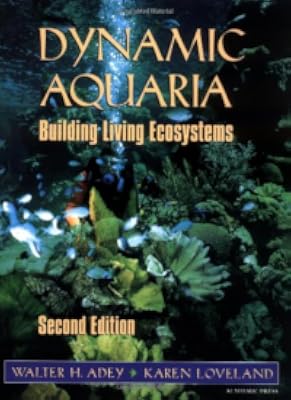
Dynamic Aquaria: Building Living Ecosystems
by Walter H. Adey
On This Page
Description
In its third edition, this praised book demonstrates how the living systems modeling of aquatic ecosystems for ecological, biological and physiological research, and ecosystem restoration can produce answers to very complex ecological questions. This book further offers an understanding developed in 25 years of living ecosystem modeling and discusses how this knowledge has produced methods of efficiently solving many environmental problems. Public education through this methodology is the show more additional key to the broader ecosystem understanding necessary to allow human society to pass through the show lessTags
Recommendations


























Member Reviews
What a fascinating book. Written by aquarium specialist from the Smithsonian Institute and the National Museum of Natural History who have researched and worked very hard (obviously) over the years to recreate living ecosystems ...especially those in the marine environment. Mainly that covers fish tanks or coral reefs but they seem to take it a lot further. For example they have what they term "mesocosms" that emulate wetlands and the intertidal zones. And, interesting to me, they partnered with the Great Barrier reef authority to develop a coral reef system in miniature.
Having had my share of table top fish tanks over the years, I've always wondered about water quality in semi closed systems and wondered about the migration of ions show more from both the construction of the tank (glass, sealants) and the contents...stone, sand, plastic, etc., This book actually goes into a lot of detail about these sort of breakdowns and toxic products produced in the process. And they seem to have developed what they call an "Algal Scrubber" which helps to remove such toxic byproducts. (At least, I think they developed it....they certainly refer to it and use it a lot).
I was also impressed with the way the book was very oriented to the practitioner:....the person who actually keeps an aquarium or vivariium or paludarium. And there were instructions there for the family who keep a fish tank as well as for a state body maintaining a national asset. There is also a wealth of information there about marine plants including information such as the likely evolutionary pathway for plants that live wholly underwater , those that have their roots in the water and those that hug the waterline. One thing that I found interesting was the relative net productivity of the different species with submerged plants producing up to 20kg dry matter per year whilst emergent plants (like rushes, sedges, grasses0 can produce between 3--85 tonnes dry matter per ha per year. (p357). This compares with maize which might produce 25 tonnes of DM per ha per annum in very good conditions. (Actually this is not quite fair because a maize crop produces this in about 5-6 months. I was also fascinated by the relationship between organism size and the numbers of that organism (p253) which showed the typical straight line relationship when plotted on a log/log basis but showed a drop off below a certain size (below 0.005 m. They suggest that even with adding protozoa and bacteria this drop off would remain. I'm not so sure. (many of these tiny animals have yet to be identified).
And I've long been aware that the oyster is a filter feeder but the diagram on p443 put this into perspective. I was not aware that they could remove particles as small as 1 micrometer. (We need to get these guys working in the road tunnel ventilation systems near to my home.....particles of this size are implicated in all sorts of medical conditions).
I've actually visited a lot of aquariums around the world ....probably the most impressive one was in Okinawa where there were huge whale sharks cruising around a simply massive acrylic tank. I guess that they must practice very complex water treatment etc to maintain this.
They are clearly of the view that the more complex systems with plants predators and animals of various sorts are also the most stable and they emphasise a whole "ecosystem" approach to maintaining aquaria.
A huge amount of information in this book. I've only scratched the surface with these comments. Really liked the book. My version is now a little dated (1991) and there are a least two more recent editions since then. Easily five stars from me. show less
Having had my share of table top fish tanks over the years, I've always wondered about water quality in semi closed systems and wondered about the migration of ions show more from both the construction of the tank (glass, sealants) and the contents...stone, sand, plastic, etc., This book actually goes into a lot of detail about these sort of breakdowns and toxic products produced in the process. And they seem to have developed what they call an "Algal Scrubber" which helps to remove such toxic byproducts. (At least, I think they developed it....they certainly refer to it and use it a lot).
I was also impressed with the way the book was very oriented to the practitioner:....the person who actually keeps an aquarium or vivariium or paludarium. And there were instructions there for the family who keep a fish tank as well as for a state body maintaining a national asset. There is also a wealth of information there about marine plants including information such as the likely evolutionary pathway for plants that live wholly underwater , those that have their roots in the water and those that hug the waterline. One thing that I found interesting was the relative net productivity of the different species with submerged plants producing up to 20kg dry matter per year whilst emergent plants (like rushes, sedges, grasses0 can produce between 3--85 tonnes dry matter per ha per year. (p357). This compares with maize which might produce 25 tonnes of DM per ha per annum in very good conditions. (Actually this is not quite fair because a maize crop produces this in about 5-6 months. I was also fascinated by the relationship between organism size and the numbers of that organism (p253) which showed the typical straight line relationship when plotted on a log/log basis but showed a drop off below a certain size (below 0.005 m. They suggest that even with adding protozoa and bacteria this drop off would remain. I'm not so sure. (many of these tiny animals have yet to be identified).
And I've long been aware that the oyster is a filter feeder but the diagram on p443 put this into perspective. I was not aware that they could remove particles as small as 1 micrometer. (We need to get these guys working in the road tunnel ventilation systems near to my home.....particles of this size are implicated in all sorts of medical conditions).
I've actually visited a lot of aquariums around the world ....probably the most impressive one was in Okinawa where there were huge whale sharks cruising around a simply massive acrylic tank. I guess that they must practice very complex water treatment etc to maintain this.
They are clearly of the view that the more complex systems with plants predators and animals of various sorts are also the most stable and they emphasise a whole "ecosystem" approach to maintaining aquaria.
A huge amount of information in this book. I've only scratched the surface with these comments. Really liked the book. My version is now a little dated (1991) and there are a least two more recent editions since then. Easily five stars from me. show less
Ratings
Members
- Recently Added By
Author Information
4 Works 31 Members
Classifications
- Genres
- Nonfiction, Science & Nature, General Nonfiction
- DDC/MDS
- 639.34 — Applied science & technology Agriculture Hunting, fishing, conservation, related technologies Pet Reptiles Fish culture in aquariums
- LCC
- SF457.5 .A33 — Agriculture Animal husbandry. Animal science Animal culture Pets Fishes. Aquariums
- BISAC
Statistics
- Members
- 28
- Popularity
- 984,355
- Reviews
- 1
- Rating
- (4.10)
- Languages
- English
- Media
- Paper, Ebook
- ISBNs
- 6