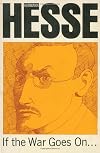
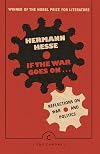
If the War Goes on: Reflections on War and Politics
by Hermann Hesse
On This Page
Description
A collection of essays from Hermann Hesse concerning World War II, his personal anguish and his antagonism to racism, nationalism and war.Tags
Recommendations






















Member Reviews
The two World Wars of the 20th century were unfathomably polarizing. There were those who believed war was necessary to defeat either national or global enemies, and those who believed acts of agression and war were counter to our enlightened place in history. Hermann Hesse, in If the War Goes On, is vehemently against war. In this collection of 27 essays, Hesse explores his own feelings about war and also the experiences of living through both great calamities.
Hermann Hesse’s writing won him the 1946 Nobel Prize in Literature for pieces that “exemplify the classical human ideals,” and those ideals are on display in his nonfiction. While most of the pieces are reactions to World War I, we see his vivid pacificism grow when the show more World War II starts thirty years later. One strange facet of the writing, however, is that he very seldomly condemns the Nazis for their actions. Much of his focus is on the larger idea of war itself and how that turns innocuous feelings of nationalism into a deadly frenzy. Hesse calls on those fighting to examine what they are doing and what that means not only for their future, but also future generations.
I rather enjoyed this collection. While the book itself is a little dated, the feelings aren’t. The translation is very crisp and tries to capture a lot of Hesse’s original energy. This is one of those books I would come back every five years or so for a bit grounding or perspective. This collection comes from a great era of anti-war writing and shouldn’t be passed up. An invigorating read. show less
Hermann Hesse’s writing won him the 1946 Nobel Prize in Literature for pieces that “exemplify the classical human ideals,” and those ideals are on display in his nonfiction. While most of the pieces are reactions to World War I, we see his vivid pacificism grow when the show more World War II starts thirty years later. One strange facet of the writing, however, is that he very seldomly condemns the Nazis for their actions. Much of his focus is on the larger idea of war itself and how that turns innocuous feelings of nationalism into a deadly frenzy. Hesse calls on those fighting to examine what they are doing and what that means not only for their future, but also future generations.
I rather enjoyed this collection. While the book itself is a little dated, the feelings aren’t. The translation is very crisp and tries to capture a lot of Hesse’s original energy. This is one of those books I would come back every five years or so for a bit grounding or perspective. This collection comes from a great era of anti-war writing and shouldn’t be passed up. An invigorating read. show less
If the War Goes On . . . Reflections on War and Politics, by Hermann Hesse (28 Aug 2003) This book published in 1970 collects 28 pieces by Hesse written at various times between 1914 and 1948. Some are exceptionally telling and memorable. Hesse not only at once saw the evil of Hitler but also, in contradistinction to folk such as Thomas Mann, opposed Germany's course in 1914. The essays have been translated into lucid English and are really admirable. For instance, these words, written to his sister in 1946, recalling their childhood days: "the golden legend of our childhood is revived and once more we see before us the world that surrounded us and nurtured us, the world of our parents and ancestors, a world that both German and show more Christian, both Swabian and international, a world in which every soul, Christian or not, was held in equal worth..." I found this a surprisingly fine and inspiring book. show less
Ratings
Members
- Recently Added By
Author Information

Hermann Hesse (July 2, 1877 -- August 9, 1962) was a German poet, novelist, essayist and painter. His best-known works included Steppenwolf, Siddhartha, and The Glass Bead Game, each of which explores an individual's search for authenticity, self-knowledge and spirituality. In 1946, he received the Nobel Prize in Literature. Hess publicly show more announced his views on the savagery of World War I, and was considered a traitor. He moved to Switzerland where he eventually became a naturalized citizen. He warned of the advent of World War II, predicting that cultureless efficiency would destroy the modern world. His theme was usually the conflict between the elements of a person's dual nature and the problem of spiritual loneliness. His first novel, Peter Camenzind, was published in 1904. His masterpiece, Death and the Lover (1930), contrasts a scholarly abbot and his beloved pupil, who leaves the monastery for the adventurous world. Steppenwolf (1927), a European bestseller, was published when defeated Germany had begun to plan for another war. It is the story of Haller, who recognizes in himself the blend of the human and wolfish traits of the completely sterile scholarly project. During the 1960s Hesse became a favorite writer of the counter culture, especially in the United States, though his critical reputation has never equaled his popularity. Hermann Hesse died in 1962. (Bowker Author Biography) show less
Some Editions
Common Knowledge
- Canonical title*
- Krieg und Frieden : Betrachtungen zu Krieg und Politik seit dem Jahr 1914
- Original title
- Krieg und Frieden: Betrachtungen zu Krieg und Politik zeit dem Jahr 1914
- Original publication date
- 1946
*Some information comes from Common Knowledge in other languages. Click "Edit" for more information.
Classifications
Statistics
- Members
- 421
- Popularity
- 73,745
- Reviews
- 2
- Rating
- (4.03)
- Languages
- 8 — English, Finnish, French, German, Italian, Norwegian (Bokmål), Norwegian, Spanish
- Media
- Paper, Ebook
- ISBNs
- 18
- ASINs
- 10