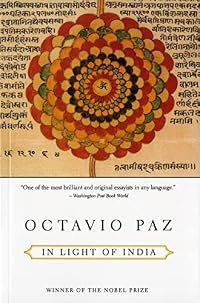
In Light of India
by Octavio Paz
On This Page
Description
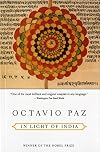
“One of the most brilliant and original essayists in any language” (Washington Post Book World) reflects on the six years he spent in India as Mexican ambassador-and reveals how the people and culture of that extraordinary land changed his life. Translated by Eliot Weinberger.Tags
Recommendations












Member Recommendations

Member Reviews
This rich volume began life as a lecture, delivered in Delhi in 1985 by Octavio Paz, poet and former Mexican ambassador to India. He expanded the lecture into this book: 'not a memoir, but rather an essay that attempts, with a few quick notes, to answer a question that goes beyond personal anecdotes: How does a Mexican writer, at the end of the twentieth century, view the immense reality of India?' The book, Paz says, 'is the child not of knowledge but of love'. The love of this writer is clearly no frothy affair: he has steeped himself in India's history, politics and culture(s), or at least been a deeply engaged, observant visitor. He wrote this book towards the end of his life, and the section on Hinduism, a brilliant essay on show more comparative religion, reads as a kind of summing up of everything he has learned about the human quest for transcendence. It is a joy to read, not least for the bright, shiny, epigrammatic gems scattered through it. show less
Even through the filter of translation from Spanish to English, Octavio Paz writes well. As soon as I read a few lines in the 2nd hand bookshop, I had to take In Light of India home. Paz is primarily known as a poet, winning the Nobel for Literature in 1990.
Paz held a number of diplomatic posts for Mexico. He ended up in Asia mostly, India and Japan. His first assignment as a junior was to India. On the ship there in 1951 (via Paris) he met an extraordinary array of people some we might now view as on the periphery of history: a Maharajah, the widow of Brancusi, the sculptor, a flock of Polish nuns, WH Auden’s brother, the author Santha Rau and her husband, former aide-de-camp to General Douglas McArthur. I only mention this because show more long-haul economy air travel never offers such opportunities. The world has well and truly changed since the 1950s.
Paz makes the point that this is not a memoir, but an essay. One of the directions it takes is to compare his home country (Mexico) to India. I find broad ranging comparisons pointless and yawned my way through these aspects. But to students of the period, both countries were on the cusp of something new. He does offer an interesting critique of capitalism and individualism as to their value to national development.
Paz wrote this essay may years after he moved on, in the 1990s; he died a few years later.
The most interesting parts of this is Paz’s lucid explanation of the caste system. By the time I learned about caste as a teenager it was seen as a profound evil system of control. What is far more interesting than that is for all its rigidity, it was not a class system, the lens through which I had learned about it. It may reinforce poverty and wealth and concentrate it, the overall impression I got is that it was a social system with a longevity of anywhere up to 3000 years. Even the Moghuls couldn’t disrupt it.
castes are part of the Hindu hierarchical system, but the basis of their order is neither money or power, but rather a religious notion.
Another point of interest was that in the cycle of reincarnation, Brahmins sit higher because they have been born as humans twice, bestowing superiority. Of course, it’s impossible to verify ones reincarnations. More likely social control by a few is a more compelling reason for caste. But with everyone in their own caste, there is a sense of belonging. For a moment, the world of order almost convinced me.
caste is one of the links in the chain of births and rebirths that make up existence, a chain of which all living things are part.
Except for the Dalit who do not have a caste and sit outside the system unprotected by its cultural norms. As do the sadhus, those gangly, ropey, wizened creatures seen all over India ash-covered and unkempt who choose to leave their cast and seek another path to enlightenment. But they are "sacred men" on a mission.
Pre-eminence of the collective: the individual is born, lives and dies in his caste. For us this would be intolerable. Along with change, the modern West glorifies the individual.
Despite his clear explanations, there was nothing romantic about the system of social order. I can only be an outsider to it.
The next most interest part is the adoption of Hindi as the official language for the new India. I didn’t know that Urdu (not just a language spoken in the west and now Pakistan) was rejected but it was also the most commonly spoken of the ancient living offshoots of Hindi. Hindi (or high Hindi) was barely spoken and exceeded in use by half a dozen other languages, even English had greater claims to use as a governing language. High Hindi, needed adaptation to become a living language like Urdu. Hindustani, Punjabi, Rajastani, Bengali, Marathi, Oriya and Bihari were all widely spoken in the regions. As I understand it, Hindi, Hindustani and Urdu are all derived from Sanskrit the way French, Italian, Spanish are derived from Latin.
When Hindi was adopted, Urdu was spurned, which put off the Muslim population among whom it was widely spoken. But Hindi had to be fashioned into a working language from bits and pieces. It didn’t come easy.
Paz, even in the 1990s, was up with the rise of nationalism in India. He saw the BJP as a party that would disrupt the notion of India as a successful constellation of disparate parts. Contemporary India is defined by Hindu nationalism. It’s ironic to think, though, that many of the sites we visit in India as tourists are of Moghul origin.
Here is my favourite thought from the book:
… ancient India had no notion of history. Time is a dream of Brahma. It is maya: an illusion. show less
Paz held a number of diplomatic posts for Mexico. He ended up in Asia mostly, India and Japan. His first assignment as a junior was to India. On the ship there in 1951 (via Paris) he met an extraordinary array of people some we might now view as on the periphery of history: a Maharajah, the widow of Brancusi, the sculptor, a flock of Polish nuns, WH Auden’s brother, the author Santha Rau and her husband, former aide-de-camp to General Douglas McArthur. I only mention this because show more long-haul economy air travel never offers such opportunities. The world has well and truly changed since the 1950s.
Paz makes the point that this is not a memoir, but an essay. One of the directions it takes is to compare his home country (Mexico) to India. I find broad ranging comparisons pointless and yawned my way through these aspects. But to students of the period, both countries were on the cusp of something new. He does offer an interesting critique of capitalism and individualism as to their value to national development.
Paz wrote this essay may years after he moved on, in the 1990s; he died a few years later.
The most interesting parts of this is Paz’s lucid explanation of the caste system. By the time I learned about caste as a teenager it was seen as a profound evil system of control. What is far more interesting than that is for all its rigidity, it was not a class system, the lens through which I had learned about it. It may reinforce poverty and wealth and concentrate it, the overall impression I got is that it was a social system with a longevity of anywhere up to 3000 years. Even the Moghuls couldn’t disrupt it.
castes are part of the Hindu hierarchical system, but the basis of their order is neither money or power, but rather a religious notion.
Another point of interest was that in the cycle of reincarnation, Brahmins sit higher because they have been born as humans twice, bestowing superiority. Of course, it’s impossible to verify ones reincarnations. More likely social control by a few is a more compelling reason for caste. But with everyone in their own caste, there is a sense of belonging. For a moment, the world of order almost convinced me.
caste is one of the links in the chain of births and rebirths that make up existence, a chain of which all living things are part.
Except for the Dalit who do not have a caste and sit outside the system unprotected by its cultural norms. As do the sadhus, those gangly, ropey, wizened creatures seen all over India ash-covered and unkempt who choose to leave their cast and seek another path to enlightenment. But they are "sacred men" on a mission.
Pre-eminence of the collective: the individual is born, lives and dies in his caste. For us this would be intolerable. Along with change, the modern West glorifies the individual.
Despite his clear explanations, there was nothing romantic about the system of social order. I can only be an outsider to it.
The next most interest part is the adoption of Hindi as the official language for the new India. I didn’t know that Urdu (not just a language spoken in the west and now Pakistan) was rejected but it was also the most commonly spoken of the ancient living offshoots of Hindi. Hindi (or high Hindi) was barely spoken and exceeded in use by half a dozen other languages, even English had greater claims to use as a governing language. High Hindi, needed adaptation to become a living language like Urdu. Hindustani, Punjabi, Rajastani, Bengali, Marathi, Oriya and Bihari were all widely spoken in the regions. As I understand it, Hindi, Hindustani and Urdu are all derived from Sanskrit the way French, Italian, Spanish are derived from Latin.
When Hindi was adopted, Urdu was spurned, which put off the Muslim population among whom it was widely spoken. But Hindi had to be fashioned into a working language from bits and pieces. It didn’t come easy.
Paz, even in the 1990s, was up with the rise of nationalism in India. He saw the BJP as a party that would disrupt the notion of India as a successful constellation of disparate parts. Contemporary India is defined by Hindu nationalism. It’s ironic to think, though, that many of the sites we visit in India as tourists are of Moghul origin.
Here is my favourite thought from the book:
… ancient India had no notion of history. Time is a dream of Brahma. It is maya: an illusion. show less
I was actually expecting some kind of memoirs, but instead Octavio Paz offers in this book an account of the interlacing of religion, politics, invasions, colonialism, languages, and literature in India. A fairly good work, although I found the parallels with Mexico to be a bit unnecessary. The selection of poems, translated from Sanskrit, in the appendix is pretty good.
L'esperienza come ambasciatore dal 1962 al 1968, spinse l'autore a tradurre la propria conoscenza dell'India in questo volume che non si presenta solo come saggio accurato ed esaustivo sul misticismo, la religiosità, la struttura sociale. Il libro, infatti, riesce a trasmettere anche la fisicità dell'India, penetrandola ed esplorandola nella sua reale essenza. Ciò rivela le doti liriche di Octavio Paz, uno dei più grandi poeti del Messico.
Aug 23, 2013Italian
Librería 7. Estante 1.
Dec 20, 2019Spanish
Ratings
Members
- Recently Added By
Lists

All Things India
95 works; 21 members

Nobel Price Winners
222 works; 20 members
Author Information

321+ Works 9,864 Members
Octavio Paz was born in Mexico City, Mexico on March 31, 1914. In 1938, he became one of the founders of the journal, Taller. In 1943, he travelled to the United States on a Guggenheim Fellowship where he became immersed in Anglo-American Modernist poetry. He entered the Mexican diplomatic service in 1945 and was sent to France then India. In show more 1968, he resigned from the diplomatic service in protest against the government's suppression of the student demonstrations during the Olympic Games in Mexico. He was a poet and an essayist. His works include The Labyrinth of Solitude, The Grammarian Monkey, East Slope, and The Other Mexico. He received numerous awards including the Cervantes award in 1981, the American Neustadt Prize in 1982, and the Nobel Prize in Literature in 1990. He also worked as an editor and publisher. He founded two magazines dedicated to the arts and politics: Plural and Vuelta. He died of cancer on April 19, 1998. (Bowker Author Biography) show less
Some Editions
Awards and Honors
Notable Lists
25 años en 100 libros (26-100)
Series
Belongs to Publisher Series
Harvill (252)
Common Knowledge
- Original title
- Vislumbres de la India
- Original publication date
- 1995
- People/Characters
- Octavio Paz
- Important places
- India; Mexico
- Epigraph*
- ... per non cadere negli errori commessi dagli antichi Filosofi, che credevano non esistessero Antipodi.
Diccionario de Autoridades, Padre Alonso de Ovalle - Quotations*
- L'India non è entrata in me attraverso la mente, ma attraverso gli occhi, le orecchie e tutti gli altri sensi.
Il suo segreto [della cucina indiana] non sta nell'essere una mescolanza di sapori, ma una gradazione fatta di contrasti e unioni al tempo stesso violenti e sottili. È una logica che regge quasi tutte le creazioni indiane: n... (show all)on la successione, come in Occidente, ma la congiunzione.
Se, com'è stato detto, l'architettura gotica è musica pietrificata, allora l'architettura indù è danza scolpita. - Original language
- Spanish
*Some information comes from Common Knowledge in other languages. Click "Edit" for more information.
Classifications
Statistics
- Members
- 359
- Popularity
- 87,274
- Reviews
- 5
- Rating
- (3.57)
- Languages
- 7 — English, French, German, Italian, Polish, Portuguese (Portugal), Spanish
- Media
- Paper, Ebook
- ISBNs
- 22
- ASINs
- 3