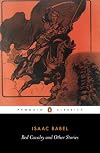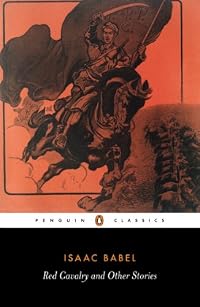
Red Cavalry and Other Stories (Penguin Classics)
by Isaac Babel
On This Page
Description
Throughout his life Isaac Babel was torn by opposing forces, by the desire both to remain faithful to his Jewish roots and yet to be free of them. This duality of vision infuses his work with a powerful energy from the earliest tales including 'Old Shloyme' and 'Childhood', which affirm his Russian-Jewish childhood, to the relatively non-Jewish world of his collection of stories entitled 'Red Cavalry'. Babel's masterpiece, 'Red Cavalry' is the most dramatic expression of his dualism and in show more his simultaneous acceptance and rejection of his heritage heralds the great American-Jewish writers from Henry Roth to Saul Bellow and Philip Roth.This translation is based on the complete, original text taken from an unexpurgated Russian edition of Babel's stories. The introduction, by David McDuff, explores the relationship between Babel's life and work. show lessTags
Recommendations








Member Reviews
Issac Babel was born in Odessa (Russia) in 1894 and was executed on 27 January 1940 as part of the Stalin purges. His career as a writer could be described as patchy. He achieved fame when some of his short stories were published in Moscow in 1923. These were taken from two of his collections: Red Cavalry and Odessa. Other stories appeared later but he seems to have struggled to publish much else. If his writing career was patchy so is much of the information concerning his life in Russia and much of this is down to the man himself. His daughter who lived in Paris and was ten years old when Isaac Babel died claims that he was a man who spun stories about his life; he could have been a spy working for one of the groups in Revolutionary show more Russia, he was almost certainly a cavalry officer if we can believe the stories he told in Red Cavalry, his 'autobiographical' stories describe a life in a jewish family struggling to cling to their religion and identity in the face of pogroms and racially motivated cleansing operations and he seems to have inside knowledge of the jewish criminal gangs operating in Odessa. We know that he tried to make a name as a film script writer and published a couple of plays, but his fame today rests on his short stories.
This book is a penguin Classics edition and groups his short stories in three main sections: Early Stories and Autobiographical Stories, Red Cavalry and Odessa stories. They are clearly the work of the same author with their mixture of realistic incidents and impressionistic flourishes that serve at times to wrong foot the reader. They are mainly told from a first person perspective or that first person is inserted into the story, here is a typical example from Sunset, one of the Odessa gangster stories:
'Benchik' he said let us take this job on ourselves, and people will come and kiss our feet. let us kill Papasha, whom the Moldavanka no longer call Mendel Krik. The Moldavanka calls him Mendel the Pogrom. Let us kill Papasha - can we wait any longer?'
'It is not yet time' replied Benchik, 'but time is passing. Listen to its footsteps and make way for it. Step aside, Lyovka.
And Lyovka stepped aside, in order to make way for time. It started on it's path - time, the old cashier - and on its path it met Dvoyra, the King's sister, Manasse, the driver, and the Russian girl Marusya Yevtushenko.
Even ten years ago I knew men who wanted Dvoyra, the daughter of Mendel the Pogrom...................................................
This first person approach adds realism or perhaps makes all the stories a sort of eye witness account. Babel may have been both a Cavalry officer and an Odessa gangster, but first and foremost he was a jewish writer, a Russian jewish writer and this is evident from both the stories in the autobiographical section and in the Odessa section. Curiously enough the author's jewish identity is subsumed in the Red Cavalry stories. Here a young man reports incidents from the wars that followed the Russian revolution: the Poles seem to be the enemy but factions from the red army and the white army are adept at changing sides. It really is the fog of war where individual incidents are used to demonstrate the dehumanising effect of what seems to be an endless war. There are some graphically explicit incidents described in a matter of fact way with elements of conversation that might have been an inspiration for Joseph Heller's [Catch 22]. Certainly the reader is made to feel the mud, the blood, the confusion and the self serving of a cavalry squadron in an age where horses were being overtaken by machinery as a weapon of war. Various officers and other characters appear and reappear in the stories but there is no underlying progression, there is however the attempt by the author to fit in, to conceal his jewishness and the final story ends:
I had to leave. I got a transfer to the sixth squadron. There things were better. Somehow or the other, Argamak had taught me how to sit in the saddle the Tikohomolov way. My dream was fulfilled. The Cossaks stopped following me and my horse with their eyes.
In collections of stories such as this some will stand out because of the content of the stories others for the portrayal of a time and place that is unfamiliar. Babel rarely fails to establish a background that is both exotic and interesting, but he can lose the reader with an overstuffing of titles and place names. Many of the stories are in some respects fragmentary incidents (especially in Red Cavalry) that have to stand on their own, eye witness accounts that have no revelatory plot twists designed to amuse; the reader must make their own judgement and draw their own conclusions. However the last two stories in the Odessa section serve to demonstrate the culture clashes caused by the revolution. 'The End of the Almshouses' tells of a group of jewish people who are housed in a building in the cemetery wall, they make a living by digging graves, washing bodies and burying the dead. The revolution has caused a shortage of wood and so the working group hit on the idea of re-using the same coffin, the living is good as people are prepared to pay, however when a local war hero is buried with military honours the workers are not able to save their coffin. Belts must be tightened, food becomes scarce and when a member of a new revolutionary council visits the cemetery the almshouses are cleared. Karl-Yankel is the story of a Jewish grandmother who kidnaps her grandson in order for a backstreet circumcision to be performed. The father returning from the war takes his grandmother to a tribunal for retribution and their follows a trial which describes the hysteria that such a clash of culture can produce.
Isaac Babel is now firmly ensconced in the canon of Russian writers and certainly in the smaller canon of Russian jewish writers. His short stories plunge the reader into an era and a culture that is entirely convincing. When I finished the book I discovered there is now available a single volume of Babel's collected works, which includes all his stories, his film scripts some letters and his plays. I was tempted to make another purchase but have contented myself by thinking I have perhaps already read the best of his stories and a re-read of these would serve just as well. I found the translation by David McDuff a bit clanky in parts, but this may be due to the style of Babel's prose. The new collected volume has a different translator.
4 stars show less
This book is a penguin Classics edition and groups his short stories in three main sections: Early Stories and Autobiographical Stories, Red Cavalry and Odessa stories. They are clearly the work of the same author with their mixture of realistic incidents and impressionistic flourishes that serve at times to wrong foot the reader. They are mainly told from a first person perspective or that first person is inserted into the story, here is a typical example from Sunset, one of the Odessa gangster stories:
'Benchik' he said let us take this job on ourselves, and people will come and kiss our feet. let us kill Papasha, whom the Moldavanka no longer call Mendel Krik. The Moldavanka calls him Mendel the Pogrom. Let us kill Papasha - can we wait any longer?'
'It is not yet time' replied Benchik, 'but time is passing. Listen to its footsteps and make way for it. Step aside, Lyovka.
And Lyovka stepped aside, in order to make way for time. It started on it's path - time, the old cashier - and on its path it met Dvoyra, the King's sister, Manasse, the driver, and the Russian girl Marusya Yevtushenko.
Even ten years ago I knew men who wanted Dvoyra, the daughter of Mendel the Pogrom...................................................
This first person approach adds realism or perhaps makes all the stories a sort of eye witness account. Babel may have been both a Cavalry officer and an Odessa gangster, but first and foremost he was a jewish writer, a Russian jewish writer and this is evident from both the stories in the autobiographical section and in the Odessa section. Curiously enough the author's jewish identity is subsumed in the Red Cavalry stories. Here a young man reports incidents from the wars that followed the Russian revolution: the Poles seem to be the enemy but factions from the red army and the white army are adept at changing sides. It really is the fog of war where individual incidents are used to demonstrate the dehumanising effect of what seems to be an endless war. There are some graphically explicit incidents described in a matter of fact way with elements of conversation that might have been an inspiration for Joseph Heller's [Catch 22]. Certainly the reader is made to feel the mud, the blood, the confusion and the self serving of a cavalry squadron in an age where horses were being overtaken by machinery as a weapon of war. Various officers and other characters appear and reappear in the stories but there is no underlying progression, there is however the attempt by the author to fit in, to conceal his jewishness and the final story ends:
I had to leave. I got a transfer to the sixth squadron. There things were better. Somehow or the other, Argamak had taught me how to sit in the saddle the Tikohomolov way. My dream was fulfilled. The Cossaks stopped following me and my horse with their eyes.
In collections of stories such as this some will stand out because of the content of the stories others for the portrayal of a time and place that is unfamiliar. Babel rarely fails to establish a background that is both exotic and interesting, but he can lose the reader with an overstuffing of titles and place names. Many of the stories are in some respects fragmentary incidents (especially in Red Cavalry) that have to stand on their own, eye witness accounts that have no revelatory plot twists designed to amuse; the reader must make their own judgement and draw their own conclusions. However the last two stories in the Odessa section serve to demonstrate the culture clashes caused by the revolution. 'The End of the Almshouses' tells of a group of jewish people who are housed in a building in the cemetery wall, they make a living by digging graves, washing bodies and burying the dead. The revolution has caused a shortage of wood and so the working group hit on the idea of re-using the same coffin, the living is good as people are prepared to pay, however when a local war hero is buried with military honours the workers are not able to save their coffin. Belts must be tightened, food becomes scarce and when a member of a new revolutionary council visits the cemetery the almshouses are cleared. Karl-Yankel is the story of a Jewish grandmother who kidnaps her grandson in order for a backstreet circumcision to be performed. The father returning from the war takes his grandmother to a tribunal for retribution and their follows a trial which describes the hysteria that such a clash of culture can produce.
Isaac Babel is now firmly ensconced in the canon of Russian writers and certainly in the smaller canon of Russian jewish writers. His short stories plunge the reader into an era and a culture that is entirely convincing. When I finished the book I discovered there is now available a single volume of Babel's collected works, which includes all his stories, his film scripts some letters and his plays. I was tempted to make another purchase but have contented myself by thinking I have perhaps already read the best of his stories and a re-read of these would serve just as well. I found the translation by David McDuff a bit clanky in parts, but this may be due to the style of Babel's prose. The new collected volume has a different translator.
4 stars show less
Award-winning novelist Aleksandar Hemon has chosen to discuss Isaac Babel’s Red Cavalry and other stories , on FiveBooks (http://five-books.com) as one of the top five on his subject - Man’s Inhumanity to Man, saying that:
“… This is a fictionalised account of the expedition of the Red Cavalry – the Soviet expeditionary force – which in 1920 attacked Poland, hoping to reach Warsaw and establish a Soviet government. It is an incredible piece of literature. Babel has an aesthetic that corresponds to not only his sensibility, but also to his awkward circumstance. It was tricky for him: how to bear witness to things, how to talk about the fact that Cossacks were killing Jews, without being sent before a firing squad..…”.
The show more full interview is available here: http://thebrowser.com/books/interviews/aleksandar-hemon show less
“… This is a fictionalised account of the expedition of the Red Cavalry – the Soviet expeditionary force – which in 1920 attacked Poland, hoping to reach Warsaw and establish a Soviet government. It is an incredible piece of literature. Babel has an aesthetic that corresponds to not only his sensibility, but also to his awkward circumstance. It was tricky for him: how to bear witness to things, how to talk about the fact that Cossacks were killing Jews, without being sent before a firing squad..…”.
The show more full interview is available here: http://thebrowser.com/books/interviews/aleksandar-hemon show less
Ratings
Members
- Recently Added By
Author Information

163+ Works 4,380 Members
Isaac Babel was born in Odessa, Russia, in 1894. He won early success with stories about his native Odessa and about the exploits of the Bolshevik cavalry in the Polish campaign of 1920-21. During the 1930s his output was small, but his talent remained undiminished. He was arrested in May 1939 during the Great Purge, and his manuscripts were show more confiscated. His exact fate remains unknown. Although Babel's reputation was restored in 1956, he was still published only occasionally in the Soviet Union-the very strong Jewish element in his stories, as well as the ambiguous positions he took on war and revolution, made his stories uncomfortable for Soviet authorities. For a Russian reader, the Odessa Tales (1916) are particularly exotic. Their protagonists, members of the city's Jewish underworld, are presented in romantic, epic terms. The Red Cavalry stories are noted for their account of the horrors of war. In both cycles Babel relies on precisely constructed short plots, on paradox of situation and of character response, and on nonstandard, captivating language-be it the combination of Yiddish, slang, and standard Russian in the Odessa Tales or of uneducated Cossack speech and standard Russian in the Red Cavalry cycle. The result of such features is a prose heritage rare in the history of Russian literature. Isaac Babel passed away in 1941. (Bowker Author Biography) Isaac Babel was born on July 13, 1894 in Odessa, Russia, to a middle-class Jewish family. He attended the Institute of Business Studies. His life was filled with persecution, which greatly influenced his writing. During the civil war that followed the Russian Revolution, Babel served as a soldier in Poland. This experience provided him with material for Red Cavalry, a collection of his stories. Later, in the Odessa Tales, published in 1931, Babel drew on his Jewish heritage to create colorful and memorable characters. As with many great artists in Russia, Babel's creative style was unpopular with the Stalin regime. Babel admitted to a long association with Trotskyites, but denied this testimony at his trial. He was ultimately found guilty of espionage and shot in Moscow in 1939, although, nearly a year later, his wife and the general public were told that he died in a labor camp. (Bowker Author Biography) show less
Common Knowledge
- Original title
- Rasskazts Jzbrannoju
Classifications
- Genres
- General Fiction, Fiction and Literature
- DDC/MDS
- 813 — Literature & rhetoric American literature in English American fiction in English
- LCC
- PG3476 .B2 .K613 — Language and Literature Slavic languages and literatures. Baltic languages. Albanian language Slavic. Baltic. Albanian Russian literature Individual authors and works 1917-1960
- BISAC
Statistics
- Members
- 206
- Popularity
- 157,107
- Reviews
- 2
- Rating
- (3.91)
- Languages
- Danish, English
- Media
- Paper, Ebook
- ISBNs
- 2
- ASINs
- 3