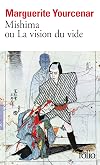
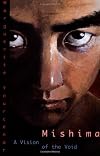
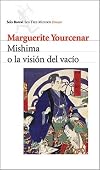
Mishima: A Vision of the Void
by Marguerite Yourcenar
On This Page
Description
On November 25, 1970, Japan's most renowned postwar novelist, Yukio Mishima, stunned the world by committing ritual suicide. Here, Marguerite Yourcenar, a brilliant reader of Mishima and a scholar with an eye for the cultural roles of fiction, unravels the author's life and politics: his affection for Western culture, his family and his homosexuality, his brilliant writings, and his carefully premeditated death.Tags
Recommendations

































Member Recommendations

Member Reviews
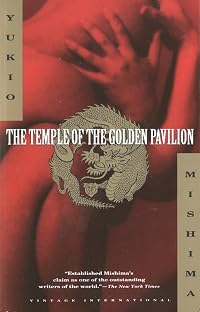
Yourcenar's novella-length essay on Mishima is largely an attempt to answer the question "why did he kill himself?" in a way that would make sense to a western reader. She gives a brief sketch of Mishima's background and upbringing, then looks in some detail at a number of his works, in particular The Golden Pavilion, the Sea of Fertility tetralogy and the 1966 film Patriotism, based on his story of the same title, in which Mishima played an officer who commits seppuku after the failed 1936 army coup. Yourcenar discusses Mishima's own "attempted coup" in quite some detail and makes it fairly clear that we should understand it as an aesthetic rather than a political gesture - from the way she describes it, Mishima can't have had any show more serious belief that he would be able to convince the Japanese army to mutiny and restore imperial power, but for reasons of his own, he needed to be seen making the gesture. However, she reminds us that equally quixotic acts of revolution have succeeded in overturning apparently stable governments elsewhere (at the time of writing she must have been thinking of Iran).
This often reads more as a literary work than as a critical essay - Yourcenar's instinct as a story-teller gets the better of her sometimes, and the plot-summaries of Mishima's works almost turn into full-scale re-imaginings. And she seems to have been almost as turned on as Mishima by the gruesome details of disembowelment and decapitation. In the final section she contrasts the fine Buddhist aesthetic of the closing image of the Tetralogy, the vision of the empty sky, with the physical reality of a photograph of Mishima's and Morita's detached heads. A clear and brutal reminder of the unromantic ugliness of death, but somehow I couldn't help thinking of the imagined decapitation in The Mikado, where Pooh-Bah relates that the detached head "...stood on its neck, with a smile well-bred, / And bowed three times to me." Yourcenar probably wasn't a G&S buff. show less
This often reads more as a literary work than as a critical essay - Yourcenar's instinct as a story-teller gets the better of her sometimes, and the plot-summaries of Mishima's works almost turn into full-scale re-imaginings. And she seems to have been almost as turned on as Mishima by the gruesome details of disembowelment and decapitation. In the final section she contrasts the fine Buddhist aesthetic of the closing image of the Tetralogy, the vision of the empty sky, with the physical reality of a photograph of Mishima's and Morita's detached heads. A clear and brutal reminder of the unromantic ugliness of death, but somehow I couldn't help thinking of the imagined decapitation in The Mikado, where Pooh-Bah relates that the detached head "...stood on its neck, with a smile well-bred, / And bowed three times to me." Yourcenar probably wasn't a G&S buff. show less
Ratings
Members
- Recently Added By
Lists

Stuff from Bard
70 works; 1 member
Author Information

A French novelist, playwright, and essayist born in Belgium, Marguerite Yourcenar was a resident of the United States for many years, living in isolation on a small island off the coast of Maine. Educated at home by wealthy and cultured parents, she had a strong humanistic background, translating the ancient Greek poet Pindar and the poems of the show more modern Greek Constantine Cavafy. She has translated American Negro spirituals and works of Virginia Woolf (see Vol. 1) and Henry James (see Vol. 1). Her novels include Alexis (1929) and Coup de Grace (1939). A collection of poems, Fires, was published in 1936. Yourcenar is particularly known for Hadrian's Memoirs (1951), a philosophical meditation in the form of a fictional autobiography of the second-century Roman emperor. In Germaine Bree's judgment, "With great erudition and great psychological insight, Marguerite Yourcenar constructed a body of work that is a meditation on the destiny of mankind." In 1981, she became the first woman ever elected to the French Academy. (Bowker Author Biography) show less
Series
Belongs to Publisher Series
Common Knowledge
- Canonical title
- Mishima: A Vision of the Void
- Original title
- Mishima ou La vision du vide
- Original publication date
- 1980 (original French) (original French); 1986 (English translation) (English translation)
- People/Characters
- Yukio Mishima
- Epigraph*
- L'Énergie est le délice éternel.
William Blake,
Le mariage du ciel et de l'enfer.
Si le sel perd sa saveur, comment la lui rendra-t-on ?
Évangile selon saint Matthieu,
chap. V, 13.
Mourez en pensée chaque matin, et vous ne craindrez plus de mourir.
Hagakure,
traité japonais du XVIIIe siècle. - Dedication*
- /
- First words*
- Il est toujours difficile de juger un grand écrivain contemporain : nous manquons de recul. [...]
- Original language*
- Français
*Some information comes from Common Knowledge in other languages. Click "Edit" for more information.
Classifications
- Genres
- Literature Studies and Criticism, Biography & Memoir, Fiction and Literature
- DDC/MDS
- 895.6 — Literature & rhetoric Literatures of other languages Literatures of East and Southeast Asia Japanese
- LCC
- PL833 .I7 .Z98713 — Language and Literature Languages and literatures of Eastern Asia, Africa, Oceania Languages of Eastern Asia, Africa, Oceania Japanese language and literature Japanese literature Individual authors and works
- BISAC
Statistics
- Members
- 305
- Popularity
- 105,084
- Reviews
- 1
- Rating
- (3.53)
- Languages
- 11 — Dutch, English, French, German, Italian, Japanese, Portuguese, Romanian, Spanish, Swedish, Turkish
- Media
- Paper, Ebook
- ISBNs
- 29
- ASINs
- 8