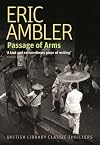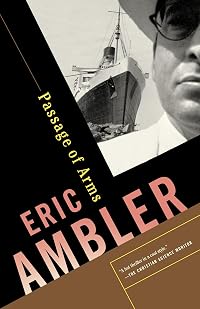
Passage of Arms
by Eric Ambler
On This Page
Description
Girija Krishnan, an Indian clerk, sees the opportunity of his lifetime when he stumbles on a lost cache of arms hidden in the Malayan jungle. If he can find a buyer for the weapons, he will be able to achieve his life-long dream of creating his own bus company. But the risks are as high as the rewards, as the arms draw ever more people into their dangerous orbit - an entrepreneurial trio of Chinese brothers, a sleazy British former soldier, and a naive American couple who find themselves show more horribly out of their depth. show lessTags
Recommendations


































Member Reviews
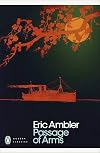
My copy of this one is in a Penguin Modern Classic edition, with that seductive eau de nil spine. Maybe I'm just being impressed by the cover, but I think this is the first of the run that I would recommend even to those without much interest in the genre.
If it's not the cover, it might be the setting that's getting to me. We seem to have spent a lot of time recently in dingy, straitened parts of southern England, and so it's a pleasant change to be instead in the South China Sea in the post-war era. I really don't know as much about this time and place as I might, but the picture painted here is of a febrile set of countries, bubbling with revolutionaries of various kinds, jockeying for political and territorial position to take show more advantage of the inevitable withdrawal of British colonial power—but, importantly, safe and exotic enough to allow enterprise and attract tourists.
The plot concerns the arms of the title: an abandoned cache of weapons, discovered by a lowly Indian clerk, Girija. He wants to sell them. He needs a middleman, for which he enlists a fairly shady family of Chinese businessmen with connections around the Sea. The need a dupe to launder the arms and present them for sale to a group of guerrillas, for which they enlist an overconfident American cruise-tourist and his wife. The plot follows the progress of this convoluted deal.
There are two things that are done wonderfully as the plot unfolds, and these are the things that lead me to recommend the book widely. The first is structural. The book starts with Girija and ends with him, but in between the focus shifts further and further out from him, towards the Chinese and then the Americans, and then back again in the opposite direction. It's as if the book slowly takes in a big breath of air, holds if for a while, and lets it out again. It's a very, very neat structural trick if you can pull it off, and Ambler does.
His other neat trick is tonal. We start in a faintly comic mood, and we barely notice as things become more and more serious, until they're suddenly somewhere close to horrific. A lot of books (and perhaps even more films) aim for this shift, but don't manage it nearly as well; you can feel the wrench as the ratchet is turned. This is much more subtly done, more like that poor frog you hear of in the slowly heating water.
You can see from these two things why Ambler was highly regarded in his time and considered worthy of Penguin reissue today (my copy is from 2023, though whoever had it before me gave it quite some reading). Both Greene and Le Carré are mentioned in the blurb, and you can also see how he stands somewhat in between the two—the righteous adventuring of Greene dissolving slowly into the amoral stalemate of Le Carré (perhaps that's unfair. I really should re-read some of the tougher Greene).
One might worry that the combination of settings, peoples, and author (very much British, very much 1950s) would lead inevitably to a degree of stereotyping, if not outright racism, sufficient to spoil all the good things of the book. But I think Ambler still gets away with it. There certainly is national stereotyping, some vital to the plot, some not (there's a French character who seems only to be French to afford an opportunity to poke fun at the French), but it's not egregious for the most part, and it's probably the Americans who come off worst. In fact, at a couple of points, there is some subtle stuff about who is offended by what that shows at least some authorial awareness of how the sausage is being made. I even wonder if one could read the book as allegorical: it seems plausible that the preoccupations and preferences of the various characters are synecdochical for their nations' policies and politics in the region, though I would need to do a fair bit of reading to substantiate that hunch.
Anyway, the point is, one could find offence here if one were looking for it, but one can also certainly find a very well-structured, tonally assured, tightly written book. I enjoyed it very much and I certainly intend to read more Ambler. Give it a go if a copy comes your way. show less
If it's not the cover, it might be the setting that's getting to me. We seem to have spent a lot of time recently in dingy, straitened parts of southern England, and so it's a pleasant change to be instead in the South China Sea in the post-war era. I really don't know as much about this time and place as I might, but the picture painted here is of a febrile set of countries, bubbling with revolutionaries of various kinds, jockeying for political and territorial position to take show more advantage of the inevitable withdrawal of British colonial power—but, importantly, safe and exotic enough to allow enterprise and attract tourists.
The plot concerns the arms of the title: an abandoned cache of weapons, discovered by a lowly Indian clerk, Girija. He wants to sell them. He needs a middleman, for which he enlists a fairly shady family of Chinese businessmen with connections around the Sea. The need a dupe to launder the arms and present them for sale to a group of guerrillas, for which they enlist an overconfident American cruise-tourist and his wife. The plot follows the progress of this convoluted deal.
There are two things that are done wonderfully as the plot unfolds, and these are the things that lead me to recommend the book widely. The first is structural. The book starts with Girija and ends with him, but in between the focus shifts further and further out from him, towards the Chinese and then the Americans, and then back again in the opposite direction. It's as if the book slowly takes in a big breath of air, holds if for a while, and lets it out again. It's a very, very neat structural trick if you can pull it off, and Ambler does.
His other neat trick is tonal. We start in a faintly comic mood, and we barely notice as things become more and more serious, until they're suddenly somewhere close to horrific. A lot of books (and perhaps even more films) aim for this shift, but don't manage it nearly as well; you can feel the wrench as the ratchet is turned. This is much more subtly done, more like that poor frog you hear of in the slowly heating water.
You can see from these two things why Ambler was highly regarded in his time and considered worthy of Penguin reissue today (my copy is from 2023, though whoever had it before me gave it quite some reading). Both Greene and Le Carré are mentioned in the blurb, and you can also see how he stands somewhat in between the two—the righteous adventuring of Greene dissolving slowly into the amoral stalemate of Le Carré (perhaps that's unfair. I really should re-read some of the tougher Greene).
One might worry that the combination of settings, peoples, and author (very much British, very much 1950s) would lead inevitably to a degree of stereotyping, if not outright racism, sufficient to spoil all the good things of the book. But I think Ambler still gets away with it. There certainly is national stereotyping, some vital to the plot, some not (there's a French character who seems only to be French to afford an opportunity to poke fun at the French), but it's not egregious for the most part, and it's probably the Americans who come off worst. In fact, at a couple of points, there is some subtle stuff about who is offended by what that shows at least some authorial awareness of how the sausage is being made. I even wonder if one could read the book as allegorical: it seems plausible that the preoccupations and preferences of the various characters are synecdochical for their nations' policies and politics in the region, though I would need to do a fair bit of reading to substantiate that hunch.
Anyway, the point is, one could find offence here if one were looking for it, but one can also certainly find a very well-structured, tonally assured, tightly written book. I enjoyed it very much and I certainly intend to read more Ambler. Give it a go if a copy comes your way. show less
There's a sort of thriller, and I don't know if they do this any more or if things have changed so radically since their heyday they're simply unrecognisable, that takes the research-driven mechanics of its plot profoundly seriously, such that much of it is the meticulous working out of practical solutions to obstacles that are either physical, financial or even philosophical. Hence, we have an Indian clerk in Malaysia who finds a cache of arms and has to work out how best to turn them into capital for his endearingly modest dream of owning and running a bus service. It's the financial side of things that draws in an American tourist to act as a broker in name only, and it's tricky dealings over getting a cheque signed that sends him show more and his wife into danger, because, of course, practical solutions are all very well until they meet various unavoidable imponderables to do with human nature, politics and prejudice. Intelligent, sly, and rich in setting, milieu and assorted colourful characters. show less
Quite a stylish spy novel. A unique thriller located in Southeast Asia, from Malaya (events take place just as the Malayan Emergency has played out) to Singapore, from Manila to Sumatra. And what makes it all so interesting is the quite large cast of characters. At the center is a naive American couple, Greg and Dorothy Nilsen, who find themselves caught up in an arms smuggling operation. There is plenty to explore in the motivations of these two innocents abroad. But there is also quite a bit of time given to various figures that surround them. This includes the typically British prig, Colonel Soames of the police in Singapore, on one hand, and the raffish British rogue, Captain Lukey and his Eurasian wife, on the other. The entire show more scheme starts because of the entrepreneurial dreams of an Indian plantation foreman, Girija Krishnan, and his willingness to take a forgotten cache of Communist weapons and deal them through the three unscrupulous Tan brothers, who have built out their would-be empire in Manila, Malaya, and Singapore. All is enhanced with Communist Malays, Major Gani, Indonesian government loyalists, Gen. Iskaq, Muslim Malay rebels, Col. Oda and Maj. Sutan, and for the first half of the book, a particularly ugly American, in the pushy and obnoxious form of Arlene Drecker.
Passage of Arms makes for a trilogy of sorts that concerns Southeast Asian politics and spies from three British authors. The first was Norman Lewis' A Single Pilgrim, with much of the atmosphere coming from his earlier travel book, A Dragon Apparent; and the second had been Graham Greene's The Quiet American. There is an evolution from the early 1950s to Ambler's view of things in Southeast Asia at the end of the decade. Truth be said, it appears that Greene was "inspired" by much of the plot and ideas contained in Lewis' A Single Pilgrim. Both are serious works, with moral overtones. The issue of moral corruption is here in Ambler's novel, too, but it is treated in a much more breezy fashion than with the other two.
Also apparent is the influence of Alfred Hitchcock on Ambler. He was married to Hitchcock associate Joan Harrison. And there is a common thread running through Ambler and Hitchcock's works of sidetracked naifs drawn into a subterranean world of intrigue and murder/killing, from which they only escape through the courage to dare to survive--and a little luck. show less
Passage of Arms makes for a trilogy of sorts that concerns Southeast Asian politics and spies from three British authors. The first was Norman Lewis' A Single Pilgrim, with much of the atmosphere coming from his earlier travel book, A Dragon Apparent; and the second had been Graham Greene's The Quiet American. There is an evolution from the early 1950s to Ambler's view of things in Southeast Asia at the end of the decade. Truth be said, it appears that Greene was "inspired" by much of the plot and ideas contained in Lewis' A Single Pilgrim. Both are serious works, with moral overtones. The issue of moral corruption is here in Ambler's novel, too, but it is treated in a much more breezy fashion than with the other two.
Also apparent is the influence of Alfred Hitchcock on Ambler. He was married to Hitchcock associate Joan Harrison. And there is a common thread running through Ambler and Hitchcock's works of sidetracked naifs drawn into a subterranean world of intrigue and murder/killing, from which they only escape through the courage to dare to survive--and a little luck. show less
This 1959 work isn't as murky or as tense as Ambler's pre-war work, but it still has atmosphere galore and an intelligent narrative that stands out in the genre. Ambler is indeed the quintessential writer of "innocent man in over his head" thrillers, though in this case the main protagonist, Greg Nilson, an American factory owner, has only himself to blame when he gets involved in an arms deal--more for the novelty of it than because of the money he stands to make. Luckily, Nilson has a rather stoic wife who sticks beside him when the going gets rough. Along the way, Ambler gives us a little shipboard domestic drama - which in retrospect has very little to do with the rest of the book other than pushing Nilson and his wife to leave the show more ship to get away from the woman who is monopolizing their time--and some interesting shady characters, both Oriental and Occidental.
Surprisingly, with its tale of terrorists, rebels, and arms deals, the book feels strangely contemporary. There's a lot of other odd tidbits here as well - you'll learn a little bit about buses, for instance, that make this an enjoyable read. show less
Surprisingly, with its tale of terrorists, rebels, and arms deals, the book feels strangely contemporary. There's a lot of other odd tidbits here as well - you'll learn a little bit about buses, for instance, that make this an enjoyable read. show less
This is a wonderful book. The fortuitous discovery of an abandoned arms cache in Malaya, and its transfer to freedom fighters in Indonesia envelopes three very different sets of people, and the results for all three are life changing, and very diverse. The prose is tight, and the memory never goes away. All people prone to the romantic approach to world affairs should internalise this book!
This takes us from Ambler's usual European haunts to the equally mysterious if sunnier precints of south east Asia. Written in 1959, it is constructed as a series of stories within stories -- who stole an arms cache, who tried to sell it, and who got involved in the sale. The last involves the central character of the book, a guileless American tourist who gets in way, way over his head. Terrific story, great atmosphere.
One of the 5 classic amblers written before wwii
Members
- Recently Added By
Lists

Reading LIst
648 works; 1 member
Author Information

71+ Works 10,378 Members
Eric Ambler was born in London on June 28, 1909. Ambler toured in the late 1920s as a music-hall comedian and wrote plays, following in the footsteps of his parents, who were entertainers. After studying engineering at London University from 1924 to 1927, he took an apprenticeship in engineering at the Edison Swan Electric Company. When the show more company became part of Associated Electrical Industries, he worked in its advertising department and wrote avant-garde plays in his spare time. By 1937 he was the director of a London ad agency. He later resigned and moved to Paris where he dedicated himself to writing. In 1936, his first novel, The Dark Frontier, appeared and followed by another five by 1940, as well as working as script consultant for Alexander Korda. During World War II he joined first the artillery and was then later posted to a combat photographic unit. He served in Italy as assistant director of army cinematography and during this period, wrote and produced nearly one hundred training and propaganda films. After the war Ambler was screenwriter for the Rank organization and starting from 1951 he published a number of novels with Charles Rodda under the pseudonym Eliot Reed. Several of his novels were made into films, including A Coffin for Dimitrios in 1944, Journey into Fear in 1942, and Topkapi in 1964. Ambler also wrote screenplays, including those for The Cruel Sea in 1953 and The Guns of Navarone in 1961. In the 1960s he moved to Hollywood and was responsible for the TV shows Checkmate and The Most Deadly Game. Ambler received the Gold Dagger in 1959 for Passage of Arms, in 1967 for Dirty Story and in 1972 for The Levanter. He also received the Diamond Dagger in 1986 plus an Edgar in 1964 for The Light of Day and was nominated Grand Master in 1975. Ambler was named an Officer of the Order of the British Empire in 1981, and received other literary awards in France and Sweden. He died in London in October 1998. Ambler published 23 novels total, 19 under his own name and four in collaboration Eric Amber died in London on October 22, 1998, at the age of 89. (Bowker Author Biography) show less
Awards and Honors
Awards
Distinctions
Series
Belongs to Publisher Series
Work Relationships
Common Knowledge
- Canonical title
- Passage of Arms
- Original title
- Passage of Arms
- Original publication date
- 1959
- People/Characters
- Girija Krishnan; Greg Nilsen; Colonel Soames; Captain Lukey
- Important places
- Malaysia
- First words
- All that Mr. Wright, the rubber estate manager, ever knew of the business was that an army patrol had ambushed a band of terrorists within a mile of his bungalow, that five months later his Indian clerk, Girija Krishnan, had ... (show all)reported the theft of three tarpaulins from the curing sheds, and that three years after that someone had removed the wheels from an old scooter belonging to one of his children.
- Last words
- (Click to show. Warning: May contain spoilers.)He wished that his father, the subahdar, could have been there.
Classifications
Statistics
- Members
- 399
- Popularity
- 77,743
- Reviews
- 7
- Rating
- (3.72)
- Languages
- 10 — Danish, Dutch, English, Finnish, French, German, Greek, Japanese, Spanish, Swedish
- Media
- Paper, Audiobook, Ebook
- ISBNs
- 32
- ASINs
- 19