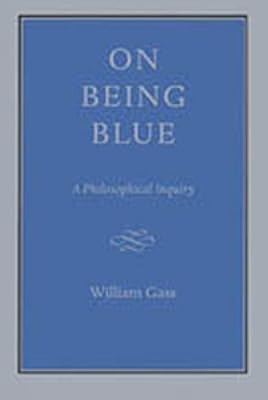
On being blue: a philosophical inquiry
by William H. Gass
On This Page
Description
On Being Blueis a book about everything blue-sex and sleaze and sadness, among other things-and about everything else. It brings us the world in a word as only William H. Gass, among contemporary American writers, can do. Gass writes- Of the colors, blue and green have the greatest emotional range. Sad reds and melancholy yellows are difficult to turn up. Among the ancient elements, blue occurs everywhere- in ice and water, in the flame as purely as in the flower, overhead and inside caves, show more covering fruit and oozing out of clay. Although green enlivens the earth and mixes in the ocean, and we find it, copperish, in fire; green air, green skies, are rare. Gray and brown are widely distributed, but there are no joyful swatches of either, or any of the exuberant black, sullen pink, or acquiescent orange. Blue is therefore most suitable as the color of interior life. Whether slick light sharp high bright think quick sour new and cool or low deep sweet dark soft slow smooth heavy old and warm- blue moves easily among them all, and all profoundly qualify our states of feeling. show lessTags
Recommendations


























Member Reviews
Blue's more than a color, mood, or groove of a jukebox tune. The symbology of blue, along with its definitions, are as infinite as its nuanced hues. Aqua, azure, turquoise, cerulean, indigo, cobalt, ad infinitum . . . There's endless shades of adjectives on the adjective, blue.
Or so posits William H. Gass (and I tend to believe him), in his idiosyncratic, intertextual synthesis, On Being Blue: A Philosophical Inquiry (1976), of all that's ever been—or could be—blue.
Besides blue ontologically and blue philosophically, Gass covers blue cross-culturally, literarily, aesthetically, psychologically, epistemologically, phenomenologically, erotically, metaphorically, and practically every other word ending, "-ically," that one might show more encounter in the O.E.D. too.
At the book's core, I believe Gass is asking: How do blue's meanings become blue's meanings and what do blue's meanings then mean to our very being? Even an intrepid or sadomasochistic-type reader easily lured by books odd or arcane, incomprehensible, might be wondering "huh?" or even, regrettably, "WTF!?" at such an inquiry regarding "blue meaning and blue being," as I was, after having just asked it up above. Keep in mind, if you're still with me, that if Gass confounds you to the point you'd like to hurl On Being Blue out the window into the great blue yonder, know you're not alone, but in some very good company, as William H. Gass is a certifiable Linguistic Mystic. He gets off on the alchemy of language—what he's coined, "a world of words," like he's a wizard wielding a wand in lieu of pen—much more so than making his language spells, particularly in On Being Blue—completely understandable to an understandably perplexed, though diehard, cult readership.
On Being Blue, while beholden to all of the momentarily forthcoming labels, is not necessarily in a monogamous relationship with only one, be it prose poetry, strict philosophy per se, literary or art criticism, soft core erotica, autobiography, or a confabulated hodgepodge of all the forms, including fiction. Rather, On Being Blue, borrowing ingredients from all styles of discourse, serves as William H. Gass's metaphysical manifesto built not out of the blue, but literally out of blue. The Epicurean blue of knowledge. The blue in gnosis and the gnosis in blue. Blue truth. It's a highly stylized interdisciplinary hybrid of a master-wordsmiths exposition that doesn't offer any easily navigated routes (let alone clues) of interpreting every facet of that diamond, blue. And Gass makes no apologies for failing to do so, either.
No surprise there, as Gass has never cared about being contemporary or orthodox or popular for everyone's easy consumption, so in love with the crafting and fashioning of language he is; and, in reading On Being Blue, it certainly seems his animated language loves him back. Self-indulgently so? Onanistic, a tad? Perhaps. And that's probably the harshest criticism I could levy against it (and perhaps against Gass' oeuvre in general) that the point of it all (in his essays) or the plot of it all (in his postmodern stories and experimental novels) gets lost in his lush, elaborate language and esoterica.
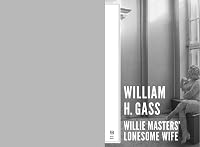
Gass echoes Walter Benjamin's philosophy and criticism in that recondite regard. For it's akin to seeking out a rare genus of weed in the Amazon rainforest, hunting for the reclusive plot (if it even exists) in, say, Gass' dark magnum opus, The Tunnel (1995), for instance. And even in his earlier fiction, like the typographical hijinks so common in the novella, Willie Masters' Lonesome Wife (1968), spliced with provocative black-and-white photography of the attractive lonesome wife's naked anatomy, posed as she is among so much sensually arranged textual formatting (discovering as she does that intercourse with words is sheer ecstasy!), the plot, nevertheless, is about as visible to the reader's naked eye as an atom.
If there is a point to On Being Blue: A Philosophical Inquiry, however, the point is obvious. The point is blue. show less
Or so posits William H. Gass (and I tend to believe him), in his idiosyncratic, intertextual synthesis, On Being Blue: A Philosophical Inquiry (1976), of all that's ever been—or could be—blue.
Besides blue ontologically and blue philosophically, Gass covers blue cross-culturally, literarily, aesthetically, psychologically, epistemologically, phenomenologically, erotically, metaphorically, and practically every other word ending, "-ically," that one might show more encounter in the O.E.D. too.
At the book's core, I believe Gass is asking: How do blue's meanings become blue's meanings and what do blue's meanings then mean to our very being? Even an intrepid or sadomasochistic-type reader easily lured by books odd or arcane, incomprehensible, might be wondering "huh?" or even, regrettably, "WTF!?" at such an inquiry regarding "blue meaning and blue being," as I was, after having just asked it up above. Keep in mind, if you're still with me, that if Gass confounds you to the point you'd like to hurl On Being Blue out the window into the great blue yonder, know you're not alone, but in some very good company, as William H. Gass is a certifiable Linguistic Mystic. He gets off on the alchemy of language—what he's coined, "a world of words," like he's a wizard wielding a wand in lieu of pen—much more so than making his language spells, particularly in On Being Blue—completely understandable to an understandably perplexed, though diehard, cult readership.
On Being Blue, while beholden to all of the momentarily forthcoming labels, is not necessarily in a monogamous relationship with only one, be it prose poetry, strict philosophy per se, literary or art criticism, soft core erotica, autobiography, or a confabulated hodgepodge of all the forms, including fiction. Rather, On Being Blue, borrowing ingredients from all styles of discourse, serves as William H. Gass's metaphysical manifesto built not out of the blue, but literally out of blue. The Epicurean blue of knowledge. The blue in gnosis and the gnosis in blue. Blue truth. It's a highly stylized interdisciplinary hybrid of a master-wordsmiths exposition that doesn't offer any easily navigated routes (let alone clues) of interpreting every facet of that diamond, blue. And Gass makes no apologies for failing to do so, either.
No surprise there, as Gass has never cared about being contemporary or orthodox or popular for everyone's easy consumption, so in love with the crafting and fashioning of language he is; and, in reading On Being Blue, it certainly seems his animated language loves him back. Self-indulgently so? Onanistic, a tad? Perhaps. And that's probably the harshest criticism I could levy against it (and perhaps against Gass' oeuvre in general) that the point of it all (in his essays) or the plot of it all (in his postmodern stories and experimental novels) gets lost in his lush, elaborate language and esoterica.
Gass echoes Walter Benjamin's philosophy and criticism in that recondite regard. For it's akin to seeking out a rare genus of weed in the Amazon rainforest, hunting for the reclusive plot (if it even exists) in, say, Gass' dark magnum opus, The Tunnel (1995), for instance. And even in his earlier fiction, like the typographical hijinks so common in the novella, Willie Masters' Lonesome Wife (1968), spliced with provocative black-and-white photography of the attractive lonesome wife's naked anatomy, posed as she is among so much sensually arranged textual formatting (discovering as she does that intercourse with words is sheer ecstasy!), the plot, nevertheless, is about as visible to the reader's naked eye as an atom.
If there is a point to On Being Blue: A Philosophical Inquiry, however, the point is obvious. The point is blue. show less
I wasn't sure what to expect from this inquiry and it surprised, and delighted me, that Gass spends so much time ruminating on the constraints of the author and limits of language around sex and bawdy behavior. Indeed, the majority of the blurbs talk about sound writing, but the main sound he's writing about is fucking. It's elegant, proactive, and challenging nonetheless.
Typical Gass. The first three sections are a brilliant sort of post-modern rambling fugue on the color, word, idea, etc. of blue. Great, huh? Then he adds a fourth section that’s like something ripped out of a different notebook that he just tacks on. At least it was overall better than [b:Omensetter's Luck|156188|Omensetter's Luck|William H. Gass|https://images.gr-assets.com/books/1347246872s/156188.jpg|150721]. Gass’s major writings are like literary practical jokes, or like a guy who writes well but doesn’t know how to use an outline. He must have missed those classes.
A seminal exegesis on the significance of words, in and of themselves, On Being Blue is a pair of bookends supporting an extended meandering through the manner in which words in the hands of a master can manipulate not just what you think, but how you think it, how you hear it, how you feel about it.
I haven't decided if I prefer the bookends to the pages they support.
I haven't decided if I prefer the bookends to the pages they support.
Video: https://www.youtube.com/watch?v=p105kzw-Wmw
========================================================
Reading note from first reading (11 December 2016):
Philosophy, philology, criticism, prosody, a mere thematic essay? All of these? None of these? What, exactly, is this book? As best I can judge, it is simply a panegyric to the splendor of language. Beyond the voluble figure-eights of the sentences, what strikes me most here, as with all of Gass's work, is his acuity for metaphor. There are tropes in here that render your mind numb with impact. Yet, at the same time, these linguistic gymnastics seem inevitable. One thinks of Yeats's poem "Adam's Curse":
========================================================
Reading note from first reading (11 December 2016):
Philosophy, philology, criticism, prosody, a mere thematic essay? All of these? None of these? What, exactly, is this book? As best I can judge, it is simply a panegyric to the splendor of language. Beyond the voluble figure-eights of the sentences, what strikes me most here, as with all of Gass's work, is his acuity for metaphor. There are tropes in here that render your mind numb with impact. Yet, at the same time, these linguistic gymnastics seem inevitable. One thinks of Yeats's poem "Adam's Curse":
I said, ‘A line will take us hours maybe;show more
Yet if it does not seem a moment’s
thought,show less
Our stitching and unstitching has been naught.
Better go down upon your marrow-bones
And scrub a kitchen pavement, or break stones
Like an old pauper, in all kinds of weather;
For to articulate sweet sounds together
Is to work harder than all these, and yet
Be thought an idler by the noisy set
Of bankers, schoolmasters, and clergymen
The martyrs call the world.’
His sentences are near perfect, the meditations deep sea. But my own sensibilities post #MeToo reacts against leavened word choice at times...
An incredibly beautiful book that demonstrates how powerful words-- just words-- can be. Unclassifiable, it's part philosophy, part poetry, part meditation, part roman a clef, and the David R. Godine edition-- even in paperback-- is sumptuous.
Members
- Recently Added By
Lists

Books to Read
9 works; 1 member
Author Information

William Howard Gass was born in Fargo, North Dakota on July 30, 1924. During World War II, he served as an ensign in the Navy. He received an A.B. in philosophy from Kenyon College in 1947 and a PhD in philosophy from Cornell University in 1954. He taught at several universities including The College of Wooster, Purdue University, and Washington show more University in St. Louis. He wrote novels, collections of short stories and novellas, and collections of criticism. His novels included Omensetter's Luck, Middle C, and The Tunnel, which received the American Book Award. His other works of fiction included In the Heart of the Heart of the Country, Willie Master's Lonesome Wife, Cartesian Sonata and Other Novellas, and Eyes: Novellas and Stories. His collections of criticism included Tests of Time; A Temple of Texts, which won the 2007 Truman Capote Award for Literary Criticism; and Habitations of the Word and Finding a Form, which both won the National Book Critics Circle Award for Criticism. His essay collections included Fiction and the Figures of Life, The World Within the Word, and Reading Rilke. He died from congestive heart failure on December 6, 2017 at the age of 93. (Bowker Author Biography) show less
Some Editions
Series
Belongs to Publisher Series
Common Knowledge
- Canonical title
- On being blue: a philosophical inquiry
- Original publication date
- 1976
- First words
- Say it. Go ahead, stand before the mirror, look at your mouth, and say it. Blue. See how you pucker up, your lips opening with the consonants into a kiss, and then that final exhalation of vowels? Blue. The word... (show all) looks like what it is, a syllable blown out into the air, and with the sound and the sight of say it as one. You blew blue, though let's pause a while before getting n to that.... -Introduction, Michael Gorra
Blue pencils, blue noses, blue movies, laws, blue legs and stockings, the language of birds, bees, and flowers as sung by longshoremen, that lead-like look the ski has when affected by cold, contusion, sickness, fear; the ro... (show all)tten rum or gin they call blue ruin and the blue devils of its delirium; Russian cats and oysters, a withheld or imprisoned breath, the blue they say that diamonds gave, deep holes in the ocean and the blazes which English athletes earn that gentlemen may wear; afflictions of the spirit - dumps, mopes, Mondays - all that's dismal - low-down gloomy music, Nova Scotians, cyanosis, hair rinse, bluing bleach.... Chapter 1 - Last words
- (Click to show. Warning: May contain spoilers.)This book was written for
all those who live in the
country of the blue
and is given in keeping
to Mary
St. Louis, September 13, 1975 - Canonical DDC/MDS
- 117
- Canonical LCC
- BH301.C6 G37
Classifications
Statistics
- Members
- 731
- Popularity
- 38,659
- Reviews
- 9
- Rating
- (3.90)
- Languages
- English
- Media
- Paper, Ebook
- ISBNs
- 6
- ASINs
- 4