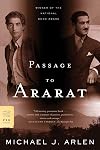
Passage to Ararat
by Michael J. Arlen
On This Page
Description
In "Passage to Ararat," which received the National Book Award in 1976, Michael J. Arlen goes beyond the portrait of his father, the famous Anglo-Armenian novelist of the 1920s, that he created in Exiles to try to discover what his father had tried to forget: Armenia and what it meant to be an Armenian, a descendant of a proud people whom conquerors had for centuries tried to exterminate. But perhaps most affectingly, Arlen tells a story as large as a whole people yet as personal as the show more uneasy bond between a father and a son, offering a masterful account of the affirmation and pain of kinship. show lessTags
Recommendations

















Member Reviews
Michael J. Arlen's father, Michael Arlen, rarely talked about Armenia or Armenians. By the time young Michael was born, his father had traded his Armenian name for a more English sounding name. Arlen thought of himself as English, then American after the family moved to the U.S. and he became an American citizen. Armenians were something “other”, not a group he felt he belonged to.
Who are the Armenians, and how did they become what they are today? A couple of decades after his father's death, Arlen set out to discover his Armenian roots. He talked to Armenian Americans such as writer William Saroyan. Finally, Arlen and his wife traveled to Soviet Armenia. Arlen spent his days seeing the country with local guide Sarkis and spent his show more nights reading histories and reference works. Arlen struggled with his reaction to what he learned about and saw of Armenian history and culture, particularly the Turkish genocide that has shaped Armenian identity since the beginning of the 20th century. His father never spoke of this, so Arlen hadn't internalized this event that shapes a particularly Armenian worldview.
It was difficult to read about the massacre of hundreds of thousands of Armenians and the suffering of those who survived. It was chilling to realize that the Germans had a presence in Turkey during the First World War, and that the things they witnessed and heard about might have influenced what the Nazis did to the Jews of Europe. Arlen's position as an “outsider” allows him to write somewhat dispassionately about the events. The bare facts are overwhelming enough.
My only disappointment with the book is that, although Arlen mentions a number of histories and quotes extensively from some of them, there isn't a bibliography to help interested readers dig deeper into Arlen's source material. Recommended for readers interested in family history, Armenia and Armenians, and memoirs. show less
Who are the Armenians, and how did they become what they are today? A couple of decades after his father's death, Arlen set out to discover his Armenian roots. He talked to Armenian Americans such as writer William Saroyan. Finally, Arlen and his wife traveled to Soviet Armenia. Arlen spent his days seeing the country with local guide Sarkis and spent his show more nights reading histories and reference works. Arlen struggled with his reaction to what he learned about and saw of Armenian history and culture, particularly the Turkish genocide that has shaped Armenian identity since the beginning of the 20th century. His father never spoke of this, so Arlen hadn't internalized this event that shapes a particularly Armenian worldview.
It was difficult to read about the massacre of hundreds of thousands of Armenians and the suffering of those who survived. It was chilling to realize that the Germans had a presence in Turkey during the First World War, and that the things they witnessed and heard about might have influenced what the Nazis did to the Jews of Europe. Arlen's position as an “outsider” allows him to write somewhat dispassionately about the events. The bare facts are overwhelming enough.
My only disappointment with the book is that, although Arlen mentions a number of histories and quotes extensively from some of them, there isn't a bibliography to help interested readers dig deeper into Arlen's source material. Recommended for readers interested in family history, Armenia and Armenians, and memoirs. show less
A tremendous book, and perhaps the perfect example of how to write a nonfiction historical novel. Arlen, whose father was Armenian but adopted English and then American ways, travels to Armenia to try to locate within himself his Armenian past. But his attempts are thwarted by his own lack of understanding of the Armenian's problems, and his relationship with his father.
I love how Arlen intertwines his first person narrative with his historical researches - both become stronger, especially in the narrative sense. His personal journey is at times harrowing, mirroring the harrowing existence of the Armenians in the last hundred years.
I love how Arlen intertwines his first person narrative with his historical researches - both become stronger, especially in the narrative sense. His personal journey is at times harrowing, mirroring the harrowing existence of the Armenians in the last hundred years.
It’s easy to see why Arlen’s exploration of his Armenian heritage won the National Book Award in 1976. Although it won in the category of Contemporary Affairs, Passage to Ararat is so much more than that. Although much of the focus is on Arlen’s trip in the early 1970s to the Armenian Soviet Republic and the history of Armenia, the book is as much memoir as history and exploration of father-son relations as travelogue. Not only is it a near exemplary success in each of those areas, it is exceptionally written. This is one of those rare books you not only look forward to reading again in the future, but regret having waited so long to pick up.
Originally posted here.
Originally posted here.
The author is the son of Michael Arlen, author of The Green Hat, a famous novel of the 1920's,. and this book is an account of the author 's trip to Soviet Armenia and his search for his relationship to the fact his father was Armenian. There is considerable discussion of the 1915 Turkish genocide aimed at obliterating Armenians in Turkey. It is a well written and sometimes poignant book
Discovery of his Armenian roots
Ratings
Members
- Recently Added By
Lists

Caucasus
122 works; 2 members
Author Information

Some Editions
Awards and Honors
Awards
Series
Belongs to Publisher Series
Work Relationships
Is contained in
Common Knowledge
- Canonical title*
- Embarquement pour l'Ararat. À la recherche de l'identité arménienne
- Original title
- Passage to Ararat
- Original publication date
- 1975
- Important places*
- Arménie
- Original language*
- Anglais (Etats-Unis) (Etats-Unis)
*Some information comes from Common Knowledge in other languages. Click "Edit" for more information.
Classifications
- Genres
- Nonfiction, Biography & Memoir, Travel, General Nonfiction
- DDC/MDS
- 909.0491992 — History & geography History World history History with respect to ethnic and national groups Other Other Indo-Europeans people East Indo-Europeans Armenians, Albanians Armenians
- LCC
- DS165 .A66 — History of Europe, Asia, Africa and Oceania Asia History of Asia Armenia
- BISAC
Statistics
- Members
- 136
- Popularity
- 241,001
- Reviews
- 5
- Rating
- (3.65)
- Languages
- English, French
- Media
- Paper, Ebook
- ISBNs
- 7
- ASINs
- 5