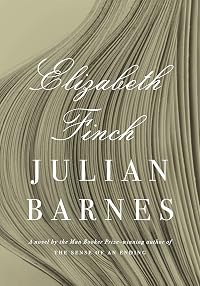
Elizabeth Finch
by Julian Barnes
On This Page
Description
"From the award-winning novelist, a compact narrative that turns on the death of a vivid and particular woman, and becomes the occasion for a man's deeper examination of love, friendship, and biography. This beautiful, spare novel of platonic unrequited love springs into being around the singular character of the stoic, exacting Professor Elizabeth Finch. Neil, the narrator, takes her class on Culture and Civilization, taught not for undergraduates but for adults of all ages; we are drawn show more into his intellectual crush on this private, withholding yet commanding woman. While other personal relationships and even his family drift from Neil's grasp, Elizabeth's application of her material to the matter of daily living remains important to him, even after her death, in a way that nothing else does. In Neil's story, we are treated to everything we cherish in Barnes: his eye for the unorthodox forms love can take between two people, a compelling swerve into nonfictional material (this time, through Neil's obsessive study of Julian the Apostate, following on notes Elizabeth left for him to discover after her death), and the forcefully moving undercurrent of history, and biography in particular, as nourishment and guide in our current lives"-- show lessTags
Recommendations











Member Reviews
In Elizabeth Finch, Julian Barnes has created a singular character, a woman who dictates and controls the terms by which she shall be regarded. The novel is narrated by Neil, in his thirties and at something of a loose end when, in Part One, he signs up for an adult education course on Culture and Civilization. The instructor is Elizabeth Finch, a stolidly unfashionable academic of indeterminate age—physically unremarkable—indeed, almost forgettable—who projects an air of unflappable confidence when speaking to her students. Neil, who harbours intellectual ambitions but lacks the grit and resolve to get things done (he refers to himself the “king of unfinished projects”), is deeply impressed with Finch’s approach to show more lecturing and the way she commands the class and encourages students to think for themselves. He also admires her mind, the way she collects and retains facts and theories and transmutes it all into wisdom. Neil wants to impress her, but at the same time is not afraid to admit he finds her intimidating. But, even more than this, he is fascinated by the how she is able to direct the conversation in order to reveal as little of herself as possible. By the end of the class, which he feels has enriched his life in ways he can hardly express, he pursues a deeper connection, arranging with her to meet for occasional lunches. By this means, over many years, the two keep up with each other’s lives, though Finch remains as secretive as ever. Then Elizabeth dies, prematurely from cancer, and Neil is shocked to find himself named executor of her papers and library. Part Two summarizes Neil’s writings based on Finch’s notebooks, which contain her jottings on topics relating to Greco-Roman and Christian philosophies, focusing in particular on how human history has been influenced by the beliefs and arguments of Julian the Apostate (331-363), the last pagan Roman Emperor prior to the ascendance of Christianity. In Part Three, more of Finch’s and Neil’s lives are revealed, though the intimate details might come too late for readers left perplexed and frustrated by the dense history lesson of Part Two. As Neil contemplates the notion of writing about Elizabeth Finch, he embarks on a mission of independent research, going so far as to reach out to Anna, a former classmate who, he discovers, has also kept in touch with Finch over the years. The novel, Elizabeth Finch—though an exquisitely written meditation on the chaos of modern life—is something of a muddle. Neil is personally and intellectually unexceptional. His observations are largely mundane and his fascination with his former teacher does not always seem warranted—though it does fill a gap in his own life. Is Barnes suggesting that humanity is approaching a watershed moment, comparable to that represented by Julian’s death on the battlefield in 363? Perhaps. But Elizabeth Finch, much like the title character, is a novel that does not relinquish its mysteries willingly. show less
Barnes has obviously been in this game long enough to know that he would never find a decently large audience for an extended essay about his namesake, the philosopher-emperor whose attempt to marginalise Christianity and put the Roman Empire back on a sane course of Hellenistic paganism was ended by his death on a Persian battlefield in 363. So he hit on the ingenious tactic of burying it in the middle of a short novel in which the narrator, Neil, dubbed "King of unfinished projects" by his daughter, tries to find out more about the life of his friend and sometime Foundation Course tutor, Elizabeth.
Of course, we soon discover that there are serious limitations to what we can ever really know about another person, whether it's the show more fourth-century Apostate or a reclusive private intellectual ("she never married," as Elizabeth sums herself up acerbically in one of her notebooks). And Neil's limitations as a biographer give Barnes plenty of licence to keep us dangling and withhold any satisfying resolution. This is a book about the process of living (and loving), not the result. Enjoyable, as a couple of hours spent in the company of Julian Barnes usually are. show less
Of course, we soon discover that there are serious limitations to what we can ever really know about another person, whether it's the show more fourth-century Apostate or a reclusive private intellectual ("she never married," as Elizabeth sums herself up acerbically in one of her notebooks). And Neil's limitations as a biographer give Barnes plenty of licence to keep us dangling and withhold any satisfying resolution. This is a book about the process of living (and loving), not the result. Enjoyable, as a couple of hours spent in the company of Julian Barnes usually are. show less
Barnes's previous short novel, "A Sense of an Ending", won the Booker Prize, but while I gave it a decent review at the time, I've changed my mind about it since. To my mind, it's the most obvious case of "We don't give lifetime achievement awards, so we'll give you this" since Robin Williams won an Academy Award for his disastrous Boston accent in "Good Will Hunting."
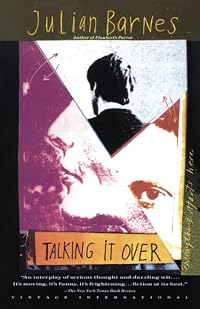
In that book, Barnes took the easy way out and relied on plot. Plot is something a nice thing to to have, but Julian Barnes has never needed it to write good novels. The plot of his excellent "Talking It Over" can be reduced to "Man marries woman, but woman changes her mind and marries his best friend instead." "Flaubert's Parrot" is half literary meditation, half mournful show more travelogue through rural France. I don't remember what happened in that book, exactly, but I did enjoy it. By contrast, "A Sense of An Ending" felt like reading a book by M. Night Shyamalan: at the end, it fairly screamed "what a tweest!" at the reader. Disappointing, to say the least. Who reads Julian Barnes for that sort of thing?
So I'm pleased to report that with "Elizabeth Finch", Barnes nudges things back in a more gently experimental direction. While I understand that some readers might not love its structure, as it's half fiction, half disquisition on the life of a historical personage belonging to the classical period, it reminded me of "Flaubert's Parrot" in the best way. Oh, and I learned some of the things I missed out on when I performed disastrously in my freshman year Ancient Greek and Rome courses. Incongruous or not, that was certainly a welcome experience.
As for the rest of the novel, I'm happy to say that it works. The book's narrator — Neil, who needs no last name — has his life changed by the book's namesake, a college professor who strikes him as brilliant, inscrutable, poised, encouraging and mysterious. When he is unexpectedly made the executor of her will, he gets a chance to discover if she left anything publishable behind and, most tantalizingly, to learn what she might really have been like.
I'll give you a guess as to how his efforts turn out, but you probably won't need it. Still, in terms of writing characters and evoking the trajectories of their various lives, Barnes is very much on his game here, and that's good news, even if, at just one hundred and seventy-five pages, "Elizabeth Finch" sometimes feels a bit too brief. But I as I read it, I came to think of it as less a testimonial to one specific emotionally guarded yet beguilingly intelligent university lecturer and more of a monument to all of the great teachers that may have shaped our personalities and the course of our lives. Neil's experiences in his the "Culture and Civilization" class that he took with Professor Finch accompany him for decades after the course finishes up. One suspects that they might have done so even if the did not later form a friendship that lasted until the title character passed away. As he course's title suggests, Elizabeth Finch helped our narrator ask the really big questions and to formulate his own answers to them. I'm happy to say that I've had an Elizabeth Finch in my own life, and that my life has been incomparably richer for it. Those sorts of people certainly deserve their own book, and Barnes's little novel, well-written and affectionate as it is, might well be worthy of the title. show less
In that book, Barnes took the easy way out and relied on plot. Plot is something a nice thing to to have, but Julian Barnes has never needed it to write good novels. The plot of his excellent "Talking It Over" can be reduced to "Man marries woman, but woman changes her mind and marries his best friend instead." "Flaubert's Parrot" is half literary meditation, half mournful show more travelogue through rural France. I don't remember what happened in that book, exactly, but I did enjoy it. By contrast, "A Sense of An Ending" felt like reading a book by M. Night Shyamalan: at the end, it fairly screamed "what a tweest!" at the reader. Disappointing, to say the least. Who reads Julian Barnes for that sort of thing?
So I'm pleased to report that with "Elizabeth Finch", Barnes nudges things back in a more gently experimental direction. While I understand that some readers might not love its structure, as it's half fiction, half disquisition on the life of a historical personage belonging to the classical period, it reminded me of "Flaubert's Parrot" in the best way. Oh, and I learned some of the things I missed out on when I performed disastrously in my freshman year Ancient Greek and Rome courses. Incongruous or not, that was certainly a welcome experience.
As for the rest of the novel, I'm happy to say that it works. The book's narrator — Neil, who needs no last name — has his life changed by the book's namesake, a college professor who strikes him as brilliant, inscrutable, poised, encouraging and mysterious. When he is unexpectedly made the executor of her will, he gets a chance to discover if she left anything publishable behind and, most tantalizingly, to learn what she might really have been like.
I'll give you a guess as to how his efforts turn out, but you probably won't need it. Still, in terms of writing characters and evoking the trajectories of their various lives, Barnes is very much on his game here, and that's good news, even if, at just one hundred and seventy-five pages, "Elizabeth Finch" sometimes feels a bit too brief. But I as I read it, I came to think of it as less a testimonial to one specific emotionally guarded yet beguilingly intelligent university lecturer and more of a monument to all of the great teachers that may have shaped our personalities and the course of our lives. Neil's experiences in his the "Culture and Civilization" class that he took with Professor Finch accompany him for decades after the course finishes up. One suspects that they might have done so even if the did not later form a friendship that lasted until the title character passed away. As he course's title suggests, Elizabeth Finch helped our narrator ask the really big questions and to formulate his own answers to them. I'm happy to say that I've had an Elizabeth Finch in my own life, and that my life has been incomparably richer for it. Those sorts of people certainly deserve their own book, and Barnes's little novel, well-written and affectionate as it is, might well be worthy of the title. show less
At first I had the same consternation as other reviewers. I was delighted with the first part of the book, and uninterested in the biography of Emperor Julian in the middle, then unsure of how it was all put together at the end. I declared on social media after the first several pages that Julian Barnes was an author I could trust, and then I felt disappointed.
But now, having had time to think about it, I begin to wonder whether the rote historical report on the emperor wasn't the point. In its dry and dull style there may be a comment on how historical biography is done. After Elizabeth Finch's death, perhaps writing some sort of biography seems to be the thing to do, but she was much more alive to the protagonist, presumably, than the show more emperor. What's odd is that he didn't know much about her when she was alive, whether she had lovers or even that she might be ill. Perhaps he finds he can only write dull prose if he tries to actually write her biography. Being fascinated by her doesn't help the way it should.
So there is something here about the mistake one makes in assuming that we really know people in the present, and that the past is dulled by distance. The protagonist does not really know Elizabeth Finch; he shares with the reader impressions and quotations, says they became friends and had coffees together but never explains how that happened (the conversations seemed to me to be just a continuation of professorial office hours), and in the end he's utterly unable to describe who she is or in what precise way she influenced him. Might there then be a futility in biography of any kind? Or in the idea that we can truly know anyone, past or present?
A book worth examining again. show less
But now, having had time to think about it, I begin to wonder whether the rote historical report on the emperor wasn't the point. In its dry and dull style there may be a comment on how historical biography is done. After Elizabeth Finch's death, perhaps writing some sort of biography seems to be the thing to do, but she was much more alive to the protagonist, presumably, than the show more emperor. What's odd is that he didn't know much about her when she was alive, whether she had lovers or even that she might be ill. Perhaps he finds he can only write dull prose if he tries to actually write her biography. Being fascinated by her doesn't help the way it should.
So there is something here about the mistake one makes in assuming that we really know people in the present, and that the past is dulled by distance. The protagonist does not really know Elizabeth Finch; he shares with the reader impressions and quotations, says they became friends and had coffees together but never explains how that happened (the conversations seemed to me to be just a continuation of professorial office hours), and in the end he's utterly unable to describe who she is or in what precise way she influenced him. Might there then be a futility in biography of any kind? Or in the idea that we can truly know anyone, past or present?
A book worth examining again. show less
The problem with reading a favourite author is the ingrained expectation of loving each book not, per se, as much as the last one, but in the same way. While I felt something was missing from the work, it’s possible that it was an intentional choice, driving home the point that we never really know much about history, about other people, about ourselves. There are several clues along the way that the narrator is unreliable in the sense that he ‘misses’ several small things around him regarding how other people view the title character and himself. Having just read Neville Morley’s “Writing Ancient History” re the errors and omissions of historical interpretation, it seemed like Barnes was exploring similar arenas, in fiction show more form.
I blame the back copy of the book for creating some distance as well: having been set up to expect one kind of narrative (Elizabeth Finch was much more than a scholar. Her secrets are waiting to be revealed . . .and will change [the narrator’s] view of the world forever) was misleading and in its “clickbait” use, unnecessary.
Employing self-aware irony and conveying that magical love/need we have for a person, sometimes for inexplicable reasons which are rationalized afterwards, Barnes continues his exploration of collected memory vs personal memory: getting our history wrong is part of being a nation, being part of a religion, a family, of being in a relationship. show less
I blame the back copy of the book for creating some distance as well: having been set up to expect one kind of narrative (Elizabeth Finch was much more than a scholar. Her secrets are waiting to be revealed . . .and will change [the narrator’s] view of the world forever) was misleading and in its “clickbait” use, unnecessary.
Employing self-aware irony and conveying that magical love/need we have for a person, sometimes for inexplicable reasons which are rationalized afterwards, Barnes continues his exploration of collected memory vs personal memory: getting our history wrong is part of being a nation, being part of a religion, a family, of being in a relationship. show less
Elizabeth Finch is typical Julian Barnes in the sense that whatever, and how much, the reader brings to the book will likely determine how much they like it. It isn't a hierarchical thing, not a case of "getting it or not getting it," but rather simply whether the dynamic between the reader and the novel is a positive one for that reader. Which is to say that even more than most novels, this will be hit or miss.
My comment about the "it" that many people refer to is, for me, a bit of a dodge when it is used. Few books, if any, have one singular "it." This one has more than most. I got several "its" out of the book while some others may get none. Since meaning-making is a function of both the writer and the reader, there doesn't have to show more be a failure on either part for the book not to work, it is simply the dynamic between the two.
I found the idea of a nontraditional student having strong feelings for a particularly effective, for them, teacher relatable. Trying to figure out those feelings also makes sense, especially for someone like Neil who doesn't have a strong background in relationships: platonic, intimate, or otherwise. I also don't find the idea of loving a teacher who impacts your life as creepy. In fact, I find those who do to be far more creepy. They met twice a year for lunch, so while the novel, which focuses on the relationship, makes it sound all-consuming and obsessional, it isn't really that bad. He never betrayed the privacy he believed she wanted, never went creeping behind her to discover more. He went on about his life, changed because of her, but not stalking her or anything that would truly be creepy.
As for reading the novel, it is in three parts, of which the second is the one that seems, at first, out of place. I certainly thought so. But as I was reading it, and largely because I kept wondering why it was here, I started seeing connections. Back to EF herself, in how Neil viewed EF after her death, and once I read part three even to those revelations. So I would have to say that, for me, the section worked well within the bigger picture even if it wasn't the most enjoyable to read. It is also in this section where I think so many connections can be made outside the novel, to our world today and even to our own lives, or at least mine.
Like life, this novel is full of flawed characters. Kinda funny how we hate the perfect characters in books because they aren't realistic enough, yet criticize flawed characters because they are in fact realistic. Questionable decisions, somewhat flawed reasoning, even just plain irritating. These things are, depending on who one asks, descriptive of all of us whether we want to admit it or not. I can't imagine a novel without these kinds of characters, so why does their inclusion become the issue with some readers?
Admittedly I work harder to try to make a novel work for me rather than lament what it isn't and wallow in that misplaced expectation. This is one of those that required that effort and, fortunately, I was rewarded for it. That isn't always the case. Elizabeth Finch the character will stay with me, or rather, Neil's view of her will. Her almost cliche-ish response to some situations look at first like simplistic but empty comments. Maybe many are, but many warrant more consideration. Nuance makes many of them far more pointed than they seem, while looking for where they don't fit gives one opportunity to question why they often go unquestioned. Those thoughts and where they led me, and continue to lead me, will also stay with me.
In recommending this book to friends and family, I am being very sure to let them know it won't read like a standard novel, it isn't action-packed, there aren't really any aha moments. Or rather, those moments come from your interaction with it rather than from a particular moment in the book. There is a historical essay in the middle. The writing is quite good and, if you happen to find your way into the story, you may discover that part of the enjoyment is forming your own responses to what is written. If you want a basic "this then that" story, find something else, you may not enjoy this one. If you feel like working with Barnes' writing to create something for yourself, you could be richly rewarded.
Reviewed from a copy made available by the publisher via NetGalley. show less
My comment about the "it" that many people refer to is, for me, a bit of a dodge when it is used. Few books, if any, have one singular "it." This one has more than most. I got several "its" out of the book while some others may get none. Since meaning-making is a function of both the writer and the reader, there doesn't have to show more be a failure on either part for the book not to work, it is simply the dynamic between the two.
I found the idea of a nontraditional student having strong feelings for a particularly effective, for them, teacher relatable. Trying to figure out those feelings also makes sense, especially for someone like Neil who doesn't have a strong background in relationships: platonic, intimate, or otherwise. I also don't find the idea of loving a teacher who impacts your life as creepy. In fact, I find those who do to be far more creepy. They met twice a year for lunch, so while the novel, which focuses on the relationship, makes it sound all-consuming and obsessional, it isn't really that bad. He never betrayed the privacy he believed she wanted, never went creeping behind her to discover more. He went on about his life, changed because of her, but not stalking her or anything that would truly be creepy.
As for reading the novel, it is in three parts, of which the second is the one that seems, at first, out of place. I certainly thought so. But as I was reading it, and largely because I kept wondering why it was here, I started seeing connections. Back to EF herself, in how Neil viewed EF after her death, and once I read part three even to those revelations. So I would have to say that, for me, the section worked well within the bigger picture even if it wasn't the most enjoyable to read. It is also in this section where I think so many connections can be made outside the novel, to our world today and even to our own lives, or at least mine.
Like life, this novel is full of flawed characters. Kinda funny how we hate the perfect characters in books because they aren't realistic enough, yet criticize flawed characters because they are in fact realistic. Questionable decisions, somewhat flawed reasoning, even just plain irritating. These things are, depending on who one asks, descriptive of all of us whether we want to admit it or not. I can't imagine a novel without these kinds of characters, so why does their inclusion become the issue with some readers?
Admittedly I work harder to try to make a novel work for me rather than lament what it isn't and wallow in that misplaced expectation. This is one of those that required that effort and, fortunately, I was rewarded for it. That isn't always the case. Elizabeth Finch the character will stay with me, or rather, Neil's view of her will. Her almost cliche-ish response to some situations look at first like simplistic but empty comments. Maybe many are, but many warrant more consideration. Nuance makes many of them far more pointed than they seem, while looking for where they don't fit gives one opportunity to question why they often go unquestioned. Those thoughts and where they led me, and continue to lead me, will also stay with me.
In recommending this book to friends and family, I am being very sure to let them know it won't read like a standard novel, it isn't action-packed, there aren't really any aha moments. Or rather, those moments come from your interaction with it rather than from a particular moment in the book. There is a historical essay in the middle. The writing is quite good and, if you happen to find your way into the story, you may discover that part of the enjoyment is forming your own responses to what is written. If you want a basic "this then that" story, find something else, you may not enjoy this one. If you feel like working with Barnes' writing to create something for yourself, you could be richly rewarded.
Reviewed from a copy made available by the publisher via NetGalley. show less
I come to this novel, by one of my favorite writers, as a student who never got through a year of school from about fifth grade on without having a crush on some teacher. All without any harm done, I hasten to say. I was willing to be engaged by this odd, dry sort-of memoirish narrative of a middle-aged man with a serious crush on his teacher. Plus I know that Julian Barnes will always feed me some unexpected observation, revelation, or just a choice of words that will startle and delight me. No disappointment here: by page 9, I had to look up the lovely word “refulgent.” Showoff.
Thirty-something narrator Neil takes an adult education class in “Culture and Civilisation,” taught by the eponymous Elizabeth Finch. Neil presumes show more she is an “independent scholar,” but Neil presumes a lot. There is much distancing, projection, guesswork: “If you had dared to ask [her],” “of course, she would have said…,” “who would dare to speak?” Barnes tries to “show” us EF, as he calls her, with details of her shoes, stockings (“you couldn’t imagine her in beachwear,” though clearly he has tried), jewelry, haircut, the existence of a West London apartment in which he “never set foot”; the way she smokes, and so on. She speaks entirely without notes, in fully-thought-out paragraphs, and is prone to aphoristic pronouncements, like “artifice is not incompatible with truth,” or “getting our history wrong is part of being a nation.” Neil is completely smitten. After the course ends, Neil manages to have lunch with EF a couple times a year – entirely on her terms, dictating place, time, dishes, and she always pays – until she dies. It was observed that her self-sufficiency was such that people were often less central to her life than they believed, or more so. She leaves Neil all her papers and books in her will – was he one of the more or less central people? Hard to say. And of course, he does “set foot” in the West London flat. Should he attempt a biography? An edition of her writings? A cryptic comment in a notebook: “J – dead at thirty-one,” gets him wondering who that might refer to… a lover? I’m thinking: Neil! Jesus, of course! But it sends Neil down a rabbit highway to construct a biography of Julian the Apostate, a historical figure of significance to EF.
Here's where the story either gets interesting, or goes off the rails. The second portion of the book is Neil’s Julian essay. It is long. It is clumsy – wandering here and there through centuries and faiths. Julian was a Roman emperor who tried to roll back the tide of Christianity and restore religious freedom and respect for the old “pagan” beliefs – but died (at thirty-one) in one of the empire’s interminable wars before he got anywhere. I quite liked him. Disloyally, I suspect Julian Barnes had gotten interested in his Apostate namesake, and that this novel was a frame (or an excuse) to make some practical use of it. At one point, Neil comments: “It is as if Julian imagined that he could win over the population by humorous yet sophisticated complaint, plus a public examination of his own character.” Julian Barnes, I see what you’ve done there. It’s also an opportunity for Barnes to muse – aptly, in this moment of current affairs and politics – on the very deep trouble arising from mixing government with religion, or, as he puts it: “the two disasters of early Christian history were the imposition of monotheism and the fusing by Constantine of Church and State.” Not to mention the historical fact that “more Christians were put to death in a single year of the Christian Empire than had been executed in three centuries of pagan dominion.”
In the third section, Neil returns to the present, connecting with EF’s brother, and a former classmate (with whom he had had a desultory affair). We learn, belatedly, about “The Shaming,” where the tabloid press goes crazy over a rare public talk given by EF and her rather mild criticism of monotheism, a scenario that strains credulity for a character whose entire life has been very much less than public. Neil’s former lover mentions going swimming regularly with EF – someone has seen her in “beachwear.” And then… it just ends.
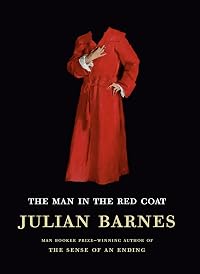
So, I got what I expect from Julian Barnes: erudition, self-depreciating humor, graceful writing. I got some wry smiles of my own, remembering my own strangely non-charismatic medieval history professor who enchanted me with his ninety-minute no-notes lectures. But something has gone wrong with the characters. Neil – unreliable and withholding as a narrator – can only describe EF as he sees her, and since she is also a closed, withholding personality, neither one of them comes to life. So the reader – even a sympathetic one like me – struggles to connect with, or even picture, them. Perhaps it’s a bit of a feat for Julian Barnes to deliberately produce a rough, almost amateurish historical bio (when I know how good he is – see The Man in the Red Coat) as a product of his amateurish character. But I rather wish he’d just gone ahead and written a historical novel – or a straight bio - of his own about the Apostate. Nevertheless, three cheers and thanks to the teachers who inspired us. Most of us never really got to know them either, did we? And, as EF observes – on different pages: “Getting our history wrong is part of being a nation…a family… a religion… a person.”
**EDIT! Thanks to Mr. Barnes, for my noodling for more information on Julian the Apostate led me to Gore Vidal's terrific historical novel, "Julian." It was quite a bit more fun than EF.**
*Thanks to NetGalley for an ARC in exchange for an honest review* show less
Thirty-something narrator Neil takes an adult education class in “Culture and Civilisation,” taught by the eponymous Elizabeth Finch. Neil presumes show more she is an “independent scholar,” but Neil presumes a lot. There is much distancing, projection, guesswork: “If you had dared to ask [her],” “of course, she would have said…,” “who would dare to speak?” Barnes tries to “show” us EF, as he calls her, with details of her shoes, stockings (“you couldn’t imagine her in beachwear,” though clearly he has tried), jewelry, haircut, the existence of a West London apartment in which he “never set foot”; the way she smokes, and so on. She speaks entirely without notes, in fully-thought-out paragraphs, and is prone to aphoristic pronouncements, like “artifice is not incompatible with truth,” or “getting our history wrong is part of being a nation.” Neil is completely smitten. After the course ends, Neil manages to have lunch with EF a couple times a year – entirely on her terms, dictating place, time, dishes, and she always pays – until she dies. It was observed that her self-sufficiency was such that people were often less central to her life than they believed, or more so. She leaves Neil all her papers and books in her will – was he one of the more or less central people? Hard to say. And of course, he does “set foot” in the West London flat. Should he attempt a biography? An edition of her writings? A cryptic comment in a notebook: “J – dead at thirty-one,” gets him wondering who that might refer to… a lover? I’m thinking: Neil! Jesus, of course! But it sends Neil down a rabbit highway to construct a biography of Julian the Apostate, a historical figure of significance to EF.
Here's where the story either gets interesting, or goes off the rails. The second portion of the book is Neil’s Julian essay. It is long. It is clumsy – wandering here and there through centuries and faiths. Julian was a Roman emperor who tried to roll back the tide of Christianity and restore religious freedom and respect for the old “pagan” beliefs – but died (at thirty-one) in one of the empire’s interminable wars before he got anywhere. I quite liked him. Disloyally, I suspect Julian Barnes had gotten interested in his Apostate namesake, and that this novel was a frame (or an excuse) to make some practical use of it. At one point, Neil comments: “It is as if Julian imagined that he could win over the population by humorous yet sophisticated complaint, plus a public examination of his own character.” Julian Barnes, I see what you’ve done there. It’s also an opportunity for Barnes to muse – aptly, in this moment of current affairs and politics – on the very deep trouble arising from mixing government with religion, or, as he puts it: “the two disasters of early Christian history were the imposition of monotheism and the fusing by Constantine of Church and State.” Not to mention the historical fact that “more Christians were put to death in a single year of the Christian Empire than had been executed in three centuries of pagan dominion.”
In the third section, Neil returns to the present, connecting with EF’s brother, and a former classmate (with whom he had had a desultory affair). We learn, belatedly, about “The Shaming,” where the tabloid press goes crazy over a rare public talk given by EF and her rather mild criticism of monotheism, a scenario that strains credulity for a character whose entire life has been very much less than public. Neil’s former lover mentions going swimming regularly with EF – someone has seen her in “beachwear.” And then… it just ends.
So, I got what I expect from Julian Barnes: erudition, self-depreciating humor, graceful writing. I got some wry smiles of my own, remembering my own strangely non-charismatic medieval history professor who enchanted me with his ninety-minute no-notes lectures. But something has gone wrong with the characters. Neil – unreliable and withholding as a narrator – can only describe EF as he sees her, and since she is also a closed, withholding personality, neither one of them comes to life. So the reader – even a sympathetic one like me – struggles to connect with, or even picture, them. Perhaps it’s a bit of a feat for Julian Barnes to deliberately produce a rough, almost amateurish historical bio (when I know how good he is – see The Man in the Red Coat) as a product of his amateurish character. But I rather wish he’d just gone ahead and written a historical novel – or a straight bio - of his own about the Apostate. Nevertheless, three cheers and thanks to the teachers who inspired us. Most of us never really got to know them either, did we? And, as EF observes – on different pages: “Getting our history wrong is part of being a nation…a family… a religion… a person.”
**EDIT! Thanks to Mr. Barnes, for my noodling for more information on Julian the Apostate led me to Gore Vidal's terrific historical novel, "Julian." It was quite a bit more fun than EF.**
*Thanks to NetGalley for an ARC in exchange for an honest review* show less
Members
- Recently Added By
Lists

Books published and read in 2022
82 works; 5 members

Books Read in 2023
5,547 works; 145 members
Author Information

89+ Works 43,056 Members
Julian Barnes was born in Leicester, England, on January 19, 1946. He received a degree in modern languages from Magdalen College, Oxford University in 1968. He has held jobs as a lexicographer for the Oxford English Dictionary, a reviewer and literary editor for the New Statesmen and the New Review, and a television critic. He has written show more numerous works of fiction including Arthur and George, Pulse: Stories, The Noise of Time, and England, England. He received the Somerset Maugham Award in 1980 for Metroland, the Geoffrey Faber Memorial Prize in 1985 and a Prix Medicis in 1986 for Flaubert's Parrot, and the Man Booker Prize in 2011 for The Sense of an Ending. He also writes non-fiction works including Letters from London, The Pedant in the Kitchen, and Nothing to Be Frightened Of. He received the Shakespeare Prize by the FVS Foundation in 1993, the Austrian State Prize for European Literature in 2004, and the David Cohen Prize for Literature in 2011. He writes detective novels under the pseudonym Dan Kavanaugh. His works under this name include Duffy, Fiddle City, Putting the Boot In, and Going to the Dogs. (Bowker Author Biography) show less
Some Editions
Awards and Honors
Awards
Distinctions
The Guardian Book of the Day (2022-04-11)
Notable Lists
RUSA CODES Listen List (Listen-Alike – Listen-Alike to “The Angel of Rome: And Other Stories" – 2023)
Common Knowledge
- Canonical title*
- Elizabeth Finch
- Original title
- Elizabeth Finch
- Original publication date
- 2022
- People/Characters
- Elizabeth Finch; Christopher Finch; Neil; Emma; Linda; Geoff
- Important places
- London, England, UK; Alkmaar, The Netherlands
- Dedication
- To Rachel
- First words
- She stood before us, without notes, books, or nerves.
- Quotations
- Artifice, rigour, truth. Artifice in civilisations as much as in clothes. Artifice not the opposite of truth but often its very embodiment, what makes it irresistibile.
Of course, my kind of woman is out of fashion. Not that I have ever sought fashionability, or indeed ever hade it. Sustainability is more what I sought.
Oh, they say, she never married. Such a reductive way to describe and contain a life. - Last words
- (Click to show. Warning: May contain spoilers.)And any ironic laughter you hear will be mine.
- Blurbers
- John Self
- Original language
- English
*Some information comes from Common Knowledge in other languages. Click "Edit" for more information.
Classifications
Statistics
- Members
- 522
- Popularity
- 57,360
- Reviews
- 36
- Rating
- (3.27)
- Languages
- 13 — Catalan, Dutch, English, Estonian, French, German, Italian, Polish, Portuguese, Romanian, Spanish, Swedish, Turkish
- Media
- Paper, Audiobook, Ebook
- ISBNs
- 41
- ASINs
- 9