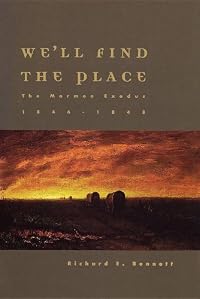
We'll Find the Place: The Mormon Exodus, 1846-1848
by Richard E. Bennett
On This Page
Description
We'll Find the Place tells the fascinating story of the Mormons' exodus from Nauvoo, Illinois, to their New Zion in the West--a story of a people's deliverance that has never before been completely told. Following the journey of the original pioneer camp of 1847 to the Salt Lake Valley and concluding with the first conference of the church there in 1848, Richard E. Bennett shows the inner workings of the Mormon exodus by probing the minds and hearts of those who suffered and triumphed show more through this remarkably difficult hour in Latter-day Saint history. A work many years in the making, We'll Find the Place looks behind the scenes to reveal Mormonism on the move, its believers sacrificing home, comfort, and sometimes life itself as they sought a safe refuge beyond the Rocky Mountains. It is faithful both to the convictions of the early pioneers and to the records they kept. show lessTags
Recommendations












Member Reviews
I have been reading this book alongside another trilogy of historical fiction on the same subject for the month of July to celebrate Pioneer Days in Salt Lake City, This is in honor of the early Utah Pioneers who crossed the plains of America to reach the Great Basin of the Salt Lake in 1847.
The trilogy books are stories of black pioneers who were involved in this same exodus. I read them side by side, one for stories of real people and the other for actual description. WE'LL FIND THE PLACE,THE MORMON EXODUS 1846-1848 is about the trek in general.It is a very extensive overview of the whole adventure, packed with a tremendous cache of details about every aspect imaginable. I found the reading somewhat laborious, especially in the show more beginning. There was so much information and details, that I wonder if any particular at all was overlooked. I couldn't help thinking, "Let's get on with it. When does this story get going?" At the same time, I knew it was mirroring just how all those people must have been feeling at the time as they struggled to cope with innumerable issues and problems before they could even get started. Reading the stories in the trilogy books provided grounding to stay an interest in all this labor.
Reading as a narrative, there is not active dialogue, but there are many quotes taken from newspapers, minutes of meetings, and journals, especially of church leaders of the time. A great deal of historic information has been researched and presented. For those who are studying LDS church history, doubtless there is ample that's new to be found. The depth of detail and record is so much that it seems to match the arduousness of the trek itself. You can easily be weary by reading about it. On the other hand,there are places and topics that you might really get into as you discover little known facts about various involvements. You can't help wondering how any of them stuck with it.
On the flipside, it was rewarding to know of the excitement and gratitude many joyfully expressed when they finally entered the Salt Lake Valley.
The book ends with 1848, after the first hard winter and additional trials of the saints. At this point, the reader is able to breathe relieved and feel that "All is well". The saints have settled at last and can begin their lives free of the persecution they fled from. I realize now that as the reader plows through all that is in this documentary, he is, in a very small way, experiencing a tiny bit of the history. You don't have to enjoy it for it to be a good book. I suspect enjoying the read, was not the author's first intention. It is a good book. show less
The trilogy books are stories of black pioneers who were involved in this same exodus. I read them side by side, one for stories of real people and the other for actual description. WE'LL FIND THE PLACE,THE MORMON EXODUS 1846-1848 is about the trek in general.It is a very extensive overview of the whole adventure, packed with a tremendous cache of details about every aspect imaginable. I found the reading somewhat laborious, especially in the show more beginning. There was so much information and details, that I wonder if any particular at all was overlooked. I couldn't help thinking, "Let's get on with it. When does this story get going?" At the same time, I knew it was mirroring just how all those people must have been feeling at the time as they struggled to cope with innumerable issues and problems before they could even get started. Reading the stories in the trilogy books provided grounding to stay an interest in all this labor.
Reading as a narrative, there is not active dialogue, but there are many quotes taken from newspapers, minutes of meetings, and journals, especially of church leaders of the time. A great deal of historic information has been researched and presented. For those who are studying LDS church history, doubtless there is ample that's new to be found. The depth of detail and record is so much that it seems to match the arduousness of the trek itself. You can easily be weary by reading about it. On the other hand,there are places and topics that you might really get into as you discover little known facts about various involvements. You can't help wondering how any of them stuck with it.
On the flipside, it was rewarding to know of the excitement and gratitude many joyfully expressed when they finally entered the Salt Lake Valley.
The book ends with 1848, after the first hard winter and additional trials of the saints. At this point, the reader is able to breathe relieved and feel that "All is well". The saints have settled at last and can begin their lives free of the persecution they fled from. I realize now that as the reader plows through all that is in this documentary, he is, in a very small way, experiencing a tiny bit of the history. You don't have to enjoy it for it to be a good book. I suspect enjoying the read, was not the author's first intention. It is a good book. show less
Members
- Recently Added By
Author Information
16+ Works 132 Members
Richard E. Bennett is Professor of Church History and Doctrine at Brigham Young University, Provo, Utah.
Classifications
- Genres
- Nonfiction, History, Religion & Spirituality, General Nonfiction, Biography & Memoir
- DDC/MDS
- 978.02088283 — History & geography History of North America Western United States 19th Century
- LCC
- F592 .B42 — Local History of the United States, Canada and Latin America United States local history The West. Trans-Mississippi Region. Great Plains
- BISAC
Statistics
- Members
- 24
- Popularity
- 1,006,008
- Reviews
- 1
- Rating
- (4.50)
- Languages
- English
- Media
- Paper
- ISBNs
- 2