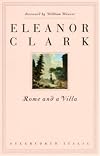
Rome and a Villa
by Eleanor Clark
On This Page
Description
"These essays gather up Rome and hold it before us, bristling and dense and dreamlike, with every scene drenched in the sound of fountains, of leaping and falling water." -- The New Yorker "Perhaps the finest book ever to be written about a city." -- New York Times Bringing to life the legendary city's beauty and magic in all its many facets, Eleanor Clark's masterful collection of vignettes, Rome and a Villa, has transported readers for generations. In 1947 a young american woman named show more Eleanor Clark went to Rome on a Guggenheim fellowship to write a novel. But instead of a novel, Clark created a series of sketches of Roman life written mostly between 1948 and 1951. Wandering the streets of this legendary city, Eleanor fell under Rome's spell--its pace of life, the wry outlook of its men and women, its magnificent history and breathtaking contribution to world culture. Rome is life itself--a sensuous, hectic, chaotic, and utterly fascinating blend of the comic and the tragic. Clark highlights Roman art and architecture, including Hadrian's Villa--an enormous, unfinished palace--as a prism to view the city and its history, and offers a lovely portrait of the Cimitero acattolico--long known as the Protestant cemetery--where Keats, Shelley, and other foreign notables rest. show lessTags
Recommendations

















Member Reviews
Even though the last time Clark visited Rome the year was 1974, you cannot help but daydream of traveling to Rome when you read Rome and a Villa. I started a mental checklist of everything I hoped to see, should I get there myself: the 124 steps of Santa Mana Aracoeli beside the Campidoglio, feral cats scattering in the rain, the Piazza Vittorio, the famous Trevi Fountain which was funded with a second tax on wine, and capable of moving 80,000 cubic meters of water per day.
Clark even opened my eyes to the Roman influences here in the United States: Penn Station in New York City; how it was designed with the Baths of Caracalle in mind.
Beyond architecture and tourist draws, Clark paints pictures of influential individuals like Julius show more Caesar and Hadrian. She meanders with her narrative and is sometimes difficult to follow, but worth it if you can stick with her. show less
Clark even opened my eyes to the Roman influences here in the United States: Penn Station in New York City; how it was designed with the Baths of Caracalle in mind.
Beyond architecture and tourist draws, Clark paints pictures of influential individuals like Julius show more Caesar and Hadrian. She meanders with her narrative and is sometimes difficult to follow, but worth it if you can stick with her. show less
This is a famous book, well-reviewed when it came out, still highly recommended back when I was in college. It has marinated on my shelves for quite a while. And now, a great disappointment. Clark writes in a random, stream-of-consciousness, frequently run-on sentence style that I find quite off-putting. She often tends toward the epigrammatic (think Martial, but all of the epigram, none of the humanity). Sometimes she devolves into mere catalogs, e.g., for the fountains and palaces of Rome. These can grow quite tedious. She can be a judgmental Yankee. Sometimes she is lacking in aesthetics of language: Cesare Borgia is called Caesar Borgia; just doesn't sound right. Sometimes the problem is as simple as wordy descriptions of buildings show more or works of art where a picture would be better. I mostly just skimmed the last part of the book.
Clark covers Rome of all periods. "Roman Journal I" covers mostly ancient remains, II mostly Renaissance with a nod to the early Christian. One whole chapter, "Salvatore Giuliano," is devoted to a Sicilian bandit who had nothing to do with Rome or the Villa. The long chapter on Hadrian's Villa has its moments (a few), but is mostly a nastygram on Hadrian himself. "Beside the Pyramid," an addition to later editions, is largely about the English in Rome, particularly Keats and Shelley. The final chapter, is devoted to the Roman poet G.G. Belli. At least that brought back fond memories of a college Latin professor, the late and wonderful Carl Trahman, who would quote stretches of Belli in his course on Roman satire.
I gave this three stars more because of its reputation than my enjoyment. It may be the sort of thing you like, if you like that sort of thing. show less
Clark covers Rome of all periods. "Roman Journal I" covers mostly ancient remains, II mostly Renaissance with a nod to the early Christian. One whole chapter, "Salvatore Giuliano," is devoted to a Sicilian bandit who had nothing to do with Rome or the Villa. The long chapter on Hadrian's Villa has its moments (a few), but is mostly a nastygram on Hadrian himself. "Beside the Pyramid," an addition to later editions, is largely about the English in Rome, particularly Keats and Shelley. The final chapter, is devoted to the Roman poet G.G. Belli. At least that brought back fond memories of a college Latin professor, the late and wonderful Carl Trahman, who would quote stretches of Belli in his course on Roman satire.
I gave this three stars more because of its reputation than my enjoyment. It may be the sort of thing you like, if you like that sort of thing. show less
quite boring. no pictures of what she was talking about. no maps to show us where she was. thought many times of not finishing. but parts were interesting.
Edition: // Descr: 303 p. : ill. 18.5 cm. // Series: Call No. { 947 C54 } Drawings by Eugene Berman. // //
Ratings
Members
- Recently Added By
Published Reviews
ThingScore 75
added by booksaplenty1949
Lists

Best of Travel Narratives
142 works; 28 members

Mustich's 1000 Books to Read Before You Die: A Life Changing List
1,001 works; 19 members
Author Information

10+ Works 442 Members
Some Editions
Awards and Honors
Work Relationships
Is abridged in
Common Knowledge
- Important places
- Rome, Italy; Villa Adriana, Rome, Italy
- Epigraph
- My aunt Julia was descended, on the maternal side from a race of kings, and by her father from the immortal gods.
Julius Caesar
Che gran dono de Dio ch'e la bellezza!
G.G. Belli - Dedication
- To Isabel and Laurance Roberts
- First words
- The first thing about the Campidoglio, aside from what it is, is the stairs.
Classifications
- Genres
- Travel, Nonfiction, General Nonfiction, Biography & Memoir
- DDC/MDS
- 945.632 — History & geography History of Europe Italy Marches, Umbria, Lazio; Vatican City Rome And Vatican City Rome
- LCC
- DG814 .C6 — History of Europe, Asia, Africa and Oceania City History of Italy Central Italy Rome (Modern city)
- BISAC
Statistics
- Members
- 201
- Popularity
- 162,669
- Reviews
- 4
- Rating
- (3.44)
- Languages
- English
- Media
- Paper, Ebook
- ISBNs
- 10
- ASINs
- 5