Serendipities: Language and Lunacy
by Umberto Eco
On This Page
Description
Best-selling author Umberto Eco's latest work unlocks the riddles of history in an exploration of the "linguistics of the lunatic," stories told by scholars, scientists, poets, fanatics, and ordinary people in order to make sense of the world. Exploring the "Force of the False," Eco uncovers layers of mistakes that have shaped human history, such as Columbus's assumption that the world was much smaller than it is, leading him to seek out a quick route to the East via the West and thus show more fortuitously "discovering" America. The fictions that grew up around the cults of the Rosicrucians and Knights Templar were the result of a letter from a mysterious "Prester John"-undoubtedly a hoax-that provided fertile ground for a series of delusions and conspiracy theories based on religious, ethnic, and racial prejudices. While some false tales produce new knowledge (like Columbus's discovery of America) and others create nothing but horror and shame (the Rosicrucian story wound up fueling European anti-Semitism) they are all powerfully persuasive.In a careful unraveling of the fabulous and the false, Eco shows us how serendipities-unanticipated truths-often spring from mistaken ideas. From Leibniz's belief that the I Ching illustrated the principles of calculus to Marco Polo's mistaking a rhinoceros for a unicorn, Eco tours the labyrinth of intellectual history, illuminating the ways in which we project the familiar onto the strange.Eco uncovers a rich history of linguistic endeavor-much of it ill-conceived-that sought to "heal the wound of Babel." Through the Middle Ages and the Renaissance, Greek, Hebrew, Chinese, and Egyptian were alternately proclaimed as the first language that God gave to Adam, while-in keeping with the colonial climate of the time-the complex language of the Amerindians in Mexico was viewed as crude and diabolical. In closing, Eco considers the erroneous notion of linguistic perfection and shrewdly observes that the dangers we face lie not in the rules we use to interpret other cultures but in our insistence on making these rules absolute.With the startling combination of erudition and wit, bewildering anecdotes and scholarly rigor that are Eco's hallmarks, Serendipities is sure to entertain and enlighten any reader with a passion for the curious history of languages and ideas. show lessTags
Recommendations

Member Reviews
Having struggled to get beyond the first section of this book for what is alarmingly revealed to me by Goodreads as all but a year, and then having completed it in the space of a day or two, my conclusion is this:
this is not a book to read last thing at night, first thing on a sunday morning, when drunk, ill or exhausted, irritated by children, employers or clients, or in any other way distractable from what is without doubt a mental task of no small order.
Eco is rarely light reading and this collection is less so than many of his others. In the right space however and with sufficient resources at hand he is, as always, delightful, hilarious, provocative, illuminating and persuasive.
this is not a book to read last thing at night, first thing on a sunday morning, when drunk, ill or exhausted, irritated by children, employers or clients, or in any other way distractable from what is without doubt a mental task of no small order.
Eco is rarely light reading and this collection is less so than many of his others. In the right space however and with sufficient resources at hand he is, as always, delightful, hilarious, provocative, illuminating and persuasive.
Umberto Eco is best known for his book, "The Name of the Rose" which was made into a movie starring Sean Connery. He was, however, a literary critic and university professor. For this book, he has his philosopher's hat on.
It is a fascinating collection of five essays about language revised from lectures Eco gave in the 1990s. The lectures can be read separately, but they are related and make a good set. In them, Eco speculates on aspects of language, including the efforts over the ages to search for an original Hebrew, language of Adam; the evolution of language through misunderstandings, conquests and exchange; creation of a universal dictionary (much like the universal language of mathematics). Although there is much to absorb here, show more Eco's arguments are well laid out with broad cultural references, and beautifully written. show less
It is a fascinating collection of five essays about language revised from lectures Eco gave in the 1990s. The lectures can be read separately, but they are related and make a good set. In them, Eco speculates on aspects of language, including the efforts over the ages to search for an original Hebrew, language of Adam; the evolution of language through misunderstandings, conquests and exchange; creation of a universal dictionary (much like the universal language of mathematics). Although there is much to absorb here, show more Eco's arguments are well laid out with broad cultural references, and beautifully written. show less
Somewhere in an earlier Alomodovar film, maybe Flower of the Secret, a character describes a scenario for a film, one which actually A would eventually create as Volver. I really like that, the inclusion. Eco anticipates his Cemetery of Prague with a devilish delight in this one, little surprise as nearly all of PC, outside of the protagonist, is grounded in historical evidence. I liked this dizzying book, though the final section did leave me grasping, if not gasping.
A collection of essays about various historical ideas on the subject of language. The first essay, "The Force of Falsity" is actually about false ideas which have had significant impacts on history and culture in general, but that certainly applies to a lot of the language-related concepts he talks about in the rest of the book. The second, "Languages in Paradise," is mostly about the search for the language supposedly spoken by Adam in the Garden of Eden, with particular attention to what Dante had to say on the subject. Number three, "From Marco Polo to Leibniz," is about European misconceptions about Egyptian hieroglyphics and Chinese pictograms. Number four, "The Language of the Austral Land," looks at the idea of artificial show more languages constructed so as to be self-evidently based on the logic of reality, mainly by means of examining a parody version. And the last, "The Linguistics of Joseph de Maistre" is a detailed takedown of one particular person's mystical view of the origin and evolution of language.
It's kind of an odd little book, really. Eco doesn't seem especially interested in giving a broad overview of his topic, but rather on poking into the specific little corners of it that interest him. It is, on the whole, probably a bit more detailed, dense and scholarly than I'd have preferred. I found that whenever his topic was something I already had some familiarity with, I got a fair bit out of it and appreciated Eco's thoughts and insights, and whenever he touched on subjects I had little knowledge of, I got a little lost. show less
It's kind of an odd little book, really. Eco doesn't seem especially interested in giving a broad overview of his topic, but rather on poking into the specific little corners of it that interest him. It is, on the whole, probably a bit more detailed, dense and scholarly than I'd have preferred. I found that whenever his topic was something I already had some familiarity with, I got a fair bit out of it and appreciated Eco's thoughts and insights, and whenever he touched on subjects I had little knowledge of, I got a little lost. show less
I liked Name of the Rose and Island of the Day Before but I love Foucalts Pendulum.
This is a lovely and wonderous little book.
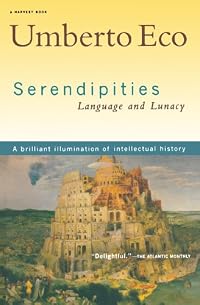
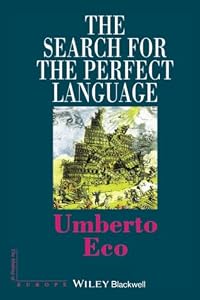
Peter Bruegel's Tower of Babl on the cover makes it even better.
I bathe in ancient history, origins of language, odd religions, psychic archeology, magick and the occult, and semiotics.
Geurilla ontology.
This book is about the serach for the a priori perfect pre-Adamic language. It used to be assumed that it was Hebrew. Early thinkers thought an infant left completely alone would naturally start speaking Hebrew. It was the language with which God conversed with Adam and the linguistic roots that Adam used to name everything.
It's about the fascinating failures of attempts to reconstruct and establish an show more architectonically perfect system of ideas composed of mutual dependences and strict classifications from the general to the particular.
It would, for instance, solve the librarian's dilemma at where to catalog a book (Dewey s system leaves a lot tobe desired and complimentary books at opposite ends of the library....)
Eco speaks of mentalese, a hopeful proposed language "written in the very convulutions of our brains, capable of supplying the deep structure of every expression in any natural language."
Borges plays with the idea and quotes from the Foucalt's description of the Chinese encyclopedia Celestial Emporium of Benevolent Recognitions":
CLASSIFICATION OF ANIMALS:
-those that belong to the Emperor
-embalmed ones
-those that are trained
-suckling pigs
-mermaids
-fabulous ones
-stray dogs
-those included in the present classification
-those that tremble as if they were mad
-innumerable ones
-those drawn with a very fine camelhair brush
others
-those that have just broken a flower vase
-those that look like flies from far away....
Wow.
Loving it. We are getting closer to a polydimensional encyclopedia with hypertext nowadays.
And Alembert could have been have been talking about Wikipedia hundreds of years ago:
"...a labyrinth, a tortuous path, composed of diverse branches, some of which converge towards a same center...and since departing from it , it is not possible to follow all the paths at once---the choice is determined by the nature of the different spirits..."
Interesting, funny, thoght-provoking, and an excellent translation by my favorite translator of Italian, William Weaver. (Is it too geeky to have a favorite translator? I love Cleary, too.)
BUY, BORROW, or BURN?
BORROW show less
This is a lovely and wonderous little book.
Peter Bruegel's Tower of Babl on the cover makes it even better.
I bathe in ancient history, origins of language, odd religions, psychic archeology, magick and the occult, and semiotics.
Geurilla ontology.
This book is about the serach for the a priori perfect pre-Adamic language. It used to be assumed that it was Hebrew. Early thinkers thought an infant left completely alone would naturally start speaking Hebrew. It was the language with which God conversed with Adam and the linguistic roots that Adam used to name everything.
It's about the fascinating failures of attempts to reconstruct and establish an show more architectonically perfect system of ideas composed of mutual dependences and strict classifications from the general to the particular.
It would, for instance, solve the librarian's dilemma at where to catalog a book (Dewey s system leaves a lot tobe desired and complimentary books at opposite ends of the library....)
Eco speaks of mentalese, a hopeful proposed language "written in the very convulutions of our brains, capable of supplying the deep structure of every expression in any natural language."
Borges plays with the idea and quotes from the Foucalt's description of the Chinese encyclopedia Celestial Emporium of Benevolent Recognitions":
CLASSIFICATION OF ANIMALS:
-those that belong to the Emperor
-embalmed ones
-those that are trained
-suckling pigs
-mermaids
-fabulous ones
-stray dogs
-those included in the present classification
-those that tremble as if they were mad
-innumerable ones
-those drawn with a very fine camelhair brush
others
-those that have just broken a flower vase
-those that look like flies from far away....
Wow.
Loving it. We are getting closer to a polydimensional encyclopedia with hypertext nowadays.
And Alembert could have been have been talking about Wikipedia hundreds of years ago:
"...a labyrinth, a tortuous path, composed of diverse branches, some of which converge towards a same center...and since departing from it , it is not possible to follow all the paths at once---the choice is determined by the nature of the different spirits..."
Interesting, funny, thoght-provoking, and an excellent translation by my favorite translator of Italian, William Weaver. (Is it too geeky to have a favorite translator? I love Cleary, too.)
BUY, BORROW, or BURN?
BORROW show less
More language than lunacy, some of it almost too academicky, but Eco’s the kind of semiotician we’d like to drink with. Dante, Borges, Prester John, the cage of fundamentalism, god mumbling with an accent.
Jack’s Abby Calyptra Session IPL
Uinta Organic Hazel Amber Wheat
Jack’s Abby Calyptra Session IPL
Uinta Organic Hazel Amber Wheat
I greatly enjoyed the 'The Force of Falsity' with its many examples of how falsehoods end up have great consequences and historical impact. 'Languages in Paradise' was interesting but I admit to not knowing all of the references Eco made in the essay. I had never been aware of the inconsistency between the story of the Tower of Babel and Genesis 10. The search for the original sacred language is a fascinating concept in itself.
Members
- Recently Added By
Lists

Italian Literature
556 works; 41 members
Author Information

501+ Works 115,111 Members
Umberto Eco was born in Alessandria, Italy on January 5, 1932. He received a doctorate of philosophy from the University of Turin in 1954. His first book, Il Problema Estetico in San Tommaso, was an extension of his doctoral thesis on St. Thomas Aquinas and was published in 1956. His first novel, The Name of the Rose, was published in 1980 and won show more the Premio Strega and the Premio Anghiar awards in 1981. In 1986, it was adapted into a movie starring Sean Connery. His other works include Foucault's Pendulum, The Island of the Day Before, Baudolino, The Prague Cemetery, and Numero Zero. He also wrote children's books and more than 20 nonfiction books including Serendipities: Language and Lunacy. He taught philosophy and then semiotics at the University of Bologna. He also wrote weekly columns on popular culture and politics for L'Espresso. He died from cancer on February 19, 2016 at the age of 84. (Bowker Author Biography) show less
Some Editions
Common Knowledge
- Original publication date
- 1999
- First words
- Chapter 1: In the Quaestio quodlibetalis XII, 14, Saint Thomas declares "utrum veritas sit fortior inter vinium et regem mulierem," raising, that is, the question of which is more powerful, more convincing, more constrictive:... (show all) the power of the king, the influence of wine, the charms of woman, or the strength of truth.
- Last words
- (Click to show. Warning: May contain spoilers.)The Thought of Tradition serves only to confirm a mystical belief that arrests any further reasoning.
- Original language
- Italian
Classifications
Statistics
- Members
- 1,385
- Popularity
- 17,023
- Reviews
- 17
- Rating
- (3.61)
- Languages
- English, Korean
- Media
- Paper, Ebook
- ISBNs
- 10
- ASINs
- 6