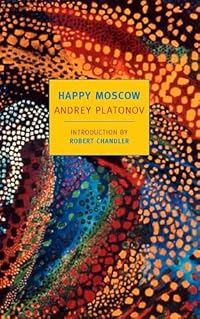
Happy Moscow
by Andrey Platonov
On This Page
Description
An anarchic satire from one of Russia's greatest twentieth-century writers, long censored and forgotten TRANSLATED AND WITH AN INTRODUCTION BY ROBERT CHANDLER Moscow in the 1930s is a symbol of Soviet paradise; a fairy-tale capital where, in Stalin's words, 'life has become better, life has become merrier". Beautiful, passionate, Moscow Chestnova bears her captial's name, and seeks the happiness it promises. She flits from man to man, fascinated by the brave new world supposedly taking shape show more around her, on a quest for the better life. This anarchic satire is accompanied by related works - short stories, an essay and a screenplay - and through Robert Chandler's acclaimed new translations Platonov's extraordinary prose and original vision can at last be experienced in full. show lessTags
Recommendations
















Member Recommendations
Member Reviews
The book comprises a main story 'Happy Moscow' and related works - short stories, an essay, and a screenplay. Unexpectedly, the story I like most is "The Sparrow's Journey". I was contemplating skipping it since it is not the main story. Glad I read it. It is a simple story but it leaves a deep impression. An old lonely fiddler finds company in a sparrow which has been listening to his playing. One day, the sparrow was carried away to a faraway land by a hurricane. Since then, the sparrow had been trying to find a way home whereas the fiddler was left forlorn by the sparrow's absence. The sparrow did make its way home and by coincidence or design, the old man found the sparrow. The return journey had left the sparrow severely injured show more and it died not long after. The old fiddler was inconsolable. You wonder if it would be better if the sparrow had not returned? show less
The book Happy Moscow includes not just the title novella but also other works Platonov wrote in the mid-1930s: two short stories, an essay, and a screenplay. I previously read and admired Platonov's Soul and Other Stories and The Foundation Pit, considered his masterpiece, but found it very difficult to understand because of the almost random way the plot jumps around and because Platonov's writing is both allusive and symbolic. I had the same problems with these works, although the translators' notes were again extremely helpful.
The novella tells the story of an orphan who is named Moscow, a beautiful young woman who starts off her career as a parachutist, symbolic of the technological heights to which Soviet Russia hoped to soar. show more Later she works underground on the subway, again symbolic of technological accomplishments. At the same time, these activities and the activities of other characters, including a doctor who is hoping to find a way to essentially keep people from dying and an engineer who works to find a way to make perfect scales, are reflective of projects that were actually happening in Soviet Russia. From this bright start, looking towards the future, the characters' lives become increasingly restricted and sad, both with respect to love and with respect to profession. In the intervening chapters, Platonov portrays some of the realities of life in 1930s Moscow, including a large market in which new identities, as well as food and other goods, are for sale.
After reading the novella, I turned to the story "The Moscow Violin." Much to my surprise, large chunks of text from the novella were repeated in the story, or perhaps it was vice versa, as Platonov worked on both at the same time. I found the screenplay, "Father," perhaps the most interesting piece in the book. And, although the translator calls the essay, "On the First Socialist Tragedy," "one of the earliest and greatest of classic ecological texts, for me it was more of an essay about the conflict between the individual "soul" (which has a greater meaning to Platonov than our English word) and technological prowess.
One of the interesting things about Platonov, besides his language and style, is the way certain themes and images recur. As in both of the books I previously read, there is a strong thread of technology and engineering in this collection: how railroads work, electrical plants, underground systems, medical advances (or quackery), perfecting instruments. Platonov is fascinated by technological advances. There is also a strong thread of music, especially in these pieces the violin, which finds its way into almost all of them. And then there is love, and love triangles, and people puzzling over what love means. Other repeated images and themes include orphans, attempted and successful suicide, and sparrows. Finally, there is a character in the novella who tries to will his own death, much as characters longed for death in The Foundation Pit.
As must be clear, I really didn't know what to make of the pieces in this collection. I was eager to read them because of my admiration for Platonov's work, but for the most part I struggled to understand what Platonov was trying to say. Anyone interested in trying Platonov should not start with this collection! show less
The novella tells the story of an orphan who is named Moscow, a beautiful young woman who starts off her career as a parachutist, symbolic of the technological heights to which Soviet Russia hoped to soar. show more Later she works underground on the subway, again symbolic of technological accomplishments. At the same time, these activities and the activities of other characters, including a doctor who is hoping to find a way to essentially keep people from dying and an engineer who works to find a way to make perfect scales, are reflective of projects that were actually happening in Soviet Russia. From this bright start, looking towards the future, the characters' lives become increasingly restricted and sad, both with respect to love and with respect to profession. In the intervening chapters, Platonov portrays some of the realities of life in 1930s Moscow, including a large market in which new identities, as well as food and other goods, are for sale.
After reading the novella, I turned to the story "The Moscow Violin." Much to my surprise, large chunks of text from the novella were repeated in the story, or perhaps it was vice versa, as Platonov worked on both at the same time. I found the screenplay, "Father," perhaps the most interesting piece in the book. And, although the translator calls the essay, "On the First Socialist Tragedy," "one of the earliest and greatest of classic ecological texts, for me it was more of an essay about the conflict between the individual "soul" (which has a greater meaning to Platonov than our English word) and technological prowess.
One of the interesting things about Platonov, besides his language and style, is the way certain themes and images recur. As in both of the books I previously read, there is a strong thread of technology and engineering in this collection: how railroads work, electrical plants, underground systems, medical advances (or quackery), perfecting instruments. Platonov is fascinated by technological advances. There is also a strong thread of music, especially in these pieces the violin, which finds its way into almost all of them. And then there is love, and love triangles, and people puzzling over what love means. Other repeated images and themes include orphans, attempted and successful suicide, and sparrows. Finally, there is a character in the novella who tries to will his own death, much as characters longed for death in The Foundation Pit.
As must be clear, I really didn't know what to make of the pieces in this collection. I was eager to read them because of my admiration for Platonov's work, but for the most part I struggled to understand what Platonov was trying to say. Anyone interested in trying Platonov should not start with this collection! show less
http://kaggsysbookishramblings.wordpress.com/2013/02/01/recent-reads-happy-mosco...
Wonderful book that gets under your skin, amazingly presented here by NYRB
Wonderful book that gets under your skin, amazingly presented here by NYRB
Ratings
Members
- Recently Added By
Author Information

149+ Works 2,838 Members
Andrei Platonov was born in Yanskaya, Sloboda, Russia. An engineer and land-reclamation specialist, Platonov was also a writer. He His first poems were published in the 1920s. Stories and folk tales followed. He became a member of the Pereval group of the 1920s and early 1930s. This group of writers was influenced by the humanistic, cultivated show more ideas of the critic Voronsky. After World War II, the more extreme proletarian writers and critics of the time vehemently attacked Platonov for what was considered his ideological mistakes. Platonov was forced to stop publishing. Russians knew only a portion of his real output until the 1960s when he became popular again. During the 1970s, publication of Platonov's writings in the West revealed him to be an important figure in modern Russian prose. His key novels, The Fountain Pit (1975), and Chevengur (1978), explored the bitter ironies of a land of triumphant socialism-a new Utopia-which systematically deforms language. Profoundly pessimistic, the novels reveal a man deeply skeptical of attempts to remold human nature and highly sensitive to the dark underside of Stalin's grandiose economic projects. (Bowker Author Biography) Andrei Platonov was born in Yanskaya, Sloboda, Russia. An engineer and land-reclamation specialist, Platonov was also a writer. He His first poems were published in the 1920s. Stories and folk tales followed. He became a member of the Pereval group of the 1920s and early 1930s. This group of writers was influenced by the humanistic, cultivated ideas of the critic Voronsky. After World War II, the more extreme proletarian writers and critics of the time vehemently attacked Platonov for what was considered his ideological mistakes. Platonov was forced to stop publishing. Russians knew only a portion of his real output until the 1960s when he became popular again. During the 1970s, publication of Platonov's writings in the West revealed him to be an important figure in modern Russian prose. His key novels, The Fountain Pit (1975), and Chevengur (1978), explored the bitter ironies of a land of triumphant socialism-a new Utopia-which systematically deforms language. Profoundly pessimistic, the novels reveal a man deeply skeptical of attempts to remold human nature and highly sensitive to the dark underside of Stalin's grandiose economic projects. (Bowker Author Biography) Alvar Aalto is considered the father of modernism in Scandinavia. He was born in Kuortane, Finland. His reputation as an architect has spread far beyond the bounds of his native country, where he built the major part of his work. He is perhaps Finland's greatest architect and certainly one of the major figures of twentieth-century architecture. As early as 1923, Aalto built in a typical Scandinavian style, relying heavily on native materials-timber in Finland's case-and produced such masterworks as the Library at Viipuri (1927-35), the Paimio Sanitarium, and the Villa Mairea. In 1932 he invented the process for making bent wood furniture. After World War II, his work began to be noticed internationally as he developed his own singular style, and he built some of his finest works-the Finlandia Concert Hall, in Helsinki, and the Baker Dorms at the Massachusetts Institute of Technology, his only building in the United States, (1947-49). His style is based on irregular and asymmetric forms with many curved walls and single-pitched roofs and with a highly imaginative use of natural materials. Aalto is also known for the design of several classic styles of chairs, tables, and glassware. (Bowker Author Biography) show less
Some Editions
Awards and Honors
Awards
Series
Belongs to Publisher Series
Work Relationships
Contains
Common Knowledge
- Canonical title
- Happy Moscow
- Original publication date
- 1991 (posthumous Russian) (posthumous Russian); 2001 (English: Chandler) (English: Chandler)
- People/Characters
- Moscow Chestnova; Sartorius; Sambikin
- Important places
- Moscow
- Disambiguation notice
- Contains: Happy Moscow, The Moscow Violin, On the First Socialist Tragedy, Father, and Love for the Motherland.
Classifications
- Genres
- General Fiction, Fiction and Literature
- DDC/MDS
- 891.73 — Literature & rhetoric Asian Literature East Indo-European and Celtic literatures Russian and East Slavic languages Russian fiction
- LCC
- PG3476 .P543 .A2 — Language and Literature Slavic languages and literatures. Baltic languages. Albanian language Slavic. Baltic. Albanian Russian literature Individual authors and works 1917-1960
- BISAC
Statistics
- Members
- 168
- Popularity
- 194,216
- Reviews
- 3
- Rating
- (3.77)
- Languages
- 5 — Dutch, English, German, Italian, Swedish
- Media
- Paper, Ebook
- ISBNs
- 7
- UPCs
- 1
- ASINs
- 1