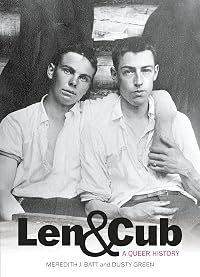
Len & Cub: A Queer History
by Meredith Batt, Dusty Green
On This Page
Description
Leonard "Len" Keith and Joseph "Cub" Coates grew up in the rural New Brunswick village of Havelock in the early 20th century. The two were neighbours, and they clearly developed an inseparable relationship. Len was an amateur photographer and automobile enthusiast who went on to own a local garage and poolhall after serving in the First World War. Cub was the son of a farmer, also a veteran of the First World War, a butcher, contractor, and lover of horses. Their time together is catalogued show more by Len's photos, which show that the two shared a mutual love of the outdoors, animals, and adventure. Photographs of Len and Cub on hunting and canoe trips with arms around each other's shoulders or in bed together make clear the affection they held for each other. Their story is one of the oldest photographic records of a same-sex couple in the Maritimes. Len & Cub features Len's photos of their life and tells the story of their relationship against the background of same-sex identity and relationships in rural North America of the early 20th century. Although Len was outed and forced to leave Havelock in the 1930s, the story of Len and Cub is one of love and friendship that challenges contemporary ideas about sex and gender expression in the early 20th century. show lessTags
Recommendations




















Member Reviews
Len and Cub were two rural New Brunswick men who, it seems, had a loving relationship for several years in the early decades of the twentieth century. The photos collected in this book give insight into their lives. But the book is equally valuable for the careful way it lays out the contemporary social and legal circumstances of their society, and how the authors pieced together their stories through inferences and interpretations of the few facts available.
Based entirely on photos with the barest of notations (subjects, dates, locations at best) and a few remembered rumours, supplemented with a few surviving official records and news clippings, the story is drawn out by two archivists who came across the photo collection with the show more description that it referred to a man and his “boyfriend.” I’d be curious, too, especially since many of the photos, taken by Len, illustrate a close and intimate friendship. The authors use their professional training and what must have been a significant amount of personal time to piece together the story, without romanticizing or going beyond reasonable inference. As a result, they create a detailed portrait of what a same-sex relationship must have been like in their specific time and place. This is a much richer and more human picture than one gets in broader histories, which often rely only on collections of small snippets and anecdotes to represent a social setting in general terms. It’s a remarkable addition to the “microhistory” approach that focuses in depth on a specific story to add understanding that is hard to get out of a broader historical approach.
Their story seems similar in many ways to what might occur in a rural town 100 years later. A young man, Len, finds that his interest in a younger neighbour, Cub, is reciprocated. They hang out together, becoming increasingly close. Having a car allows Len, the more affluent of the pair, to arrange private getaways, and having a camera allows him to make a record of their friendship. In their gossipy town, they keep their relationship private, in a way that many do now. They risk social sanctions and perhaps condemnation from their families and friends, although the danger of criminal prosecution that they faced no longer exists. Over time, their relationship weakens, possibly because the structures that could strengthen it did not exist. Len is driven from the town over a scandal that is apparently covered up by his family’s social standing. Cub enters a childless marriage to a 39-year-old woman, and after a time moves to a larger city. While the legal repercussions are no longer as strong, and a couple today would have many more options, young men today who want to remain within a conservative small town could find themselves on similar tracks.
While the personal details are thin, the photos themselves give the richness that makes the book unique. Len was an early photo buff and apparently took thousands of photos of his friends and family, his surroundings and, with the aid of a timer, himself. Many are deliberately posed to show the relationship that Len wanted to capture. Some are candid snapshots. Some are not great shots and the reproduction in some is unfortunately grey, but many show the facial expressions, gestures and physicality of their relationship. A reader can see the lives of Len and Cub in the photos and from the pictures infer a story that is much more concrete and memorable than a simple text description would be.
A string of lucky circumstances led to the photos being saved by Len’s sister, purchased and donated to the New Brunswick archive, and then discovered and researched by the authors. They offer a unique view into the lives of two men who could perhaps stand in for many of those living in small towns across Canada and the USA in the 1910s and ’20s. show less
Based entirely on photos with the barest of notations (subjects, dates, locations at best) and a few remembered rumours, supplemented with a few surviving official records and news clippings, the story is drawn out by two archivists who came across the photo collection with the show more description that it referred to a man and his “boyfriend.” I’d be curious, too, especially since many of the photos, taken by Len, illustrate a close and intimate friendship. The authors use their professional training and what must have been a significant amount of personal time to piece together the story, without romanticizing or going beyond reasonable inference. As a result, they create a detailed portrait of what a same-sex relationship must have been like in their specific time and place. This is a much richer and more human picture than one gets in broader histories, which often rely only on collections of small snippets and anecdotes to represent a social setting in general terms. It’s a remarkable addition to the “microhistory” approach that focuses in depth on a specific story to add understanding that is hard to get out of a broader historical approach.
Their story seems similar in many ways to what might occur in a rural town 100 years later. A young man, Len, finds that his interest in a younger neighbour, Cub, is reciprocated. They hang out together, becoming increasingly close. Having a car allows Len, the more affluent of the pair, to arrange private getaways, and having a camera allows him to make a record of their friendship. In their gossipy town, they keep their relationship private, in a way that many do now. They risk social sanctions and perhaps condemnation from their families and friends, although the danger of criminal prosecution that they faced no longer exists. Over time, their relationship weakens, possibly because the structures that could strengthen it did not exist. Len is driven from the town over a scandal that is apparently covered up by his family’s social standing. Cub enters a childless marriage to a 39-year-old woman, and after a time moves to a larger city. While the legal repercussions are no longer as strong, and a couple today would have many more options, young men today who want to remain within a conservative small town could find themselves on similar tracks.
While the personal details are thin, the photos themselves give the richness that makes the book unique. Len was an early photo buff and apparently took thousands of photos of his friends and family, his surroundings and, with the aid of a timer, himself. Many are deliberately posed to show the relationship that Len wanted to capture. Some are candid snapshots. Some are not great shots and the reproduction in some is unfortunately grey, but many show the facial expressions, gestures and physicality of their relationship. A reader can see the lives of Len and Cub in the photos and from the pictures infer a story that is much more concrete and memorable than a simple text description would be.
A string of lucky circumstances led to the photos being saved by Len’s sister, purchased and donated to the New Brunswick archive, and then discovered and researched by the authors. They offer a unique view into the lives of two men who could perhaps stand in for many of those living in small towns across Canada and the USA in the 1910s and ’20s. show less
Ratings
Members
- Recently Added By
Lists

Top Five Books of 2022
736 works; 272 members

Books for a Queer Valentine's Day
46 works; 6 members

Books Read in 2022
5,168 works; 114 members

Books published and read in 2022
82 works; 5 members
Author Information
1 Work 48 Members
2 Works 49 Members
Classifications
- Genres
- Sexuality and Gender Studies, Nonfiction, LGBTQ+, Biography & Memoir, History, Art & Design, General Nonfiction
- DDC/MDS
- 306.766 — Society, government, & culture Social sciences, sociology & anthropology Social Behavior - Dating, Marriage, Divorce Sexual relations Sexual orientation, transgender identity, intersexuality Homosexuality
- LCC
- HQ75.7 .B39 — Social sciences The family. Marriage, Women and Sexuality The Family. Marriage. Women Sexual life Homosexuality. Lesbianism
- BISAC
Statistics
- Members
- 48
- Popularity
- 626,023
- Reviews
- 1
- Rating
- (4.42)
- Languages
- English
- Media
- Paper, Ebook
- ISBNs
- 2
- ASINs
- 1