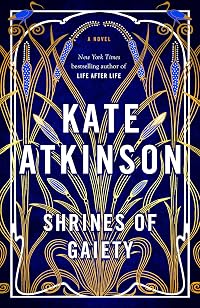
Shrines of Gaiety
by Kate Atkinson
On This Page
Description
"The #1 national bestselling, award-winning author of Life after Life transports us to the dazzling London of the Roaring Twenties in a whirlwind tale of corruption, seduction, and debts that have come due. 1926, and in a country still recovering from the Great War, London has become the focus for a delirious new nightlife. In the clubs of Soho, peers of the realm rub shoulders with starlets, foreign dignitaries with gangsters, and girls sell dances for a shilling a time. The notorious queen show more of this glittering world is Nellie Coker, ruthless but also ambitious to advance her six children, including the enigmatic eldest, Niven, whose character has been forged in the crucible of the Somme. But success breeds enemies, and Nellie's empire faces threats from without and within. For beneath the dazzle of Soho's gaiety, there is a dark underbelly, a world in which it is all too easy to become lost. With her unique Dickensian flair, Kate Atkinson gives us a window in a vanished world. Slyly funny, brilliantly observant, and ingeniously plotted, Shrines of Gaiety showcases the myriad talents that have made Atkinson one of the most lauded writers of our time"-- show lessTags
Recommendations













Member Reviews
There were the shrines to memorialize the men lost in the war, and there were the shrines of gaiety were people could lose themselves in wild pleasure and excess to forget the war.
1920s London drew the rich and the powerful to the nightclubs in Soho. And from the suburbs and countryside, young women came to the city dreaming of the stage and fame, only to be reduced to living by their wits, or beds, or if they were lucky, as paid dancers at a night club. The money and tips were good. The recent epidemic of missing dancing girls is not.
Upon the death of her mother, Gwendolyn the librarian discovers she is wealthy. She leaves her quiet life to search for her best friend’s missing daughter who ran off to London with her best friend, sure show more they would be dancers on stage. Gwendolyn is plucky, an optimist, a risk taker. She has no fear. She was a nurse during the war, already she has seen the worst. She has freedom and money and is keen to embrace life.
Searching for the missing Florence and Freda, Gwendolyn becomes entangled with two men. The proper, melancholy Chief Inspector Frobisher who enlists her to infiltrate Nellie Coker’s clubs. And Niven Coker, war veteran and Nellie’s eldest son. Frobisher is married to a woman bearing the scars of war, and Nevin has no plans to settle down.
The delinquent Coker empire was a house of cards that Frobisher aimed to topple. The filthy, glittering underbelly of London was concentrated in its nightclubs…
from Shrines of Gaiety by Kate Atkinson
Nellie is a self-made woman who has built an empire of nightclubs, from the low-life, drug-addled dens of inequity to the Amethyst where the Prince of Wales and film stars hang out, sometimes joined by local street gangs. She loves sweets and wears furs in all weather, matronly and plain. Her appearance belies her iron will and shrewd business sense. Also, she isn’t afraid of getting her hands dirty, especially when protecting her empire.
The Coker children are rich in things and poor in parental love. Edith, her eldest, is the family business bookkeeper, her mother’s second in command. She is entangled with a police officer who gets kickbacks from Nellie, but is up to no good. The younger daughters Betty and Shirley may be Cambridge educated, but they are vacuous and vain. Nellie most despairs of the youngest, Kitty. Then there is Ramsey, an addict with plans to write a novel, confused about his sexual orientation. The eldest of the clan, Niven was a sniper during the war. Like Gwendolyn, he is sick of death and war.
Freda discovers that fame comes with a price, and the naïve Florence disappears. Meanwhile, Gwendolyn searches for the girls.
Based on real people and places, capturing a society reeling from a devastating war and seeking oblivion in living in the moment, Shrines of Gaiety has a Dickensian scope, delving into a criminal underworld that takes advantage of starry-eyed girls and the world-weary. It’s filled with wit and humor, mystery and suspense, betrayals, and plot twists. It’s a ripping good read.
I received a free egalley from the publisher through NetGalley. My review is fair and unbiased. show less
1920s London drew the rich and the powerful to the nightclubs in Soho. And from the suburbs and countryside, young women came to the city dreaming of the stage and fame, only to be reduced to living by their wits, or beds, or if they were lucky, as paid dancers at a night club. The money and tips were good. The recent epidemic of missing dancing girls is not.
Upon the death of her mother, Gwendolyn the librarian discovers she is wealthy. She leaves her quiet life to search for her best friend’s missing daughter who ran off to London with her best friend, sure show more they would be dancers on stage. Gwendolyn is plucky, an optimist, a risk taker. She has no fear. She was a nurse during the war, already she has seen the worst. She has freedom and money and is keen to embrace life.
Searching for the missing Florence and Freda, Gwendolyn becomes entangled with two men. The proper, melancholy Chief Inspector Frobisher who enlists her to infiltrate Nellie Coker’s clubs. And Niven Coker, war veteran and Nellie’s eldest son. Frobisher is married to a woman bearing the scars of war, and Nevin has no plans to settle down.
The delinquent Coker empire was a house of cards that Frobisher aimed to topple. The filthy, glittering underbelly of London was concentrated in its nightclubs…
from Shrines of Gaiety by Kate Atkinson
Nellie is a self-made woman who has built an empire of nightclubs, from the low-life, drug-addled dens of inequity to the Amethyst where the Prince of Wales and film stars hang out, sometimes joined by local street gangs. She loves sweets and wears furs in all weather, matronly and plain. Her appearance belies her iron will and shrewd business sense. Also, she isn’t afraid of getting her hands dirty, especially when protecting her empire.
The Coker children are rich in things and poor in parental love. Edith, her eldest, is the family business bookkeeper, her mother’s second in command. She is entangled with a police officer who gets kickbacks from Nellie, but is up to no good. The younger daughters Betty and Shirley may be Cambridge educated, but they are vacuous and vain. Nellie most despairs of the youngest, Kitty. Then there is Ramsey, an addict with plans to write a novel, confused about his sexual orientation. The eldest of the clan, Niven was a sniper during the war. Like Gwendolyn, he is sick of death and war.
Freda discovers that fame comes with a price, and the naïve Florence disappears. Meanwhile, Gwendolyn searches for the girls.
Based on real people and places, capturing a society reeling from a devastating war and seeking oblivion in living in the moment, Shrines of Gaiety has a Dickensian scope, delving into a criminal underworld that takes advantage of starry-eyed girls and the world-weary. It’s filled with wit and humor, mystery and suspense, betrayals, and plot twists. It’s a ripping good read.
I received a free egalley from the publisher through NetGalley. My review is fair and unbiased. show less
Pure entertainment, on a par with Wodehouse, although there is more characterisation; a delightful confection.
Sprightly, full of itself and exuding an overwrought 1920’s joie de vivre after the horrors of the First World War, this is a seductively moreish read. Short chapters tell the story from multiple perspectives, set in 1926 London, using flashbacks to fill in the characters’ backstories.
And it’s a fun story, knowing and sometimes arch, plotted like an intricate dance, a complicated clockwork carousel with plenty of coincidences, and although humorous like Wodehouse, it doesn’t descend into farce. However Atkinson does delightfully ham up her characters at times, and includes many throwaway literary quotes (one character is show more a librarian and the police detective is well read). show less
Sprightly, full of itself and exuding an overwrought 1920’s joie de vivre after the horrors of the First World War, this is a seductively moreish read. Short chapters tell the story from multiple perspectives, set in 1926 London, using flashbacks to fill in the characters’ backstories.
And it’s a fun story, knowing and sometimes arch, plotted like an intricate dance, a complicated clockwork carousel with plenty of coincidences, and although humorous like Wodehouse, it doesn’t descend into farce. However Atkinson does delightfully ham up her characters at times, and includes many throwaway literary quotes (one character is show more a librarian and the police detective is well read). show less
Things I love about Kate Atkinson’s writing include the rounded, fully realized characters, her deft juggling of different narrative perspectives, her carefully constructed sentences, and her ironic observations. While almost all writers, no matter how skilled, occasionally drop their guard and let a cliché or tired metaphor slip in, Atkinson counters this by consciously employing them and drawing attention to them. Of Frobisher, one of the central characters, she writes: “He had entangled his mind horribly in sea-faring imagery, there seemed no way out of it but to abandon ship.”
All of these characteristics are on full display in this crime story, loosely based on a real personage, a woman who owned a string of nightclubs where show more aristocrats, gangsters, and out-of-towners shared a dance floor and guzzled overpriced champagne in the hedonistic aftermath of World War I.
My enjoyment of the book extended even to the denouement. People who’d read it before me, whose book judgment I greatly respect, had reported enjoying the book up to a point but then feeling that Atkinson didn’t know how to wrap up the complex plot she’d set in motion. I can see why they would think that, but I read it in light of her sardonic humor. It’s a feature of fiction that we become drawn into the lives of the seemingly real characters, and then, when we close the book, we leave them suspended, frozen in time. In contrast, Atkinson (as if to remind us this is fiction we’re reading, not history) recounts laconically how life continued and ended for each central figure, except Niven and Gwen, whom she pointedly leaves in mid-action, on the cusp of a momentous decision. show less
All of these characteristics are on full display in this crime story, loosely based on a real personage, a woman who owned a string of nightclubs where show more aristocrats, gangsters, and out-of-towners shared a dance floor and guzzled overpriced champagne in the hedonistic aftermath of World War I.
My enjoyment of the book extended even to the denouement. People who’d read it before me, whose book judgment I greatly respect, had reported enjoying the book up to a point but then feeling that Atkinson didn’t know how to wrap up the complex plot she’d set in motion. I can see why they would think that, but I read it in light of her sardonic humor. It’s a feature of fiction that we become drawn into the lives of the seemingly real characters, and then, when we close the book, we leave them suspended, frozen in time. In contrast, Atkinson (as if to remind us this is fiction we’re reading, not history) recounts laconically how life continued and ended for each central figure, except Niven and Gwen, whom she pointedly leaves in mid-action, on the cusp of a momentous decision. show less
Shrines of Gaiety -Atkinson
Audio performance by Jason Watkins
4 stars
This book was everything I've come to expect from Kate Atkinson; quirky characters, plenty of ironic humor, non-linear storytelling with an ambiguous, though satisfying ending.
The story is set in the roaring of the Soho nightclubs in post WW1 London. In the opening chapter, Nellie Coker, night club mavin, is being released from prison after serving some months on a liquor licensing charge. She is welcomed home, with varying levels of enthusiasm, by her six children. Nellie’s shady empire is threatened on several fronts; old enemies seeking revenge, corrupt policemen seeking fortune, and one honest policeman seeking justice. Beneath the glitter and frantic gaiety of show more the club scene there’s a muck of abuse and violence.
With the death of her mother, former front line nurse Gwendolyn Kelling is ready to leave her boring librarian job. When a friend’s young half sister runs away to London with another local girl, Gwen offers to go in search of Freda and Florence.
The plot meanders. Freda and Florence leave a trail that Gwen and Frobisher (the honest policeman) aren’t quite able to follow. Nellie Coker manages to stay one step ahead of her persecutors, just barely. Each of Nellie’s six children court disaster in their own individual ways. The Roaring 20’s roars on.
There’s a feminist edge to this story. It has a strong theme of righteous female retribution. Although there are some unanswered questions at the end of the book, Atkinson does provide the future history of some characters. It is clear that the gaiety will end. Debauchery and decadence has a price. The next war is coming. show less
Audio performance by Jason Watkins
4 stars
This book was everything I've come to expect from Kate Atkinson; quirky characters, plenty of ironic humor, non-linear storytelling with an ambiguous, though satisfying ending.
The story is set in the roaring of the Soho nightclubs in post WW1 London. In the opening chapter, Nellie Coker, night club mavin, is being released from prison after serving some months on a liquor licensing charge. She is welcomed home, with varying levels of enthusiasm, by her six children. Nellie’s shady empire is threatened on several fronts; old enemies seeking revenge, corrupt policemen seeking fortune, and one honest policeman seeking justice. Beneath the glitter and frantic gaiety of show more the club scene there’s a muck of abuse and violence.
With the death of her mother, former front line nurse Gwendolyn Kelling is ready to leave her boring librarian job. When a friend’s young half sister runs away to London with another local girl, Gwen offers to go in search of Freda and Florence.
The plot meanders. Freda and Florence leave a trail that Gwen and Frobisher (the honest policeman) aren’t quite able to follow. Nellie Coker manages to stay one step ahead of her persecutors, just barely. Each of Nellie’s six children court disaster in their own individual ways. The Roaring 20’s roars on.
There’s a feminist edge to this story. It has a strong theme of righteous female retribution. Although there are some unanswered questions at the end of the book, Atkinson does provide the future history of some characters. It is clear that the gaiety will end. Debauchery and decadence has a price. The next war is coming. show less
Kate Atkinson’s latest novel is a sprawling tale of 1920s London, specifically the seedy nightclub culture, a form of organized crime that trafficked in drugs and young girls. Nellie Coker, owner of several clubs, is released from prison (for reasons never explained), and assumes control of her empire, which during her absence was cared for by her adult children. Nellie is crafty and driven, both to succeed in business and ensure her children live in comfort. The police are wise to Nellie, but many are also in her employ.
The “good guys” in this tale include Frobisher, seemingly the only London detective who has not sold out to corruption, and Gwendolen Kelling, a young woman from York searching for two girls who recently left show more their families to “seek their fortunes.” From time to time readers also get a glimpse of the girls and understand the reality of their situation far more than Frobisher or Gwendolen.
I enjoyed the ride for a while, but ultimately the novel as a whole simply does not work. There are so many characters that none are realized fully enough for the reader to become emotionally invested in them. Frobisher, for example, is in a sad marital relationship but his wife’s back story, why they married, and how they got into such a bad state, are not sufficiently explained. Frobisher is also surprisingly inept even when clues are in front of him. This may have been Atkinson’s wry humor at play, but the humor doesn’t quite land and instead left me frustrated at Frobisher’s inability to solve a serious crime.
And subplots abound, so much so that after about 350 pages Atkinson abruptly starts killing people off and then resorts to one of those “where are they now” chapters that tidily sums up what happened to each character later. When my daughter (now a writer) was in primary school, she would end all of her stories with a sudden, unexplained party. That was fine coming from a 10-year-old. It is not fine coming from an author of Kate Atkinson’s calibre. show less
The “good guys” in this tale include Frobisher, seemingly the only London detective who has not sold out to corruption, and Gwendolen Kelling, a young woman from York searching for two girls who recently left show more their families to “seek their fortunes.” From time to time readers also get a glimpse of the girls and understand the reality of their situation far more than Frobisher or Gwendolen.
I enjoyed the ride for a while, but ultimately the novel as a whole simply does not work. There are so many characters that none are realized fully enough for the reader to become emotionally invested in them. Frobisher, for example, is in a sad marital relationship but his wife’s back story, why they married, and how they got into such a bad state, are not sufficiently explained. Frobisher is also surprisingly inept even when clues are in front of him. This may have been Atkinson’s wry humor at play, but the humor doesn’t quite land and instead left me frustrated at Frobisher’s inability to solve a serious crime.
And subplots abound, so much so that after about 350 pages Atkinson abruptly starts killing people off and then resorts to one of those “where are they now” chapters that tidily sums up what happened to each character later. When my daughter (now a writer) was in primary school, she would end all of her stories with a sudden, unexplained party. That was fine coming from a 10-year-old. It is not fine coming from an author of Kate Atkinson’s calibre. show less
Kate Atkinson is one of my favorite authors and she has yet to disappoint me. As always, her prose sucks me into whatever realm she's created. This time, it's 1926 and London's notorious nightclub owner, Nellie Coker, has just been released from prison. With police Chief Inspector Frobisher determined to put Nellie back in prison and enemies just as determined to steal her night clubs from her, along with trying to secure the future of her six mostly grown children, Nellie has a lot on her plate and few people she can trust. There's a nice Dickensian feel to the narration, with darkness underlying the gaiety of the clubs. Bodies of girls are being pulled out of the Thames, and other girls go missing. Gwendolen Kelling, a librarian from show more York, shows up at Frobisher's office, hoping the police can help her find two girls who have runaway to find fame and fortune on the London stage. Atkinson pulls all the plot threads together in a satisfying way. As with all my favorite authors, the characters linger with me after I read the last page. show less
With its many vivid characters and detailed world building, this book reads like a Charles Dickens novel if that author had lived to describe the Roaring Twenties in London.
The novel focuses on the glitzy and sleazy nightlife in London in 1926. The owner of several nightclubs is Nellie Croker who has built an empire of six shrines of gaiety/dens of iniquity. Chief Inspector John Frobisher sets out to topple that empire: “It was not the moral delinquency – the dancing, the drinking, not even the drugs – that dismayed Frobisher. It was the girls. Girls were disappearing in London. At least five he knew about had vanished over the last few weeks. Where did they go? He suspected that they went in through the doors of the Soho clubs show more and never came out again.” The bodies of some girls have washed up in the Thames. Frobisher enlists the help of Gwendolen Kelling, a former war nurse and discontented librarian from York, who comes to London to find two 14-year-old girls, Freda Murgatroyd and Florence Ingram, who have fled to the city in hopes of careers on stage. Gwendolen infiltrates Nellie’s queendom and becomes exposed to the machinations of the Crokers and others wanting to bring down the queen.
There are numerous colourful characters: the ruthless Nellie and her six children (Niven, Edith, Ramsey, Betty, Shirley, Kitty), the melancholic Frobisher and his troubled wife, star-struck Freda and her naïve friend Florence, corrupt policemen, a back alley abortionist, pickpockets, hedonistic socialites, sex workers, and gangsters. My favourite character is the plucky and competent Gwendolen. She is more astute than Frobisher, and because of her war experience, remains calm and cool regardless of circumstances. Her witty exchanges and not taking herself too seriously add some lighthearted notes to a novel set in the dark underbelly of London.
And there is indeed darkness: poverty, corruption, robberies, drug usage, alcoholism, gambling, prostitution, sexual assaults, gang violence, suicide, missing women, and murders. Certainly, all seven deadly sins make an appearance. The novel makes repeated reference to the trauma of the war that ended less than a decade earlier: “War was a foul thing. It should be sent back to the hell where it had come from and never let out again.” Gwendolen and Nellie’s eldest son Niven were both in the war and both think of it in derogatory terms: “At no point in the war or after . . . did Niven ever think anyone had won” and “Gwendolen had known men in the war whose nerves had not just been frayed but shredded by the abominations they had witnessed” and “the insanely stupid bastards in government who thought war was necessary and good.”
There are frequent shifts in perspective: certainly more than a dozen. The omniscient narrator takes the reader into the consciousness of Nellie, Frobisher, Gwendolen, and Freda several times, but also into the minds of many secondary characters. As a consequence, it is not possible to see anyone as one-dimensional. Nellie is an appealing anti-hero, and even villains have some positive traits.
There are also many coincidences. Objects like a demonic doorknocker, a bluebird brooch, and a silver penknife appear more than once and connect disparate characters. Characters also meet with improbable frequency. For instance, Frobisher has a chance encounter with Freda without realizing who she is. The coincidences in Dickens’ novels usually involve unexpected connections between a relatively small number of people, and that is the case here: Gwendolen and Niven, Freda and Ramsey, and Edith and Maddox. Atkinson is well aware of the number of coincidences because she even comments, “And then at that moment an extraordinary coincidence.”
This book can be described as an experimental genre. Ramsey Croker, a wannabe author, begins a novel he describes as unwieldy: ‘it was a crime novel, but it was also ‘a razor-sharp dissection of the various strata of society in the wake of the destruction of war’.’’ Atkinson’s book can be described as historical fiction with elements of a crime drama and romance, as well as satire. It is not, however, unwieldy. I loved the commentary on human foibles whether that is the description of Nellie and dictators as “hard-nosed yet occasionally mawkishly sentimental” or an older man as “foolishly flattered by the attentions of a younger woman . . . a story as ancient as the Greek gods themselves.” Some of the insights are more affecting: Freda meets a friend who behaves like a “jaded metropolitan girl” but Freda realizes “If you looked carefully, beneath the heavy makeup and the strained, tired eyes, the real Cherry was probably still in there trying to protect herself.”
Like all of Atkinson’s books, I enjoyed this one. It has all those elements which I like and have come to associate with her, regardless of the genre: a complicated plot, eccentric characters, literary allusions, erudite vocabulary, and insights into human nature delivered with compassion and humour. This is an entertaining and immersive read.
Note: Please check out my reader's blog (https://schatjesshelves.blogspot.com/) and follow me on Twitter (@DCYakabuski). show less
The novel focuses on the glitzy and sleazy nightlife in London in 1926. The owner of several nightclubs is Nellie Croker who has built an empire of six shrines of gaiety/dens of iniquity. Chief Inspector John Frobisher sets out to topple that empire: “It was not the moral delinquency – the dancing, the drinking, not even the drugs – that dismayed Frobisher. It was the girls. Girls were disappearing in London. At least five he knew about had vanished over the last few weeks. Where did they go? He suspected that they went in through the doors of the Soho clubs show more and never came out again.” The bodies of some girls have washed up in the Thames. Frobisher enlists the help of Gwendolen Kelling, a former war nurse and discontented librarian from York, who comes to London to find two 14-year-old girls, Freda Murgatroyd and Florence Ingram, who have fled to the city in hopes of careers on stage. Gwendolen infiltrates Nellie’s queendom and becomes exposed to the machinations of the Crokers and others wanting to bring down the queen.
There are numerous colourful characters: the ruthless Nellie and her six children (Niven, Edith, Ramsey, Betty, Shirley, Kitty), the melancholic Frobisher and his troubled wife, star-struck Freda and her naïve friend Florence, corrupt policemen, a back alley abortionist, pickpockets, hedonistic socialites, sex workers, and gangsters. My favourite character is the plucky and competent Gwendolen. She is more astute than Frobisher, and because of her war experience, remains calm and cool regardless of circumstances. Her witty exchanges and not taking herself too seriously add some lighthearted notes to a novel set in the dark underbelly of London.
And there is indeed darkness: poverty, corruption, robberies, drug usage, alcoholism, gambling, prostitution, sexual assaults, gang violence, suicide, missing women, and murders. Certainly, all seven deadly sins make an appearance. The novel makes repeated reference to the trauma of the war that ended less than a decade earlier: “War was a foul thing. It should be sent back to the hell where it had come from and never let out again.” Gwendolen and Nellie’s eldest son Niven were both in the war and both think of it in derogatory terms: “At no point in the war or after . . . did Niven ever think anyone had won” and “Gwendolen had known men in the war whose nerves had not just been frayed but shredded by the abominations they had witnessed” and “the insanely stupid bastards in government who thought war was necessary and good.”
There are frequent shifts in perspective: certainly more than a dozen. The omniscient narrator takes the reader into the consciousness of Nellie, Frobisher, Gwendolen, and Freda several times, but also into the minds of many secondary characters. As a consequence, it is not possible to see anyone as one-dimensional. Nellie is an appealing anti-hero, and even villains have some positive traits.
There are also many coincidences. Objects like a demonic doorknocker, a bluebird brooch, and a silver penknife appear more than once and connect disparate characters. Characters also meet with improbable frequency. For instance, Frobisher has a chance encounter with Freda without realizing who she is. The coincidences in Dickens’ novels usually involve unexpected connections between a relatively small number of people, and that is the case here: Gwendolen and Niven, Freda and Ramsey, and Edith and Maddox. Atkinson is well aware of the number of coincidences because she even comments, “And then at that moment an extraordinary coincidence.”
This book can be described as an experimental genre. Ramsey Croker, a wannabe author, begins a novel he describes as unwieldy: ‘it was a crime novel, but it was also ‘a razor-sharp dissection of the various strata of society in the wake of the destruction of war’.’’ Atkinson’s book can be described as historical fiction with elements of a crime drama and romance, as well as satire. It is not, however, unwieldy. I loved the commentary on human foibles whether that is the description of Nellie and dictators as “hard-nosed yet occasionally mawkishly sentimental” or an older man as “foolishly flattered by the attentions of a younger woman . . . a story as ancient as the Greek gods themselves.” Some of the insights are more affecting: Freda meets a friend who behaves like a “jaded metropolitan girl” but Freda realizes “If you looked carefully, beneath the heavy makeup and the strained, tired eyes, the real Cherry was probably still in there trying to protect herself.”
Like all of Atkinson’s books, I enjoyed this one. It has all those elements which I like and have come to associate with her, regardless of the genre: a complicated plot, eccentric characters, literary allusions, erudite vocabulary, and insights into human nature delivered with compassion and humour. This is an entertaining and immersive read.
Note: Please check out my reader's blog (https://schatjesshelves.blogspot.com/) and follow me on Twitter (@DCYakabuski). show less
Members
- Recently Added By
Lists

Best Historical Fiction
620 works; 257 members

Best Books Set in London
157 works; 42 members

Books Read in 2023
5,547 works; 145 members

Books Set in Great Britain
191 works; 13 members

Books published and read in 2022
82 works; 5 members

Literature About Women and Girls
394 works; 39 members

Netgalley Reads
468 works; 3 members

Maybe This Year? Books to Look Forward To
412 works; 9 members

READ in 2023
244 works; 1 member

Books Read in 2022
5,168 works; 112 members

Top Five Books of 2023
767 works; 317 members

Best Mysteries With a Historical Setting
292 works; 160 members

Historical fiction set in Britain
13 works; 1 member

Fiction Published in 2022
21 works; 1 member

Top Five Books of 2025
954 works; 303 members
Author Information

36+ Works 52,583 Members
Kate Atkinson was born in York, and studied English Literature at the University of Dundee. She earned her Masters Degree from Dundee in 1974. She then went on to study for a doctorate in American Literature but she failed at the viva (oral examination) stage. After leaving the university, she took on a variety of jobs from home help to legal show more secretary and teacher. Her first novel, Behind the Scenes at the Museum, won the 1995 Whitbread Book of the Year ahead of Salman Rushdie's The Moor's Last Sigh and Roy Jenkins's biography of William Ewart Gladstone. It went on to be a Sunday Times bestseller. Since then, she has published another five novels, one play, and one collection of short stories. Her work is often celebrated for its wit, wisdom and subtle characterisation, and the surprising twists and plot turns. Her most recent work has featured the popular former detective Jackson Brodie. In 2009, she donated the short story Lucky We Live Now to Oxfam's 'Ox-Tales' project, four collections of UK stories written by 38 authors. Atkinson's story was published in the 'Earth' collection. In March 2010, Atkinson appeared at the York Literature Festival, giving a world-premier reading from an early chapter from her forthcoming novel Started Early, Took My Dog, which is set mainly in the English city of Leeds. Atkinson's bestselling novel, Life after Life, has won numerous awards, including the COSTA Novel Award for 2013. The follow-up to Life After Life is A God in Ruins and was published in 2015. This title won a Costa Book Award 2015 in the novel category. (Bowker Author Biography) show less
Some Editions
Awards and Honors
Awards
Distinctions
Notable Lists
Common Knowledge
- Canonical title
- Shrines of Gaiety
- Original title
- Shrines of Gaiety
- Original publication date
- 2022
- People/Characters
- Nellie Coker ('Old Ma'); Niven Coker; Edith Coker; Ramsay Coker; Alfreda Murgatroyd ('Freda'); Florence Ingram (show all 9); DCI John Frobisher; DS Arthur Maddox; Gwendolen Kelling
- Important places
- Soho, London, England, UK
- Epigraph
- Every morning, every evening,
Ain't we got fun?
Not much money, oh, but honey!
Ain't we got fun? - Dedication
- For Peter Straus
- First words
- "Is it a hanging?" an eager newspaper delivery boy asked no one in particular.
- Quotations
- There was nothing wrong with having a good time as long as she didn't have to have one herself (9% - The Queen of Clubs)
At no point in the war or after, including the Armistice and the Peace, did Niven ever think anyone had won. (10% - The Queen of Clubs)
Life was for absorbing, not recording. And in the end, it was all just paper that someone would have to dispose of after you were gone. Perhaps, after all, one's purpose in this world was to be forgotten, not remembered. (22%... (show all) - The Sights of London)
He brought her a cup of tea, the first and last resource of an English husband. (43% - Morning Tea)
Some people were complete in themselves, as if born of the gods. Which was not a compliment. The gods were ruthlessly indifferent to humanity. (51% - Night in the Square Mile of Vice)
War was a foul thing. It should besent back to hell where it had come from and never let out again. (77% - Pour le Sport)
The world he traversed every day was a barren desert. (85% - The Waste Land)
We're all dead men, he thought, from the moment we come into this world. (93% - Death by Water) - Last words
- (Click to show. Warning: May contain spoilers.)Florence had no idea what had happened to her friend, in fact she seemed barely able to remember her.
- Blurbers
- Osman, Richard; Flynn, Gillian
- Original language
- English
Classifications
Statistics
- Members
- 1,479
- Popularity
- 15,749
- Reviews
- 65
- Rating
- (3.87)
- Languages
- 7 — English, French, Hungarian, Italian, Spanish, Swedish, Ukrainian
- Media
- Paper, Audiobook, Ebook
- ISBNs
- 29
- ASINs
- 8