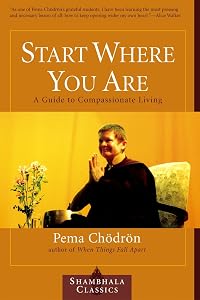
Start Where You Are: A Guide to Compassionate Living
by Pema Chödrön
On This Page
Description
Start Where You Are is an indispensable handbook for cultivating fearlessness and awakening a compassionate heart. With insight and humor, Pema Chödrön presents down-to-earth guidance on how we can "start where we are"--embracing rather than denying the painful aspects of our lives. Pema Chödrön frames her teachings on compassion around fifty-nine traditional Tibetan Buddhist maxims, or slogans, such as: "Always apply only a joyful state of mind," "Don't seek others' pain as the limbs of show more your own happiness," and "Always meditate on whatever provokes resentment." Working with these slogans and through the practice of meditation, Start Where You Are shows how we can all develop the courage to work with our inner pain and discover joy, well-being, and confidence. show lessTags
Recommendations







Member Reviews
Don't let my three (and a half) star rating dissuade you from reading this. It's substantial, and I think it will help people. There was however an off-the-cuff remark about eating hotdogs or hamburgers for lunch that I found inconsistent with compassionate living, so I docked a star off.
I suspect that I am assigning a 2 star ranking mainly because the terms Pema uses in the book are terms that a lay person wouldn't know such as tonglen. Going around terms that I didn't understand, yet understanding the concepts that she presented made the book somewhat more complicated to read and comprehend than I originally thought it would be. That being said, Pema Chodron is a leader in bringing Buddhism to the western world.
I would have had a difficult time with this book if I had not been meditating and reading up on the subject for a while. It seems to have been derived from a series of talks on mind training "lojong", a certain teaching that incorporates slogans to reflect upon. Despite the jargon, she keeps up a friendly, chatty tone while presenting intense ideas about how to approach the experience of having a brain with thoughts and emotions. It's given me some new tools to work with. Thanks, Pema!
This book is a real mixed bag, at least from my non-expert perspective. At times, Chodron's wisdom really shines through. Other times, though, she gets a bit too much into a hippy-esque tone which tends to make her ideas seem trite. The book is essentially a compilation of interpretations of certain slogans used by the branch of Buddhism she practices. Sometimes her interpretation of a slogan seem almost intentionally perverse. It's as if she is thinking "the slogan can't mean what it says on its most literal level, so I'm free to make it mean something else." I don't know if this is a fair criticism. For all I know, there are centuries of tradition behind her interpretations. Nevertheless, I sometimes couldn't see the point she was show more making about the given slogan. show less
Recommended by a friend and my first foray into the work of Pema Chodron. I found it thought-provoking in parts, hopeful in others. "A Guide to Compassionate Living" is a bit of a stretch, though, for any author or book to claim. The idea of a guidebook makes the whole task seem just a bit easier than it ever is.
This book definitely requires a re-read, as do all of Pema's books. I find some of the slogans difficult to understand, having had no experience in Buddhism. But that doesn't take away the wisdom inherent in this book. I take her advice to help me understand not just other's actions but my own as well.
I am pretty sure I have read this before but for some reason I can't find any record of it on my goodreads account. Pema Chodron is a Buddhist nun of some repute and has written a variety of English language books. This particular book is about learning to accept yourself and your situation whatever that may be, and how to develop compassion for others in even the most trying of circumstances. Many of Chodron's books are very accessible and approach things in a very practical and pragmatic modern way. This book however isn't one of those, it digs deeper into some of the more esoteric Buddhist ways. This doesn't mean that there is nothing of practical value, in fact there is plenty, but I personally prefer not to have to rely on belief show more to get results.
This isn't a bad book, it just isn't quite what I was hoping it was. show less
This isn't a bad book, it just isn't quite what I was hoping it was. show less
Members
- Recently Added By
Lists

Books Read in 2024
4,727 works; 128 members
Author Information

Series
Belongs to Publisher Series
Work Relationships
Common Knowledge
- Canonical title
- Start Where You Are: A Guide to Compassionate Living
- Original title
- Start Where You Are: A Guide to Compassionate Living
- Alternate titles
- Start Where You Are: How to Accept Yourself and Others
- Original publication date
- 1994
- Original language
- English
Classifications
- Genres
- Religion & Spirituality, Nonfiction, General Nonfiction, Philosophy
- DDC/MDS
- 294.3444 — Religion Other religions Dharmic religions Buddhism Buddhism - practice Religious experience, life, practice Religious life and practice
- LCC
- BQ7805 .C49 — Philosophy, Psychology and Religion Buddhism Buddhism Modifications, schools, etc. Tibetan Buddhism (Lamaism)
- BISAC
Statistics
- Members
- 1,630
- Popularity
- 13,885
- Reviews
- 17
- Rating
- (4.21)
- Languages
- 7 — Dutch, English, French, German, Polish, Spanish, Portuguese (Portugal)
- Media
- Paper, Audiobook, Ebook
- ISBNs
- 27
- UPCs
- 1
- ASINs
- 13