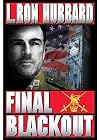
Final Blackout
by L. Ron Hubbard
On This Page
Description
As the great World War grinds to a halt a force more sinister than Hitler's Nazis has seized control of Europe and is systematically destroying every adversary except one. In the heart of France a crack unit of British soldiers survive, overcoming all opposition under the leadership of a hardened military strategist highly trained in every method of combat and known only as "The Lieutenant". Ordered to return to British Headquarters, the Lieutenant is torn between obeying the politicians in show more London or doing what he knows is right for his country, regardless of the price. show lessTags
Recommendations


















Member Reviews
Others have already synopsized the storyline but there are other aspects of the story that are quite timeless.
Story and Plot:
Considering the fact the author wrote this before World War II suggests an uncanny attempt to ask what would happen if World War I never ended and just ground on for generations. It was an attempt to see what happens to men and women when the horrors of war become a way of life; the only way to live is through strategy rather than being out-gunned. It’s the smart soldier who lives rather than the brave one.
I really liked the characters in this tale. The Lieutenant (we never know his real name) leads a ragtag band of what’s left of regiments and battalions. It’s a mix of different races and countrymen whose show more real purpose is just survive. Loved the battle with the Russian commander who was outsmarted in a raid. The leaders meet and are quite mannerly and respectful.
Contrast that with the armchair admirals and colonels at GQ (General Headquarters ) in Paris where men are called back from the field to be locked up and stripped of command. These communists want nothing better than to retake Europe and spread their philosophy of death. The Lieutenant has other things to say about that.
Characters: My favorite was the sadist Markey, with his chain covered with spikes, trips up his enemy and laughs about it. It sounds gruesome but was quite hilarious.
The end of the tale takes place in England. Outnumbered and outgunned, their wit gets them through to the main Communist camp. I won’t spoil it for you, but learning of the Americans coming to colonize their land is a bit much.
Great ending, a heroic if sad one.
Conclusion: Final Blackout asks the question that has been asked for hundreds of years. War, what is it good for? We were still asking this in Vietnam, in Iraq and other lands. Final Blackout’s answer is a compelling one.
Recommended. show less
Story and Plot:
Considering the fact the author wrote this before World War II suggests an uncanny attempt to ask what would happen if World War I never ended and just ground on for generations. It was an attempt to see what happens to men and women when the horrors of war become a way of life; the only way to live is through strategy rather than being out-gunned. It’s the smart soldier who lives rather than the brave one.
I really liked the characters in this tale. The Lieutenant (we never know his real name) leads a ragtag band of what’s left of regiments and battalions. It’s a mix of different races and countrymen whose show more real purpose is just survive. Loved the battle with the Russian commander who was outsmarted in a raid. The leaders meet and are quite mannerly and respectful.
Contrast that with the armchair admirals and colonels at GQ (General Headquarters ) in Paris where men are called back from the field to be locked up and stripped of command. These communists want nothing better than to retake Europe and spread their philosophy of death. The Lieutenant has other things to say about that.
Characters: My favorite was the sadist Markey, with his chain covered with spikes, trips up his enemy and laughs about it. It sounds gruesome but was quite hilarious.
The end of the tale takes place in England. Outnumbered and outgunned, their wit gets them through to the main Communist camp. I won’t spoil it for you, but learning of the Americans coming to colonize their land is a bit much.
Great ending, a heroic if sad one.
Conclusion: Final Blackout asks the question that has been asked for hundreds of years. War, what is it good for? We were still asking this in Vietnam, in Iraq and other lands. Final Blackout’s answer is a compelling one.
Recommended. show less
My reaction to reading this novel in 1998. Spoilers follow.
“Introduction”, Algis Budrys -- While Budrys may be too credulous about Hubbard’s purported accomplishments, he has interesting things to say about this novel’s importance. Originally published in Astounding Science Fiction in 1941 (March through May I believe), this novel is remarkable. It’s not just a novel of future war. They existed before this novel. Budrys finds the novel original in its political sophistication. He explicitly compares it to George Orwell’s 1984 which was to come years later. Though he doesn’t specifically mention it, both feature worlds under the thumb of constantly warring totalitarian states. It was also one of the first (maybe the first) show more US novel to feature US Marines suppressing the “hero”.
“Preface”, L. Ron Hubbard -- This is Hubbard’s preface to the 1948 edition (1948) of his novel. (Unfortunately, I don’t know how it varies from the magazine edition.) Hubbard’s account of the controversy around the novel (he was called a Fascist and a Communist.) is true. But the preface is a bit too fulsome and coy. Still, as Hubbard points out, when he wrote this novel Britain banned its publication and was not Socialist (as it became post war) and Russia was sitting out the war. It also predicted (no great trick) civilian casualties and atomic warfare (H. G. Wells did that first.)
Final Blackout, L. Ron Hubbard -- This novel stands, I suspect, as the fount of modern military science fiction. There were certainly future war stories before. H.G. Wells’ The War of the Worlds springs to mind immediately. But the modern incarnation of military men in science fiction, the no-nonsense mercenaries of David Drake and Jerry Pournelle who frequently get involved in politics probably all go back to Hubbard’s Lieutenant. Pournelle's John Christian Falkenberg immediately comes to mind, and Pournelle has a blurb for this novel.) Hubbard's characters is never called anything but the Lieutenant. The battle scenes of this novel and its geography are sometimes confusing and are certainly not up to Drake or Pournelle’s works. However the grim background and tone are interesting and compelling. The world the Lieutenant was born in has been ruined, much like the beginning of H.G. Wells’ The Shape of Things to Come, by a war known variously as the War of Books, the War of Creeds, the War Which Ended War, or “World Wars two, three, four, and five. The countries fighting the war constantly convulse with new governments. Russia gets a king, Britain goes Commie. Atomic weapons or guided missiles (I’d really like to know if this feature was in the original edition) destroy industrial civilization. Nations lose the ability to build complex weapons like airplanes; the manufacture of artillery shells stop as does the replacement of worn artillery. Warfare reverts back to the old mode of organized looting for future supplies. Germ warfare kills millions and also destroys crops. The British Expeditionary Force is forbidden to return to England lest it bring the plague. The upper staff command is incompetent. All this is the Prologue. The Lieutenant is called back to HQ as part of a purge to remove certain potentially troublesome officers. He resists, takes over HQ, and fashions a large army from the shattered, roving bands of soldiers (from many countries) in Europe. (The engagements between bands of soldiers are almost chivalrous in their attempts to avoid spilling unnecessary blood and the respect the officers accord each other.) When the Lieutenant finds out a vaccine now exists in England for the dreaded “soldier’s disease”, its off to England. First his growing army travels through a blasted Europe and a trap laid by peasants. The peasants’ women and supplies are looted though some instinctively respect him as a strong man. In England, the Lieutenant sets up a depressingly plausible feudal state where all veterans are to be revered. That it is not fascist is explicitly stated since there is no link of business and state. Hubbard is right in that this is plain old historical warlordism. The Lieutenant sets them up as an aristocracy selected by survivinng war. His feudal England is allegedly happy as it attempts to rebuild. Then, in a surprising development, Imperialistic Americans show up. America, the first nation to use nukes (again, I’d like to know if this was in the original edition), withdrew from the war early and sat it out unscathed. Its superiority in technology preserved (its gone Socialist) it wants, it says, to help rebuild Mother England. Actually, it just needs to relieve its popular problem, and the Lieutenant arranges as good a treaty as he can given his weak positions, then resigns and kills the American representatives before being killed. However, it seems slightly improbable that, whatever the legality of the treaty, America would not take vengeance on England for the Lieutenant’s act. show less
“Introduction”, Algis Budrys -- While Budrys may be too credulous about Hubbard’s purported accomplishments, he has interesting things to say about this novel’s importance. Originally published in Astounding Science Fiction in 1941 (March through May I believe), this novel is remarkable. It’s not just a novel of future war. They existed before this novel. Budrys finds the novel original in its political sophistication. He explicitly compares it to George Orwell’s 1984 which was to come years later. Though he doesn’t specifically mention it, both feature worlds under the thumb of constantly warring totalitarian states. It was also one of the first (maybe the first) show more US novel to feature US Marines suppressing the “hero”.
“Preface”, L. Ron Hubbard -- This is Hubbard’s preface to the 1948 edition (1948) of his novel. (Unfortunately, I don’t know how it varies from the magazine edition.) Hubbard’s account of the controversy around the novel (he was called a Fascist and a Communist.) is true. But the preface is a bit too fulsome and coy. Still, as Hubbard points out, when he wrote this novel Britain banned its publication and was not Socialist (as it became post war) and Russia was sitting out the war. It also predicted (no great trick) civilian casualties and atomic warfare (H. G. Wells did that first.)
Final Blackout, L. Ron Hubbard -- This novel stands, I suspect, as the fount of modern military science fiction. There were certainly future war stories before. H.G. Wells’ The War of the Worlds springs to mind immediately. But the modern incarnation of military men in science fiction, the no-nonsense mercenaries of David Drake and Jerry Pournelle who frequently get involved in politics probably all go back to Hubbard’s Lieutenant. Pournelle's John Christian Falkenberg immediately comes to mind, and Pournelle has a blurb for this novel.) Hubbard's characters is never called anything but the Lieutenant. The battle scenes of this novel and its geography are sometimes confusing and are certainly not up to Drake or Pournelle’s works. However the grim background and tone are interesting and compelling. The world the Lieutenant was born in has been ruined, much like the beginning of H.G. Wells’ The Shape of Things to Come, by a war known variously as the War of Books, the War of Creeds, the War Which Ended War, or “World Wars two, three, four, and five. The countries fighting the war constantly convulse with new governments. Russia gets a king, Britain goes Commie. Atomic weapons or guided missiles (I’d really like to know if this feature was in the original edition) destroy industrial civilization. Nations lose the ability to build complex weapons like airplanes; the manufacture of artillery shells stop as does the replacement of worn artillery. Warfare reverts back to the old mode of organized looting for future supplies. Germ warfare kills millions and also destroys crops. The British Expeditionary Force is forbidden to return to England lest it bring the plague. The upper staff command is incompetent. All this is the Prologue. The Lieutenant is called back to HQ as part of a purge to remove certain potentially troublesome officers. He resists, takes over HQ, and fashions a large army from the shattered, roving bands of soldiers (from many countries) in Europe. (The engagements between bands of soldiers are almost chivalrous in their attempts to avoid spilling unnecessary blood and the respect the officers accord each other.) When the Lieutenant finds out a vaccine now exists in England for the dreaded “soldier’s disease”, its off to England. First his growing army travels through a blasted Europe and a trap laid by peasants. The peasants’ women and supplies are looted though some instinctively respect him as a strong man. In England, the Lieutenant sets up a depressingly plausible feudal state where all veterans are to be revered. That it is not fascist is explicitly stated since there is no link of business and state. Hubbard is right in that this is plain old historical warlordism. The Lieutenant sets them up as an aristocracy selected by survivinng war. His feudal England is allegedly happy as it attempts to rebuild. Then, in a surprising development, Imperialistic Americans show up. America, the first nation to use nukes (again, I’d like to know if this was in the original edition), withdrew from the war early and sat it out unscathed. Its superiority in technology preserved (its gone Socialist) it wants, it says, to help rebuild Mother England. Actually, it just needs to relieve its popular problem, and the Lieutenant arranges as good a treaty as he can given his weak positions, then resigns and kills the American representatives before being killed. However, it seems slightly improbable that, whatever the legality of the treaty, America would not take vengeance on England for the Lieutenant’s act. show less
Stark novel of survival and politics set in Europe after WW III in a desolate harsh environment where soldiers are in small roving bands hunting for food and shelter and using weapons patched together out of scraps of old equipment.
The Lieutenant knows the needs of his company and shrewdly makes and executes plans to get to get home to his home country of England from which he has been banned due to fear of disease.
The Lieutenant knows the needs of his company and shrewdly makes and executes plans to get to get home to his home country of England from which he has been banned due to fear of disease.
Ratings
Members
- Recently Added By
Author Information

905+ Works 19,763 Members
L. Ron Hubbard was born in Tilden, Nebraska on March 13, 1911. He attended George Washington University and Princeton University. He began his career as a writer for pulp magazines and later as a science fiction writer. His science fiction works include the Buckskin Brigades, Final Blackout, Fear, The Kingslayer, and Black Towers to Danger. His show more book, Dianetics, was published in 1950. He spent the next 30 years devoting himself to the development of Dianetics and Scientology. In 1954, he founded the Church of Scientology. In the 1980s, he published his final fiction works Battlefield Earth and the Mission Earth series, which won the Cosmos 2000 Award from French readers and the Nova Science Fiction Award from Italy's Perseo Libri. He died on January 24, 1986. (Bowker Author Biography) show less
Some Editions
Awards and Honors
Notable Lists
Series
Belongs to Publisher Series
Urania [Mondadori] (701)
Common Knowledge
- Canonical title
- Final Blackout
- Original title
- Final Blackout
- Original publication date
- 1991
- Dedication
- To the men and officers
with whom I served
in World War II,
first phase, 1941-1945. - First words
- He was born in an air-raid shelter—and his first wail was drowned by the shriek of bombs, the thunder of falling walls and the coughing chatter of machine guns raking the sky.
- Last words*
- (Click to show. Warning: May contain spoilers.)Quella bandiera sventola ancora ma sulla targhetta, più sotto, le parole incise "Se l'unità rimane, qualsiasi cosa avvenga all'ufficiale, lui non è sconfitto", sono state cancellate dal tempo.
*Some information comes from Common Knowledge in other languages. Click "Edit" for more information.
Classifications
Statistics
- Members
- 329
- Popularity
- 96,213
- Reviews
- 3
- Rating
- (3.56)
- Languages
- 5 — English, Estonian, French, Hungarian, Italian
- Media
- Paper, Audiobook, Ebook
- ISBNs
- 24
- ASINs
- 17