
Algis Budrys (1931–2008)
Author of Rogue Moon
About the Author
Image credit: Shunn
Series
Works by Algis Budrys
L. Ron Hubbard Presents Writers of the Future, Volume 4 (1988) — Editor; Introduction — 107 copies, 1 review
L. Ron Hubbard Presents Writers of the Future, Volume 8 (1992) — Senior Editor — 53 copies, 1 review
Bibliothek der besten SF- Stories. Die fünfziger Jahre I. ( 1950 - 1954 ). (SF- Spezial). (1981) — Contributor — 8 copies
The Silent Eyes of Time [novella] 5 copies
Galaxy 4 ; Eine Auswahl der besten Stories aus dem Science Fiction Magazin GALAXY (1965) — Contributor — 4 copies
1981 and Counting 3 copies
Terrestri alla prova 3 copies
Silent Brother 3 copies
Lower Than Angels 3 copies
Short Science Fiction Collection 033 2 copies
Wonderbird 2 copies
Short Science Fiction Collection 058 2 copies
All For Love 2 copies
The Distant Sound Of Engines 2 copies
Lost Love [short story] 2 copies
Nightsound 2 copies
Protective Mimicry 2 copies
First to Serve 2 copies
And Then She Found Him 2 copies
Never Meet Again 1 copy
Firegod 1 copy
Infiltration 1 copy
Blood On My Jets 1 copy
Progetto terra 1 copy
Cage Of A Thousand Wings 1 copy
Due Process 1 copy
Dream of Victory [novelette] 1 copy
Watch Your Step 1 copy
Walk to the World 1 copy
For Love [short story] 1 copy
The Weeblies 1 copy
The Skirmisher [short story] 1 copy
1986 1 copy
Tomorrow Speculative Fiction 1 copy
Testimoni Dell'uomo 1 copy
Chain Reaction [novelette] 1 copy
The War is Over 1 copy
The Man Who Tasted Ashes 1 copy
Il satellite proibito 1 copy
The Fiend 1 copy
Associated Works
The Science Fiction Hall of Fame, Volume Two B: The Greatest Science Fiction Novellas of All Time (1973) — Contributor — 924 copies, 11 reviews
American Science Fiction: Nine Classic Novels of the 1950s (2012) — Contributor — 122 copies, 3 reviews
Isaac Asimov's Wonderful Worlds of Science Fiction, Volume 9: Robots (1989) — Contributor — 121 copies, 2 reviews
SF: The Year's Greatest Science-Fiction and Fantasy: Second Annual Volume (1958) — Contributor — 75 copies, 1 review
SF: The Year's Greatest Science-Fiction and Fantasy: 3rd Annual Volume (1958) — Contributor — 66 copies, 2 reviews
Nebula Awards 22: Sfwa's Choices for the Best Science Fiction and Fantasy 1986 (Nebula Awards Showcase) (1988) — Contributor — 53 copies, 1 review
Nebula Awards 21: Sfwa's Choices for the Best Science Fiction and Fantasy, 1985 (Nebula Awards Showcase) (1986) — Contributor — 44 copies, 2 reviews
The Best Science Fiction Stories and Novels: Ninth Series (2024) — Contributor — 42 copies, 1 review
The Magazine of Fantasy and Science Fiction July 1977, Vol. 53, No. 1 (1977) — Book reviewer — 31 copies
Nebula Awards 20: SFWA's Choices for the Best Science Fiction and Fantasy 1984 (1985) — Contributor — 28 copies
Analog Science Fiction/Science Fact: Vol. XCV, No. 5 (May 1975) (1975) — Contributor — 27 copies, 1 review
The Magazine of Fantasy and Science Fiction June 1991, Vol. 80, No. 6 (1991) — Contributor — 22 copies
The Magazine of Fantasy and Science Fiction August 1980, Vol. 59, No. 2 (1980) — Book reviewer — 22 copies
The Magazine of Fantasy and Science Fiction May 1980, Vol. 58, No. 5 (1980) — Contributor — 21 copies, 2 reviews
The Magazine of Fantasy and Science Fiction October 1990, Vol. 79, No. 4 (1990) — Book reviewer — 20 copies, 1 review
The Magazine of Fantasy and Science Fiction May 1991, Vol. 80, No. 5 (1991) — Book reviewer — 19 copies
The Magazine of Fantasy and Science Fiction November 1990, Vol. 79, No. 5 (1990) — Book reviewer — 17 copies
The Magazine of Fantasy and Science Fiction May 1978, Vol. 54, No. 5 (1978) — Book reviewer — 16 copies
The Magazine of Fantasy and Science Fiction October 1982, Vol. 63, No. 4 (1982) — Book reviewer — 16 copies
The Magazine of Fantasy and Science Fiction August 1984, Vol. 67, No. 2 (1984) — Book reviewer — 15 copies
The Magazine of Fantasy and Science Fiction August 1982, Vol. 63, No. 2 (1982) — Contributor — 15 copies
The Magazine of Fantasy and Science Fiction December 1985, Vol. 69, No. 6 (1985) — Book reviewer — 15 copies
The Magazine of Fantasy and Science Fiction October 1988, Vol. 75, No. 4 (1988) — Book reviewer — 15 copies
The Magazine of Fantasy and Science Fiction November 1978, Vol. 55, No. 5 (1987) — Contributor — 14 copies
The Magazine of Fantasy and Science Fiction January 1990, Vol. 78, No. 1 (1990) — Book reviewer — 14 copies
The Magazine of Fantasy and Science Fiction June 1985, Vol. 68, No. 6 (1985) — Book reviewer — 14 copies
The Magazine of Fantasy and Science Fiction March 1986, Vol. 70, No. 3 (1986) — Contributor — 13 copies
The Magazine of Fantasy and Science Fiction January 1989, Vol. 76, No. 1 (1989) — Contributor — 13 copies
The Magazine of Fantasy and Science Fiction August 1988, Vol. 75, No. 2 (1988) — Contributor — 13 copies
The Magazine of Fantasy and Science Fiction September 1988, Vol. 75, No. 3 (1988) — Book reviewer — 13 copies
The Magazine of Fantasy and Science Fiction November 1982, Vol. 63, No. 5 (1982) — Contributor — 13 copies
The Magazine of Fantasy and Science Fiction February 1985, Vol. 68, No. 2 (1985) — Contributor — 13 copies
The Magazine of Fantasy and Science Fiction April 1983, Vol. 64, No. 4 (1983) — Contributor — 12 copies
The Magazine of Fantasy and Science Fiction March 1990, Vol. 78, No. 3 (1990) — Book reviewer — 12 copies, 1 review
The Magazine of Fantasy and Science Fiction November 1986, Vol. 71, No. 5 (1986) — Contributor — 12 copies, 1 review
The Magazine of Fantasy and Science Fiction May 1983, Vol. 64, No. 5 (1983) — Book reviewer — 12 copies
The Magazine of Fantasy and Science Fiction May 1990, Vol. 78, No. 5 (1990) — Book reviewer — 12 copies
The Magazine of Fantasy and Science Fiction June 1990, Vol. 78, No. 6 (1990) — Book reviewer — 11 copies
The Magazine of Fantasy and Science Fiction October 1989, Vol. 77, No. 4 (1989) — Author — 11 copies
The Magazine of Fantasy and Science Fiction April 1990, Vol. 78, No. 4 (1990) — Contributor — 10 copies
The Magazine of Fantasy and Science Fiction November 1988, Vol. 75, No. 5 (1988) — Book reviewer — 10 copies
The Magazine of Fantasy and Science Fiction December 1989, Vol. 77, No 6 (1989) — Book reviewer — 9 copies
The Magazine of Fantasy and Science Fiction June 1989, Vol. 76, No. 6 (1989) — Book reviewer — 9 copies
Science Fiction Stories 1953 — Contributor — 2 copies
Short Science Fiction Collection 043 — Author — 1 copy
Tagged
Common Knowledge
- Legal name
- Budrys, Algirdas Jonas (birth name)
- Other names
- Budrys, Algis
Hodgkins, David C.
Janvier, Ivan
Janvier, Paul
Jaulyn, Gordon
Javlyn, Gordon (show all 13)
Marner, Robert
Mason, Frank
Oldmann, Jeffries
Rome, Alger (with Jerome Bixby)
Scarff, William
Sentry, John A.
Stroud, Albert - Birthdate
- 1931-01-09
- Date of death
- 2008-06-09
- Gender
- male
- Education
- University of Miami
Columbia University - Occupations
- editor
critic
publicist
writer - Organizations
- Writers of the Future
- Awards and honors
- SFRA Pilgrim Award (2007)
- Agent
- John Berlyne (Zeno Agency)
- Cause of death
- melanoma
- Nationality
- Lithuania
USA - Birthplace
- Königsberg, East Prussia
- Places of residence
- Königsberg, Prussia (birth)
Evanston, Illinois, USA - Place of death
- Evanston, Illinois, USA
- Map Location
- Lithuania
Members
Reviews

With "Rogue Moon," Budrys struggles to play out philosophical discussions on life, death, the meaning of True Manhood, and whether memory is immortality or not. To cause these to play out, he's whipped up an alien puzzle box much like that the Strugatski Brothers would perfect in "Roadside Picnic" and put it on the Moon, but it is more a MacGuffin than anything else; also, the matter transporter central to the plot presages that in 'Star Trek' by five years but ends up being the source of a show more massive, unspoken moral dilemma. Having created sentient, slave dopplegangers that have no rights or individual futures just seems to be a part of the job to everyone involved: ain't that nice?
The SF value is moot, though. The philosophical digressions are banal and blustery; the overarching frame of the story is both dated and unbelievable. But what makes this book nearly unreadable is the reduction of characters to theatrical masks, like in Greek tragedy: they are archetypes. There's the Rational But Clueless Man (Hawks), the Arrogant & Toxic Male (Barker), the Whore of Babylon (Claire), the Superficial Fool (Connington), the Blowhard Boss (Cobey), and the Patient Penelope (Elizabeth). What forgiving reviewers call "character development" reads to me like episode after episode of toxic posturing bathed in cigar smoke, Scotch, and pheromones.
This book is not just dated, but fails. Stanislaw Lem wrote a better, similar book then ("Eden," publ. 1959) and Alastair Reynolds intentionally improved on this more recently (novella "Diamond Dogs," 2001). Perhaps its air of sophistication and cerebral ruminations wowed the audience in 1960, but this is nothing more than an artifact now and should be read as such. show less
The SF value is moot, though. The philosophical digressions are banal and blustery; the overarching frame of the story is both dated and unbelievable. But what makes this book nearly unreadable is the reduction of characters to theatrical masks, like in Greek tragedy: they are archetypes. There's the Rational But Clueless Man (Hawks), the Arrogant & Toxic Male (Barker), the Whore of Babylon (Claire), the Superficial Fool (Connington), the Blowhard Boss (Cobey), and the Patient Penelope (Elizabeth). What forgiving reviewers call "character development" reads to me like episode after episode of toxic posturing bathed in cigar smoke, Scotch, and pheromones.
This book is not just dated, but fails. Stanislaw Lem wrote a better, similar book then ("Eden," publ. 1959) and Alastair Reynolds intentionally improved on this more recently (novella "Diamond Dogs," 2001). Perhaps its air of sophistication and cerebral ruminations wowed the audience in 1960, but this is nothing more than an artifact now and should be read as such. show less
Who? by Algis Budrys
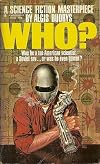
If there is such a thing as science fiction noir then Budrys is certainly one of its most important voices. He is not an author one goes to for juvenile wish fulfillment or escapism. Who? offers complex, nuanced characters who try to do what’s right in a suspicious and unforgiving world. I seem to have enjoyed this gritty cold war rumination on identity and futility more than most.

The best science fiction is about ideas, and Rogue Moon wrestles with at least a couple of big existential ones, e.g. what meaning can there be living in an impersonal universe? In its day (the late 1950s), the book was considered pretty ground-breaking, and perhaps it was. After all, Americans at that time were fairly confident they knew their place in the universe: few questioned America's dominance and with the churches full on Sunday mornings, everyone could easily ride the complacent show more wave that that's exactly the way God wanted it.
In the half-century since, however, there have been enough crises of confidence that it is no longer considered heresy to entertain the belief that our universe is indeed impersonal and that surrendering to that "truth" and discovering personal meaning within it can be a real struggle. In short, while Budrys' ideas may have been challenging at the time of Rogue Moon's publication, a reader of today's generation will probably come to it already having considered them in other contexts.
I'm a creature of the post-Rogue Moon generation. While I liked the book in its presentation of the question, it's nothing that knocked my socks off. show less
In the half-century since, however, there have been enough crises of confidence that it is no longer considered heresy to entertain the belief that our universe is indeed impersonal and that surrendering to that "truth" and discovering personal meaning within it can be a real struggle. In short, while Budrys' ideas may have been challenging at the time of Rogue Moon's publication, a reader of today's generation will probably come to it already having considered them in other contexts.
I'm a creature of the post-Rogue Moon generation. While I liked the book in its presentation of the question, it's nothing that knocked my socks off. show less

Very well written though a bit dated. Psychological study of what drives men (use men intentionally) to achieve what is ultimately a pointless goal.
Lists
Awards


You May Also Like


Associated Authors
Statistics
- Works
- 133
- Also by
- 152
- Members
- 5,051
- Popularity
- #4,955
- Rating
- 3.6
- Reviews
- 93
- ISBNs
- 221
- Languages
- 7
- Favorited
- 6