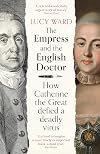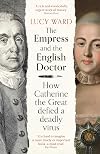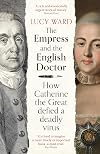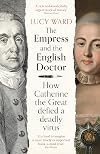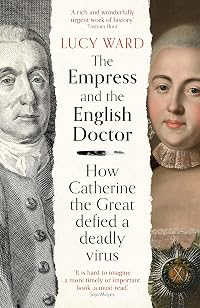
The Empress and the English Doctor: How Catherine the Great defied a deadly virus
by Lucy Ward
On This Page
Description
Within living memory, smallpox was a dreaded disease. Over human history it has killed untold millions. Back in the eighteenth century, as epidemics swept Europe, the first rumours emerged of an effective treatment: a mysterious method called inoculation. But a key problem remained: convincing people to accept the preventative remedy, the forerunner of vaccination. Arguments raged over risks and benefits, and public resistance ran high. As smallpox ravaged her empire and threatened her show more court, Catherine the Great took the momentous decision to summon the Quaker physician Thomas Dimsdale to St. Petersburg to carry out a secret mission that would transform both their lives. show lessTags
Recommendations




Member Reviews
This is both a book about an encounter between the Empress of Russia and an English doctor, unlikely as that may seem. It is also about the history of small pox and goes through the the 1980s when small pox was eradicated, the only disease that mankind has eliminated.
It starts with a review of smallpox, where it is believed to have come from the symptoms, the prevalence and the very high death toll. The book then goes on to follow the introduction of smallpox innoculation, tracing the efforts of the various people who brought the practice from the east and Africa. As it was introduced, the medical profession got their hands on it and made it both more complicated and less safe. However, the Sutton family simplifed the technique and set show more out to both make a lot of money and innoculate a lot of people. The introduction of data driven methods to review effectiveness of the technique was also covered. The Suttons did not publish their work, that fell to Dr Dimsdale, the doctor of the title. The book reviews the uptake of innoculation in the royal fmaily in England and the spread and attitudes across Europe. When Catherine the Great decides to have herself and her son and heir innoculated, the court sends a messenger to London and invites Dr Dimsdale to return with them. His visit forms the heart of the book.
He forms a friendship with Catherine that lasts until her death, returning to Russia some years later to also innoculate her grandsons.
The final portion of the book reviews the introduction of the smallpox vaccine, by Jenner, based on the cowpox, a safer version of the disease that gave immunity to smallpox. It was interesting to hear writers from the late 18thC discussing strategies to eliminate smallpox, that it took 200 years to actually do tells you something of the effort required. The resistance to innoculation and then vaccination is discussed, both on a national and individual level, anti vaccination movements are nothing new.
This was a little long, but there was a lot of information to cover and to do so in an understandable way that took some time. Continuing the tale to the elimination of smallpox was a sensible decision on the part of the author.
This is an interesting detailed history. show less
It starts with a review of smallpox, where it is believed to have come from the symptoms, the prevalence and the very high death toll. The book then goes on to follow the introduction of smallpox innoculation, tracing the efforts of the various people who brought the practice from the east and Africa. As it was introduced, the medical profession got their hands on it and made it both more complicated and less safe. However, the Sutton family simplifed the technique and set show more out to both make a lot of money and innoculate a lot of people. The introduction of data driven methods to review effectiveness of the technique was also covered. The Suttons did not publish their work, that fell to Dr Dimsdale, the doctor of the title. The book reviews the uptake of innoculation in the royal fmaily in England and the spread and attitudes across Europe. When Catherine the Great decides to have herself and her son and heir innoculated, the court sends a messenger to London and invites Dr Dimsdale to return with them. His visit forms the heart of the book.
He forms a friendship with Catherine that lasts until her death, returning to Russia some years later to also innoculate her grandsons.
The final portion of the book reviews the introduction of the smallpox vaccine, by Jenner, based on the cowpox, a safer version of the disease that gave immunity to smallpox. It was interesting to hear writers from the late 18thC discussing strategies to eliminate smallpox, that it took 200 years to actually do tells you something of the effort required. The resistance to innoculation and then vaccination is discussed, both on a national and individual level, anti vaccination movements are nothing new.
This was a little long, but there was a lot of information to cover and to do so in an understandable way that took some time. Continuing the tale to the elimination of smallpox was a sensible decision on the part of the author.
This is an interesting detailed history. show less
Thomas Dimsdale was one of the foremost practitioners of inoculation against smallpox in 18th-century England, and his fame was such that he was invited to Russia by the Empress Catherine herself to inoculate her and her son, and to introduce the life-saving practice to her realm. Lucy Ward uses the story of Dimsdale's trip to Russia as a hook to tell the broader history of inoculation and how it set the stage for vaccination proper. Ward has a journalist's eye for an entertaining anecdote, but the structure of the book inevitably suffers from trying to tell a book-length account of a global development in the history of medicine through the encounter of one doctor and two elite patients.
The Empress and the English Doctor
Lucy Ward, Jun 2022, Oneworld Publications, an imprint of Simon & Schuster
Themes: History, 18th century, Medical
THE EMPRESS AND THE ENGLISH DOCTOR is a fast-paced, nonfiction narrative telling the story of Catherine the Great’s quest to inoculate the masses against smallpox. Rather than focusing on the science itself, the true story explores the challenges of preventative health care in the 18th century.
Take-aways: Use this story as an example of the importance of political leadership in promoting science.
Lucy Ward, Jun 2022, Oneworld Publications, an imprint of Simon & Schuster
Themes: History, 18th century, Medical
THE EMPRESS AND THE ENGLISH DOCTOR is a fast-paced, nonfiction narrative telling the story of Catherine the Great’s quest to inoculate the masses against smallpox. Rather than focusing on the science itself, the true story explores the challenges of preventative health care in the 18th century.
Take-aways: Use this story as an example of the importance of political leadership in promoting science.
Ratings
Members
- Recently Added By
Lists

al.vick-wishlist-history
70 works; 2 members
Author Information
5 Works 77 Members
Awards and Honors
Awards
Distinctions
Classifications
- Genres
- History, Nonfiction, General Nonfiction, Science & Nature, Biography & Memoir
- DDC/MDS
- 947.063 — History & geography History of Europe Eastern European Counties and Russia Russian & Slavic History by Period Catharine I - Catharine II 1725-96 Catherine II (the Great), 1762-1796
- LCC
- DK170 .W37 — History of Europe, Asia, Africa and Oceania Russia. Soviet Union. Former Soviet Republics – Poland History of Russia. Soviet Union. Former Soviet Republics History House of Romanov, 1613-1917
- BISAC
Statistics
- Members
- 72
- Popularity
- 436,919
- Reviews
- 3
- Rating
- (4.13)
- Languages
- English
- Media
- Paper, Audiobook, Ebook
- ISBNs
- 8
- ASINs
- 3