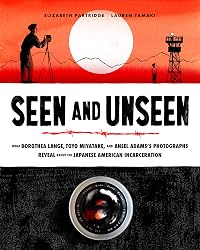
Seen and Unseen: What Dorothea Lange, Toyo Miyatake, and Ansel Adams's Photographs Reveal About the Japanese American Incarceration
by Elizabeth Partridge
On This Page
Description
"Legendary photographers Dorothea Lange, Toyo Miyatake, and Ansel Adams all photographed the Japanese American incarceration, but with different approaches-and different results. This nonfiction picture book for middle grade readers examines the Japanese-American incarceration-and the complexity of documenting it-through the work of these three photographers"--Tags
Recommendations



















Member Reviews
Seen and Unseen really opened up my eyes to how history can be told in different ways depending on who's holding the camera. The book contrasts the photographs of Dorothea Lange, Toyo Miyatake, and Ansel Adams, with each telling a different version of the same story. Miyake's photos especially stood out as he was actually incarcerated, so his images captured a deeply personal connection with the history. The book will spark a lot of strong conversations about bias, censorship and civil liberties. It is a wonderful example of the connection between art and history.
Shortly after the bombing of Pearl Harbor in December 1941, President Roosevelt issued Executive Order 9066, authorizing the removal of 120,000 Japanese-American people from the West Coast - a violation of their constitutional rights. Issei and Nisei alike had to give up their homes, businesses, pets, and most of their possessions; they were incarcerated for years, and when they were released, most of them had lost their homes, possessions, and businesses and had to start all over.
Dorothea Lange, Toyo Miyatake, and Ansel Adams all took photographs that now serve as a stark historical record and reminder of the U.S. government's unjust action during wartime.
Quotes
"I have to record everything. This kind of thing should never happen show more again." (Toyo Miyatake, 53)
The truth is powerful. We need to use honest, accurate language to tell the real story of our history. (107)
It's clear that racial prejudice and unfounded fears played a huge part in the incarceration. (108)
[On the "Yellow Peril"/model minority myths] Asian Americans were unfairly tasked with dismantling the lies the American government had fabricated and spread across the country. (116) show less
Dorothea Lange, Toyo Miyatake, and Ansel Adams all took photographs that now serve as a stark historical record and reminder of the U.S. government's unjust action during wartime.
Quotes
"I have to record everything. This kind of thing should never happen show more again." (Toyo Miyatake, 53)
The truth is powerful. We need to use honest, accurate language to tell the real story of our history. (107)
It's clear that racial prejudice and unfounded fears played a huge part in the incarceration. (108)
[On the "Yellow Peril"/model minority myths] Asian Americans were unfairly tasked with dismantling the lies the American government had fabricated and spread across the country. (116) show less
This is a stunning, award-winning informational book that belongs in every school library. Seen and Unseen captures the perspectives of 3 different photographers who documented life at Manzanar internment camp during WW II. Dorothea Lange was hired by the US government, but critical of its actions. Ansel Adams was hired by the internment camp to present photos of resilience and cheer. And Toyo Miyatake, who managed to smuggle in his camera while he was imprisoned there.
The book weaves together first-person accounts, beautiful paintings, and of course photographs to capture a horrific time in American history. Although it was created with middle readers in mind, older students deserve to experience its powerful messages, too.
The book weaves together first-person accounts, beautiful paintings, and of course photographs to capture a horrific time in American history. Although it was created with middle readers in mind, older students deserve to experience its powerful messages, too.
Three different photographers took pictures of the Japanese American internment camps. One was an outsider who saw an injustice that she wanted to reveal to the American people. Another, also an outsider, thought that the government had done the right thing, but that the incarcerated people should be able to return to civic life fully and peacefully after the war. The third was an insider, secretly photographing the real conditions of the camps, despite personal danger.
I knew a lot of the general information in this book before going in, but hadn't known about the photographers who provided visual documentation of the conditions. An eye-opening book, accessible to older children and teens, but also of interest to adults.
I knew a lot of the general information in this book before going in, but hadn't known about the photographers who provided visual documentation of the conditions. An eye-opening book, accessible to older children and teens, but also of interest to adults.
I'm kind of in love with this book because of how well it documents (or seeks to document) one of the travesties of American History--that of internment camps. (Which are really concentration camps let's be real)
See how media control narratives flipped the script
See how cameras were smuggled in to tell the whole story
See how the spirit of the Japanese Americans never wavered
This is a must for collections
See how media control narratives flipped the script
See how cameras were smuggled in to tell the whole story
See how the spirit of the Japanese Americans never wavered
This is a must for collections
We view the WW2 incarceration of Japanese Americans through the lenses of three photographers: Dorothea Lange, Ansel Adams, and Toyo Miyatake who was incarcerated at Manzanar. This is an intriguing exploration of how the incarceration was portrayed by the government and how these photographers interpreted what they saw. It also covers how the government controlled what images were published. Toyo of course had the lived experience and the personal connection to the community, and his photos resonate with a quality missing from the others. This thought-provoking pictorial book will inspire lively book discussion of many levels. Tamaki's illustrations help tell the story of the incarceration and provide connection among the photos.
Great design in this nonfiction book that explores Japanese American incarceration during World War II. It uses photographs by Dorothea Lange, Toyo Miyatake, and Ansel Adams to show images of the camps and help illustrate the history. A quick read that packs a punch and tells a story through sparce text, primary source documents, and illustrations.
Members
- Recently Added By
Lists

SYES Library Wishlist
1,080 works; 4 members

Robert F. Sibert Informational Book Medal
102 works; 1 member

History: War & Terrorism
64 works; 1 member

Books Read in 2026
1,942 works; 66 members
Author Information

21+ Works 1,990 Members
Awards and Honors
Awards
Distinctions
Notable Lists
Common Knowledge
- Important events
- World War II
Classifications
Statistics
- Members
- 165
- Popularity
- 198,561
- Reviews
- 14
- Rating
- (4.35)
- Languages
- English
- Media
- Paper, Audiobook, Ebook
- ISBNs
- 5
- ASINs
- 1