
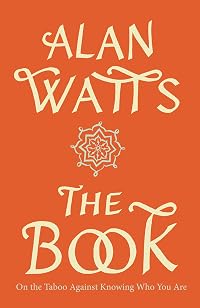
The Book: On the Taboo Against Knowing Who You Are
by Alan Watts
On This Page
Description
Drawing upon ancient Hindu philosophy, the author explores the human psyche and the importance of personal identity. In The Book, Alan Watts provides us with a much-needed answer to the problem of personal identity, distilling and adapting the Hindu philosophy of Vedanta. At the root of human conflict is our fundamental misunderstanding of who we are. The illusion that we are isolated beings, unconnected to the rest of the universe, has led us to view the "outside" world with hostility, and show more has fueled our misuse of technology and our violent and hostile subjugation of the natural world. To help us understand that the self is in fact the root and ground of the universe, Watts has crafted a revelatory primer on what it means to be human--and a mind-opening manual of initiation into the central mystery of existence. -- From publisher's description show lessTags
Recommendations










Member Reviews
Don't read if you're religious and intend to stay that way lol. I'm not, so this book was incredible. Written clearly and amiably. Hard to believe this was written in '66 as it converses so well with 2023. There was plenty he said that didn't age well, and of course there's plenty to critique (fitting for philosophy) but The Book is fundamental. Watts does what he says he will, and gives us plenty of beautiful things to ponder along the way without losing us with density. Fascinating pastiche of cultural thought. Actually super interdisciplinary.
Alan Watts (1915-73) was a British-born writer and philosopher who is now most remembered as a popularizer of Eastern philosophy and religion. However, as a survey of his career and prodigious writings reveal, he was much more than that. His early interest in Buddhism led him to become a secretary of the London Buddhist Lodge at the precocious age of 16, and, at 21, to publish his first book, The Spirit of Zen. However, he shortly after moved to America, where his interests developed in numerous directions - Christianity, philosophy, physics, cybernetics, psychology, anthropology, ecology, and any other field that piqued his restless curiosity. But such wide-ranging studies were not the flighty fads of a shallow intellectual dabbler or show more spiritual tourist - he obtained post-graduate degrees in theology and divinity, and for 5 years held the position of a Christian priest; rather, it suggests the questing spirit of a man unhappy with existing dogmas and traditions, and keen to draw new parallels and connections between different cultures and outlooks, between science and religion, between the old world and the new.
It is this desire for synthesis which has upset some purists. Especially in his later writings, Watts is often not content merely to elucidate a certain position or outlook (Vedanta, Buddhism), but instead wants to reveal what different perspectives have in common, or how they may be combined to suit different needs or suggest solutions to different problems. If, in the course of doing so, he glosses over fine distinctions or ignores controversies, then it is generally in the interest of practical application. It is of secondary interest to him to be technically correct or doctrinally accurate, for his main concern is with how we might apply these ideas and attitudes within our own lives, and in this he is passionate, persuasive, insightful and entertaining.
It is in this spirit, then, that we should approach The book - On the Taboo Against Knowing Who You Are (to give it its full, rather unwieldy title - hereafter, simply The Book). It is a polemic against a single idea: the modern, Western notion that human beings are ultimately separate individual egos divorced from the physical word in which they live - that each of us is, in Watts’ words, an ‘ego in a bag of skin’. In attacking this view, which can be found in both religious and secular guises, Watts draws on numerous fields: the Vedantic philosophy of Hinduism, which pictures the underlying nature of reality as a single, universal self, or Brahman; the modern discipline of cybernetics, which sees things in terms not of individuals, but overall processes and systems; and quantum physics, which undermines the ‘mechanism’ of Newton and Descartes (the ‘billiard ball’ view of the universe), and the idea that reality ultimately consists of separate individual objects. The common theme of these and the other approaches that Watts calls upon is to dispute the idea that reality/the world is ‘out there’ and the self is ‘in here’. As such, it attacks the standard position of philosophical realism and the dualist picture of mind and body associated with Descartes. So, we are not ‘ghosts’ in the ‘machines’ of our bodies (as Descartes’s view implies), but nor must we be tied to one or other of the alternatives that dualism represents: spiritual idealism (only the mind or soul is real) is as false as mechanistic materialism (the universe is merely one soulless machine working like a giant clock). Rather, as Vedanta proposes, we should seek to overcome this false duality, and to realize that, ultimately, there is no distinction to be drawn between ‘individuals’ and the universe of which we are a part: we are everything, and everything is us.
This may sound like some vague hippie mantra, but Watts’ arguments do not involve any appeal to otherworldly substances or supernatural entities. In fact, he identifies traditional religious notions (as they are often misunderstood) as responsible for our failure to realize this fundamental truth. For instance, if we were not so caught up with seeing God as a father figure whom we must obey, or else be judged and punished by, then we might be open to a deeper understanding of this concept. In a sense, he argues, we are ‘God’, could we but realize it, yet the theological baggage attached to such terms does little more than obscure this realization, which should be within the grasp of any one of us at any time. If we could let go of the false idea that our body is physically separate from the matter of the universe (such as physics denies), and that we possess a unique and distinct personality or self (which both psychology and philosophy call into question), then we would gain a truer sense of who we are, and of what ancient sages meant by such concepts as ‘Buddha nature’ and ‘God’.
Central to Watts’ position is what he calls ‘the game of black and white’, whereby God - the universe, "IT", whatever you want to call it - plays a cosmic game of hide and seek with itself. In that game, whilst each individual thing might seem like a separate piece, in reality each of us is just a means of manifesting the same thing, finger puppets of the same universal hand. ‘Self’ and ‘world’, ‘me’ and ‘you’, ‘mind’ and ‘matter’, are therefore simply different aspects of the game, but each of which ultimately has no independent reality.
Some people may find such a view either preposterous or disquieting. How can we all be part of the same thing? And even if we are, doesn’t this make everything meaningless? A mere game? Watts argues that we may play this game sincerely whilst not taking it too seriously: we can fight for goodness and justice, engage in love and work, and so on, whilst realizing that, as the old saying has it, ‘at the end of the game, king and pawn go back in the same box’ - we all return to the state we had before we were born. ‘Life’ and ‘death’ are mere labels that we place upon aspects of reality. Such terms - like ‘good’ and ‘evil’, ‘self’ and ‘other’ - mutually define and depend upon each other, but ultimately - once we realize that these opposites are merely the terms of the ‘game’ - they have no independent meaning. However, to take them literally is to court misery and delusion. For instance, in philosophy the basis for personal identity has long been a controversial problem. But if we could succeed in solving it - in establishing necessary and sufficient criteria for the continued existence of a unified self or ‘I’ (our ego) - then it would be a disaster. As Watts’ puts it, ‘nothing fails like success’. The victory of fixed literalness over shifting uncertainty and ambiguity may actually be a bad thing. Death, failure, disruption, dissolution - these are necessary things too, and from the universal perspective may fulfill important and positive roles.
There are many other interesting and important features of Watts’ arguments, but I’ve provided enough of a taste here to give you a flavor of his approach - I’ll leave the rest to Watts, who puts it much better than I could. However, to finish, I would like to highlight a few points that I think are interesting and important.
Firstly, the emphasis of The Book is not simply philosophical, but experiential. Watts believes that, as interesting as the ideas he presents are, they are empty and meaningless if they do not result in a change in our actual experience and patterns of thought and behaviour. We must learn a new way of seeing, which in turn must lead us to a richer, more positive outlook on life, where we are more fully alive in the present. So, for Watts, dogma and belief are always second to experience and practical realization, and it is in this specific sense that his approach is ‘mystical’, thus linking him directly to the goals and methods of Zen Buddhism and other approaches that emphasize practical insight over theoretical knowledge.
Secondly, whilst The Book is aimed at a general readership, it is no lightweight popularization, but - within the limits of its purpose - engages meaningfully with fundamental debates in philosophy, science and religion. It is obvious that Watts has read widely and thought deeply about the issues he raises, and, whilst we may not always agree with him - and there is plenty in The Book to challenge common assumptions - his ideas are always substantial and interesting.
Finally, there is the question of the book’s continued relevance. Aside from the fact that the philosophical and religious issues with which The Book deals never really go away, many of Watts’ views on technology and society now seem remarkably prescient. The following passage is a notable example (p.44):
Written in 1966, it is clear that - like his contemporary Marshall McLuhan - Watts recognized that technology did not just enable us to interact differently with our environment, but actually represented an extension of our nervous systems: technology actually changes who we are. We may talk of being glued to the TV, or joke of someone who treats their phone as if it were a vital organ, but there is a seed of literal truth in these metaphorical ways of speaking. Just as, in evolutionary terms, our sense organs represented extensions of our primitive nervous systems, so technological means of perception and communication extend sense-perception. So, whilst it’s tempting to draw the limits of ‘self’ at the body’s borders with the external world, the potential for amputation or artificial augmentation actually reveals that our notion of self is fluid and culturally defined. ‘Me’ is not a fixed concept, but a practical consideration: I could lose all my limbs and still retain it, so why not gain new ‘limbs’ and extend it?
Watts’ key contribution here is to show that such considerations are not merely the stuff of science fiction, but have their roots in ancient religious and philosophical notions of selfhood. But in pointing this out, he also highlights an important difference. The religious and mystical extension of self was organic and life affirming; in identifying with everything, we become more than an ‘ego in a bag of skin’, but part of the active processes of life itself. In contrast, the technological extensions of self make us more and more passive. We become consumers, dependent on a mechanical system that treats individuals as mere cogs in the overall machine. In the former view, we become more than we thought we were; in the latter, we become, in a sense, less. For most people, such technological ‘transhumanism' seems as implausible and remote as the religious variety, but this is because they hold to the naive notion of the individual ego that is Watt’s main target. Thus, they sleepwalk into technological extensions of self, blithely accepting the unread terms and conditions of a system that introduces greater and greater uniformity of thought and experience through the illusion of greater freedom of choice and expression. Social networks connect us to people we may never meet in person, but they also restrict our expression of what is distinctive about us: we become a set of ‘likes’ and ‘dislikes’, a tick-list of preferences and hobbies, where who we are is reduced to a profile picture and our views on life must fit within a 140 character limit (or whatever it is now...).
Watts’ views are therefore more relevant than ever. Faced with the problems and challenges of globalization and digitization, with increasing multiculturalism and secularization on the one hand and the backlash of nationalism and fundamentalism on the other, this last great taboo - the question of who or what we are - could never be more pressing.
Gareth Southwell is a philosopher, writer and illustrator. show less
It is this desire for synthesis which has upset some purists. Especially in his later writings, Watts is often not content merely to elucidate a certain position or outlook (Vedanta, Buddhism), but instead wants to reveal what different perspectives have in common, or how they may be combined to suit different needs or suggest solutions to different problems. If, in the course of doing so, he glosses over fine distinctions or ignores controversies, then it is generally in the interest of practical application. It is of secondary interest to him to be technically correct or doctrinally accurate, for his main concern is with how we might apply these ideas and attitudes within our own lives, and in this he is passionate, persuasive, insightful and entertaining.
It is in this spirit, then, that we should approach The book - On the Taboo Against Knowing Who You Are (to give it its full, rather unwieldy title - hereafter, simply The Book). It is a polemic against a single idea: the modern, Western notion that human beings are ultimately separate individual egos divorced from the physical word in which they live - that each of us is, in Watts’ words, an ‘ego in a bag of skin’. In attacking this view, which can be found in both religious and secular guises, Watts draws on numerous fields: the Vedantic philosophy of Hinduism, which pictures the underlying nature of reality as a single, universal self, or Brahman; the modern discipline of cybernetics, which sees things in terms not of individuals, but overall processes and systems; and quantum physics, which undermines the ‘mechanism’ of Newton and Descartes (the ‘billiard ball’ view of the universe), and the idea that reality ultimately consists of separate individual objects. The common theme of these and the other approaches that Watts calls upon is to dispute the idea that reality/the world is ‘out there’ and the self is ‘in here’. As such, it attacks the standard position of philosophical realism and the dualist picture of mind and body associated with Descartes. So, we are not ‘ghosts’ in the ‘machines’ of our bodies (as Descartes’s view implies), but nor must we be tied to one or other of the alternatives that dualism represents: spiritual idealism (only the mind or soul is real) is as false as mechanistic materialism (the universe is merely one soulless machine working like a giant clock). Rather, as Vedanta proposes, we should seek to overcome this false duality, and to realize that, ultimately, there is no distinction to be drawn between ‘individuals’ and the universe of which we are a part: we are everything, and everything is us.
This may sound like some vague hippie mantra, but Watts’ arguments do not involve any appeal to otherworldly substances or supernatural entities. In fact, he identifies traditional religious notions (as they are often misunderstood) as responsible for our failure to realize this fundamental truth. For instance, if we were not so caught up with seeing God as a father figure whom we must obey, or else be judged and punished by, then we might be open to a deeper understanding of this concept. In a sense, he argues, we are ‘God’, could we but realize it, yet the theological baggage attached to such terms does little more than obscure this realization, which should be within the grasp of any one of us at any time. If we could let go of the false idea that our body is physically separate from the matter of the universe (such as physics denies), and that we possess a unique and distinct personality or self (which both psychology and philosophy call into question), then we would gain a truer sense of who we are, and of what ancient sages meant by such concepts as ‘Buddha nature’ and ‘God’.
Central to Watts’ position is what he calls ‘the game of black and white’, whereby God - the universe, "IT", whatever you want to call it - plays a cosmic game of hide and seek with itself. In that game, whilst each individual thing might seem like a separate piece, in reality each of us is just a means of manifesting the same thing, finger puppets of the same universal hand. ‘Self’ and ‘world’, ‘me’ and ‘you’, ‘mind’ and ‘matter’, are therefore simply different aspects of the game, but each of which ultimately has no independent reality.
Some people may find such a view either preposterous or disquieting. How can we all be part of the same thing? And even if we are, doesn’t this make everything meaningless? A mere game? Watts argues that we may play this game sincerely whilst not taking it too seriously: we can fight for goodness and justice, engage in love and work, and so on, whilst realizing that, as the old saying has it, ‘at the end of the game, king and pawn go back in the same box’ - we all return to the state we had before we were born. ‘Life’ and ‘death’ are mere labels that we place upon aspects of reality. Such terms - like ‘good’ and ‘evil’, ‘self’ and ‘other’ - mutually define and depend upon each other, but ultimately - once we realize that these opposites are merely the terms of the ‘game’ - they have no independent meaning. However, to take them literally is to court misery and delusion. For instance, in philosophy the basis for personal identity has long been a controversial problem. But if we could succeed in solving it - in establishing necessary and sufficient criteria for the continued existence of a unified self or ‘I’ (our ego) - then it would be a disaster. As Watts’ puts it, ‘nothing fails like success’. The victory of fixed literalness over shifting uncertainty and ambiguity may actually be a bad thing. Death, failure, disruption, dissolution - these are necessary things too, and from the universal perspective may fulfill important and positive roles.
There are many other interesting and important features of Watts’ arguments, but I’ve provided enough of a taste here to give you a flavor of his approach - I’ll leave the rest to Watts, who puts it much better than I could. However, to finish, I would like to highlight a few points that I think are interesting and important.
Firstly, the emphasis of The Book is not simply philosophical, but experiential. Watts believes that, as interesting as the ideas he presents are, they are empty and meaningless if they do not result in a change in our actual experience and patterns of thought and behaviour. We must learn a new way of seeing, which in turn must lead us to a richer, more positive outlook on life, where we are more fully alive in the present. So, for Watts, dogma and belief are always second to experience and practical realization, and it is in this specific sense that his approach is ‘mystical’, thus linking him directly to the goals and methods of Zen Buddhism and other approaches that emphasize practical insight over theoretical knowledge.
Secondly, whilst The Book is aimed at a general readership, it is no lightweight popularization, but - within the limits of its purpose - engages meaningfully with fundamental debates in philosophy, science and religion. It is obvious that Watts has read widely and thought deeply about the issues he raises, and, whilst we may not always agree with him - and there is plenty in The Book to challenge common assumptions - his ideas are always substantial and interesting.
Finally, there is the question of the book’s continued relevance. Aside from the fact that the philosophical and religious issues with which The Book deals never really go away, many of Watts’ views on technology and society now seem remarkably prescient. The following passage is a notable example (p.44):
increasing efficiency of communication and of controlling human behavior can, instead of liberating us into the air like birds, fix us to the ground like toadstools. All information will come in by super-realistic television and other electronic devices as yet in the planning stage or barely imagined. In one way this will enable the individual to extend himself anywhere without moving his body - even to distant regions of space. But this will be a new kind of individual - an individual with a colossal external nervous system reaching out and out into infinity. And this electronic nervous system will be so interconnected that all individuals plugged in will tend to share the same thoughts, the same feelings, and the same experiences. There may be specialized types, just as there are specialized cells and organs in our bodies. For the tendency will be for all individuals to coalesce into a single bio-electronic body.
Written in 1966, it is clear that - like his contemporary Marshall McLuhan - Watts recognized that technology did not just enable us to interact differently with our environment, but actually represented an extension of our nervous systems: technology actually changes who we are. We may talk of being glued to the TV, or joke of someone who treats their phone as if it were a vital organ, but there is a seed of literal truth in these metaphorical ways of speaking. Just as, in evolutionary terms, our sense organs represented extensions of our primitive nervous systems, so technological means of perception and communication extend sense-perception. So, whilst it’s tempting to draw the limits of ‘self’ at the body’s borders with the external world, the potential for amputation or artificial augmentation actually reveals that our notion of self is fluid and culturally defined. ‘Me’ is not a fixed concept, but a practical consideration: I could lose all my limbs and still retain it, so why not gain new ‘limbs’ and extend it?
Watts’ key contribution here is to show that such considerations are not merely the stuff of science fiction, but have their roots in ancient religious and philosophical notions of selfhood. But in pointing this out, he also highlights an important difference. The religious and mystical extension of self was organic and life affirming; in identifying with everything, we become more than an ‘ego in a bag of skin’, but part of the active processes of life itself. In contrast, the technological extensions of self make us more and more passive. We become consumers, dependent on a mechanical system that treats individuals as mere cogs in the overall machine. In the former view, we become more than we thought we were; in the latter, we become, in a sense, less. For most people, such technological ‘transhumanism' seems as implausible and remote as the religious variety, but this is because they hold to the naive notion of the individual ego that is Watt’s main target. Thus, they sleepwalk into technological extensions of self, blithely accepting the unread terms and conditions of a system that introduces greater and greater uniformity of thought and experience through the illusion of greater freedom of choice and expression. Social networks connect us to people we may never meet in person, but they also restrict our expression of what is distinctive about us: we become a set of ‘likes’ and ‘dislikes’, a tick-list of preferences and hobbies, where who we are is reduced to a profile picture and our views on life must fit within a 140 character limit (or whatever it is now...).
Watts’ views are therefore more relevant than ever. Faced with the problems and challenges of globalization and digitization, with increasing multiculturalism and secularization on the one hand and the backlash of nationalism and fundamentalism on the other, this last great taboo - the question of who or what we are - could never be more pressing.
Gareth Southwell is a philosopher, writer and illustrator. show less
This book has a 60’s hippie feel to it (someone once told my brother that it was a book to “blow a joint through”), and yet the teachings springs from Eastern philosophy thousands of years old. Watts is of course was one of a wave of thinkers who turned to the East during the 60’s; it’s a little impressive to me that he was older, having been born in 1915. Perhaps that maturity made him more of the “real deal” in expressing himself, whereas others sometimes fell into the trap of pretentiousness.
The central premise is that while we feel ourselves to be separate beings with separate egos, we are in reality all a part of a larger whole, and ignoring this fact is what leads to suffering in both ourselves and everything around show more us. It’s taken a little bit to an extreme and I’m not in agreement with everything Watts says, but he is profound and reading The Book led me to read several of his other books.
This book also contains one of my favorite quotes, a description of ‘yugen’, the sense of the mysterious depth in everything that makes up nature, the sense of mystic calm in all things, and/or the sense of a strong communion with nature:
“To watch the sun sink behind a flower-clad hill, to wander on and on in a huge forest without thought of return, to stand upon the shore and gaze after a boat that disappears behind distant islands, to contemplate the flight of wild geese seen and lost among the clouds. All these are yugen, but have they in common?”
Other quotes, all of which relate to oneness:
On death:
“Death is, after all, a great event. So long as it is not imminent, we cling to ourselves and our lives in chronic anxiety, however pushed into the back of the mind. But when the time comes where clinging is no longer of the least avail, the circumstances are ideal for letting go of oneself completely. When this happens, the individual is released from his ego-prison. In the normal course of events this is the golden opportunity for awakening into the knowledge that one’s actual self is the Self which plays the universe – an occasion for great rejoicing.”
On the ego:
“In the same way, the more resolutely you plumb the question ‘Who or what am I?’ – the more unavoidable is the realization that you are nothing at all apart from everything else. Yet again, the more you strive for some kind of perfection or mastery – in morals, in art, or in spirituality – the more you see that you are playing a rarified and lofty form of the old eog-game, and that your attainment of any height is apparent to yourself and to others only by contrast with someone else’s depth or failure.”
On parts and the whole:
“For what we mean by ‘understanding’ or ‘comprehension’ is seeing how parts fit into a whole, and then realizing that they don’t compose the whole, as one assembles a jigsaw puzzle, but that the whole is a pattern, a complex wiggliness, which has no separate parts. Parts are fictions of language, of the calculus of looking at the world through a net which seems to chop it up into bits. Parts exist only for purposes of figuring and describing, and as we figure the world out we become confused if we do not remember this all the time.”
On the self:
“But I define myself in terms of you; I know myself on in terms of what is ‘other’, no matter whether I see the ‘other’ as below me or above me in any ladder of values. If above, I enjoy the kick of self-pity; if below, I enjoy the kick of pride. I being I goeswith you being you. Thus, as a great Hassidic rabbi put it, ‘If I am I because you are you, and if you are you because I am I, then I am not I, and you are not you.’” show less
The central premise is that while we feel ourselves to be separate beings with separate egos, we are in reality all a part of a larger whole, and ignoring this fact is what leads to suffering in both ourselves and everything around show more us. It’s taken a little bit to an extreme and I’m not in agreement with everything Watts says, but he is profound and reading The Book led me to read several of his other books.
This book also contains one of my favorite quotes, a description of ‘yugen’, the sense of the mysterious depth in everything that makes up nature, the sense of mystic calm in all things, and/or the sense of a strong communion with nature:
“To watch the sun sink behind a flower-clad hill, to wander on and on in a huge forest without thought of return, to stand upon the shore and gaze after a boat that disappears behind distant islands, to contemplate the flight of wild geese seen and lost among the clouds. All these are yugen, but have they in common?”
Other quotes, all of which relate to oneness:
On death:
“Death is, after all, a great event. So long as it is not imminent, we cling to ourselves and our lives in chronic anxiety, however pushed into the back of the mind. But when the time comes where clinging is no longer of the least avail, the circumstances are ideal for letting go of oneself completely. When this happens, the individual is released from his ego-prison. In the normal course of events this is the golden opportunity for awakening into the knowledge that one’s actual self is the Self which plays the universe – an occasion for great rejoicing.”
On the ego:
“In the same way, the more resolutely you plumb the question ‘Who or what am I?’ – the more unavoidable is the realization that you are nothing at all apart from everything else. Yet again, the more you strive for some kind of perfection or mastery – in morals, in art, or in spirituality – the more you see that you are playing a rarified and lofty form of the old eog-game, and that your attainment of any height is apparent to yourself and to others only by contrast with someone else’s depth or failure.”
On parts and the whole:
“For what we mean by ‘understanding’ or ‘comprehension’ is seeing how parts fit into a whole, and then realizing that they don’t compose the whole, as one assembles a jigsaw puzzle, but that the whole is a pattern, a complex wiggliness, which has no separate parts. Parts are fictions of language, of the calculus of looking at the world through a net which seems to chop it up into bits. Parts exist only for purposes of figuring and describing, and as we figure the world out we become confused if we do not remember this all the time.”
On the self:
“But I define myself in terms of you; I know myself on in terms of what is ‘other’, no matter whether I see the ‘other’ as below me or above me in any ladder of values. If above, I enjoy the kick of self-pity; if below, I enjoy the kick of pride. I being I goeswith you being you. Thus, as a great Hassidic rabbi put it, ‘If I am I because you are you, and if you are you because I am I, then I am not I, and you are not you.’” show less
The main tenet of this book is that we are not stand alone entities but all part of one super psyche. Watts argues his case very well, particularly when he says that science has tried, and failed, to find the soul within a human being but has never considered the possibility that the body is within the soul.
The book is a little sixties free philosophy but, what is wrong with that? A Tory government is squeezing the dregs of joy from the country and we need some positivity. This is the only Watts book I have read, to date, so I do not want to jump to too many conclusions but, this was definitely worth reading and I shall look for more of his work.
The book is a little sixties free philosophy but, what is wrong with that? A Tory government is squeezing the dregs of joy from the country and we need some positivity. This is the only Watts book I have read, to date, so I do not want to jump to too many conclusions but, this was definitely worth reading and I shall look for more of his work.
Alan Watts has convinced me that one can cultivate a rational mysticism, an optional way of viewing the cosmos that is paradoxically at once unnecessary and unavoidable. In "The Book" he continues in the tradition of Eastern thinkers who prefer to view the self as an indivisible part of the whole universe instead of the common Western perspective of the self being separate and apart from its environment. Like a Necker cube, no one perspective is the truly definitive way of viewing things, the Eastern view is not 'right' and the Western view is not 'wrong', what is wrong is denying the existence of one or the other. The taboo in question is the dominant Western denial of the alternative Eastern perspective of what a self, and thus what show more the cosmos, really is. show less
He who has ears, let him hear. If you only read one book by Alan Watts, this is the one. I have passed this along to my children among others. Clearly presented with good humor, Watts openly shares the most important, esoteric spiritual memes long-incubated in the mystical east, with ordinary paperback-buying westerners. Again, whether the arrow penetrates the target depends upon the answer to Hendrix's question, "Are you experienced?" Even just a little? This makes all the difference between seeing this as simply another book of clever intellectual ideas or an opening into new dimensions. If you have not glimpsed the 'elephant', the core of this message remains indecipherable.
Quite an interesting examination of the 'self' with regards to science, sociology, theology, and interpersonal dynamics (I and Thou). Covers a wide range of ideas, yet cleaves to the core that "All knowledge is a recognition of the mutual relations between sense-experiences and/or things and events." Worth a re-read, and might just pursue other of Watts' books.
Members
- Recently Added By
Lists

Blue Pyramid 1,276 Best Books of All Time
1,248 works; 32 members

Books Read in 2020
4,379 works; 123 members

Seeking the Soul
46 works; 1 member

Books About Non-Abrahamic Religions
98 works; 2 members

Books called "The Book"
8 works; 1 member
Author Information

106+ Works 10,319 Members
Awards and Honors
Series
Belongs to Publisher Series
Common Knowledge
- Original title
- The Book: On the Taboo Against Knowing Who You Are
- Original publication date
- 1966
- Dedication
- TO MY CHILDREN AND GRANDCHILDREN
Joan, David, Elizabeth, Christopher
Tia, Mark, Richard, Lila, Diane
Ann, Myra, Michael - First words
- Just what should a young man or woman know in order to be "in the know"?
- Last words
- (Click to show. Warning: May contain spoilers.)When IT plays, it plays at being everything else.
- Original language
- English
- Canonical LCC
- BD450 .W3 1972
Classifications
- Genres
- Philosophy, Religion & Spirituality, Nonfiction, General Nonfiction
- DDC/MDS
- 128.3 — Philosophy & psychology Epistemology (how do you know what you know?) Humankind Attributes and faculties
- LCC
- BD450 .W3 — Philosophy, Psychology and Religion Speculative philosophy Speculative philosophy Ontology
- BISAC
Statistics
- Members
- 2,418
- Popularity
- 8,052
- Reviews
- 32
- Rating
- (4.04)
- Languages
- 6 — Dutch, English, Finnish, German, Italian, Spanish
- Media
- Paper, Audiobook, Ebook
- ISBNs
- 26
- UPCs
- 1
- ASINs
- 28