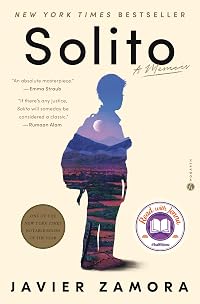
Solito: A Memoir
by Javier Zamora
On This Page
Description
"Trip. My parents started using that word about a year ago--'one day, you'll take a trip to be with us. Like an adventure.' Javier's adventure is a three-thousand-mile journey from his small town in El Salvador, through Guatemala and Mexico, and across the U.S. border. He will leave behind his beloved aunt and grandparents to reunite with a mother who left four years ago and a father he barely remembers. Traveling alone except for a group of strangers and a "coyote" hired to lead them to show more safety, Javier's trip is supposed to last two short weeks. At nine years old, all Javier can imagine is rushing into his parents' arms, snuggling in bed between them, and living under the same roof again. He cannot foresee the perilous boat trips, relentless desert treks, pointed guns, arrests and deceptions that await him; nor can he know that those two weeks will expand into two life-altering months alongside a group of strangers who will come to encircle him like an unexpected family. A memoir as gripping as it is moving, Solito not only provides an immediate and intimate account of a treacherous and near-impossible journey, but also the miraculous kindness and love delivered at the most unexpected moments. Solito is Javier's story, but it's also the story of millions of others who had no choice but to leave home." --From book jacket. show lessTags
Recommendations













Member Reviews
The memoir, Solito, written by Javier Zamora, affected me. I had to wait a couple of days before. sitting down to write this.because of the deep sadness I feel for the people who risk everything to come to the USA. Although I, fortunately, never had to undergo such an ordeal, having taught in a majority. hispanic area of Southern California, I knew many people who did take a similar journey and live through similar ordeals.
Zamora speaks as his 9m year old self in this book. I have read that the writing came after/during therapy which he undertook to discover and work through the trauma he underwent as a child who, alone with only strangers to help him, traveled for 7 weeks from El Salvador to Tucson, AZ.
Beginning in El Salvador, Zamora show more tells us of his life there. Living with his grandparents and Aunt Mali, after his mother and father immigrated to the USA, he talks of school, he was a very good student; of family, working with his grandmother at her pupusas stand, his Aunts and his cousin; he talks of the food and the trials and tribulations of being a little boy loving his family but hoping to soon be with his mother and father again.
His family trusted that he would be watched over by the local Coyote who had a very good reputation in the area where they lived. He had not only gotten Javier's mother across the border as well as many other people they knew. His grandfather also believed that one of the men on the trip, who was from their town, would watch over him. In fact, he gave that man money to care for him. As you can probably guess, both of these protectors proved not to be good choices. Thankfully, there were others who stepped up to care for him. Chino, one of the men from the beginning of the journey, Patricia and her daughter Carla. Along with Javier, they became The Four who journeyed together, protecting and encouraging one another. They were the Pretend Family.
As an adult, I can visualize the hardships over their 7 week journey, but reading tis book, I saw the journey through the hopeful eyes of a 9 year old. The days alone in the Sonoran Desert. The fear. The days in detention. The looking to the two adults to keep them alive and to help him get to his parents.
I do not see this book as overdramatic. In face, I see it as pragmatic. This is the story of a little boy telling his story. He speaks of the flavors of the food, the smell of the people, the sounds, the physical feelings of being on a boat, walking through the desert, sleeping on concrete and tiled floors. The exhaustion.
I encourage people to read this book. NOT to encourage such immigration, but to better understand the people who undertook the journey and the trauma they are undoubtably going through now that they are here. show less
Zamora speaks as his 9m year old self in this book. I have read that the writing came after/during therapy which he undertook to discover and work through the trauma he underwent as a child who, alone with only strangers to help him, traveled for 7 weeks from El Salvador to Tucson, AZ.
Beginning in El Salvador, Zamora show more tells us of his life there. Living with his grandparents and Aunt Mali, after his mother and father immigrated to the USA, he talks of school, he was a very good student; of family, working with his grandmother at her pupusas stand, his Aunts and his cousin; he talks of the food and the trials and tribulations of being a little boy loving his family but hoping to soon be with his mother and father again.
His family trusted that he would be watched over by the local Coyote who had a very good reputation in the area where they lived. He had not only gotten Javier's mother across the border as well as many other people they knew. His grandfather also believed that one of the men on the trip, who was from their town, would watch over him. In fact, he gave that man money to care for him. As you can probably guess, both of these protectors proved not to be good choices. Thankfully, there were others who stepped up to care for him. Chino, one of the men from the beginning of the journey, Patricia and her daughter Carla. Along with Javier, they became The Four who journeyed together, protecting and encouraging one another. They were the Pretend Family.
As an adult, I can visualize the hardships over their 7 week journey, but reading tis book, I saw the journey through the hopeful eyes of a 9 year old. The days alone in the Sonoran Desert. The fear. The days in detention. The looking to the two adults to keep them alive and to help him get to his parents.
I do not see this book as overdramatic. In face, I see it as pragmatic. This is the story of a little boy telling his story. He speaks of the flavors of the food, the smell of the people, the sounds, the physical feelings of being on a boat, walking through the desert, sleeping on concrete and tiled floors. The exhaustion.
I encourage people to read this book. NOT to encourage such immigration, but to better understand the people who undertook the journey and the trauma they are undoubtably going through now that they are here. show less
I just now finished reading Solito and can't stop crying.
It was such a powerful story, but it called to mind that each undocumented Salvadoran immigrant's story is much like this one with all of its suffering and pain in an effort to reach a better life with or for loved ones. This memoir was particularly brutal because it was told in excruciating detail by the author who was recalling his being smuggled into the United States "solito" (without anyone he knew) by coyotes when he was only nine years old.
To me, this is an important work because I don't think enough Americans are aware of how hard Salvadorans struggle for themselves and their families when they ultimately decide to make that ardous journey as an undocumented immigrant show more into the United States at any age.
I loved that the book was written with sprinklings of Salvadoran Spanish and culture throughout. As my husband's niece expressed to me today..."My heart soared every time there was a little nugget of Salvadoran culture or language. It was like our own little inside joke." I absolutely agree with her. show less
It was such a powerful story, but it called to mind that each undocumented Salvadoran immigrant's story is much like this one with all of its suffering and pain in an effort to reach a better life with or for loved ones. This memoir was particularly brutal because it was told in excruciating detail by the author who was recalling his being smuggled into the United States "solito" (without anyone he knew) by coyotes when he was only nine years old.
To me, this is an important work because I don't think enough Americans are aware of how hard Salvadorans struggle for themselves and their families when they ultimately decide to make that ardous journey as an undocumented immigrant show more into the United States at any age.
I loved that the book was written with sprinklings of Salvadoran Spanish and culture throughout. As my husband's niece expressed to me today..."My heart soared every time there was a little nugget of Salvadoran culture or language. It was like our own little inside joke." I absolutely agree with her. show less
Javier was nine when he left El Salvador with six strangers and a "coyote" who was supposed to convey them safely to the US. His parents had had to flee to the States during the Salvadorian war, and he had been living with his grandparents and aunt. The trip was supposed to take two weeks, but his family was not to hear from him for almost two months. The story of his journey is harrowing, touching, and a testament to both the horrific nature of migration to the US and the humanity to be found in the most unlikely places. I cannot recommend this book highly enough.
Note: The author uses a lot of Spanish in the book, not only to emphasize context, but also to show how difficult it is for people of different cultures and languages to show more understand one another. Javier and his group spent a lot of time trying to sound Mexican, for instance, and sometimes failing with disastrous results. Although I often understood the gist of the Spanish, I did find myself using a translation app fairly frequently. Not surprisingly, even that failed to convey the meaning of much of the slang. The frustration I felt was a gnat bite compared to the desperation migrants feel when trying to understand immigration officials. show less
Note: The author uses a lot of Spanish in the book, not only to emphasize context, but also to show how difficult it is for people of different cultures and languages to show more understand one another. Javier and his group spent a lot of time trying to sound Mexican, for instance, and sometimes failing with disastrous results. Although I often understood the gist of the Spanish, I did find myself using a translation app fairly frequently. Not surprisingly, even that failed to convey the meaning of much of the slang. The frustration I felt was a gnat bite compared to the desperation migrants feel when trying to understand immigration officials. show less
Fabulous. A real story, first rate writing. A true life, nail biting drama. Lives up to all the hype. A glimpse at an odyssey that few, if any, gringos like me ever even think about. Even my grandparents, who came from Italy 120 years ago, didn't have a story like this, simply because they were wanted in this country. At least for a while. Why do we do this, why can't we treat these people better, people so necessary to our economy and our professed soul, why do we treat them so poorly? We can do so much better.
he harrowing journey of a 9-year-old Salvadoran boy through Guatemala and Mexico to rejoin his parents in the U.S.
Being the child of migrants is not unusual in the small town of La Herradura, El Salvador, where Zamora’s relatives regularly disappeared with the local coyote, Don Dago, to try their luck gaining entry into the U.S. When Zamora was 5, his mother left to join his father, who had left when he was 1, in America. The author opens his engaging narrative in 1999: Don Dago has agreed that the boy is ready for the trip to join his family. At the time, Zamora was living with his grandparents and aunts and excelling in school. He was overjoyed at the prospect of reuniting with his parents yet unaware of the many dangers of the show more arduous trek. Zamora traveled within a small, tightknit group of migrants through Guatemala, Mexico, and the Sonoran Desert. The author, now a poet who has been both a Stegner and Radcliffe fellow, meticulously re-creates his tense, traumatic journey, creating a page-turning narrative that reads like fiction. Sprinkling Spanish words and phrases throughout, Zamora fashions fully fleshed portraits of his fellow travelers—e.g., a protective mother and her daughter and a variety of men who assumed leadership responsibilities—as they navigated buses and boats, packing into a single room in motels, passing through checkpoints (not always successfully), and walking for days in the desert with little food or water. Along the way, the migrants, most of them desperately trying to reach their families in the U.S., also had to learn Mexican words and change their accents in order to remain inconspicuous and avoid the dreaded La Migra, which “has helicopters. They have trucks. They have binoculars that can see in the dark. I want our own helicopter to fight against La Migra. To shoot those bad gringos making us scared.”
Beautifully wrought work that renders the migrant experience into a vivid, immediately accessible portrayal.
-Kirkus Review show less
Being the child of migrants is not unusual in the small town of La Herradura, El Salvador, where Zamora’s relatives regularly disappeared with the local coyote, Don Dago, to try their luck gaining entry into the U.S. When Zamora was 5, his mother left to join his father, who had left when he was 1, in America. The author opens his engaging narrative in 1999: Don Dago has agreed that the boy is ready for the trip to join his family. At the time, Zamora was living with his grandparents and aunts and excelling in school. He was overjoyed at the prospect of reuniting with his parents yet unaware of the many dangers of the show more arduous trek. Zamora traveled within a small, tightknit group of migrants through Guatemala, Mexico, and the Sonoran Desert. The author, now a poet who has been both a Stegner and Radcliffe fellow, meticulously re-creates his tense, traumatic journey, creating a page-turning narrative that reads like fiction. Sprinkling Spanish words and phrases throughout, Zamora fashions fully fleshed portraits of his fellow travelers—e.g., a protective mother and her daughter and a variety of men who assumed leadership responsibilities—as they navigated buses and boats, packing into a single room in motels, passing through checkpoints (not always successfully), and walking for days in the desert with little food or water. Along the way, the migrants, most of them desperately trying to reach their families in the U.S., also had to learn Mexican words and change their accents in order to remain inconspicuous and avoid the dreaded La Migra, which “has helicopters. They have trucks. They have binoculars that can see in the dark. I want our own helicopter to fight against La Migra. To shoot those bad gringos making us scared.”
Beautifully wrought work that renders the migrant experience into a vivid, immediately accessible portrayal.
-Kirkus Review show less
Javier Zamora lived his first nine years in El Salvador with his grandparents after his parents fled to the U.S. as a result of the Salvadorian civil war. He doesn't even remember his father, who left when he was one, and then four years later, his mother followed. They've told him for years that he will come to them, and after trying to legally immigrate and then bend the truth, eventually he is sent, alone, with a group of migrants and a coyote who promises to get them to the United States.
This is simply an incredible, moving, riveting and intense story. Javier's memories of what happened during the journey in 1999 had me on the edge of my seat from the moment his grandfather left and he was on his own, with each change in plans to show more the challenges of the journey, the fear and terror but also the kindness of strangers he met along the way. I was glad I read the e-book, as it made it a little easier to translate some of the Spanish, and though some of the colloquial words and phrases weren't to be found in the dictionary, I could generally follow the meaning anyway. Highly recommended. show less
This is simply an incredible, moving, riveting and intense story. Javier's memories of what happened during the journey in 1999 had me on the edge of my seat from the moment his grandfather left and he was on his own, with each change in plans to show more the challenges of the journey, the fear and terror but also the kindness of strangers he met along the way. I was glad I read the e-book, as it made it a little easier to translate some of the Spanish, and though some of the colloquial words and phrases weren't to be found in the dictionary, I could generally follow the meaning anyway. Highly recommended. show less
I've read maybe a half dozen of these nonfiction child migrant memoirs over the years. As each narrative is uniquely and individually eloquent, feel like it would be impossible to even try to compare them. So instead I'll focus on some of the things that stood out for me in this memoir of the journey of 9yr old Javier Zamora, entrusted to coyotes by his grandparents in El Salvador to complete the long, harrowing, illegal journey to the US, where his parents (a father who fled political violence, a mother who followed him in search of economic opportunity) eagerly await his arrival.
His companions on the journey: Patricia & Carla, a mother/daughter who pretty much adopt young Javier into their family group; Chino, a 22yr old acquaintance show more who joins the family group as a de facto father; and Marcelo, a hardened gangster attempting to re-enter the USA after being deported.
Together they brave a perilous ocean journey, checkpoints manned by crooked officers looking to extort money from desperate migras and their families, filthy flophouses with darkened windows, an overcrowded detention center, interminable bus rides, interminable waits, a constantly shifting cast of imperious coyotes, and heartbreaking setbacks, all culminating in a sleepless, horrific 2-day flight across the desert battling scorching heat, bitter cold, thirst, hunger, and the constant threat of discovery. To some extent these experiences are mediated by the unexpected generosity of folks Javier meets along the way: the informal family that adopts him, strangers who offer food, empathy, and encouragement. However, no amount of kindness can begin to obviate the horror of the 7 weeks that Javier spends in the company of strangers, lonely and deeply afraid.
One of Zamora's most remarkable achievements, I thought, was channeling the story through the perspective of his 9-yr-old self. I can only imagine how hard it must have been for him to resist the urge to infuse adult insights or moral/ethical perspectives! But there's power in experiencing these horrors through the naive awareness and untainted emotions of a child. As adult readers, we perceive so much more than Javier is perceiving at the time, but he, in turn, is perceiving so many things that we adults might otherwise miss: the wonders of the natural world (flying fish! lizards! so many different kinds of cactii!), the exhilaration of discovering new foods & cultures, the torment of pre-adolescent insecurity (longing to impress Carla, to be accepted by Marcelo), the confused and terrifying helplessness of being a child in an adult world.
Just one word of warning: fairly significant quantities of dialog are in Spanish - not even classroom Spanish, but regional dialect. Most of the time I was able to infer the content of these exchanges utilizing context clues, but there were a couple of scenes where I did need to turn to Google Translate to make sure I wasn't missing important information.
In summary: a powerful story, powerfully told by a gifted storyteller. show less
His companions on the journey: Patricia & Carla, a mother/daughter who pretty much adopt young Javier into their family group; Chino, a 22yr old acquaintance show more who joins the family group as a de facto father; and Marcelo, a hardened gangster attempting to re-enter the USA after being deported.
Together they brave a perilous ocean journey, checkpoints manned by crooked officers looking to extort money from desperate migras and their families, filthy flophouses with darkened windows, an overcrowded detention center, interminable bus rides, interminable waits, a constantly shifting cast of imperious coyotes, and heartbreaking setbacks, all culminating in a sleepless, horrific 2-day flight across the desert battling scorching heat, bitter cold, thirst, hunger, and the constant threat of discovery. To some extent these experiences are mediated by the unexpected generosity of folks Javier meets along the way: the informal family that adopts him, strangers who offer food, empathy, and encouragement. However, no amount of kindness can begin to obviate the horror of the 7 weeks that Javier spends in the company of strangers, lonely and deeply afraid.
One of Zamora's most remarkable achievements, I thought, was channeling the story through the perspective of his 9-yr-old self. I can only imagine how hard it must have been for him to resist the urge to infuse adult insights or moral/ethical perspectives! But there's power in experiencing these horrors through the naive awareness and untainted emotions of a child. As adult readers, we perceive so much more than Javier is perceiving at the time, but he, in turn, is perceiving so many things that we adults might otherwise miss: the wonders of the natural world (flying fish! lizards! so many different kinds of cactii!), the exhilaration of discovering new foods & cultures, the torment of pre-adolescent insecurity (longing to impress Carla, to be accepted by Marcelo), the confused and terrifying helplessness of being a child in an adult world.
Just one word of warning: fairly significant quantities of dialog are in Spanish - not even classroom Spanish, but regional dialect. Most of the time I was able to infer the content of these exchanges utilizing context clues, but there were a couple of scenes where I did need to turn to Google Translate to make sure I wasn't missing important information.
In summary: a powerful story, powerfully told by a gifted storyteller. show less
Members
- Recently Added By
Lists

Top Five Books of 2022
736 works; 272 members

Books That Made Me Cry
199 works; 105 members

Books Read in 2023
5,547 works; 145 members

Top Five Books of 2023
767 works; 317 members

Read with Jenna
91 works; 2 members

BLM
210 works; 1 member
Author Information

4+ Works 1,289 Members
Awards and Honors
Awards
Distinctions
Read with Jenna (2022-09 – 2022)
Common Knowledge
- Canonical title
- Solito: A Memoir
- Original publication date
- 2022
- People/Characters
- Javier Zamora; Patricia; Chino; Carla
- Important places
- La Herradura, El Salvador; Guatemala; Mexico
- Epigraph
- Our bodies are the texts that carry
the memories and therefore remembering
is no less than reincarnation.
-Katie Cannon
(quoted in The Body Keeps the Score)
Both boys and girls for example, made references to
the time lost and particularly to the uniqueness of a
mother's love. More than one also described the feeling
as if they had a hole in their heart due to their
-Leisy J. Abrego
Sacriricing Famiies - Dedication
- To Patricia, Carla, Chino
& all the immigrants I met
on my way to the U.S. & never saw again.
I wouldn't be here without you. - First words
- Trip, my parents started using that word about a year ago—"one day, you'll take a trip to be with us."
- Quotations
- My hands are drenched. I check my watch constantly. I stare at the short pollero’s thin gold chains around his neck. His shirt and pants aren’t as tight as the other pollero’s, who walked outside minutes ago. Then the r... (show all)ing against the door, tap, tap tap.
- Last words
- (Click to show. Warning: May contain spoilers.)Two shadows appear. At last.
- Blurbers
- Cisneros, Sandra; Cantu, Francisco; Eggers, Dave; Goldman, Francisco; Vargas, Jose Antonio; Alarcon, Daniel (show all 8); Alam, Rumaan; Forche, Carolyn
- Original language
- English
Classifications
Statistics
- Members
- 1,163
- Popularity
- 21,575
- Reviews
- 40
- Rating
- (4.40)
- Languages
- 6 — Catalan, Dutch, English, French, German, Spanish
- Media
- Paper, Audiobook, Ebook
- ISBNs
- 20
- ASINs
- 6