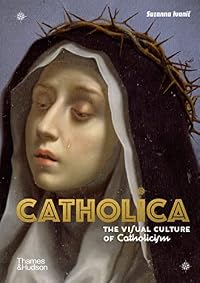
Catholica: The Visual Culture of Catholicism
by Suzanna Ivanic
On This Page
Description
Focusing on a carefully curated selection of Catholic art and artefacts, this book explains the meaning of the iconography and the mystic power of the faith's ritual objects. A wealth of often hidden symbols are identified and examined close up, building into a catalogue of key visual symbols for readers to use to interpret all Catholic visual and material culture. The book is organized into three parts - Tenet, Locus and Spiritus - each containing three themed chapters. The first part show more introduces the centrepieces of the faith, explaining the symbolism in the artistic representation of the holy family, apostles and saints, and in stories from scripture. The second part examines places of worship, identifying the constituent parts of the cathedral and presenting evocative images of roadside shrines. The third part explores celebrations and traditions, including personal devotional tools and jewelry. For each of the nine themed chapters, illustrated introductory text is followed by a spread-by-spread presentation of the key figures, the key stories and the key iconography relevant to each theme. Paintings and artefacts are examined in detail, identifying and explaining the symbolism and the stories depicted in each. As the book progresses, readers will build up knowledge of the entire Catholic visual code - the symbols that define Catholic practice, the attributes of the saints, the parts of the cathedral - allowing them to interpret Catholic imagery and objects wherever they find them and to understand the tenets, sites and rituals of the faith. show lessTags
Recommendations



Member Reviews
Thames & Hudson have produced a superb and readable guide to Catholic culture in all its distinctiveness, emphasising a little perhaps the Catholicism Triumphant of the Hispanic World over the Catholicism of the Martyred and the Militant.
It is encyclopedic. It will be merely an aide memoire with superb illustrations for most people raised in a Catholic environment - nostalgic perhaps for lapsed or 'recovering' or atheistic Catholics - but it should give a rounded and sympathetic account of the culture to anyone outside it.
What the author Suzanna Ivanic, a Czech-origin academic scholar of religiosity, gives us is a sense of the totalitarian nature of High Catholicism and how it employed the arts as a full-bodied sensorium embracing show more every aspect of life both now and in the hereafter.
I can well envisage a similar book on the much shorter human experience of High Socialism or on the longer one of Buddhism - belief systems that extended from theory to controlling institutional structures and thence entering into both social and private life using image and the senses to do so.
One can see why the Protestant North feared Catholicism much as America feared Communism. Wherever it took hold 'triumphant', it demanded a totality of engagement that extended not only from the cradle to the grave but from the city and guild down to the innermost thought.
And it was often a beautiful system both in theory and in practice even if it became gaudy and tacky at the level of the 'volk'. Some of the greatest works of humanity were produced in the service of this totality. The book gives us a context for such art and the art itself .
Ivanic does not try to do too much (Catholics themselves may well find things they did not know but not too many such things). The text is far from academic. A lot of the work is, like the subject of the book, about showing rather than telling and this proves refreshing.
She themes her tale from the text (the belief system's intellectual core) through its heroes who explicate the text through to the clerical structures that hold everything together as a total working system.
She then looks at the role of the cathedral as show place for faith, at devotion in the home, pilgrimage and carnival, the communal aspects of Catholicism, Catholic spirituality in the individual and, finally, that sensorium of experience that so upsets the Protestant mind set.
Images range from third century wall paintings to a twenty-first Valentino dress via artists from Bosch and Breugel through Caravaggio and Velasquez and Zurbaran through to those minor artists who still maintain the iconography in the age of scepticism and the modern.
'Great works' and exemplars are effectively used to explain key Catholic concepts and experiences ranging from The Last Judgement, the Saints and Cathedral Facades through to Calvary, the Sacraments and Prayer. The whole becomes a full education into an alien, recalled or felt culture. show less
It is encyclopedic. It will be merely an aide memoire with superb illustrations for most people raised in a Catholic environment - nostalgic perhaps for lapsed or 'recovering' or atheistic Catholics - but it should give a rounded and sympathetic account of the culture to anyone outside it.
What the author Suzanna Ivanic, a Czech-origin academic scholar of religiosity, gives us is a sense of the totalitarian nature of High Catholicism and how it employed the arts as a full-bodied sensorium embracing show more every aspect of life both now and in the hereafter.
I can well envisage a similar book on the much shorter human experience of High Socialism or on the longer one of Buddhism - belief systems that extended from theory to controlling institutional structures and thence entering into both social and private life using image and the senses to do so.
One can see why the Protestant North feared Catholicism much as America feared Communism. Wherever it took hold 'triumphant', it demanded a totality of engagement that extended not only from the cradle to the grave but from the city and guild down to the innermost thought.
And it was often a beautiful system both in theory and in practice even if it became gaudy and tacky at the level of the 'volk'. Some of the greatest works of humanity were produced in the service of this totality. The book gives us a context for such art and the art itself .
Ivanic does not try to do too much (Catholics themselves may well find things they did not know but not too many such things). The text is far from academic. A lot of the work is, like the subject of the book, about showing rather than telling and this proves refreshing.
She themes her tale from the text (the belief system's intellectual core) through its heroes who explicate the text through to the clerical structures that hold everything together as a total working system.
She then looks at the role of the cathedral as show place for faith, at devotion in the home, pilgrimage and carnival, the communal aspects of Catholicism, Catholic spirituality in the individual and, finally, that sensorium of experience that so upsets the Protestant mind set.
Images range from third century wall paintings to a twenty-first Valentino dress via artists from Bosch and Breugel through Caravaggio and Velasquez and Zurbaran through to those minor artists who still maintain the iconography in the age of scepticism and the modern.
'Great works' and exemplars are effectively used to explain key Catholic concepts and experiences ranging from The Last Judgement, the Saints and Cathedral Facades through to Calvary, the Sacraments and Prayer. The whole becomes a full education into an alien, recalled or felt culture. show less
A beautifully illustrated exploration of Catholic art, symbols, and material culture that helps readers interpret religious imagery; more cultural and visual than doctrinal or devotional.
Members
- Recently Added By
Lists

For Commonweal
25 works; 1 member
Author Information
3 Works 59 Members
Classifications
Statistics
- Members
- 57
- Popularity
- 535,313
- Reviews
- 2
- Rating
- (5.00)
- Languages
- English
- Media
- Paper
- ISBNs
- 1