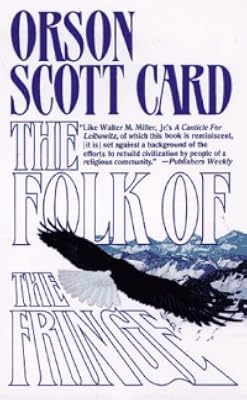
The Folk of the Fringe
by Orson Scott Card
On This Page
Description
Only a few nuclear bombs fell on North America, but that was enough to create nearly total destruction. But in the midst of the chaos a few civilized places remained. The strongest of these was the state of Deseret, in the Great Basin, where the climate had changed and the prehistoric lake refilled. There, on the fringe, valiant pioneers are making the desert blossom like a rose.Tags
Recommendations
















Member Reviews
The Folk of the Fringe is a collection of five shorter works mostly set in post-apocalyptic America and detailing the travails of Mormons struggling to survive in the face of some religious bigotry and the harsh new landscape. One thing that is interesting about the stories is that despite having suffered at the hands of intolerant non-Mormons, when they get into the majority, the Mormons in the stories are more than willing to engage in some religious bigotry of their own. Overall, four of the stories form a decent (although somewhat scary) narrative showing how a small religious group could survive the collapse of society, while the fifth seems to me to have been tacked on with little regard for continuity.
In the first story West, show more Mormon refugees from North Carolina head west to the promised land of Utah following the collapse of society after some sort of apocalyptic event. (It is never revealed exactly what the trigger for the collapse is, but it is hinted to be some sort of limited nuclear exchange triggered by a weak U.S. President confronted by a strong-handed Soviet dictator). This seems a little autobiographical, as Card had taken up residence in Greensboro, and makes the events the precipitate the story a little bit creepy. One wonders if Card imagines that his non-Mormon neighbors are just itching to round up the Mormon and slaughter them, although this kind of persecution paranoia seems to run through a lot of Mormon fiction. Granted, Mormons were persecuted . . . in the 19th century. I doubt anyone still cares nearly as much as Card imagines they do. Even so, this triggers the events of the story, without which there wouldn't be much in the way of a book, so it can be overlooked. Along the way, the Mormons, who demonstrate themselves to be pretty lousy at traveling in a post-apocalyptic world, meet up with a guide who helps them out, and inspired by their obvious goodness, duly converts and leads them west (hence the name of the story).
West leads more or less to Salvage, in which a minor character from the previous story becomes the central character. Even though he has been raised since early childhood in the Mormon promised land of Utah, Deaver Teague has somehow avoided becoming Mormon himself, which doesn't seem all that unusual until one begins to note just how oppressively religious the post-apocalyptic Mormon society has become - swearing has become a criminal offense, as has premarital sex and pretty much all of the other minor peccadilloes of modern society that Card usually rants about. Poor and with limited prospects (as a result of not being Mormon), Deaver cooks up a plan to make himself wealthy that, in the end, serves to demonstrate just how pious and wonderful the Mormons really are.
The Fringe is a story connected to the others in the book, but none of the characters from West, Salvage or Pageant Wagon appear in it. Card includes a central character with cerebral palsy, an affliction that is clearly of interest to Card due to his own son having it. In this story, the necessity and virtue of living under the thumb of the local Mormon clergy is explored, with the caveat that there need to be spies to make sure the clergy is honest in their heavy handed rule over the colonies on the fringe of farmable territory. The story includes some discussion about how the Mormon's have been systematically reclaiming arable land from the desert, which counts as science fiction, but the central thrust of the story is that a command economy run by pious Mormon leaders is necessary to make this system work.
Finally, Pageant Wagon sees the return of Deaver Teague, who runs into a traveling family of performers who make the rounds of the communities on the fringe providing more or less approved entertainment. While most of the stories about the Mormon enclave in post-apocalyptic America make Mormon rule seem quite heavy handed, and this story is no exception, Deaver finds the one more or less socially acceptable exception to this rule (although there are definite limits on what even the pageant wagon families are allowed to do). With respect to religion, this story seems almost thematically the opposite of West, as now that the Mormons are in charge, they are insufferable to non-Mormons. They don't treat outsiders as brutally as the non-Mormons in North Carolina treated Mormons, but when religious law and temporal law become one and the same, tyranny is not far behind, and it shows in the story.
The final story in the volume is America, which doesn't really fit the rest of the collection. It is supposedly the first chronologically, and draws heavily upon Mormon theology. In the story, a young Mormon boy sent to live in South America with the father he despises for being a lying, cheating, non pious sinner spends his time in the company with an older Native-American woman. He, of course, ends up sleeping with her, but its okay, because it is more or less divinely ordained that he should and that she will have a child who is marked for greatness. It doesn't fit the rest of the collection because the explanation it gives for the fall of the Westernized nations in the Americas is at odds with the story that is given in those stories. This story really amounts to little more than Mormon wish-fulfillment, and as anything other than a view into the strange world of Mormon theology and prophecy, it isn't very good.
If one is interested in reading a Mormon fantasy, then this set of stories would certainly fit the bill. I am unsure whether Card was parodying his own faith to a certain extent, or if he truly thinks that marrying religious and civil law together in a kind of religious police state is a good idea. If his intent was the first, then he didn't make himself clear. If it was the second, then this story is even scarier than I had originally thought. Either way, it is worth reading if for nothing else than to get a look into how a Mormon thinks Mormons would behave if left unfettered by silly impediments like secular law.
This has been posted to my blog Dreaming About Other Worlds. show less
In the first story West, show more Mormon refugees from North Carolina head west to the promised land of Utah following the collapse of society after some sort of apocalyptic event. (It is never revealed exactly what the trigger for the collapse is, but it is hinted to be some sort of limited nuclear exchange triggered by a weak U.S. President confronted by a strong-handed Soviet dictator). This seems a little autobiographical, as Card had taken up residence in Greensboro, and makes the events the precipitate the story a little bit creepy. One wonders if Card imagines that his non-Mormon neighbors are just itching to round up the Mormon and slaughter them, although this kind of persecution paranoia seems to run through a lot of Mormon fiction. Granted, Mormons were persecuted . . . in the 19th century. I doubt anyone still cares nearly as much as Card imagines they do. Even so, this triggers the events of the story, without which there wouldn't be much in the way of a book, so it can be overlooked. Along the way, the Mormons, who demonstrate themselves to be pretty lousy at traveling in a post-apocalyptic world, meet up with a guide who helps them out, and inspired by their obvious goodness, duly converts and leads them west (hence the name of the story).
West leads more or less to Salvage, in which a minor character from the previous story becomes the central character. Even though he has been raised since early childhood in the Mormon promised land of Utah, Deaver Teague has somehow avoided becoming Mormon himself, which doesn't seem all that unusual until one begins to note just how oppressively religious the post-apocalyptic Mormon society has become - swearing has become a criminal offense, as has premarital sex and pretty much all of the other minor peccadilloes of modern society that Card usually rants about. Poor and with limited prospects (as a result of not being Mormon), Deaver cooks up a plan to make himself wealthy that, in the end, serves to demonstrate just how pious and wonderful the Mormons really are.
The Fringe is a story connected to the others in the book, but none of the characters from West, Salvage or Pageant Wagon appear in it. Card includes a central character with cerebral palsy, an affliction that is clearly of interest to Card due to his own son having it. In this story, the necessity and virtue of living under the thumb of the local Mormon clergy is explored, with the caveat that there need to be spies to make sure the clergy is honest in their heavy handed rule over the colonies on the fringe of farmable territory. The story includes some discussion about how the Mormon's have been systematically reclaiming arable land from the desert, which counts as science fiction, but the central thrust of the story is that a command economy run by pious Mormon leaders is necessary to make this system work.
Finally, Pageant Wagon sees the return of Deaver Teague, who runs into a traveling family of performers who make the rounds of the communities on the fringe providing more or less approved entertainment. While most of the stories about the Mormon enclave in post-apocalyptic America make Mormon rule seem quite heavy handed, and this story is no exception, Deaver finds the one more or less socially acceptable exception to this rule (although there are definite limits on what even the pageant wagon families are allowed to do). With respect to religion, this story seems almost thematically the opposite of West, as now that the Mormons are in charge, they are insufferable to non-Mormons. They don't treat outsiders as brutally as the non-Mormons in North Carolina treated Mormons, but when religious law and temporal law become one and the same, tyranny is not far behind, and it shows in the story.
The final story in the volume is America, which doesn't really fit the rest of the collection. It is supposedly the first chronologically, and draws heavily upon Mormon theology. In the story, a young Mormon boy sent to live in South America with the father he despises for being a lying, cheating, non pious sinner spends his time in the company with an older Native-American woman. He, of course, ends up sleeping with her, but its okay, because it is more or less divinely ordained that he should and that she will have a child who is marked for greatness. It doesn't fit the rest of the collection because the explanation it gives for the fall of the Westernized nations in the Americas is at odds with the story that is given in those stories. This story really amounts to little more than Mormon wish-fulfillment, and as anything other than a view into the strange world of Mormon theology and prophecy, it isn't very good.
If one is interested in reading a Mormon fantasy, then this set of stories would certainly fit the bill. I am unsure whether Card was parodying his own faith to a certain extent, or if he truly thinks that marrying religious and civil law together in a kind of religious police state is a good idea. If his intent was the first, then he didn't make himself clear. If it was the second, then this story is even scarier than I had originally thought. Either way, it is worth reading if for nothing else than to get a look into how a Mormon thinks Mormons would behave if left unfettered by silly impediments like secular law.
This has been posted to my blog Dreaming About Other Worlds. show less
Five stars amy be a bit of overkill, but these linked stories are so imaginative that I felt the need to go overboard. I read this book just a few weeks after Cormac McCarthy's The Road. While the two cover a similar post-apocalyptic theme, the way they approach it could not be more different. It was amazing to me the role Card places on faith in preserving human culture at the end of the world. The stories are beautifully written and manage to hold on to hope.
I was very disappointed in this book, after having loved "Ender's Game" by the same author. This is a series of short stories about a post-apocalyptic society, but what really irritated me was the 'preachiness' of the stories, the promotion of Mormonism as the answer throughout the first two stories. I have put it down and do not plan on trying to read it again, for that reason.
It's too bad, what a wasted opportunity for this author.
It's too bad, what a wasted opportunity for this author.
A tale of post-apocalyptic America, that has some interesting characters and ideas and is well told through a set of short stories. Sometimes, it seemed, the stories did not connect very well. It's told in a Mormon context and pretty much tells the tale of "local" America--stressed. Although the apocalypse was nuclear, we saw no effects. All in all, a pretty darn average Mormon fantasy.
I didn't know this was a series of 4 short stories, loosely related, when I picked up this book. I also did not know about the Mormon theme that runs through the stories. The religious theme is not oppressive but always runs in the background. As post-apocalyptic books go it is average. I really liked the first story and thought I would settle in for a great read....but it ended in a hurry in my opinion, as though the author was bored with it and wanted to move on. The next story was ok but not being Mormon I think the significance of it was lost on me. What started as an adventure fizzled into something meaningless for me. The next story was mildly interesting about a traveling roadshow on the fringe. Very much a personal family story show more that really did not have to take place in a post-apocalyptic world. Lots of emotional struggle but it failed to grip me. The last story was one that was out in left field for me....could not finish it. Liked the first story and felt it could have been developed more....but the rest...a warm drink of water. show less
Very imaginative, but has a lot of "inside information" that non-LDS readers may miss.
Some crude language.
Some crude language.
As with all Card's books it is well written with good characters, but this just isn't among his best works.
Members
- Recently Added By
Lists

Novels that you shouldn't waste your time on
94 works; 52 members
Author Information

575+ Works 214,471 Members
Orson Scott Byron Walley Card, was born in 1951 and studied theater at Brigham Young University. He received his B.A. in 1975 and his M.A. in English in 1981. He wrote plays during that time, including Stone Tables (1973) and the musical, Father, Mother, Mother and Mom (1974). A Mormon, Scott served a two-year mission in Brazil before starting show more work as a journalist in Utah. He also designed games at Lucas Film Games, 1989-92. He is best known for his science fiction novels, including the popular Ender series. Well known titles include A Planet Called Treason (1979), Treasure Box (1996), and Heartfire (1998). He has also written the guide called How to Write Science Fiction and Fantasy (1990). His novel Ender's Game and its sequel Speaker for the Dead, both won Hugo and Nebula awards, making Card the only author to win both prizes in consecutive years. His titles Shadows in Flight, Ruins and Ender's Game made The New York Times Best Seller List. He is also the author of The First Formic War Series, which includes the titles Earth Unaware, Earth Afire, and Earth Awakens. (Bowker Author Biography) show less
Some Editions
Awards and Honors
Notable Lists
Series
Belongs to Publisher Series
Work Relationships
Common Knowledge
- Canonical title
- The Folk of the Fringe
- Original title
- The Folk of the Fringe
- Original publication date
- 1989; 1987c short story (West) (West); 1986c short story (Salvage) (Salvage); 1985 short story (The Fringe) (The Fringe); 1989 short story (Pageant Wagon) (Pageant Wagon); 1987 short story (America) (America) (show all 7); 1985 Afterword (On Sycamore Hill) (On Sycamore Hill)
- People/Characters
- Jamie Teague
- Dedication
- To Robert Stoddard: for music together, for journeys apart, always searching for the narrow road.
- First words
- It was a good scavenging trip eastward to the coast that summer, and Jamie Teague had a pack full of stuff before he even got to Marine City.
- Last words
- (Click to show. Warning: May contain spoilers.)This is what America wanted, what it bent our lives to accomplish. Even if we took twisted roads and got lost or injured on the way, even if we came limping to this place, it is a good place, it is worth the journey, it is promised, the promising land.
from 'America' - Original language*
- English
- Disambiguation notice
- Contents: 1. West -- 2. Salvage -- 3. The Fringe -- 4. Pageant Wagon -- 5. America -- Author's Note: On Sycamore Hill -- Afterword / Michael Collings
*Some information comes from Common Knowledge in other languages. Click "Edit" for more information.
Classifications
Statistics
- Members
- 1,389
- Popularity
- 17,126
- Reviews
- 23
- Rating
- (3.23)
- Languages
- English, Spanish
- Media
- Paper, Audiobook, Ebook
- ISBNs
- 13
- ASINs
- 16