On This Page
Description
Three works deal with a concentration camp survivor, a hostage holder in Palestine, and a recovering accident victim.Tags
Recommendations





















Member Recommendations
Member Reviews
The first book made me cry; the second book made me think; the third book had me soul-searching. Each is so different yet communicates a range of emotions, thoughts and insights that are incredibly different. (I thought) I was prepared for Night - but was caught unawares at the depth of the human pain; I was drawn into the inner turmoil of Dawn and the deep religious and moral implications; The Accident was less compelling to me at first, but the final - so unexpected to me - scene helped completely reframe the story.
These are truly classics. Wiesel is a talented writer, but this is definitely his most raw and intense work.
These are truly classics. Wiesel is a talented writer, but this is definitely his most raw and intense work.
A moving exploration, through memoir and fiction, of some of the most significant questions human beings can face. What is the meaning of life? Of love? Of death? Is there a God who allows lives of such pain and suffering? I was particularly moved by the first part of the trilogy, Night, as it conveyed the tragic nature of friendship, loyalty and loss in the camps. Dawn tells the story of Elisha, a Holocaust survivor. After the war, Elisha moves to the British Mandate of Palestine and joins the Irgun determined to oust the British from the area. One night, he is told he must execute a British officer at dawn. The novel covers his struggle with his inner demons. The final novel, The Accident, is the fictional story of a Holocaust show more survivor who is struck by a taxicab in New York City. While recovering from his injuries, the character reflects on his relationships and experiences during the Second World War, coming to terms with his survival and the deaths of his family and friends.Simply but very movingly told, Wiesel raises difficult issues for in these novels and engages the reader in a conversation that will last the rest of his life. show less
Night was an excellent memoir. It read well, clear and honest, if a little bit dramatized. I will read it again and would recommend it to anyone interested in holocaust literature.
Dawn and Day were a little underwhelming. Just did not have the same feel and power of night. Would not purchase or read them again.
Dawn and Day were a little underwhelming. Just did not have the same feel and power of night. Would not purchase or read them again.
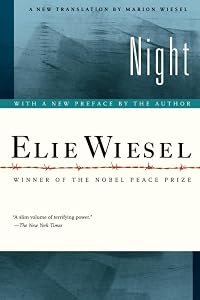
I finished Elie Wiesel’s Night.
Dark is a poignant memoir of the personal trials and tribulations of Elie Wiesel, his family and other Jews of Hungary in late World War II.
It is a personal journey and at the same time a shared experience of many others who suffered at the hands of the Nazi’s.
Wiesel describes the period when the Jews of Hungary are placed into ghettos and later the trips through many different concentration camps where his sister and mother are separated from him and his father.
It describes the journey where both his faith in god and empathy towards others including his father ebbs as each day is a struggle to survive and keep his self from being selected for death.
A dark book that we need to read so that we are show more reminded of our inner strength and never forget the evil of the Nazi’s.
There are 5 star books and then there is this, which is important for us all to read. Never forget. show less
Dark is a poignant memoir of the personal trials and tribulations of Elie Wiesel, his family and other Jews of Hungary in late World War II.
It is a personal journey and at the same time a shared experience of many others who suffered at the hands of the Nazi’s.
Wiesel describes the period when the Jews of Hungary are placed into ghettos and later the trips through many different concentration camps where his sister and mother are separated from him and his father.
It describes the journey where both his faith in god and empathy towards others including his father ebbs as each day is a struggle to survive and keep his self from being selected for death.
A dark book that we need to read so that we are show more reminded of our inner strength and never forget the evil of the Nazi’s.
There are 5 star books and then there is this, which is important for us all to read. Never forget. show less
Heartbreaking but true, Night is a book that touches your very soul. The author is right when he explains that mere words do not carry enough weight to describe the events which occurred during WWII. Words take on new meaning when heard in this story. It is truly a time that we should never forget--for so many reasons!
Just finished Dawn. Not as good as Night but I loved the idea behind the book. An interesting look into the question of what does it take to turn a victim into a killer? At what point does being committed to a religious cause become terrorism? When do the good guys turn into bad guys?
I found that I totally agree with the fact that a killer with a heart/conscience would not want his victim to become real to him...killing show more would only be doable if the victim had no personality, no face, no words....
Dawn was a lot slower and more repetitive than Night. I liked Night better--it captured and held my attention. Hoping that Day will be better than Dawn.
Day--I am struck by the fact that the protagonist is indifferent to whether he is alive or dead, but is brought to tears with emotion when he discovers that he still has a voice. Is that not a powerful statement about a person who has lived through the Holocaust? They got to the point where death no longer scared them, but what they really longed for was a voice/an identity. Man longs to be HEARD. show less
Just finished Dawn. Not as good as Night but I loved the idea behind the book. An interesting look into the question of what does it take to turn a victim into a killer? At what point does being committed to a religious cause become terrorism? When do the good guys turn into bad guys?
I found that I totally agree with the fact that a killer with a heart/conscience would not want his victim to become real to him...killing show more would only be doable if the victim had no personality, no face, no words....
Dawn was a lot slower and more repetitive than Night. I liked Night better--it captured and held my attention. Hoping that Day will be better than Dawn.
Day--I am struck by the fact that the protagonist is indifferent to whether he is alive or dead, but is brought to tears with emotion when he discovers that he still has a voice. Is that not a powerful statement about a person who has lived through the Holocaust? They got to the point where death no longer scared them, but what they really longed for was a voice/an identity. Man longs to be HEARD. show less
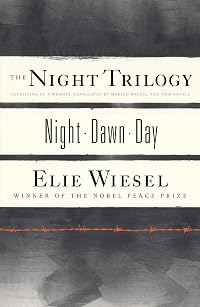
The Night Trilogy by Elie Wiesel. Epiphany-OviedoELCA library section 7 B: The Church in the World, Politics/War/Peace. This book encompasses three works by Holocaust survivor Wiesel: Night, first published in 1960, his memoir of life in three concentration camps; Dawn, a fictional work about a young Holocaust survivor who is recruited as a terrorist against the British occupation of Palestine before the creation of the nation of Israel; and The Accident, a novella that asks the question whether Holocaust survivors can forge a new life without the memories of the old.
In Night, Wiesel says, it is the “I” that speaks. In the other two narratives, it is the “I” who listens and questions. I found Night to be frightening, but very show more necessary to read. Only by reading memoirs of Holocaust survivors can we identify similar persecution in today’s world and call it by its real name without euphemism, without turning away. This is why film director Steven Spielberg began recording and documenting the memories of concentration camp survivors. Such memories are extremely painful. For example, my brother-in-law’s mother was a Holocaust survivor. At the end of her life, in need of pain medication, she could not take some of them because they caused her to hallucinate that she was back in the concentration camp. How difficult to carry such a psychic burden throughout one’s life!
Perhaps by writing this memoir, Wiesel was able to put some of his painful memories to rest. Or perhaps, though painful to relate, it was a way to help new generations grapple with the horrors and inhumanity of those events. Or perhaps writing it was a way to honor his immediate family and the millions whose lives and possessions were stolen.
In Dawn, the survivor becomes executioner; his job is to execute a British citizen as revenge for the hanging of a Jewish freedom fighter. Can a survivor, in turn, become executioner?
Of course, in each of these narratives, the author is dealing with deep questions: how could God allow the Holocaust to happen? Where was God then? Why were the survivors chosen to live? How does one deal with survivor guilt? Would it have been better to die? How can one live the rest of one’s life having seen the horrors of the camps? What are the limits of the spirit? What are the limits of the self? If you wish to grapple with such questions and find some answers, give this volume a read. If nothing else, read Night, the first in the trilogy, a masterpiece of Holocaust literature. show less
In Night, Wiesel says, it is the “I” that speaks. In the other two narratives, it is the “I” who listens and questions. I found Night to be frightening, but very show more necessary to read. Only by reading memoirs of Holocaust survivors can we identify similar persecution in today’s world and call it by its real name without euphemism, without turning away. This is why film director Steven Spielberg began recording and documenting the memories of concentration camp survivors. Such memories are extremely painful. For example, my brother-in-law’s mother was a Holocaust survivor. At the end of her life, in need of pain medication, she could not take some of them because they caused her to hallucinate that she was back in the concentration camp. How difficult to carry such a psychic burden throughout one’s life!
Perhaps by writing this memoir, Wiesel was able to put some of his painful memories to rest. Or perhaps, though painful to relate, it was a way to help new generations grapple with the horrors and inhumanity of those events. Or perhaps writing it was a way to honor his immediate family and the millions whose lives and possessions were stolen.
In Dawn, the survivor becomes executioner; his job is to execute a British citizen as revenge for the hanging of a Jewish freedom fighter. Can a survivor, in turn, become executioner?
Of course, in each of these narratives, the author is dealing with deep questions: how could God allow the Holocaust to happen? Where was God then? Why were the survivors chosen to live? How does one deal with survivor guilt? Would it have been better to die? How can one live the rest of one’s life having seen the horrors of the camps? What are the limits of the spirit? What are the limits of the self? If you wish to grapple with such questions and find some answers, give this volume a read. If nothing else, read Night, the first in the trilogy, a masterpiece of Holocaust literature. show less
I first read Elie Wiesel's "Night" in high school and planned to give it a reread after he passed away. I was surprised to learn there was a trilogy so I picked up this book, which has fictional works "Dawn" and "Day" too. While the latter two are certainly heavy with the absolute turmoil that surviving the Holocaust caused, I didn't love the pairing of both fiction and nonfiction in one big work.
"Night," of course," tells the story of some of Wiesel's acutal experiences in Auschwitz and Buchenwald. It was probably the first book about the Holocaust I ever read -- and even upon rereading, it's heart-wrenching, painful and moving to hear about the horrors from those who lived them.
"Dawn" takes a look at what might have happened had a show more survivor who had Wiesel's Holocaust experiences, moved to Palestine and become involved in the push to get Great Britain out of the country. What does it take to turn someone who was victimized into a killer himself? What role does God play the life of someone who witnessed what Wiesel witnessed? It's an interesting meditation, though I felt it wasn't as strong as the other stories.
"Day" was another fictional piece, (though it had an autobiographical vibe to it,) in which a Holocaust survivor struggles with an indifference toward the concept of death and a survivors' tactic of keeping his thoughts and feelings closed off as a sort of protective measure. While this short novel started off a little slowly, it gained momentum as it unfolded and I found it made me rather thoughtful about its themes. show less
"Night," of course," tells the story of some of Wiesel's acutal experiences in Auschwitz and Buchenwald. It was probably the first book about the Holocaust I ever read -- and even upon rereading, it's heart-wrenching, painful and moving to hear about the horrors from those who lived them.
"Dawn" takes a look at what might have happened had a show more survivor who had Wiesel's Holocaust experiences, moved to Palestine and become involved in the push to get Great Britain out of the country. What does it take to turn someone who was victimized into a killer himself? What role does God play the life of someone who witnessed what Wiesel witnessed? It's an interesting meditation, though I felt it wasn't as strong as the other stories.
"Day" was another fictional piece, (though it had an autobiographical vibe to it,) in which a Holocaust survivor struggles with an indifference toward the concept of death and a survivors' tactic of keeping his thoughts and feelings closed off as a sort of protective measure. While this short novel started off a little slowly, it gained momentum as it unfolded and I found it made me rather thoughtful about its themes. show less
Members
- Recently Added By
Lists

Top-Rated Books on LibraryThing
272 works; 117 members
My list of 100 books to read next
100 works; 4 members

Books available on Open Library
171 works; 4 members
Author Information

Eliezer "Elie" Wiesel was born in Sighet, Romania on September 30, 1928. In 1944, he and his family were deported along with other Jews to the Nazi death camp Auschwitz. His mother and his younger sister died there. He loaded stones onto railway cars in a labor camp called Buna before being sent to Buchenwald, where his father died. He was show more liberated by the United States Third Army on April 11, 1945. After the war ended, he learned that his two older sisters had also survived. He was placed on a train of 400 orphans that was headed to France, where he was assigned to a home in Normandy under the care of a Jewish organization. He was educated at the Sorbonne and supported himself as a tutor, a Hebrew teacher and a translator. He started writing for the French newspaper L'Arche. In 1948, L'Arche sent him to Israel to report on that newly founded state. He also became the Paris correspondent for the daily Yediot Ahronot. In this capacity, he interviewed the novelist Francois Mauriac, who urged him to write about his war experiences. The result was La Nuit (Night). After the publication of Night, Wiesel became a writer, literary critic, and journalist. His other books include Dawn, The Accident, The Gates of the Forest, The Jews of Silence: A Personal Report on Soviet Jewry, and Twilight. He received a numerous awards and honors for his literary work including the William and Janice Epstein Fiction Award in 1965, the Jewish Heritage Award in 1966, the Prix Medicis in 1969, and the Prix Livre-International in 1980. He received the Nobel Peace Prize in 1986 for his work in combating human cruelty and in advocating justice. He had a leading role in the creation of the United States Holocaust Memorial Museum in Washington, D. C. He died on July 2, 2016 at the age of 87. (Bowker Author Biography) show less
Some Editions
Series

Work Relationships
Contains
Common Knowledge
- Canonical title
- The Night Trilogy: Night, Dawn, and Day
- Original publication date
- 1972, 1985, 2008 (Omnibus) (Omnibus); 1958, 2006 Night; 1960, 1961, 2006 Dawn; 1961, 1962, 1990, 2006 Day
- People/Characters
- Elie Wiesel
- Important places
- Auschwitz-Birkenau concentration and extermination camps, Oświęcim, Lesser Poland, Poland
- Important events
- World War II; Holocaust
- Epigraph
- [Day]
I was once more struck by the truth of the ancient saying: Man's heart is a ditch full of blood. The loved ones who have died throw themselves down on the bank of this ditch to drink the blood and so come to life a... (show all)gain; the dearer they are to you, the more of your blood they drink.
-- NIKOS KAZNTZAKIS, Zorba the Greek - Dedication
- In memory of
my parents and of my little sister, Tzipora (E.W.)
This new translation
in memory of
my grandparents Abba, Sarah, and Nachman,
who also vanished into that night (M.W.)
[Dawn] to Francois Mauriac
[Day] For Paul Braunstein - First words
- "They call him Moishe the Beadle, as if his entire life he had never had a surname."
[Preface to the New Translation: Night] If in my lifetime I was to write only one book, this would be the one.
[Forward by Francois Mauriac: Night] Foreign journalists frequently come to see me. I am wary of them, torn as I am between my desire to speak to them freely and the fear of putting weapons into the hands of interviewers wh... (show all)ose attitude toward France I do not know.
[Preface: Dawn] This novel, my first, may be surpising for its sudden relevance to our present times.
[D]awn] Somewhere a child began to cry.
[Preface: Day] "Day" is my second novel and third book.
[Day] The accident occurred on an evening in July, right in the heart of New York, as Kathleen and I were crossing the street to go to see the movie - Quotations
- If in my lifetime I was to write only one book, this would be the one.
- Last words
- (Click to show. Warning: May contain spoilers.)"He had forgotten to take along the ashes."
(Click to show. Warning: May contain spoilers.)[Preface to the New Translation: Night] He does not want his past to become their future.
(Click to show. Warning: May contain spoilers.)[Forward by Francois Mauriac: Night] But all I could do was embrace him and weep.
(Click to show. Warning: May contain spoilers.)[Night] The look in his eyes as he gazed at me has never left me.
(Click to show. Warning: May contain spoilers.)[Preface: Dawn] And yet, this tale about despair becomes a story against despair.
(Click to show. Warning: May contain spoilers.)[Dawn] The face was my own.
(Click to show. Warning: May contain spoilers.)[Preface: Day] The suicides of these children, like the murders of their parents, will never be forgiven
(Click to show. Warning: May contain spoilers.)[Day] He had forgotten to take along the ashes. - Blurbers
- Mauriac, Francois
- Disambiguation notice
- Omnibus edition, includes Night, Dawn, and Day (Consisting of a memoir, translated by Marion Wiesel, and two novels).
Classifications
- Genre
- Biography & Memoir
- DDC/MDS
- 940.5318092 — History & geography History of Europe History of Europe 1918- World War II, 1939-1945 Social, political, economic history; Holocaust Holocaust Standard subdivisions History, geographic treatment, biography Biography
- LCC
- PQ2683 .I32 .Z467 — Language and Literature French, Italian, Spanish and Portuguese literatures French literature Modern literature 1961-2000
- BISAC
Statistics
- Members
- 2,343
- Popularity
- 8,400
- Reviews
- 20
- Rating
- (4.40)
- Languages
- 11 — Catalan, Danish, English, German, Hebrew, Hungarian, Norwegian (Bokmål), Norwegian, Spanish, Swedish, Yiddish
- Media
- Paper, Audiobook, Ebook
- ISBNs
- 25
- ASINs
- 14