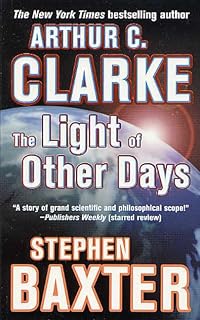
The Light of Other Days
by Arthur C. Clarke, Stephen Baxter
On This Page
Description
From Arthur C. Clarke, the brilliant mind that brought us 2001: A Space Odyssey, and Stephen Baxter, one of the most cogent SF writers of his generation, comes a novel of a day, not so far in the future, when the barriers of time and distance have suddenly turned to glass. When a brilliant, driven industrialist harnesses cutting-edge physics to enable people everywhere, at trivial cost, to see one another at all times-around every corner, through every wall-the result is the sudden and show more complete abolition of human privacy, forever. Then the same technology proves able to look backward in time as well. The Light of Other Days is a story that will change your view of what it is to be human. At the Publisher's request, this title is being sold without Digital Rights Management Software (DRM) applied. show lessTags
Recommendations






Member Recommendations
Member Reviews
A rather bizarre (and not all that important) plot built around the effect upon the world of the invention of 'wormcams' - tiny wormholes that allow viewing of the past (or present). Privacy ends, religions are thrown into turmoil, history merges with psychology, crimes long since forgotten are re-opened...I find this concept particularly fascinating, and it's stuck with me since I read the book some years ago. The idea of a completely open society, where privacy is simply impossible, is thought-provoking - would the first generation born into it actually care? Would I?
Not what I expected, at the end it veers off into something reminiscent of "Last and First Men" by Stapledon. Still, the remote viewing idea is gripping and explored from many angles (maybe dual authorship helps). And where other authors would be vague when writing about the unknowable past with such authority I'm glad these two didn't hold back - there's Jesus visiting the UK, princess Diana murdered by the shadowy organisation of misogynistic men who will not allow women to gain prominence, sentient knife wielding trilobites. It's as if the rest of the book had been just an excuse for these two to have some fun with these historical "discoveries". Well, I enjoyed it too.
My reactions to reading this novel in 2000. Spoilers follow
The title of this novel (and the dedication and the afterword) explicitly allude to Bob Shaw’s famous story of the same. It mentions it as the “best-known-and best” “time viewer” story. Oddly enough, given what I assume to be the authors’ combined knowledge of sf, there is no mention of the three sf stories which form a model for the premises and consequences of the first two-thirds of this novel: Damon Knight’s “I See You”, T.L. Sherred’s “E for Effort”, and Isaac Asimov’s “The Dead Past”. The novel postulates manipulating wormholes in order to create a “WormCam” which can view any contemporary event and, eventually, any event in the past in a show more radius at least extending to the galactic center. As in those stories great, catastrophic social upheaval results. Privacy, of course, almost vanishes. Viewing, reliving the past becomes a narcotic). Historical fact proves corrosive to ideologies and religions.
I found this book annoying and interesting for the first two thirds.
It was interesting because the premise was interesting. Clarke and Baxter introduce the notion and, while they don’t dwell on it long, they briefly show how a corrupt future US administration uses the WormCam for its own ends. They also introduce a thoroughly 90s' sf touch – the WormCam is linked to virtual rigs to relive history.
It was annoying for a variety of reasons. The authors insist on having all the significant events spring from the Patterson clan and its offshoots. Hiram Patterson, founder of the dynasty he is determined to make into the new Kennedys, puts together the team that first develops WormCams as an instanteous means of transmitting news without satellites. (He gets lots of particle physicists who were supposed to work with the cancelled Superconducting Super Collider.) Son David, a mathematician, develops the WormCam as a remote viewer. Son Bobby suggests the notion of using it as a time viewer. Bobby’s half-sister Mary seems an oh-so convenient genius who develops a miniature WormCam that makes the technology available to millions. (Bobby is technically a clone and genetically unrelated to Mary who has no Patterson genes.) The trouble with this is that this extended clan seems conveniently brainy and conveniently stupid. David and Mary extend WormCam abilities yet Hiram doesn’t see that a remote viewer will make him hated and cause massive social, cultural, and political upheaval – to him it’s just a gimmick to scoop his competitors in the news business. David, despite being a physicist, doesn’t see that the WormCam can be turned on the past until, in one of those clichéd eureka moments inspired by a naïve question, Bobby says something. Also, despite being an sf reader, David doesn’t see the upheaval inherent in time viewing.
I also thought Clarke and Baxter violated the hard sf tone I expected from them – and got – with the explanation of the theoretical underpinnings of the WormCam. I was willing to grant them software that could read lips – though human lipreaders don’t extract that much information. (Of course, Clarke used this notion in 2001: A Space Odyssey.) However, I thought the rest of the technological developments came too easily, too quickly to maintain complete suspension of disbelief. The WormCam suddenly took up a lot less energy so it could become miniaturized and widely available. While I was able to buy that you could hear through a WormCam, the absence of infrared transmission was not explained. The tracking of DNA through time has lots of problems of plausibility and technology. How is the DNA configuration determined and how much does it have to change before it is unrecognized? (According to the story’s events, the answer is never.) I also didn’t buy the air of global apathy and fatalism that clung to the world because of Wormwood’s massive impact 500 years in the future. That’s far enough in the future that I don’t think most people would give it much thought and many of those who did would think that long enough to develop some way of saving earth no matter how massive Wormwood is. (Where was the spirit of Clarke’s “Rescue Party” where humanity saves itself from the sun’s nova?)
Of course, taboos of sex and bodily functions fall, but, then, many human societies have existed without them or with greatly modified ones and they are not as vital to our modern world as secrecy is for politics, religions, morals, and business – few societies have existed with the transparency of this world. The authors are a bit too sanguine that, somehow, humans will adopt, that a new order will emerge. The very imperfect metaphor of how we adopt to, nay, seek out, crowded restaurants is evoked. Conversation is inhibited in such places because we can’t absolutely trust our neighbors to hold to the convention of no deliberate eavesdropping. They also can’t view everything that we did before we go to the restaurant.
Clarke and Baxter also don’t give us much real explanation for the Joined who are connected in an “internet of the mind” via wormholes in their heads. Metaphor as explanation is a valid sf technique, but, again, I expected better from Clarke and Baxter) The presence of this probably superior, transcendent, creepy (to the older generation, at least) new generation was reminiscent of Clarke’s Childhood’s End, and Teilhard de Chardin is mentioned in both novels.
Still, I liked this novel over all because, in its final third, it broke new ground. Clarke’s recent novels are often full of a grab bag of ideas; so was this one. There are personality-altering brain implants at birth. The highlight of the book was an exploration of life’s evolution on Earth including thermophiles, an early intelligent race which all traces have been erased of, very early ice ages in the Precambrian. I liked the Refugees, a band of people who disguise their identities so there movements can not be tracked in time. (As Mary notes, the WormCam can not see the future and governments still require many agents to arrest a Refugee even when unmasked since the agents can’t physically be everywhere.)
At it’s heart, this is another Faustian sf novel: do you really want absolute knowledge of the past and the present? show less
The title of this novel (and the dedication and the afterword) explicitly allude to Bob Shaw’s famous story of the same. It mentions it as the “best-known-and best” “time viewer” story. Oddly enough, given what I assume to be the authors’ combined knowledge of sf, there is no mention of the three sf stories which form a model for the premises and consequences of the first two-thirds of this novel: Damon Knight’s “I See You”, T.L. Sherred’s “E for Effort”, and Isaac Asimov’s “The Dead Past”. The novel postulates manipulating wormholes in order to create a “WormCam” which can view any contemporary event and, eventually, any event in the past in a show more radius at least extending to the galactic center. As in those stories great, catastrophic social upheaval results. Privacy, of course, almost vanishes. Viewing, reliving the past becomes a narcotic). Historical fact proves corrosive to ideologies and religions.
I found this book annoying and interesting for the first two thirds.
It was interesting because the premise was interesting. Clarke and Baxter introduce the notion and, while they don’t dwell on it long, they briefly show how a corrupt future US administration uses the WormCam for its own ends. They also introduce a thoroughly 90s' sf touch – the WormCam is linked to virtual rigs to relive history.
It was annoying for a variety of reasons. The authors insist on having all the significant events spring from the Patterson clan and its offshoots. Hiram Patterson, founder of the dynasty he is determined to make into the new Kennedys, puts together the team that first develops WormCams as an instanteous means of transmitting news without satellites. (He gets lots of particle physicists who were supposed to work with the cancelled Superconducting Super Collider.) Son David, a mathematician, develops the WormCam as a remote viewer. Son Bobby suggests the notion of using it as a time viewer. Bobby’s half-sister Mary seems an oh-so convenient genius who develops a miniature WormCam that makes the technology available to millions. (Bobby is technically a clone and genetically unrelated to Mary who has no Patterson genes.) The trouble with this is that this extended clan seems conveniently brainy and conveniently stupid. David and Mary extend WormCam abilities yet Hiram doesn’t see that a remote viewer will make him hated and cause massive social, cultural, and political upheaval – to him it’s just a gimmick to scoop his competitors in the news business. David, despite being a physicist, doesn’t see that the WormCam can be turned on the past until, in one of those clichéd eureka moments inspired by a naïve question, Bobby says something. Also, despite being an sf reader, David doesn’t see the upheaval inherent in time viewing.
I also thought Clarke and Baxter violated the hard sf tone I expected from them – and got – with the explanation of the theoretical underpinnings of the WormCam. I was willing to grant them software that could read lips – though human lipreaders don’t extract that much information. (Of course, Clarke used this notion in 2001: A Space Odyssey.) However, I thought the rest of the technological developments came too easily, too quickly to maintain complete suspension of disbelief. The WormCam suddenly took up a lot less energy so it could become miniaturized and widely available. While I was able to buy that you could hear through a WormCam, the absence of infrared transmission was not explained. The tracking of DNA through time has lots of problems of plausibility and technology. How is the DNA configuration determined and how much does it have to change before it is unrecognized? (According to the story’s events, the answer is never.) I also didn’t buy the air of global apathy and fatalism that clung to the world because of Wormwood’s massive impact 500 years in the future. That’s far enough in the future that I don’t think most people would give it much thought and many of those who did would think that long enough to develop some way of saving earth no matter how massive Wormwood is. (Where was the spirit of Clarke’s “Rescue Party” where humanity saves itself from the sun’s nova?)
Of course, taboos of sex and bodily functions fall, but, then, many human societies have existed without them or with greatly modified ones and they are not as vital to our modern world as secrecy is for politics, religions, morals, and business – few societies have existed with the transparency of this world. The authors are a bit too sanguine that, somehow, humans will adopt, that a new order will emerge. The very imperfect metaphor of how we adopt to, nay, seek out, crowded restaurants is evoked. Conversation is inhibited in such places because we can’t absolutely trust our neighbors to hold to the convention of no deliberate eavesdropping. They also can’t view everything that we did before we go to the restaurant.
Clarke and Baxter also don’t give us much real explanation for the Joined who are connected in an “internet of the mind” via wormholes in their heads. Metaphor as explanation is a valid sf technique, but, again, I expected better from Clarke and Baxter) The presence of this probably superior, transcendent, creepy (to the older generation, at least) new generation was reminiscent of Clarke’s Childhood’s End, and Teilhard de Chardin is mentioned in both novels.
Still, I liked this novel over all because, in its final third, it broke new ground. Clarke’s recent novels are often full of a grab bag of ideas; so was this one. There are personality-altering brain implants at birth. The highlight of the book was an exploration of life’s evolution on Earth including thermophiles, an early intelligent race which all traces have been erased of, very early ice ages in the Precambrian. I liked the Refugees, a band of people who disguise their identities so there movements can not be tracked in time. (As Mary notes, the WormCam can not see the future and governments still require many agents to arrest a Refugee even when unmasked since the agents can’t physically be everywhere.)
At it’s heart, this is another Faustian sf novel: do you really want absolute knowledge of the past and the present? show less
A good and thought-provoking story that explores what might happen if technology allowed us to see anywhere or any time.
I especially liked the extensive look at the disruption the WormCam technology caused in society, and it caused me to think about how different I would act if I knew that at any time I could be watched without my knowledge. The thought of something as basic as privacy being effectively eradicated represents a fairly frightening unknown, and is something I personally hope to not have to confront in my lifetime.
In terms of what I didn't like, the story took some unexpected (and IMO, unneeded) turns, and I was a bit disappointed by how some of the story threads were resolved.
Also, the end sequence in which the main show more characters reverse-view the history of the Earth went on a bit too long for my tastes, and it seemed that some of the sub-plots and other story elements came to naught in the end, but these didn't detract from the overall story too much.
Overall, I recommend this to SF fans who enjoy good thought-provoking stories. show less
I especially liked the extensive look at the disruption the WormCam technology caused in society, and it caused me to think about how different I would act if I knew that at any time I could be watched without my knowledge. The thought of something as basic as privacy being effectively eradicated represents a fairly frightening unknown, and is something I personally hope to not have to confront in my lifetime.
In terms of what I didn't like, the story took some unexpected (and IMO, unneeded) turns, and I was a bit disappointed by how some of the story threads were resolved.
Also, the end sequence in which the main show more characters reverse-view the history of the Earth went on a bit too long for my tastes, and it seemed that some of the sub-plots and other story elements came to naught in the end, but these didn't detract from the overall story too much.
Overall, I recommend this to SF fans who enjoy good thought-provoking stories. show less
The French-translation is pretty good and give a nice touch to the book. I'm pretty sure that the role of the translator often become an additional author of the book. On the story itself, the idea is clever. The rhythm is pretty good (beside being a large book) and the idea of the "quantum" viewer is really great. The only drawback is the soap-like story with the protagonists in the story. A really good work and an easy catch for sci-fi fans.
‘Luz de otros días’ es una obra de ciencia ficción especulativa escrita a cuatro manos por, a mi entender, dos grandes del género, ambos de origen británico. Uno es Arthur C. Clarke, del que a estas alturas poco se puede añadir, y el otro es Stephen Baxter, que de unos años a esta parte se ha abierto una hueco importante en el género, con obras ciertamente importantes como ‘Antihielo’, una ucronía espectacular, y ‘Las naves del tiempo’, la sorprendente continuación de ‘La máquina del tiempo’ de H.G. Wells.
Clarke y Baxter introducen un interesante elemento en esta novela, las GusanoCámaras (una idea del también escritor Bob Shaw, que introdujo la idea del cristal lento, la posibilidad de observar el pasado, en show more ‘Otros días, otros ojos’; de hecho la novela está dedicada a él). Provenientes de la física cuántica, estos dispositivos consisten en agujeros de gusano que pueden ser colocados en cualquier lugar, retransmitiendo cualquier acto al instante. Esto es una sucinta explicación, porque las GusanoCámaras dan para mucho. Las barreras de la intimidad no tardan en caer, y es que nadie está a salvo de ese implacable Ojo que todo lo ve. Pero la historia no tardará en complicarse cuando se consiga no sólo espiar en el espacio sino también en el tiempo, es decir, la posibilidad de poder observar el pasado. La Historia deja de estar a salvo y cualquier situación y personaje famoso, leyenda o mito, puede ser observado y juzgado como realmente fue. Y a esto habría que añadir la amenaza cierta de El Ajenjo, un asteroide que caerá dentro de unos cientos de años y que acabará con la humanidad, lo que supone que la gente actúe de manera indiscriminada, sabiendo que el futuro ha dejado de importar.
Entre los peonajes de la novela, habría que mencionar a Hiram Patterson, el magnate de las comunicaciones, manipulador y megalomaníaco, cuya empresa ha creado las GusanoCámaras. También está Bobby, el hijo de Hiram, destinado a heredar el imperio de su padre. Y David, el otro hijo de Hiram, físico de profesión cuyas ideas harán avanzar en está tecnología. Y por último, Kate, una periodista interesada en desmantelar los planes de Hiram.
En resumen, ‘Luz de otros días’ es una buena novela especulativa, cuya primera mitad me ha parecido la más interesante, ya que hacía el final creo que pierde un tanto el norte. show less
Clarke y Baxter introducen un interesante elemento en esta novela, las GusanoCámaras (una idea del también escritor Bob Shaw, que introdujo la idea del cristal lento, la posibilidad de observar el pasado, en show more ‘Otros días, otros ojos’; de hecho la novela está dedicada a él). Provenientes de la física cuántica, estos dispositivos consisten en agujeros de gusano que pueden ser colocados en cualquier lugar, retransmitiendo cualquier acto al instante. Esto es una sucinta explicación, porque las GusanoCámaras dan para mucho. Las barreras de la intimidad no tardan en caer, y es que nadie está a salvo de ese implacable Ojo que todo lo ve. Pero la historia no tardará en complicarse cuando se consiga no sólo espiar en el espacio sino también en el tiempo, es decir, la posibilidad de poder observar el pasado. La Historia deja de estar a salvo y cualquier situación y personaje famoso, leyenda o mito, puede ser observado y juzgado como realmente fue. Y a esto habría que añadir la amenaza cierta de El Ajenjo, un asteroide que caerá dentro de unos cientos de años y que acabará con la humanidad, lo que supone que la gente actúe de manera indiscriminada, sabiendo que el futuro ha dejado de importar.
Entre los peonajes de la novela, habría que mencionar a Hiram Patterson, el magnate de las comunicaciones, manipulador y megalomaníaco, cuya empresa ha creado las GusanoCámaras. También está Bobby, el hijo de Hiram, destinado a heredar el imperio de su padre. Y David, el otro hijo de Hiram, físico de profesión cuyas ideas harán avanzar en está tecnología. Y por último, Kate, una periodista interesada en desmantelar los planes de Hiram.
En resumen, ‘Luz de otros días’ es una buena novela especulativa, cuya primera mitad me ha parecido la más interesante, ya que hacía el final creo que pierde un tanto el norte. show less
Clarke's second last book. In the Afterword the authors mention that there's a long history of time-viewer stories. They mention a couple, including Bob Shaw's, from which they took their title. Oddly they do not mention Asimov's The Dead Past which is the most closely related thematically to the events and concerns of over half of this novel.
As would be expected from these authors, this is hard-core what-if SF. What are all the applications and ramifications of a technology that allows seeing (but not hearing) anything that is or has happened, no matter where or how far back. The book slows down frequently for pages of description about this, told outside the story arcs of the main characters. The pace of development of the show more technology, from a proof of concept requiring a roomful of a equipment to portable in-the-skull devices makes the evolution of computers appear positively glacial.
The book is a reasonable cap to themes Clarke explored in Childhood's End, and an interesting precursor to the Stapledonian themes Baxter would (over-)expand in the Manifold trilogy and the Long Earth pentalogy. ("Stapledonians" are introduced as a concept late in the book.)
Recommended if you like either author, a bit more so if you like both. show less
As would be expected from these authors, this is hard-core what-if SF. What are all the applications and ramifications of a technology that allows seeing (but not hearing) anything that is or has happened, no matter where or how far back. The book slows down frequently for pages of description about this, told outside the story arcs of the main characters. The pace of development of the show more technology, from a proof of concept requiring a roomful of a equipment to portable in-the-skull devices makes the evolution of computers appear positively glacial.
The book is a reasonable cap to themes Clarke explored in Childhood's End, and an interesting precursor to the Stapledonian themes Baxter would (over-)expand in the Manifold trilogy and the Long Earth pentalogy. ("Stapledonians" are introduced as a concept late in the book.)
Recommended if you like either author, a bit more so if you like both. show less
Members
- Recently Added By
Lists

Best Science Fiction Novels
816 works; 426 members
Favorite Science Fiction
452 works; 216 members
Author Information

862+ Works 130,028 Members
Arthur C. Clarke was born in Minehead, Somerset, England, on December 16, 1917. During World War II, he served as a radar specialist in the RAF. His first published piece of fiction was Rescue Party and appeared in Astounding Science, May 1946. He graduated from King's College in London with honors in physics and mathematics, and worked in show more scientific research before turning his attention to writing fiction. His first book, Prelude to Space, was published in 1951. He is best known for his book 2001: A Space Odyssey, which was later turned into a highly successful and controversial film under the direction of Stanley Kubrick. His other works include Childhood's End, Rendezvous with Rama, The Garden of Rama, The Snows of Olympus, 2010: A Space Odyssey II, 2062: Odyssey III, and 3001: The Final Odyssey. During his lifetime, he received at least three Hugo Awards and two Nebula Awards. He died of heart failure on March 19, 2008 at the age of 90. (Bowker Author Biography) show less

260+ Works 43,820 Members
Series
Belongs to Publisher Series
Sündmuste horisont (50)
Heyne Allgemeine Reihe (13257)
Common Knowledge
- Original title
- The Light of Other Days
- Original publication date
- 2000
- Epigraph
- Is it not possible--I often wonder--that things we have felt with great intensity have an experience independent of our minds; are in fact still in existenace? And if so, will it not be possible, in time, that some device wil... (show all)l be invented by which we can tap tehm? . . . Instead of remembering here a scene and there a sound, I shall fit a plug into the wall; and listen in to the past . . .
--Virginia Woolf (1882-1941)
We . . . know how cruel the truth often is, and we wonder whether delusion is not more consoling.
--Henri Poincare (1854-1912) - Dedication
- To Bob Shaw
- First words
- Bobby could see the Earth, complete and serene, within its cage of silver light.
--Prologue
Who was to blame? For three days Alveron's thoughts had come back to that question. A creature of a less civilized or a less sensitive race would never have let it tortue his mind.
A little after sawn, Vitaly Keldysh climbed stiffly into his care, engaged the SmartDrive, and let the car sweep him away from the run-down hotel. - Last words
- (Click to show. Warning: May contain spoilers.)Hand in hand they walked into the light.
(Click to show. Warning: May contain spoilers.)"Something tells me they'll be very determined people," he added. "We had better be polite to them. After all, wo only outnumber them about a thousand million to one."
Rogun laughed at his captain's little joke.
Twenty years afterward, the remark didn't seem funny. - Original language
- English
Classifications
Statistics
- Members
- 1,889
- Popularity
- 11,293
- Reviews
- 33
- Rating
- (3.70)
- Languages
- 10 — Czech, Dutch, English, Estonian, French, German, Hungarian, Italian, Polish, Spanish
- Media
- Paper, Audiobook, Ebook
- ISBNs
- 33
- ASINs
- 12