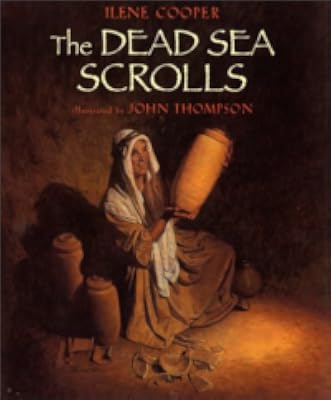
The Dead Sea Scrolls
by Ilene Cooper
On This Page
Description
Details the important archaeological discovery of the ancient manuscripts known as the Dead Sea Scrolls and discusses efforts to translate them, the battle over their possession, and the people who have figured in their history.Tags
Recommendations
















Member Reviews
This book is extremely informative about the discovery of the Dead Sea Scrolls. The author's note at the end also gives insight regarding why this book is considered fiction. Some of the dates and events are still debated and he explained how and why he used the ones given. This is an excellent book which should be in all school libraries.
The Dead Sea Scrolls by Ilene Cooper. Library section 10 A: Youth (grades 6-8), Religion. Here’s a real-life Indiana Jones adventure. Ten miles south of Jerusalem in 1947 by the shores of the Dead Sea, a shepherd boy found a cave that held several lidded pottery jugs. Inside the jugs were ancient scrolls. He had stumbled upon one of the greatest archeological finds of the 20th century: the Dead Sea Scrolls. More caves and more scrolls were discovered and found to be dated to the times before and after the life of Christ. The scrolls were made of papyrus (paper made from river rushes), leather, and even copper. Bedouins would scrape up papyrus fragments, some as tiny as your pinky fingernail, and bring them to the archeologists, simply show more dumping them out on a worktable in a jumble, to the dismay of archeologists. There were some 15,000 fragments representing over 500 different manuscripts!
The scrolls were bought and sold by different antiquities dealers, and even a bishop in the Syrian Orthodox Church. Eventually they were gathered together at Jerusalem’s Israel Museum. Archeologists had to fit these fragments together like a gigantic jigsaw puzzle. This took years and years to do. It was even difficult to unroll crumbling, brittle leather or copper. Machines had to be devised to do this. The advent of computers made it possible to arrange the fragments in the proper order, take digital photos of them, and then translate them.
Many of these scrolls are translations in Aramaic of the books of the Bible we know today. A special scroll is The Manual of Discipline, a set of rules and punishments for disobedience in the commune of the Essenes near Qumran, beside the Dead Sea. An Essene village was unearthed near the caves that has given us additional information about them. The Essene community was much like a male monastery of the era. Possessions, food and housing were shared communally by this group of Jewish men. It is thought that the scrolls were written by, and stored away for safekeeping, by the Essenes, but nobody can say for sure, or why they would have hidden the scrolls away.
These scrolls are important because they offer us information about the beginnings of Christianity. There were similarities between the teachings of Jesus and the Essenes: common property, a simple lifestyle, and shared sacred meals over bread and wine. But there were differences as well. Essenes were more rigid and excluded those who disagreed with their beliefs, while Jesus welcomed all people. The Essenes did not consider Jesus the Messiah; they thought there might be two Messiahs – a warrior savior and a second priestly and peaceful one.
The scrolls have been translated and are available to all of us to read. Many are copies of Biblical books with which we are familiar. Others are completely new and provide a window into earliest Christianity. This book is for middle school grade level, though adults will find it very informative as an overview of the scrolls discovery, how and who made them, and what they mean for us today. There are black and white illustrations, a map of the caves, and a glossary of terms including words like, “antiquities,” “carbon 14 dating,” and “B.C.E./C.E.” show less
The scrolls were bought and sold by different antiquities dealers, and even a bishop in the Syrian Orthodox Church. Eventually they were gathered together at Jerusalem’s Israel Museum. Archeologists had to fit these fragments together like a gigantic jigsaw puzzle. This took years and years to do. It was even difficult to unroll crumbling, brittle leather or copper. Machines had to be devised to do this. The advent of computers made it possible to arrange the fragments in the proper order, take digital photos of them, and then translate them.
Many of these scrolls are translations in Aramaic of the books of the Bible we know today. A special scroll is The Manual of Discipline, a set of rules and punishments for disobedience in the commune of the Essenes near Qumran, beside the Dead Sea. An Essene village was unearthed near the caves that has given us additional information about them. The Essene community was much like a male monastery of the era. Possessions, food and housing were shared communally by this group of Jewish men. It is thought that the scrolls were written by, and stored away for safekeeping, by the Essenes, but nobody can say for sure, or why they would have hidden the scrolls away.
These scrolls are important because they offer us information about the beginnings of Christianity. There were similarities between the teachings of Jesus and the Essenes: common property, a simple lifestyle, and shared sacred meals over bread and wine. But there were differences as well. Essenes were more rigid and excluded those who disagreed with their beliefs, while Jesus welcomed all people. The Essenes did not consider Jesus the Messiah; they thought there might be two Messiahs – a warrior savior and a second priestly and peaceful one.
The scrolls have been translated and are available to all of us to read. Many are copies of Biblical books with which we are familiar. Others are completely new and provide a window into earliest Christianity. This book is for middle school grade level, though adults will find it very informative as an overview of the scrolls discovery, how and who made them, and what they mean for us today. There are black and white illustrations, a map of the caves, and a glossary of terms including words like, “antiquities,” “carbon 14 dating,” and “B.C.E./C.E.” show less
Ratings
Members
- Recently Added By
Author Information

48 Works 3,704 Members
Awards and Honors
Classifications
Statistics
- Members
- 82
- Popularity
- 383,559
- Reviews
- 2
- Rating
- (4.00)
- Languages
- English
- Media
- Paper
- ISBNs
- 2