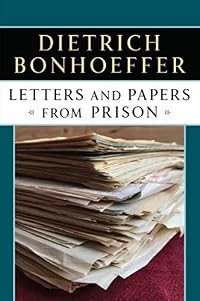
Letters and Papers from Prison {enlarged edition}
by Dietrich Bonhoeffer
On This Page
Description
This new, greatly expanded version, while omitting nothing found in the earlier edition, shifts the emphasis of earlier editions on Dietrich Bonhoeffer's theological reflections to the private sphere of his life. His letters now appear in far greater detail, and show his daily concerns and the enormous warmth and humanity of the young German pastor who was executed by the Nazis in 1945 for his part in the "officers' plot".Tags
Recommendations









Member Reviews
Letters and Papers from Prison is a collection of notes and correspondence covering the period from Dietrich Bonhoeffer's arrest in 1943 to his execution by the Gestapo in 1945. The book is probably most famous, and most important, for its idea of "religionless Christianity"--an idea Bonhoeffer did not live long enough fully to develop, but whose timeliness only increases as the lines between secular and ecclesial life blur. Bonhoeffer's first mention of "religionless Christianity" came in a letter in 1944:
What is bothering me incessantly is the question what Christianity really is, or indeed who Christ really is, for us today. The time when people could be told everything by means of words, whether theological or pious, is over, and show more so is the time of inwardness and conscience--and that means the time of religion in general. We are moving towards a completely religionless time; people as they are now simply cannot be religious any more. Even those who honestly describe themselves as "religious" do not in the least act up to it, and so they presumably mean something quite different by "religious."
The pleasures of Letters and Papers from Prison, however are not all so profound. Occasionally, Bonhoeffer's letters burst into song--sometimes with actual musical notations, other times with unforgettable phrases. Looking forward to seeing his best friend, Bonhoeffer writes, "To meet again is a God." --Michael Joseph Gross show less
What is bothering me incessantly is the question what Christianity really is, or indeed who Christ really is, for us today. The time when people could be told everything by means of words, whether theological or pious, is over, and show more so is the time of inwardness and conscience--and that means the time of religion in general. We are moving towards a completely religionless time; people as they are now simply cannot be religious any more. Even those who honestly describe themselves as "religious" do not in the least act up to it, and so they presumably mean something quite different by "religious."
The pleasures of Letters and Papers from Prison, however are not all so profound. Occasionally, Bonhoeffer's letters burst into song--sometimes with actual musical notations, other times with unforgettable phrases. Looking forward to seeing his best friend, Bonhoeffer writes, "To meet again is a God." --Michael Joseph Gross show less
An amazing look into Bonhoeffer's tragically abbreviated life, and the theological thought he didn't live long enough to fully flesh out. This edition contains additional letters to his mentor, Eberhard Bethge, as well as an appendix that re-prints an article for Union Theological Seminary written by his fiance after his execution. That appendix was probably the most difficult for me to read. Bonhoeffer hints at wrestling with the decision that landed him in the Nazi prison here. For anyone interested in his theological thought or life, this must be on your shelf.
A very difficult work to get through emotionally, especially if you know the background of the circumstances. Bonhoeffer was part of a conspiracy against Hitler and was imprisoned in April 1943 on unrelated charges. This book represents the correspondence between Bonhoeffer and his family and friends, especially Eberhard Bethge, to whom he sent letters illegally. The book tells the story of Bonhoeffer's hopes and dreams along with this theological reflections in his circumstance.
The personal information is quite interesting. Anyone who expects the book to be mostly about theology will be rather disappointed; nevertheless, the thoughts that Bonhoeffer does put down are quite good and worthy of consideration, especially in regards to the show more Christian's relationship to the Old Testament and what it means to be a Christian in a "post-God" world.
A book worth reading if one has a good understanding of Bonhoeffer through other works. show less
The personal information is quite interesting. Anyone who expects the book to be mostly about theology will be rather disappointed; nevertheless, the thoughts that Bonhoeffer does put down are quite good and worthy of consideration, especially in regards to the show more Christian's relationship to the Old Testament and what it means to be a Christian in a "post-God" world.
A book worth reading if one has a good understanding of Bonhoeffer through other works. show less
I've read this a couple of times, and I just read a book about Anne Frank and the person who likely betrayed her hiding place to the bad guys. I imagine a world where Anne Frank, Dietrich Bonhoeffer, and Elie Wiesel all survived into the 21st century. What a powerful force the three of them could have been, with their pens, for the improvement of the world.
Bonhoeffer writes to his fiance, family, and friends with a deep sense of hope even when his days were getting darker.
He mentioned at one point that the Nazi government's horrible crimes served as proof for the need of a theocracy. Bonhoeffer died as a supporter of the church and as a believer in the reign of God over and against evil.
He mentioned at one point that the Nazi government's horrible crimes served as proof for the need of a theocracy. Bonhoeffer died as a supporter of the church and as a believer in the reign of God over and against evil.
Always an important and inspiration book for us.
Expanded version of Letters & papers from Prison in greatly enlarged edition. When combined with the historical & theological passages, give aspects of Bonhoeffer's experience a new setting in the context of the war years.
Members
- Recently Added By
Lists

Church Times 100 Best Christian Books
106 works; 26 members

quero ler
1 work; 1 member

Books about World War II
241 works; 22 members

Reading list
170 works; 1 member
Author Information

284+ Works 33,586 Members
Born in 1906 in Breslau, Germany, now part of Poland, Dietrich Bonhoeffer became a radical theologian. He was raised in a home where the intellect was honored. His father was a physician and professor of psychiatry at the University of Berlin. Such scholars as the church historian Adolph von Harnack, the theologian and sociohistorian Ernst show more Troeltsch, and Max Weber, a founder of modern sociology, were frequent guests of the Bonhoeffers. A precocious student who evidenced a degree of independence of thought that was at odds with the reverence in which his fellow students held their professors, Bonhoeffer decided early on the church and theology as his life's work. He was a product of liberal studies that were greatly influenced by Karl Barth. Bonhoeffer's doctoral dissertation, Sanctorum Communio: A Dogmatic Investigation of the Sociology of the Church, was published in 1930, at the time he was teaching theology at the University of Berlin. A year's study in the United States followed and leadership of the World Alliance of Churches, where his flair for languages and his genial disposition won him many friends. His American and British friends tried unsuccessfully to dissuade him from returning to Germany after the rise of Hitler in 1932. But Bonhoeffer returned, and joining the so-called Confessing Church of those who resisted Germanizing the church, he conducted an illegal seminary in Finkenwalde. Out of this experience came his Life Together; out of his struggles to encourage Christians to resist the Nazis came The Cost of Discipleship, his study of the Sermon on the Mount. Although Bonhoeffer escaped military duty by joining the intelligence service, he was eventually arrested and imprisoned by the Gestapo and was linked to the attempt on Hitler's life. His Letters and Papers from Prison (translated in 1953), was his testimony of faith; the writing gave the American death of God movement the term religionless Christianity. Bonhoeffer was killed in 1945 while he was in prison in Flossenburg. (Bowker Author Biography) show less
All Editions
Some Editions
Work Relationships
Is abridged in
Is an expanded version of
Common Knowledge
- Canonical title
- Letters and Papers from Prison {enlarged edition}
- Disambiguation notice
- This is an enlarged edition of Letters and Papers from Prison. Do not combine with original collection.
Classifications
- Genres
- Religion & Spirituality, Nonfiction, Biography & Memoir, History
- DDC/MDS
- 230.092 — Religion Christianity Christianity Doctrinal Dogmatics - Theology Biography And History Biography
- LCC
- BX4827 .B57 .A43 — Philosophy, Psychology and Religion Christian Denominations Christian Denominations Protestantism General
- BISAC
Statistics
- Members
- 1,985
- Popularity
- 10,559
- Reviews
- 7
- Rating
- (4.06)
- Languages
- English
- Media
- Paper, Ebook
- ISBNs
- 5
- ASINs
- 22