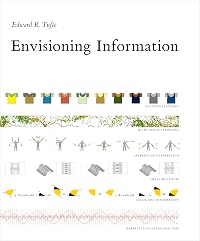
Envisioning Information
by Edward R. Tufte 
On This Page
Description
This book celebrates escapes from the flatlands of both paper and computer screen, showing superb displays of high-dimensional complex data. The most design-oriented of Edward Tufte's books, Envisioning Information shows maps, charts, scientific presentations, diagrams, computer interfaces, statistical graphics and tables, stereo photographs, guidebooks, courtroom exhibits, timetables, use of color, a pop-up, and many other wonderful displays of information. The book provides practical show more advice about how to explain complex material by visual means, with extraordinary examples to illustrate the fundamental principles of information displays. Topics include escaping flatland, color and information, micro/macro designs, layering and separation, small multiples, and narratives. Winner of 17 awards for design and content. 400 illustrations with exquisite 6- to 12-color printing throughout. Highest quality design and production. show lessTags
Recommendations















Member Recommendations
Member Reviews
All the way back to Galileo sharing about Jupiter’s moons, science has relied upon visualizations to communicate its findings. Some things are just better depicted visually instead of through words. In contemporary society, information graphics have played an increasingly larger role as computers quickly translate data into a more accessible format. Newspapers and Internet websites have made them commonplace. Even though this book was written in 1990, before ubiquitous computing, it identifies the philosophical and graphical issues in mass presentations. Edward Tufte, the modern academic master of visualization, provides this text to teach us how to think about and make better visualizations.
Like the rest of his books, this work has a show more strongly artistic bent. Most of the visualizations involve some craftsmanship from a visual artist. In 1990, computer graphics, especially of massive datasets, were primitive compared to today. Still, the principles for what looks good – i.e., what communicates – remain constant. This book seeks to teach us how to read graphs by using those principles and how to communicate by incorporating those principles in our own graphs.
I’ve read a lot of books about visualizations, and Tufte is as good as it gets. This book is an appropriate introduction to reading and making graphs. Graphical interpretation of data is a mainstay of almost every academic field these days. While religions have been often rooted in the visual arts, modern scientific explorations have combined the artistry with data. These days, it’s hard to navigate a train station or a car trip without some sort of visualization. This book teaches us how to do so more effectively and how to leverage those insights to lead others more effectively. Anyone interested in better visual communication can benefit from books like this. show less
Like the rest of his books, this work has a show more strongly artistic bent. Most of the visualizations involve some craftsmanship from a visual artist. In 1990, computer graphics, especially of massive datasets, were primitive compared to today. Still, the principles for what looks good – i.e., what communicates – remain constant. This book seeks to teach us how to read graphs by using those principles and how to communicate by incorporating those principles in our own graphs.
I’ve read a lot of books about visualizations, and Tufte is as good as it gets. This book is an appropriate introduction to reading and making graphs. Graphical interpretation of data is a mainstay of almost every academic field these days. While religions have been often rooted in the visual arts, modern scientific explorations have combined the artistry with data. These days, it’s hard to navigate a train station or a car trip without some sort of visualization. This book teaches us how to do so more effectively and how to leverage those insights to lead others more effectively. Anyone interested in better visual communication can benefit from books like this. show less
As a non-mathematician with a serious problem with diagrams (like a lot of librarians, I connect much better with lists) this was going to be a challenge for me. But every page was a pleasure. Tuftes believes that complex information can be easily understood if presented in the right way. He applies the same principles to his writing which is clear without being dry. I'm still a long way from feeling comfortable creating anything more complex than a table, but I definitely feel I've made a start (and I'll eliminate those gridlines!).
I began reading Tuft's graphic information series in an attempt to thwart and destroy the boring academic PowerPoint. For those not aware, academic and/or scholarly PowerPoints, particularly those used to present research at conferences, are really, really, really...really...bad. Scholars are enamored with data and try to cram as much of it onto one slide as possible, literally presenting their audience with chapters of words on one slide (that no audience member can read and still reasonably listen to the presenter), APA-formatted tables (that no audience member can read because the data is too small), and lines of equations (that no audience member can decipher, but I'm certain the scholar believes looks impressive). Academic show more PowerPoints are distracting at their best, baffling at their worst. Tuft's series gives easy to understand textual and visual explanations on how to achieve good visual data. I do not believe it is necessary for academicians and scholars to become graphic artists; however, I believe it is necessary to learn how to display data in a manner that gets to the point of research and research outcomes with the impact intended.
______________________________________
Books in the series:
Tufts, E. R. (1990). Envisioning information. Cheshire, CT: Graphics Press.
Tufts, E. R. (1997). Visual explanations: Images and quantities, evidence and narrative. Cheshire, CT: Graphics Press.
Tufts, E. R. (2001). The visual display of quantitative information (2nd Ed.). Cheshire, CT: Graphics Press. show less
______________________________________
Books in the series:
Tufts, E. R. (1990). Envisioning information. Cheshire, CT: Graphics Press.
Tufts, E. R. (1997). Visual explanations: Images and quantities, evidence and narrative. Cheshire, CT: Graphics Press.
Tufts, E. R. (2001). The visual display of quantitative information (2nd Ed.). Cheshire, CT: Graphics Press. show less
This is a much better book than the first one, there's a lot more substance and less polemic. However, it's not very well written and his main points get lost in the long series of examples, so it takes some work to get that substance out of it.
This is the third volume in a series by Edward Tufte (the others are "The Visual Display of Quantitative Information", and "Envisioning Information"). All three are beautifully crafted books that are a delight to read and to handle. The most recent one brings the reader's attention to the use of graphics, narrative, and numbers to convey motion, process, mechanism, cause and effect. In order to exemplify his thinking, Tufte uses a very wide range of subjects, from the explanation of magic tricks to the coloring of bathymetric maps. One chapter is devoted almost entirely to an argument that the Shuttle Challenger disaster could have been avoided, had the appropriate statistical data about the relationship between o-ring failures and show more temperature at launch been presented in a clearer fashion. Tufte's design of a computer kiosk for an art museum contains wisdom that should be useful to anyone constructing Web interfaces. show less
My fave of the 'original Tufte trilogy'. Awesome concepts around representing information in clear, truthful, and accurate ways. A lot of focus on map-based graphics, but concepts are applicable to other types as well. Sometimes a bit of high-and-mighty writing, but it's still eye-opening.
A must-read for anyone in the field of information design, not to mention a refreshing counterpoint to the PowerPoint credo of our day. Envisioning Information is a visually sumptuous book with page after page of remarkable examples through history of multi-dimensional data adroitly transcribed to the 2D surface (a.k.a. flatland).
Members
- Recently Added By
Published Reviews
added by Delfi_r
Lists

Top Five Books of 2020
982 works; 350 members

Bret Victor's Five-Star List
46 works; 5 members

Alan Kay's Reading List
103 works; 3 members

Five star books
1,767 works; 110 members
Author Information

21 Works 16,773 Members
Edward Tufte is Professor Emeritus at Yale University where he taught courses in statistical evidence and information design. He also served as Professor of Public Affairs at Princeton University
Edward R. Tufte is a LibraryThing Author, an author who lists their personal library on LibraryThing.
Awards and Honors
Work Relationships
Common Knowledge
- Original publication date
- 1990-05
- Dedication
- for my teacher, Inge Druckey
for my parents, Edward E Tufte and Virginia James Tufte
and for Moshe, Tanya, Charlie, Natasha, Babar and Frida - First words
- Even though we navigate daily through a perceptual world of three spatial dimensions and reason occasionally about higher dimensional arenas with mathematical ease, the world portrayed on our information displays is caught up... (show all) in the two-dimensionality of endless flatlands of paper and video screen.
The world is complex, dynamic, multidimensional; the paper is static, flat. - Last words
- (Click to show. Warning: May contain spoilers.)Perhaps one day high-resolution computer visualizations, which combine slightly abstracted representations along with a dynamic and animated flatland, will lighten the laborious complexity of encodings - and yet still capture some worthwhile part of the subtlety of the human itinerary.
(Click to show. Warning: May contain spoilers.)Epilogue: In 1613, when Galileo published the first telescopic observations of Saturn, word and drawing were as one. The stunning images, never seen before, were just another sentence element. Saturn, a drawing, a word, a noun. The wonderful becomes familiar and the familiar wonderful.
Classifications
- Genres
- Art & Design, Nonfiction, General Nonfiction, Business, Technology
- DDC/MDS
- 302.23 — Society, government, & culture Social sciences, sociology & anthropology Mass Communication & Media Communication Media (Means of communication)
- LCC
- P93.5 .T84 — Language and Literature Philology. Linguistics Communication. Mass media
Statistics
- Members
- 4,352
- Popularity
- 3,461
- Reviews
- 23
- Rating
- (4.31)
- Languages
- Czech, English
- Media
- Paper
- ISBNs
- 6
- ASINs
- 15