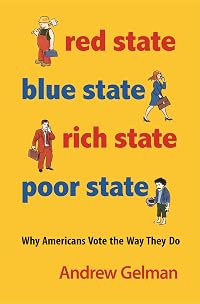
Red State, Blue State, Rich State, Poor State: Why Americans Vote the Way They Do
by Andrew Gelman
On This Page
Description
On the night of the 2000 presidential election, Americans watched on television as polling results divided the nation's map into red and blue states. Since then the color divide has become symbolic of a culture war that thrives on stereotypes--pickup-driving red-state Republicans who vote based on God, guns, and gays; and elitist blue-state Democrats woefully out of touch with heartland values. With wit and prodigious number crunching, Andrew Gelman debunks these and other political myths. show more This expanded edition includes new data and easy-to-read graphics explaining the 2008 election. Red State, Blue State, Rich State, Poor State is a must-read for anyone seeking to make sense of today's fractured political landscape. show lessTags
Recommendations











Member Recommendations
by anonymous user

by anonymous user
Member Reviews
A few years ago I saw Thomas Frank doing a television interview, laughingly agreeing that the real paradox of American politics isn't just "What's the Matter with Kansas?", but that there was an equal contradiction in wealthy northeastern states voting for Democrats: Frank noted that he should do a sequel called "What's the Matter with Connecticut?"
Gelman (et al)' s study of Amercian voting habits is an answer to Frank: using data down to the 2004 election, they set out to explain how the thesis of "What's the Matter With Kansas" oversimplifies the actual patterns of American voting. Their "secret weapon" of repeated modeling exposes some underlying demographic truths. (Applied regression, time-series analyses and multilevel modelling, show more yum.)
And it's successful at elaborating upon Frank, but fails to come up with a snappier summation of the situation than "Well, it's significantly more complicated than that."
"...the red-blue division is greatest among the rich...Rich people in red America are much more conservative - on both economic and social issues - than their counterparts in the blue states."
(Of course, the 2008 election results are now in, and this book - published on August 10th - is outdated.)
And yes, at least through the 2004 election, the country IS becoming more polarized.
Fun Fact I Did Not Know: In 1948, the dixiecrats won control of the Democratic party in several southern states and kept their sitting US president entirely OFF the ballot.
Extra LT bonus: LT member cshalizi had a hand in the famous election map you've seen, the one that distorts the red and blue areas to be proportional to population. show less
Gelman (et al)' s study of Amercian voting habits is an answer to Frank: using data down to the 2004 election, they set out to explain how the thesis of "What's the Matter With Kansas" oversimplifies the actual patterns of American voting. Their "secret weapon" of repeated modeling exposes some underlying demographic truths. (Applied regression, time-series analyses and multilevel modelling, show more yum.)
And it's successful at elaborating upon Frank, but fails to come up with a snappier summation of the situation than "Well, it's significantly more complicated than that."
"...the red-blue division is greatest among the rich...Rich people in red America are much more conservative - on both economic and social issues - than their counterparts in the blue states."
(Of course, the 2008 election results are now in, and this book - published on August 10th - is outdated.)
And yes, at least through the 2004 election, the country IS becoming more polarized.
Fun Fact I Did Not Know: In 1948, the dixiecrats won control of the Democratic party in several southern states and kept their sitting US president entirely OFF the ballot.
Extra LT bonus: LT member cshalizi had a hand in the famous election map you've seen, the one that distorts the red and blue areas to be proportional to population. show less
I have reached my goal of finishing this book and writing about it before the election, although I happened to have voted a couple of weeks ago thanks to Washington state's new mail-in ballot system. After reading this, I am more excited than ever to see the results of this year's presidential election. I am curious to see how all of the author's postulations turn out. This is a statistics focused book, filled with graphs, charts, and all kinds of number crunching. Luckily, Gelman is able to break all of it down into easily understood arguments and explanations.
Here are some of the basic points:
Geography matters politically
Race matters politically
Religion matters politically
Differences between rich and poor states can be considered show more historically
Political differences between Democratic and Republican voters are greatest among the middle-class and rich
While most voters are aware of these topics, it is the last two that are the most intriguing. For example, Gelman states that "the red-blue division is greatest among the rich." It is the upper-income bracket whose voting and political attitudes are correlated with location and lifestyle. Therefore it is not just how much money you make, but it is income coupled with how you live and where you live. For example, rich people everywhere are more likely to vote Republican. But if you add the caveat of rich in a red state and attendance in religious services, the chance of voting Republican increases significantly. Why? First, there are cultural differences between red and blue states and these differences are more pronounced among rich people. Second, in poor states in the South, rich people are more religious than rich people in rich states in the northeast. This all boils down to: "Richer people within any state are more likely to vote Republican, but the relation between income and vote choice is much stronger in poor states than in rich states."
So why do poor people vote Republican? It's ideology, stupid. "Within each income group, there is some evidence that economic issues are more important in Democratic-leaning states and social issues are more important in Republican-leaning states, but these geographic differences are much smaller than the differences in income categories."
To conclude, despite being equipped with clear explanations, the patterns are so complex that it can be pure agony to try to figure out how and why people vote the way that they do. The red-blue map that we have become accustomed to since 2000 is an over-simplified version of voting patterns in America. Actually, the map should be made up of counties rather than states and should show gradations of color from red to purple to blue as well as population proportional distortions. While mainstream news media attempts to simplify patterns for mass consumption (and I don't blame them), the truth is that these patterns cannot be simplified without losing their potency. There are ways to predict voting, but it is not easy or neat. Predicting voting is complicated, messy, and constantly evolving. show less
Here are some of the basic points:
Geography matters politically
Race matters politically
Religion matters politically
Differences between rich and poor states can be considered show more historically
Political differences between Democratic and Republican voters are greatest among the middle-class and rich
While most voters are aware of these topics, it is the last two that are the most intriguing. For example, Gelman states that "the red-blue division is greatest among the rich." It is the upper-income bracket whose voting and political attitudes are correlated with location and lifestyle. Therefore it is not just how much money you make, but it is income coupled with how you live and where you live. For example, rich people everywhere are more likely to vote Republican. But if you add the caveat of rich in a red state and attendance in religious services, the chance of voting Republican increases significantly. Why? First, there are cultural differences between red and blue states and these differences are more pronounced among rich people. Second, in poor states in the South, rich people are more religious than rich people in rich states in the northeast. This all boils down to: "Richer people within any state are more likely to vote Republican, but the relation between income and vote choice is much stronger in poor states than in rich states."
So why do poor people vote Republican? It's ideology, stupid. "Within each income group, there is some evidence that economic issues are more important in Democratic-leaning states and social issues are more important in Republican-leaning states, but these geographic differences are much smaller than the differences in income categories."
To conclude, despite being equipped with clear explanations, the patterns are so complex that it can be pure agony to try to figure out how and why people vote the way that they do. The red-blue map that we have become accustomed to since 2000 is an over-simplified version of voting patterns in America. Actually, the map should be made up of counties rather than states and should show gradations of color from red to purple to blue as well as population proportional distortions. While mainstream news media attempts to simplify patterns for mass consumption (and I don't blame them), the truth is that these patterns cannot be simplified without losing their potency. There are ways to predict voting, but it is not easy or neat. Predicting voting is complicated, messy, and constantly evolving. show less
Ratings
Members
- Recently Added By
Author Information
13+ Works 958 Members
Andrew Gelman is a professor at Columbia University, New York, USA John B. Carlin is a professor at the University of Melbourne, Australia Hal S. Stern is a professor at the University of California, Irvine, USA Donald B. Rubin is a professor at Harvard University, Cambridge, Massachusetts, USA
Common Knowledge
- First words
- The Paradox, Introduction: "Okay, but there's the fact that nobody ever, ever mentions - Democrats win rich people. Over $100,000 in income, you are likely more than not to vote for Democrats. People never point that out. Ric... (show all)h people vote liberal. I don't know what that's all about." -Tucker Carlson, 2007 Carlson was half right, Nowadays, the Democrats win the rich states, but rich people vote Republican, just as they have for decades.
- Canonical DDC/MDS
- 324.973
- Canonical LCC
- JK1976
Classifications
- Genres
- Politics and Government, Nonfiction, General Nonfiction, Sociology
- DDC/MDS
- 324.973 — Society, government, & culture Political science Politics & Elections Biography And History North America United States
- LCC
- JK1976 — Political Science Political institutions and public administration (United States) Political institutions and public administration United States Political rights. Practical politics Electoral system
- BISAC
Statistics
- Members
- 146
- Popularity
- 223,237
- Reviews
- 2
- Rating
- (4.08)
- Languages
- English
- Media
- Paper, Ebook
- ISBNs
- 4
- ASINs
- 3