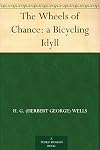
The Wheels of Chance
by H. G. Wells
There is 1 current discussion about this work.
On This Page
Description
The comical Wheels of Chance was written in 1896 at the height of the golden age of the bicycle, when practical and affordable bicycles led to profound social shifts in England. Suddenly people of modest means could travel greater distances for work or even for pleasure, without the limitations of rail schedules, weakening England's rigid class structure and strengthening the movement towards the liberation of women. In the novel, the poorly-paid draper's assistant Mr. Hoopdriver sets out on show more a cycling holiday, and awkwardly encounters a pretty young woman cycling alone and wearing bloomers, an shocking image in its time and one that summed up the new freedom, liberation and exhilaration of the bicycle.. show less
Tags
Recommendations



















Member Reviews
https://fromtheheartofeurope.eu/the-wheels-of-chance-by-h-g-wells/
This is one of H.G. Wells’ earliest novels, published in 1896 between The Island of Dr Moreau and The War of the Worlds, and I think his first non-genre novel. I thought it was a little gem. The protagonist, Mr Hoopdriver, working unhappily in a draper’s shop, goes on a cycling holiday across southern England, and finds himself acting as saviour to a teenage girl who has run away from home with a much older man. Often I find Wells’ portrayal of the lower middles classes annoying and patronising, but here I felt there was enough characterisation in the portrayal of Hoopdriver and self-deprecation in Wells’ own tone that the brief story hung together perfectly well. show more It’s not quite up to the level of Love and Mr Lewisham, the next non-genre novel that Wells wrote, but I enjoyed it all the same. show less
This is one of H.G. Wells’ earliest novels, published in 1896 between The Island of Dr Moreau and The War of the Worlds, and I think his first non-genre novel. I thought it was a little gem. The protagonist, Mr Hoopdriver, working unhappily in a draper’s shop, goes on a cycling holiday across southern England, and finds himself acting as saviour to a teenage girl who has run away from home with a much older man. Often I find Wells’ portrayal of the lower middles classes annoying and patronising, but here I felt there was enough characterisation in the portrayal of Hoopdriver and self-deprecation in Wells’ own tone that the brief story hung together perfectly well. show more It’s not quite up to the level of Love and Mr Lewisham, the next non-genre novel that Wells wrote, but I enjoyed it all the same. show less
Originally published in 1896; [The Wheels of Chance] was Wells' first social comedy in novel form. It followed closely on the heels of [The Time Machine], [The Wonderful Visit] and [The Island of Doctor Moreau], however the only fantasy in this new novel is in the head of its hero: Mr Hoopdriver
Wells subtitled his novel "A Bicycling Idyll" which reflected both his own interest in cycling and the new craze which swept the country when bicycles became affordable and people of all classes could take to the open road. Hoopdriver is an indentured drapers assistant, who is a keen novice cyclist in what little free time he has and so when his two weeks holiday comes round he takes off on his bike on a tour of the South of England. This is a show more time of unpaved roads where the horse and cart/carriage ruled and our Mr Hoopdriver soon comes to grief cycling up Putney Hill, his bid for freedom temporarily ending in a dusty and painful tumble, but this proves to be only one of many as the shin barked Hoopdriver struggles with his 43lb machine. On the second day of his adventure he stumbles upon a female cyclist "the lady in grey" and their paths continue to cross as the day proceeds. It soon becomes apparent that "the lady in grey" is being held under some compulsion by her companion: the lecherous Bechemel. Hoopdriver despite his misgivings becomes involved, but his inexperience of life is almost on an equal footing with that of the "the lady in grey": the 17 year old Jessie Milton, however Hooopdriver gets to play the Knight Errant and rescues Jessie from Bechemel, only to find that the couple are then pursued by Jessie's Aunt and her three sycophants. There is a marvellous chase across the South of England before the couple are eventually brought to heel, but in the meantime Hoopdriver discovers a few things about life and begins to dream of a better position for himself.
H G Wells himself spent a short period locked into the world of a drapers assistant and so is able to empathise with Hoopdrivers dilemma and conveys wonderfully well the sense of freedom that the early cyclists must have experienced when they took to the road for the first time. Hoopdrivers journey through the South of England can still be followed on a map today and Wells' descriptions of the small towns and villages with their inns and tea houses is evocative of a time now difficult to imagine. There is humour and pathos in Wells writing and much social commentary on the class system that the cyclists of his day would help to erode little by little, as they made their way around the country that was beginning to open up for them. It is too early for Hoopdriver and although there is a glimmer of hope for him at the end of the novel, the reader is left with the idea of a suffocating class system that will grind on and be too much for the likes of a drapers assistant. H G Wells escaped of course, but then he had a special talent, unlike Hoopdriver who needs to screw up all his courage just to stay free for his two weeks holiday.
Wells is secure in his own abilities and at the start of Wheels of Chance after describing Hoopdriver to the reader he says:
"But real literature, as distinguished from anecdote, does not concern itself with superficial appearances alone. Literature is a revelation. Modern literature is indecorous revelation, it is the duty of the earnest author to tell you what you would not have seen - even at the cost of some blushes"
Wells feels comfortable enough to name drop fellow authors such as George Gissing and George Bernard Shaw and Jessie's aunt is featured as a popular author of melodramatic novels, which is obviously based on a novelist at the time. There is also a short rant on the advantages of socialism, although this passes way over the head of Hoopdriver and Jessie, however it is the light hearted comic touch that Wells brings to this story that makes it swing along so entertainingly. There is charm, there is wit and underneath it all a sense of a world beginning to change. An excellent read which I rate at 4 stars. show less
Wells subtitled his novel "A Bicycling Idyll" which reflected both his own interest in cycling and the new craze which swept the country when bicycles became affordable and people of all classes could take to the open road. Hoopdriver is an indentured drapers assistant, who is a keen novice cyclist in what little free time he has and so when his two weeks holiday comes round he takes off on his bike on a tour of the South of England. This is a show more time of unpaved roads where the horse and cart/carriage ruled and our Mr Hoopdriver soon comes to grief cycling up Putney Hill, his bid for freedom temporarily ending in a dusty and painful tumble, but this proves to be only one of many as the shin barked Hoopdriver struggles with his 43lb machine. On the second day of his adventure he stumbles upon a female cyclist "the lady in grey" and their paths continue to cross as the day proceeds. It soon becomes apparent that "the lady in grey" is being held under some compulsion by her companion: the lecherous Bechemel. Hoopdriver despite his misgivings becomes involved, but his inexperience of life is almost on an equal footing with that of the "the lady in grey": the 17 year old Jessie Milton, however Hooopdriver gets to play the Knight Errant and rescues Jessie from Bechemel, only to find that the couple are then pursued by Jessie's Aunt and her three sycophants. There is a marvellous chase across the South of England before the couple are eventually brought to heel, but in the meantime Hoopdriver discovers a few things about life and begins to dream of a better position for himself.
H G Wells himself spent a short period locked into the world of a drapers assistant and so is able to empathise with Hoopdrivers dilemma and conveys wonderfully well the sense of freedom that the early cyclists must have experienced when they took to the road for the first time. Hoopdrivers journey through the South of England can still be followed on a map today and Wells' descriptions of the small towns and villages with their inns and tea houses is evocative of a time now difficult to imagine. There is humour and pathos in Wells writing and much social commentary on the class system that the cyclists of his day would help to erode little by little, as they made their way around the country that was beginning to open up for them. It is too early for Hoopdriver and although there is a glimmer of hope for him at the end of the novel, the reader is left with the idea of a suffocating class system that will grind on and be too much for the likes of a drapers assistant. H G Wells escaped of course, but then he had a special talent, unlike Hoopdriver who needs to screw up all his courage just to stay free for his two weeks holiday.
Wells is secure in his own abilities and at the start of Wheels of Chance after describing Hoopdriver to the reader he says:
"But real literature, as distinguished from anecdote, does not concern itself with superficial appearances alone. Literature is a revelation. Modern literature is indecorous revelation, it is the duty of the earnest author to tell you what you would not have seen - even at the cost of some blushes"
Wells feels comfortable enough to name drop fellow authors such as George Gissing and George Bernard Shaw and Jessie's aunt is featured as a popular author of melodramatic novels, which is obviously based on a novelist at the time. There is also a short rant on the advantages of socialism, although this passes way over the head of Hoopdriver and Jessie, however it is the light hearted comic touch that Wells brings to this story that makes it swing along so entertainingly. There is charm, there is wit and underneath it all a sense of a world beginning to change. An excellent read which I rate at 4 stars. show less
Personally, I consider this one of Wells' lesser efforts, in that it fails to utilize his unparalleled ability to produce great works of science fiction. Wells' story telling ability is always top notch. So to with this quaint book, although the actual content is dated and the story line hardly captivating.
Ostensibly, the novel concerns the quaint holiday adventure of a working class Englishman who decides to venture out on a bicycling adventure- at the time, a novel but highly popular activity. On a deeper level, Wells' writes about the societal restrictions of the 19th century class system- we encounter this in the main character's interaction with a lovely young lady of higher social standing he meets during his trip.
Ostensibly, the novel concerns the quaint holiday adventure of a working class Englishman who decides to venture out on a bicycling adventure- at the time, a novel but highly popular activity. On a deeper level, Wells' writes about the societal restrictions of the 19th century class system- we encounter this in the main character's interaction with a lovely young lady of higher social standing he meets during his trip.
A rather odd and peculiar novel, short in nature, about a man with a bicycle and the events that transpose from it. I feel that Wells was very inventive here, and taking quite a few liberties. Overall, it was interesting, but I don't see that much of lasting value with it apart from a few little things.
3 stars.
3 stars.
Utterly charming with a female character who is an early version of Ann Veronica.
Ratings
Members
- Recently Added By
Talk Discussions
Current Discussions
OT: H.G. Wells "The Wheels of Chance" Kings Langley Press in Easton Press Collectors (August 2025)
Past Discussions
OT: The Wheels of Chance by H.G. Wells, Kings Langley Press in Folio Society Devotees (June 2025)
Author Information

1,553+ Works 108,970 Members
H. G. Wells was born in Bromley, England on September 21, 1866. After a limited education, he was apprenticed to a draper, but soon found he wanted something more out of life. He read widely and got a position as a student assistant in a secondary school, eventually winning a scholarship to the Royal College of Science in South Kensington, where show more he studied biology. He graduated from London University in 1888 and became a science teacher. He also wrote for magazines. When his stories began to sell, he left teaching to write full time. He became an author best known for science fiction novels and comic novels. His science fiction novels include The Time Machine, The War of the Worlds, The Wonderful Visit, The Island of Doctor Moreau, The Invisible Man, The First Men in the Moon, and The Food of the Gods. His comic novels include Love and Mr. Lewisham, Kipps: The Story of a Simple Soul, The History of Mr. Polly, and Tono-Bungay. He also wrote several short story collections including The Stolen Bacillus, The Plattner Story, and Tales of Space and Time. He died on August 13, 1946 at the age of 79. (Bowker Author Biography) show less
Series
Belongs to Publisher Series
Gallimard, Folio (1560)
Work Relationships
Common Knowledge
- Original title
- THE WHEELS OF CHANCE
- Original publication date
- 1896: The Wheels of Chance
- Related movies
- The Wheels of Chance (1922 | IMDb)
- First words
- If you (presuming you are of the sex that does such things)—if you had gone into the Drapery Emporium—which is really only magnificent for shop-of Messrs. Antrobus & Co.—a perfectly fictitious “Co.,” by the bye—of... (show all) Putney, on the 14th of August, 1895, had turned to the right-hand side, where the blocks of white linen and piles of blankets rise up to the rail from which the pink and blue prints depend, you might have been served by the central figure of this story that is now beginning.
- Last words
- (Click to show. Warning: May contain spoilers.)The gate closes upon him with a slam, and he vanishes from our ken.
- Original language
- English
Classifications
Statistics
- Members
- 198
- Popularity
- 165,446
- Reviews
- 5
- Rating
- (3.08)
- Languages
- English, French, Hungarian
- Media
- Paper, Audiobook, Ebook
- ISBNs
- 41
- ASINs
- 15